In 2025 and beyond, enterprises are rapidly adopting AI agents that integrate with internal systems and workflows. But connecting these agents to diverse data sources often demands custom-built connectors that are costly and hard to maintain.
The Model Context Protocol (MCP) addresses this challenge by offering a standardized, open-source protocol for secure, reliable AI access to enterprise tools and data.
Explore 10 essential features enterprise should prioritize in MCP platforms for 2026 with CData Connect AI emerging as the leading solution for secure, real-time connectivity to 270+ data sources, without data replication.
CData Connect AI: Leading with seamless, secure MCP integration
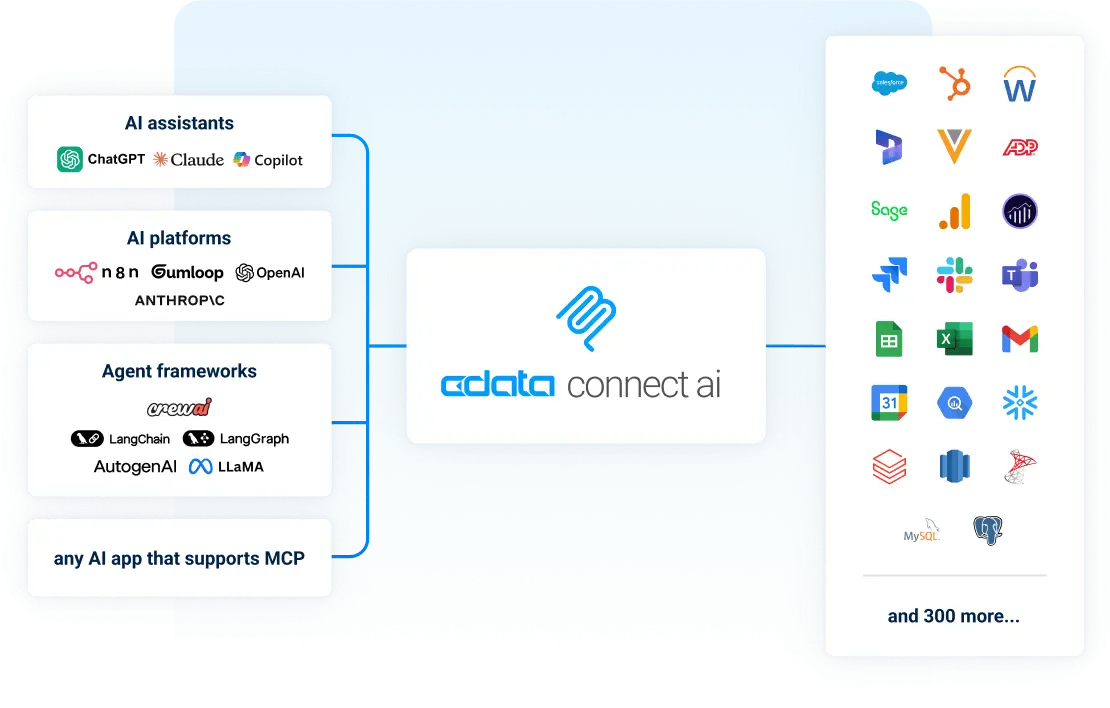
CData Connect AI offers a managed MCP platform that brings together broad enterprise data integration, security, governance, and simplicity. By combining real-time, context-aware connectivity across over 270+ data sources with enterprise-grade security standards including OAuth 2.1, SOC 2 compliance, and role-based access control. CData Connect AI stands apart from typical MCP offerings, which often require intensive configuration and custom infrastructure.
Unlike many platforms that demand data replication, CData Connect AI accesses data in place, reducing governance risks and ensuring AI agents work with the most current context. Its plug-and-play design allows rapid deployment with minimal setup complexity, supporting seamless integrations with leading AI ecosystems such as Claude, ChatGPT, and Microsoft Copilot.
This architecture makes CData Connect AI uniquely equipped for enterprises seeking real-time, secure, and scalable AI connectivity without the trade-offs of traditional MCP implementations.
1. Plug-and-play integrations for rapid connectivity
Plug-and-play integrations are prebuilt, instantly deployable connectors that enable rapid connection to enterprise systems with minimal configuration. Within the MCP framework, these integrations allow organizations to seamlessly link AI agents to core business systems such as CRM platforms, ERP solutions, financial applications, and file repositories without the need for custom development or extended setup cycles.
The MCP standard supports interoperability between AI tools and enterprise infrastructure, allowing agents like chatbots, code copilots, and workflow assistants to interface with backend systems through a consistent, secure protocol.
For instance, a company can quickly configure access to its internal database, document storage, and CRM environment, enabling an AI agent to draw unified context across systems in real time dramatically accelerating deployment timelines and operational efficiency.
2. Real-time monitoring
Real-time monitoring refers to continuously tracking the status and performance of AI processes and context accesses. In an enterprise setting, this includes logging context requests, tracking which data sources are used, monitoring API calls in short, building audit trails for all AI activity.
MCP servers enable this through their client-server architecture every request from an AI client goes through a central server that can log actions, version context, and record metadata.
Organizations leveraging MCP have reported up to a 30% improvement in context processing efficiency and a 25% increase in customer engagement, highlighting its impact on AI responsiveness and user satisfaction.
3. Scalability to support growing enterprise needs
Scalability is the ability of a platform to handle increased workloads, users, and data sources without degrading performance or reliability. For enterprise AI that may need to serve many agents, large user bases, or global teams, scalability is non‑negotiable.
Because MCP decouples AI agents (clients) from data sources (via servers), platforms can scale each side independently distributing load across multiple servers or deploying in microservices.
Core features like distributed training, auto-scaling, real-time monitoring, automated versioning, drag-and-drop interfaces, and pre-built templates support flexible, high-performance growth.
Enterprises have seen up to a 30% boost in training speed, improved resource efficiency, and reduced downtime.
Suggestion: A step-by-step visualization can help illustrate how MCP seamlessly scales AI workloads across global teams and multi-cloud environments.
4. Robust security features and compliance
Enterprises integrating AI deeply into workflows need strong security and compliance guarantees.
Security Mechanism | Description | Business Risk Mitigated |
OAuth 2.1 authentication | Secure, token-based access control protocol for AI clients and services | Unauthorized access, credential leakage |
Role-based access control (RBAC) | Assigns permissions based on user roles and responsibilities | Privilege escalation, unauthorized data exposure |
Data encryption in transit | Ensures data exchanged between clients and servers is encrypted (TLS/SSL) | Data interception, man-in-the-middle attacks |
Server-side execution | Enforces AI execution logic on the server, not on client side | Endpoint tampering, uncontrolled execution |
Context boundary enforcement | Isolates access to specific datasets or context scopes | Data leakage, cross-context contamination |
Centralized logging and auditing | Tracks all AI access and system activity with time-stamped logs | Lack of traceability, compliance violations |
SOC 2 alignment | Framework ensuring controls around security, availability, and confidentiality | Governance gaps, audit failure, regulatory penalties |
5. User-friendly interface for simplified AI management
An intuitive, point-and-click interface where users can visually create and manage connections without coding is key to accelerating MCP adoption. CData Connect AI, as the first fully managed MCP platform, empowers non-developers through user-friendly dashboards and drag-and-drop tools. These interfaces reduce training time, lower error rates, and promote enterprise self-service.
For example, users can quickly add a new data source, configure access permissions, or monitor real-time activity all without writing code. This design approach democratizes AI integration across business teams, eliminating the need for customers to manage CI/CD pipelines while ensuring consistent, policy-driven MCP deployment.
6. Automated deployment with continuous integration and delivery
A modern MCP platform must use automated CI/CD pipelines to continuously validate, test, and deploy updates ensuring platform reliability, security, and compliance. In this context, CI/CD includes integration testing, security checks, versioned updates, and controlled rollouts.
As the first fully managed MCP platform, CData Connect AI delivers these benefits without customer-managed infrastructure. This ensures always-current AI capabilities, zero-downtime updates, and audit-ready history while supporting compliance through consistent, traceable, policy-enforced updates across the MCP ecosystem.
7. Comprehensive error handling and validation mechanisms
Error handling is the systematic detection and management of operational issues to ensure smooth system behavior. Validation mechanisms check data or user inputs for correctness before processing. Common strategies include:
Platforms that support rich error management can significantly reduce troubleshooting time.
8. Cross-platform compatibility with multiple AI agents
Cross-platform compatibility the ability of a system to support multiple operating systems, devices, or AI agents through a unified interface is critical for future-proofing enterprise AI strategies.
MCP platforms enable cross-model and cross-platform integration, supporting AI assistants, chatbots, internal copilots, and autonomous agents across varied environments.
This flexibility reduces vendor lock-in and eliminates the need for major refactoring when adopting new AI tools ensuring seamless integration across evolving ecosystems and aligning with emerging global AI governance standards.
9. Advanced AI capabilities for intelligent automation
Modern MCP platforms must support advanced AI capabilities that drive automation, analytics, and enterprise productivity. By enabling real-time access to contextual data, MCP empowers AI agents to perform tasks beyond basic responses.
AI Capability | Business Function | Example Use Case | Enterprise Impact |
Semantic search | Knowledge management, IT | Surface relevant internal documents for employee queries | Faster decision-making, reduced support burden |
Natural language processing | Customer service, HR | Analyze and route customer or employee inquiries | Improved response accuracy, better user experience |
Document parsing | Finance, Legal | Extract data from invoices, contracts, reports | Reduced manual work, higher accuracy in processing |
Agent-driven workflow automation | Operations, Procurement | Auto-approve purchase orders based on policy | Time savings, policy compliance, reduced delays |
Web automation | Marketing, Data Ops | Auto-publish content, scrape web data for insights | Faster campaign execution, real-time market tracking |
Database querying | Analytics, BI, Engineering | Pull structured data for dashboards or AI input | Real-time insights, unified reporting, lower latency |
3D modeling automation | Manufacturing, Design | Generate model previews for parts or products | Accelerated prototyping, streamlined design workflows |
10. Cost-effectiveness and flexible pricing models
MCP Pricing Models: Key Considerations for Enterprise Evaluation
Pricing Model | Description | Pros | Cons | Best Fit For |
Subscription-based | Fixed monthly or annual fee for platform access and usage within set limits | Predictable costs, easier budgeting, clear feature tiers | May overpay if usage is low, limited flexibility | Enterprises with stable, high-volume usage |
Token-based (usage) | Pay-per-use model based on tokens or credits consumed by API calls or workloads | Cost-efficient for low or variable usage, scalable | Harder to predict costs, potential for overages | Teams with fluctuating or workloads |
Enterprises should consider whether the MCP platform operates on a subscription basis or utilizes a token-based pricing model, which might be more economical based on usage.
Tip for Decision-Makers: Create a cost evaluation checklist considering projected usage, budget stability, compliance overhead, and feature-to-cost alignment.
For more details, see CData’s transparent pricing.
Choosing the right MCP platform for your enterprise needs
Enterprises should prioritize platforms based on core needs integration breadth, governance, automation support, scalability, and security. Use a feature matrix or RFP-style checklist to objectively compare solutions. CData Connect AI stands out as a scalable, secure, fully managed MCP platform that reduces integration effort while maximizing AI adoption and governance.
Frequently asked questions
What is the Model Context Protocol and why is it important for enterprises?
The Model Context Protocol (MCP) is a standardized framework that allows AI agents to securely access and act on enterprise data. It improves interoperability across systems while eliminating data silos that limit AI effectiveness.
How do MCP platforms enhance AI agent workflows and integration?
MCP platforms streamline integration by using a single protocol to connect AI agents with diverse enterprise systems. This enables faster deployment, more reliable automation, and richer, context-aware insights.
What security and governance features should enterprises expect from MCP platforms?
Enterprises should expect strong authentication mechanisms, role-based access control, detailed audit logging, and centralized policy management to meet security, governance, and compliance requirements.
Are there prebuilt MCP connectors for popular business applications?
Yes. Leading MCP platforms offer prebuilt connectors for widely used enterprise applications, enabling fast, low-code integrations without extensive custom development.
How can enterprises balance cost and functionality when selecting an MCP platform?
Organizations can balance cost and functionality by comparing subscription-based and usage-based pricing models against required capabilities to ensure flexibility, scalability, and long-term value.
Start your AI integration journey with CData Connect AI
Experience secure, scalable, and governed AI connectivity across your enterprise systems, start your free trial today.





