





The OData JDBC Driver enables users to connect with live OData services, directly from any applications that support JDBC connectivity. Easy-to-use OData client (consumer) enables developers to build Java applications that easily communicate with OData services.
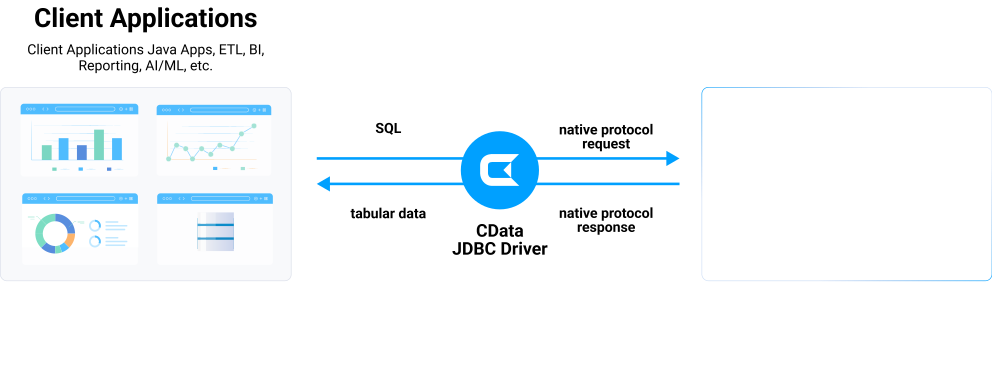

OData JDBC Connectivity Features
- Seamlessly maps SQL-92 queries to OData requests
- Compatible with OData version 2.0, 3.0, and 4.0
- Utilizes navigation properties to build a relational model of OData APIs
- Connect to live OData data, for real-time data access with the OData ODBC Driver
- Full support for data aggregation and complex JOINs in SQL queries
- Secure connectivity through modern cryptography, including TLS 1.2, SHA-256, ECC, etc.
- Seamless integration with leading BI, reporting, and ETL tools and with custom applications via the OData Connector.
Target Service, API
The driver provides access to any OData v2, v3, or v4 service. Automatically discovers service metadata and entities through standard OData protocols.
Schema, Data Model
Dynamically models OData entities as tables based on service metadata. Supports complex types, navigation properties, and functions as stored procedures.
Key Objects
All entities exposed by the OData service, including custom entities. Navigation properties exposed as foreign key relationships.
Operations
Full CRUD operations based on OData service capabilities. Supports OData query options ($filter, $select, $expand, $orderby) through SQL syntax.
Authentication
Supports various authentication methods including Basic, OAuth, Windows/NTLM, and custom headers. Adapts to service requirements.
Start a 30-day Free Trial Today
JDBC Access to OData
Full-featured and consistent SQL access to any supported data source through JDBC
-
Certified Compatibility*
Our drivers undergo extensive testing and are certified to be compatible with leading analytics and reporting applications like SAP Crystal Reports, Pentaho, Business Objects, Crystal Reports and many more.
-
Metadata Discovery
Full support for JDBC DatabaseMetaData provides extensive schema discovery capabilities. Explore tables, columns, keys, and other data constructs based on user identity.
-
Developer Friendly
Design-time support for all major Java IDEs, including Eclipse, IntelliJ, and NetBeans.
-
JDBC Remoting
Our exclusive remoting feature allows hosting the JDBC connection on a server to enable connections from various clients on any platform (Java, .NET, C++, PHP, Python), using any standards-based technology (ODBC, JDBC, etc.). JDBC Remoting is enabled using the popular MySQL wire protocol server.
-
Replication and Caching
Our replication and caching commands make it easy to copy data to local and cloud data stores such as Oracle, SQL Server, Google Cloud SQL, etc. The replication commands include many features that allow for intelligent incremental updates to cached data.
-
String, Date, Numeric SQL Functions
The driver includes a library of over 50 functions that can manipulate column values into the desired result. Popular examples include Regex, JSON, and XML processing functions.
-
Collaborative Query Processing
Our drivers enhance the data source's capabilities by additional client-side processing, when needed, to enable analytic summaries of data such as SUM, AVG, MAX, MIN, etc.
-
Easily Customizable and Configurable
The data model exposed by our JDBC Drivers can easily be customized to add or remove tables/columns, change data types, etc. without requiring a new build. These customizations are supported at runtime using human-readable schema files that are easy to edit.
-
Secure Connectivity
Includes standard Enterprise-class security features such as TLS/ SSL data encryption for all client-server communications.
See what you can do with OData JDBC Driver

Integrate OData into your systems and data warehouses through popular Java-based ETL/EAI tools. Supports both self-hosted environments and cloud service deployment.

Connect to OData from any JDBC-compatible BI, reporting, and data virtualization platform. Provides seamless integration using SQL as the standard query interface across all tools.

Use the OData JDBC Driver to rapidly deliver Java-based applications that connect with OData. Universal SQL-based interactivity simplifies integration and speeds time to market.
Connect to OData — empower every team
- CData JDBC Drivers for OData will act as if it is a native connector for you ETL, BI, Data Virtualization tool.
- Organizations can connect to the new services to capture full view of business, or migrate to modern data technology while maintaining the connection to existing sytems.
- Speed up your AI initiative with CData. Connect your data with the AI / ML platform of your choice.
Need to integrate your internal systems with OData? CData JDBC Drivers let you do it easily. Java based applications can easily connect to OData with SQL/JDBC — any ETL, EAI (Enterprise Application Integration), ESB (Enterpriese Service Bus) can connect to OData.
- Embed CData JDBC Drivers for OData to your product and differentiate with your connectivity
- Standard SQL access. Stop researching on different authentication, data model and query methods.
- Utilize your resource to build your product, CData takes care of your connectivity

AI-Assisted Development with CData Code Assist MCP
Build OData integrations faster with AI that understands your schema
Supported AI Coding Tools




Code Assist MCP gives AI coding tools direct access to your OData schema. No more guessing table names or column types—AI sees the same metadata as your JDBC Driver.
Table names, column names, and SQL syntax in Code Assist MCP are identical to this JDBC Driver. Queries you validate with AI work directly in your production code.
Stop guessing. Start shipping. Prototype queries in conversation, validate against live data, then deploy with CData JDBC Drivers—no rewriting required.
Free for development. No trial period. No credit card required.
Frequently Asked OData JDBC Driver Questions
Learn more about OData JDBC drivers for data and analytics integration
Can OData be used with Java?
Yes, OData can be used with Java . CData provides a JDBC type 4/5 driver for OData that allows Java applications to connect to OData using standard JDBC APIs. This driver enables you to execute SQL queries, manage connections, and process data stored in OData from Java, or any Java-based application that supports JDBC.
Does OData support JDBC?
Not natively. However, CData offers a JDBC driver for OData that allows you to connect to OData data from any Java-based application that supports JDBC, just like you would access a traditional database. This can be useful for tasks like:
- Accessing OData from applications: Connect to OData data in popular tools and applications including Informatica, Talend, Apache Spark, Apache NiFi, and many others.
- Real-time data: You can work with live OData data within these applications, enabling tasks like reporting and analysis.
- Connecting systems: Build data integrations between OData and other systems.
The OData JDBC driver is a pure Java type 4/5 driver with comprehensive ANSI SQL-92 support. This means that virtually any application that can connect to data via JDBC, can use the CData JDBC driver for real-time integration. Download a fully functional free trial of the OData JDBC driver today to get started.
Is there a JDBC driver for OData?
Yes, the CData JDBC driver for OData provides universal JDBC data connectivity for OData. The OData JDBC driver offers a simple SQL-based layer of abstraction that simplifies real-time data access for users and applications, enabling them to communicate with OData using a standardized set of functions. Virtually any application on any platform can use the CData JDBC driver for real-time integration.
How do I connect to OData via JDBC?
Connectivity to OData via JDBC is easy. First, download and install the OData JDBC driver.
Once the installation is complete, navigate to the JDBC driver documentation page. Here, you'll find a wealth of information about the installed driver. The step-by-step instructions for creating a DSN and using it to connect to OData via JDBC are just the beginning. The documentation also provides extensive configuration details for using the OData JDBC driver with all your favorite applications and development tools, ensuring you have all the support you need.
Where can I download a JDBC driver for OData?
All of the CData JDBC drivers, including the OData JDBC driver are available for download online. To get started, download a fully functional free trial of the OData JDBC driver today.
How do I install the JDBC driver for OData?
To install the OData driver, simply download one of the OData JDBC driver installers available online. The installers are comprehensive setup utilities that will install all the components required to use the OData JDBC driver on your system.
Popular JDBC Videos:
