





Use Grok to Talk to Your HCL Domino Data via CData Connect AI

Grok AI is a large language model developed by xAI for real-time reasoning, tool invocation, and agentic workflows. It enables developers to build AI agents that can reason over live data, discover tools dynamically, and take intelligent actions.
CData Connect AI provides a secure cloud-to-cloud interface for integrating 350+ enterprise data sources with Grok AI. Using Connect AI, live HCL Domino data is exposed through a remote MCP endpoint without replication, allowing Grok AI agents to securely query and analyze governed enterprise data in real time.
Step 1: Configure HCL Domino in CData Connect AI
To enable Grok to query live HCL Domino data, first create a HCL Domino connection in CData Connect AI. This connection is exposed through the CData Remote MCP Server.
-
Log into Connect AI, click Sources, and then click Add Connection.

-
Select "HCL Domino" from the Add Connection panel.

-
Enter the required authentication properties.
Connecting to Domino
To connect to Domino data, set the following properties:
- URL: The host name or IP of the server hosting the Domino database. Include the port of the server hosting the Domino database. For example: http://sampleserver:1234/
- DatabaseScope: The name of a scope in the Domino Web UI. The driver exposes forms and views for the schema governed by the specified scope. In the Domino Admin UI, select the Scopes menu in the sidebar. Set this property to the name of an existing scope.
Authenticating with Domino
Domino supports authenticating via login credentials or an Entra ID (formerly Azure AD) OAuth application:
Login Credentials
To authenticate with login credentials, set the following properties:
- AuthScheme: Set this to "OAuthPassword"
- User: The username of the authenticating Domino user
- Password: The password associated with the authenticating Domino user
The driver uses the login credentials to automatically perform an OAuth token exchange.
EntraID (formerly AzureAD)
This authentication method uses Entra ID (formerly Azure AD) as an IdP to obtain a JWT token. You need to create a custom OAuth application in Entra ID (formerly Azure AD) and configure it as an IdP. To do so, follow the instructions in the Help documentation. Then set the following properties:
- AuthScheme: Set this to "EntraID (formerly AzureAD)"
- InitiateOAuth: Set this to GETANDREFRESH. You can use InitiateOAuth to avoid repeating the OAuth exchange and manually setting the OAuthAccessToken.
- OAuthClientId: The Client ID obtained when setting up the custom OAuth application.
- OAuthClientSecret: The Client secret obtained when setting up the custom OAuth application.
- CallbackURL: The redirect URI defined when you registered your app. For example: https://localhost:33333
- AzureTenant: The Microsoft Online tenant being used to access data. Supply either a value in the form companyname.microsoft.com or the tenant ID.
The tenant ID is the same as the directory ID shown in the Azure Portal's Entra ID (formerly Azure AD) > Properties page.
 Click Create & Test.
-
Open the Permissions tab and configure user access.

Add a Personal Access Token
A Personal Access Token (PAT) authenticates MCP requests from Agno to CData Connect AI.
- Open Settings and navigate to Access Tokens.
- Click Create PAT.
-
Save the generated token securely.

Step 2: Install required dependencies
Remote MCP Tools allow Grok to connect to external MCP (Model Context Protocol) servers, extending its capabilities with custom tools from third parties or your own implementations. Simply specify a server URL and optional configuration xAI manages the MCP server connection and interaction on your behalf.
Open the terminal and install the required dependencies for the MCP integration using pip.
pip install xai-sdk==1.4.0
The xai-sdk (v1.4.0) enables Remote MCP tools, and python-dotenv is used to securely load environment variables.
pip install python-dotenv
Step 3: Generate an xAI API key
- Create or login to xAI account
- Open xAI API console
- Navigate to API Keys
- Click on create API key
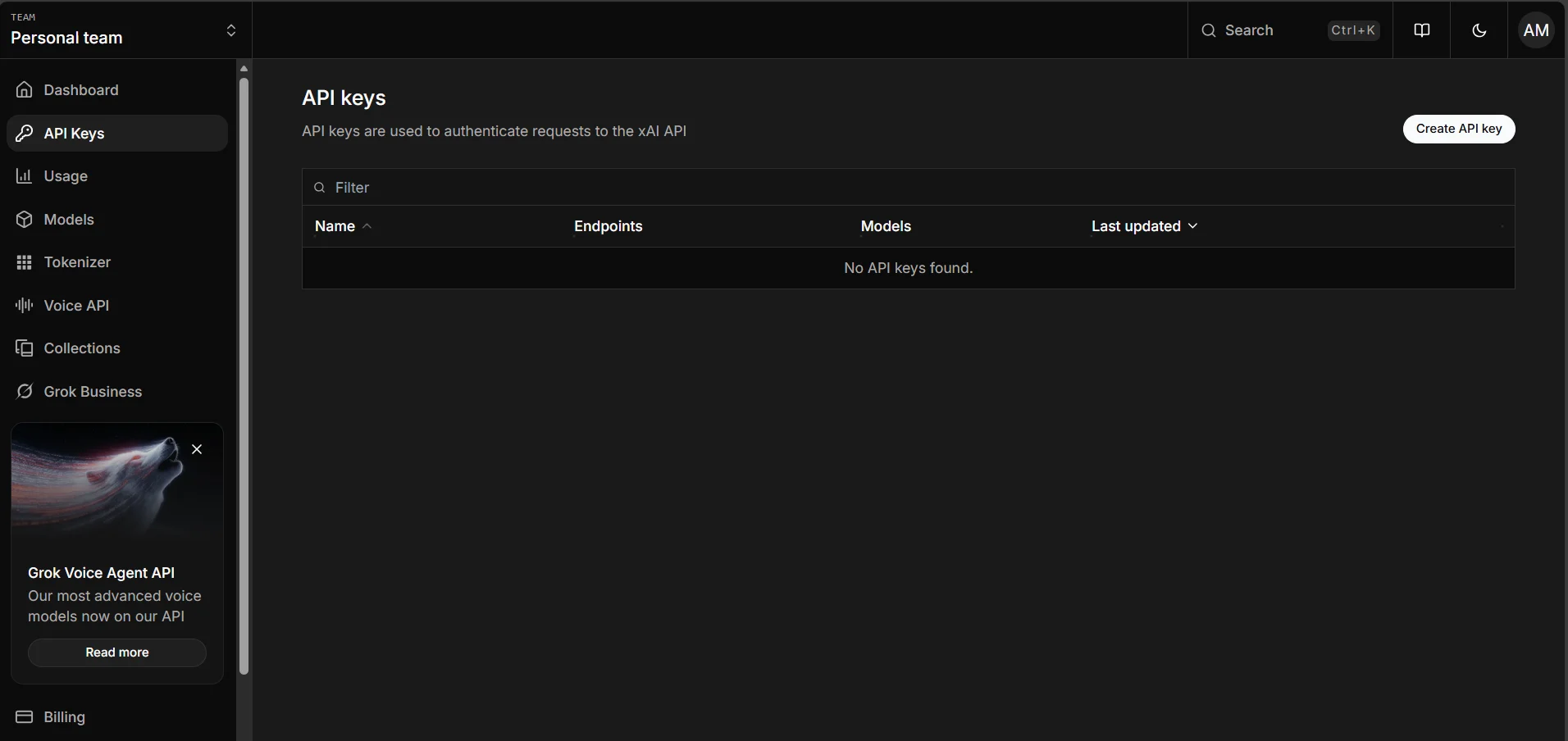
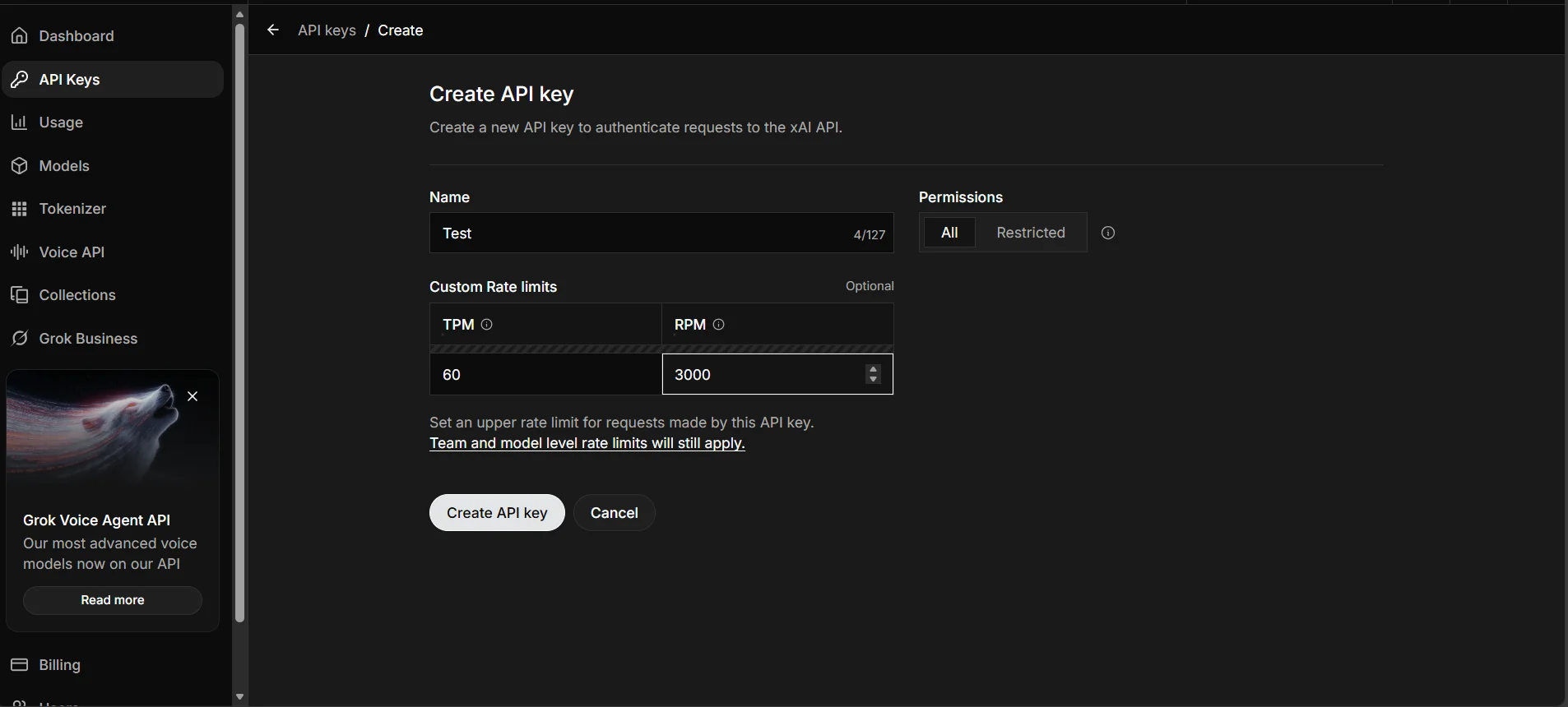
After generating an API key, user need to save it somewhere safe. Recommended option is to export it as an environment variable in your terminal or save it to a .env file.
Step 4: Connect to CData Connect AI
Initialize the Grok client and configure the MCP connection to CData Connect AI. The code below establishes a secure connection and sends a natural language query to your data source.
import os

from xai_sdk import Client
from xai_sdk.chat import user
from xai_sdk.tools import mcp

client = Client(api_key="Your_xAI-API_KEY")
chat = client.chat.create(
	model="grok-4-1-fast-non-reasoning",
	tools=[
		mcp(
			server_url="https://mcp.cloud.cdata.com/mcp",
			extra_headers={"Authorization": "Basic Username:PAT"} #Base64 Encoded Username:PAT
		)
		],
	include=["verbose_streaming"],
)

chat.append(user("List the top two catalogs for me please"))

is_thinking = True
for response, chunk in chat.stream():
	# View the server-side tool calls as they are being made in real-time
	for tool_call in chunk.tool_calls:
		print(f"
Calling tool: {tool_call.function.name} with arguments: {tool_call.function.arguments}")
	if response.usage.reasoning_tokens and is_thinking:
		print(f"
Thinking... ({response.usage.reasoning_tokens} tokens)", end="", flush=True)
	if chunk.content and is_thinking:
		print("

Final Response:")
		is_thinking = False
	if chunk.content and not is_thinking:
		print(chunk.content, end="", flush=True)

print("

Usage:")
print(response.usage)
print(response.server_side_tool_usage)
print("

Server Side Tool Calls:")
print(response.tool_calls)
This code initializes the Grok AI client, connects to CData Connect AI via MCP using Basic Authentication, and streams the response in real-time. The agent automatically discovers available tools, invokes them to query your live data, and displays both the tool calls and final results.
Run the script to see Grok query your connected data source.
Query Results
The output shows Grok invoking MCP tools through CData Connect AI and returning live data from your connected source.
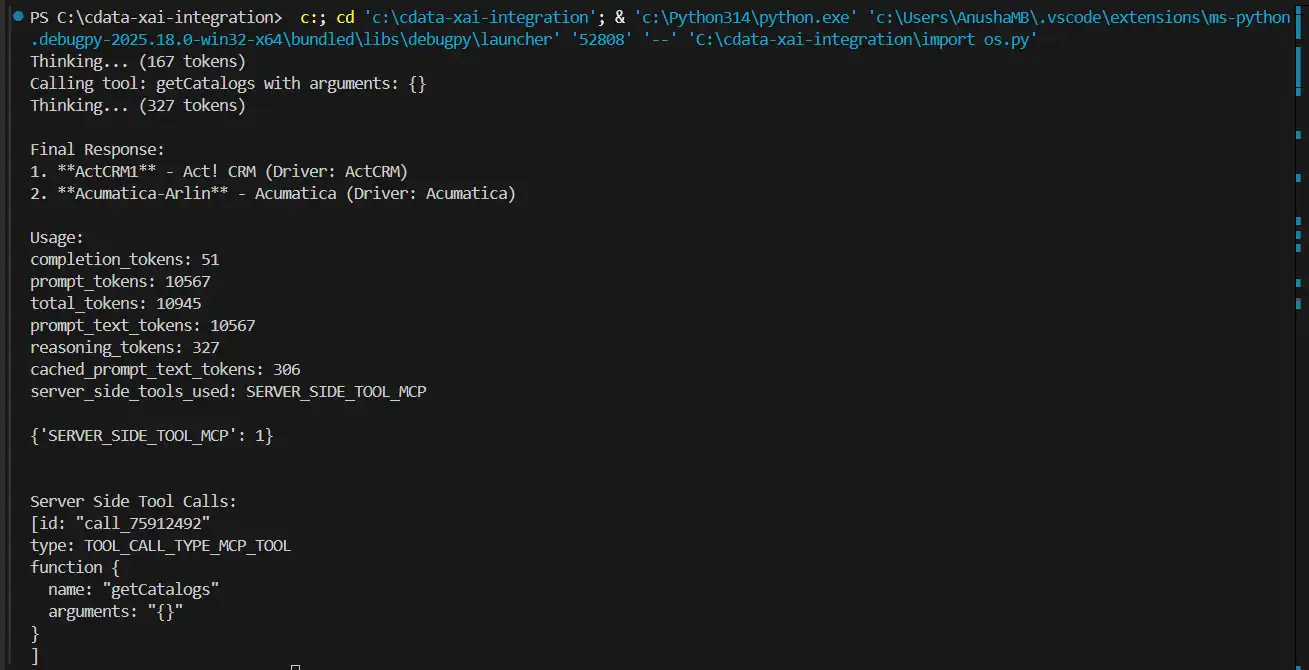
User can now query live data using natural language through Grok AI.
Build agentic workflows with Grok and CData Connect AI
Combining Grok AI with CData Connect AI delivers AI-powered data access without pipelines or custom integrations. Start your free trial today to see how CData can empower Grok with live, secure access to 350+ external systems.