





Integrating the CData JDBC Driver for Salesforce Data 360 with Ignition SCADA

Ignition is an industrial supervisory control and data acquisition (SCADA) and industrial Internet of Things (IIoT) platform from Inductive Automation. Its central Gateway service manages device connections, tags, and database connections. Ignition doesn't ship with a connector for Salesforce Data 360, so reaching Salesforce Data 360 data usually means custom middleware or manual exports.
The CData JDBC Driver for Salesforce Data 360 bridges this gap by exposing Salesforce Data 360 as a standard Java Database Connectivity (JDBC) data source. Ignition treats any JDBC driver as a standard database connection. Once the driver is registered in the Gateway, you can query live Salesforce Data 360 data from the Script Console, SQL Bridge, tags, or a Perspective or Vision screen, without replication, custom connectors, or extract, transform, load (ETL) pipelines.
This guide outlines the steps to install and commission Ignition, register the CData JDBC Driver for Salesforce Data 360, create the connection, and verify it with a live query.
Prerequisites
- Ignition for Windows (Windows 10/11 or Windows Server), with administrator rights to install a Windows service
- CData JDBC Driver for Salesforce Data 360
- A Salesforce Data 360 account with valid credentials and application programming interface (API) access enabled
- A supported desktop browser (Google Chrome, Mozilla Firefox, Microsoft Edge, or Safari) to open the Gateway web interface
Step 1: Install and set up Ignition
If Ignition is already installed and running, skip to Step 2.
Download Ignition
-
Go to the Inductive Automation downloads page and download Ignition for Windows.
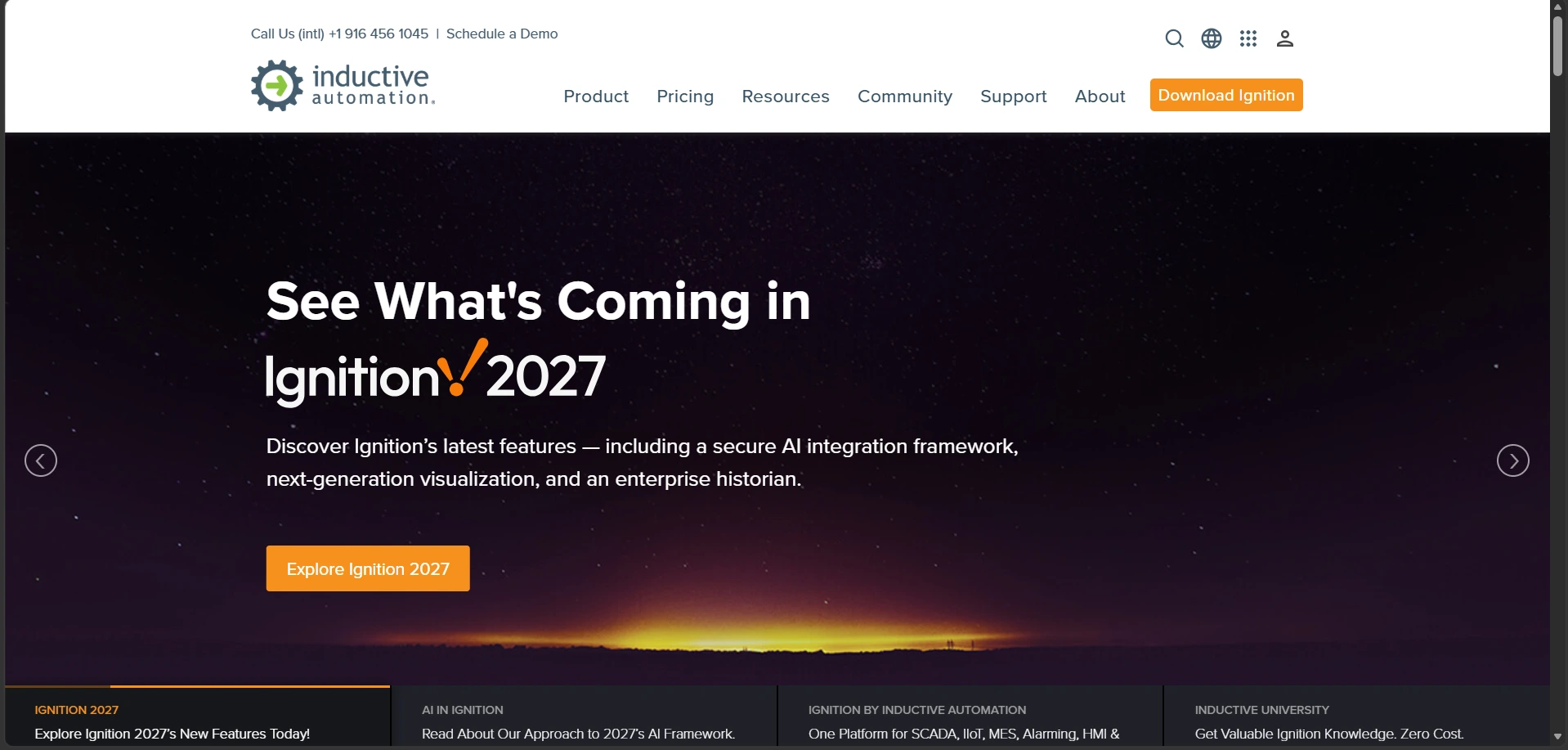
- This single download is the full Ignition Gateway installer. It includes both the Gateway service and the Designer Launcher, so you don't need a separate Designer download.
Install Ignition
- Run the installer, accept the license agreement, and choose an install location.
- Leave Install as a Windows Service checked so the Gateway starts with Windows.
- Finish the installer. The Gateway service starts, and a browser window opens to http://localhost:8088 and shows the Commissioning wizard. If the page shows a Browser Not Supported notice, open the same address in Chrome, Firefox, Edge, or Safari.
Commission the Gateway
- In the Commission Ignition Gateway wizard, set a Gateway Name and create an administrator username and password.
- Accept the End User License Agreement, then start a trial or activate a purchased Ignition license.
-
When commissioning finishes, log in with the administrator account. You land on the Gateway Home page.
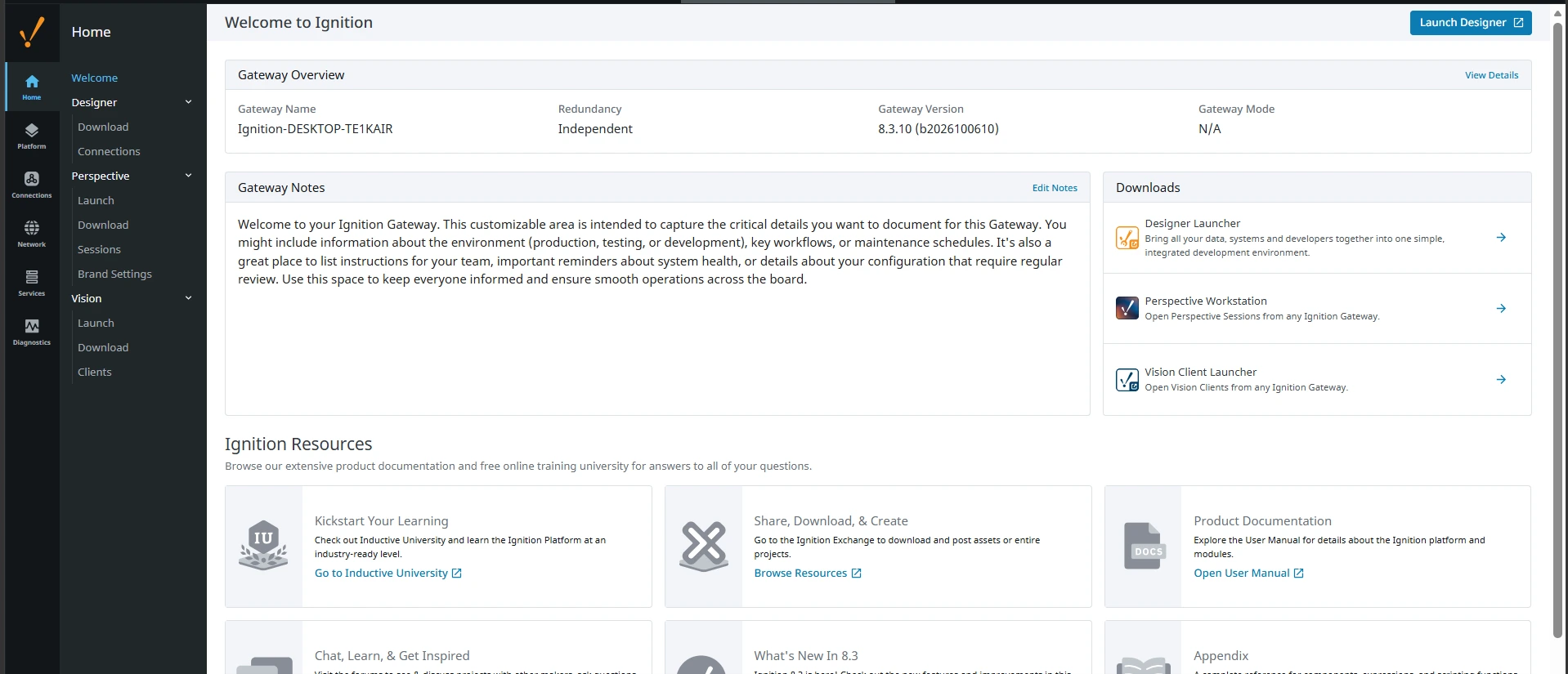
Note: A trial shows a countdown timer on every Gateway page, and the timer resets when the Gateway service restarts. This is fine for testing, but production use requires a license.
Step 2: Register the CData JDBC Driver in Ignition
Ignition lets you upload any third-party JDBC driver through the Gateway web interface, without touching the file system directly.
- Log in to the Gateway as an administrator.
- Go to Connections > Databases > Settings, open the Drivers tab, and click Create JDBC Driver.
-
In the dialog, enter the following:
- Name: Salesforce Data 360
- Classname: cdata.jdbc.salesforcedatacloud.SalesforceDataCloudDriver
- Driver Type: Generic
- Default Validation Query: SELECT [Account ID] FROM Account LIMIT 1
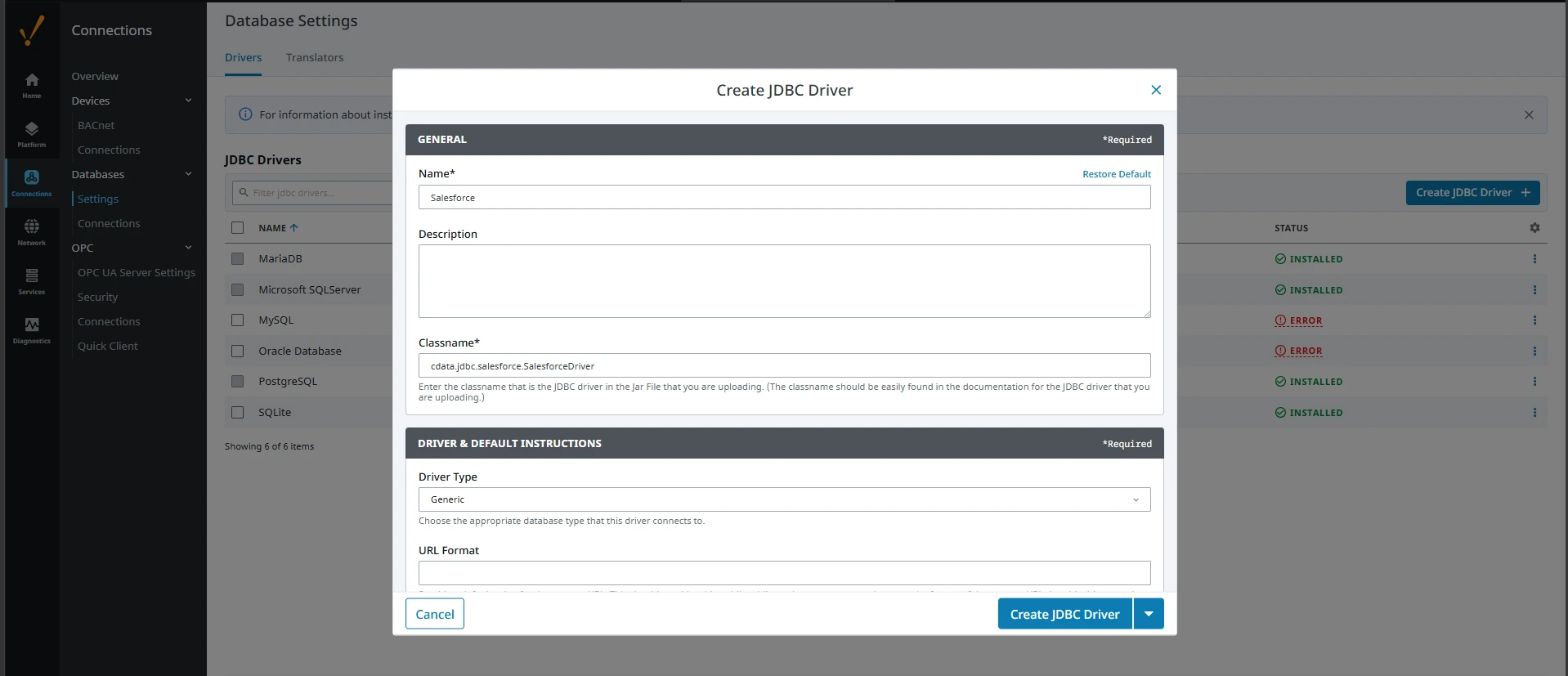
- Click Create JDBC Driver. In current Ignition 8.3 releases, the create dialog doesn't include a Java archive (JAR) file upload field, so you add the JAR file in the next step.
- Open the menu at the right of the new driver row, choose Manage JAR files, upload cdata.jdbc.salesforcedatacloud.jar from the lib folder of the driver installation, and save.
-
Confirm the driver shows an INSTALLED status in the drivers list.
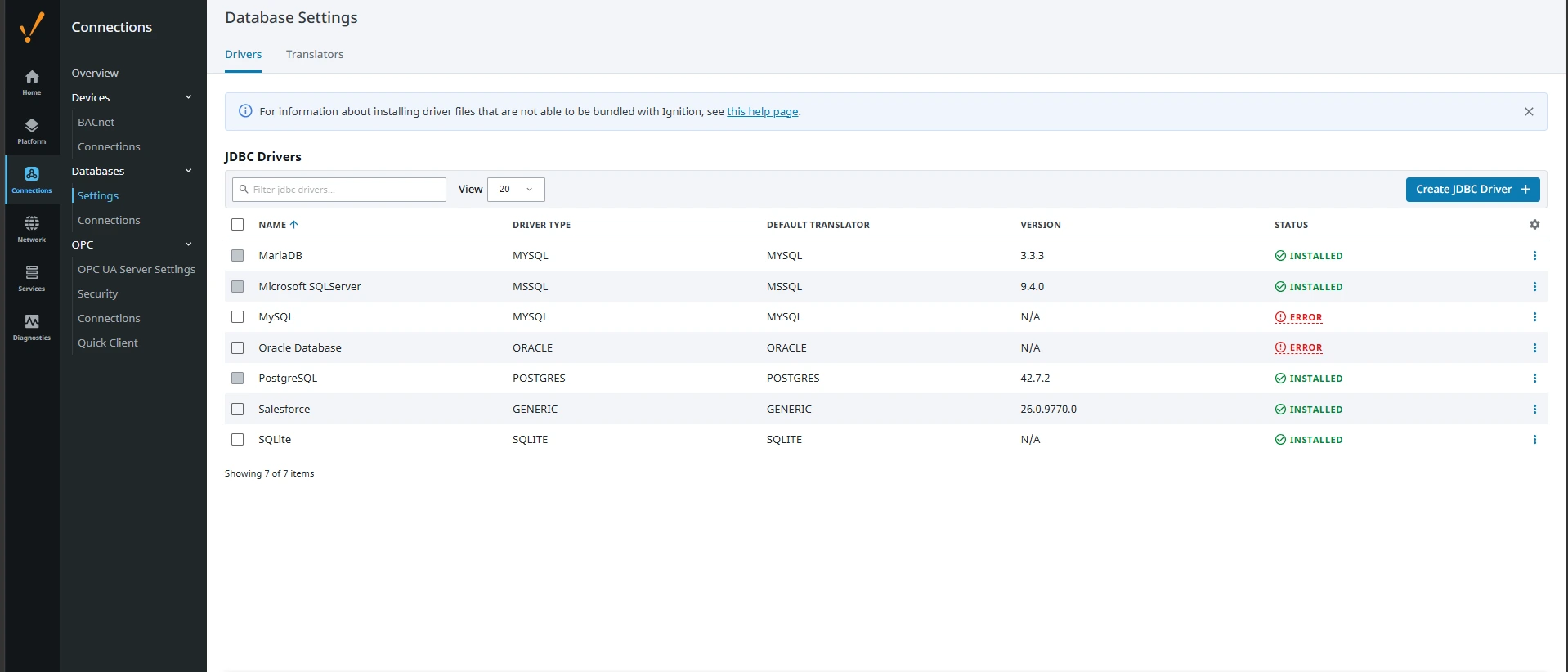
Step 3: Create the Salesforce Data 360 connection
- Go to Connections > Databases > Connections and click Create Database Connection.
-
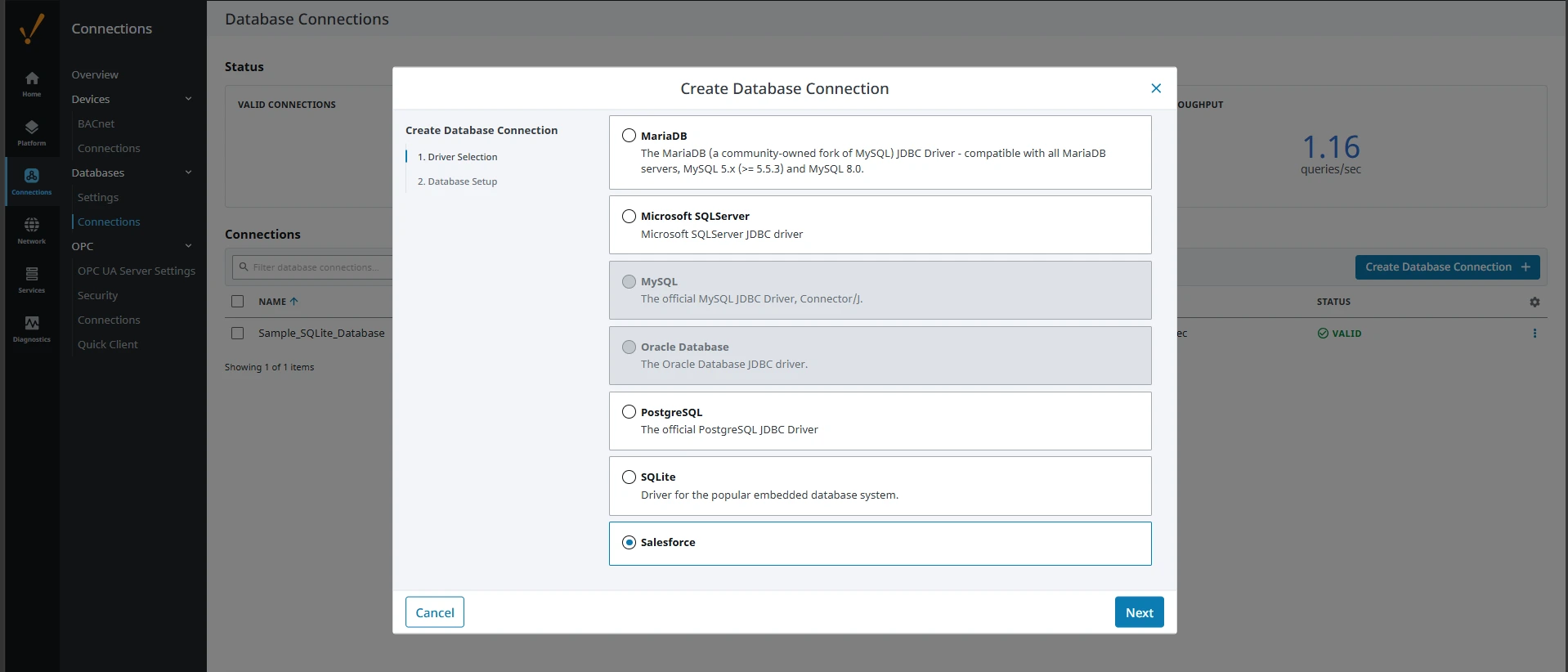
On the Driver Selection step, select Salesforce Data 360 and click Next.
- On the Database Setup step, set the Name to Salesforce Data 360. Leave Username empty and select None for Password, because the credentials go in the connect URL.
-
In Connect URL, enter the connection string:
jdbc:salesforcedatacloud:InitiateOAuth=GETANDREFRESH;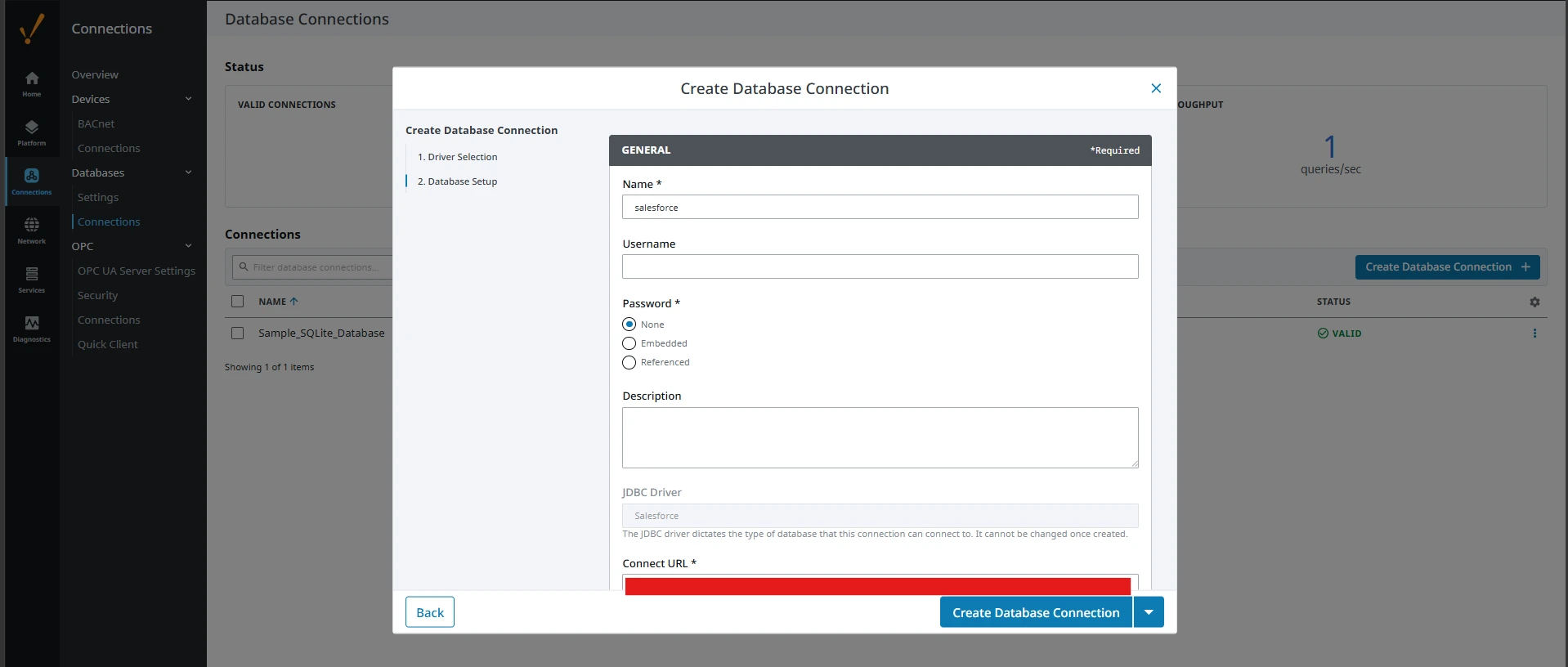
-
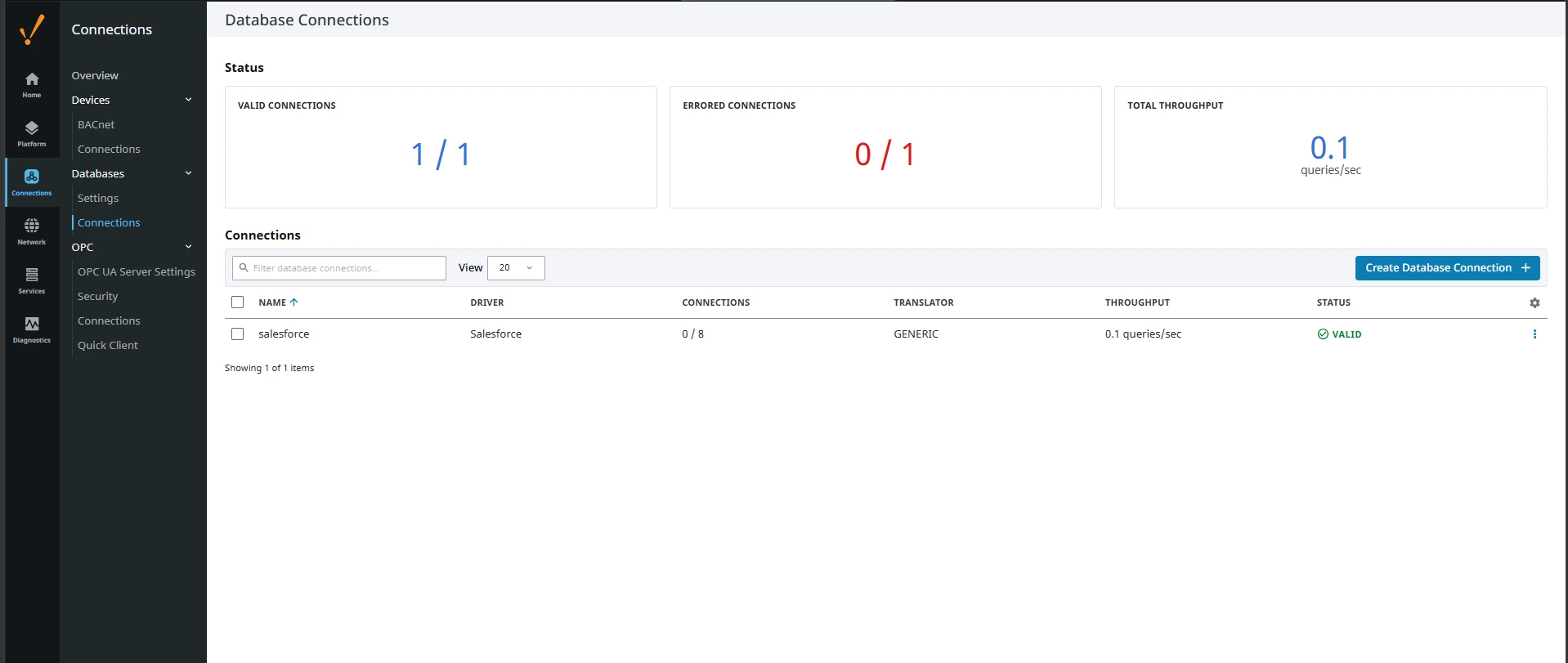
Click Create Database Connection and confirm the connection shows a VALID status on the Database Connections page.
Connection properties for Salesforce Data 360
Salesforce Data 360 supports authentication via the OAuth standard.
OAuth
Set AuthScheme to OAuth.
Desktop Applications
CData provides an embedded OAuth application that simplifies authentication at the desktop.
You can also authenticate from the desktop via a custom OAuth application, which you configure and register at the Salesforce Data 360 console. For further information, see Creating a Custom OAuth App in the Help documentation.
Before you connect, set these properties:
- InitiateOAuth: GETANDREFRESH. You can use InitiateOAuth to avoid repeating the OAuth exchange and manually setting the OAuthAccessToken.
- OAuthClientId (custom applications only): The Client ID assigned when you registered your custom OAuth application.
- OAuthClientSecret (custom applications only): The Client Secret assigned when you registered your custom OAuth application.
When you connect, the driver opens Salesforce Data 360's OAuth endpoint in your default browser. Log in and grant permissions to the application.
The driver then completes the OAuth process as follows:
- Extracts the access token from the callback URL.
- Obtains a new access token when the old one expires.
- Saves OAuth values in OAuthSettingsLocation so that they persist across connections.
-
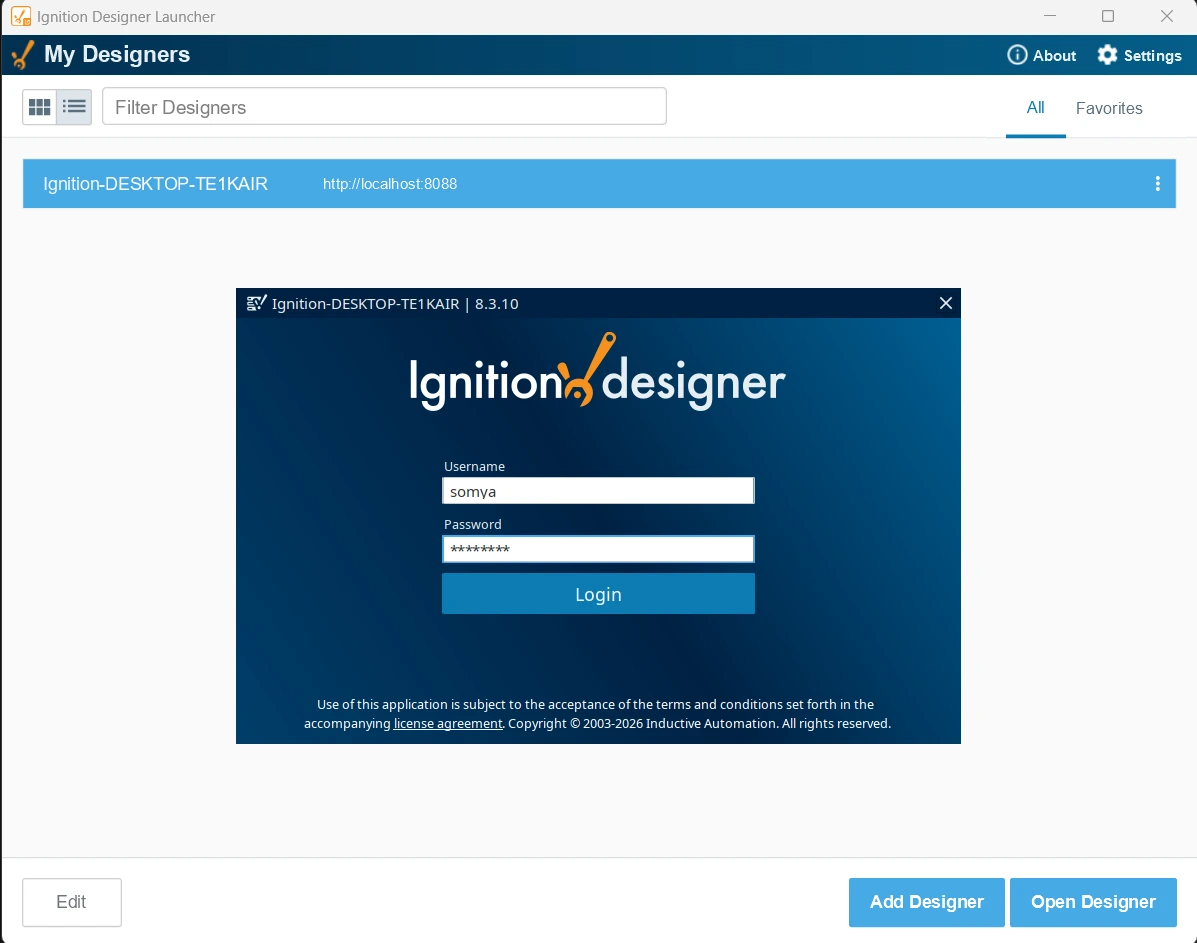
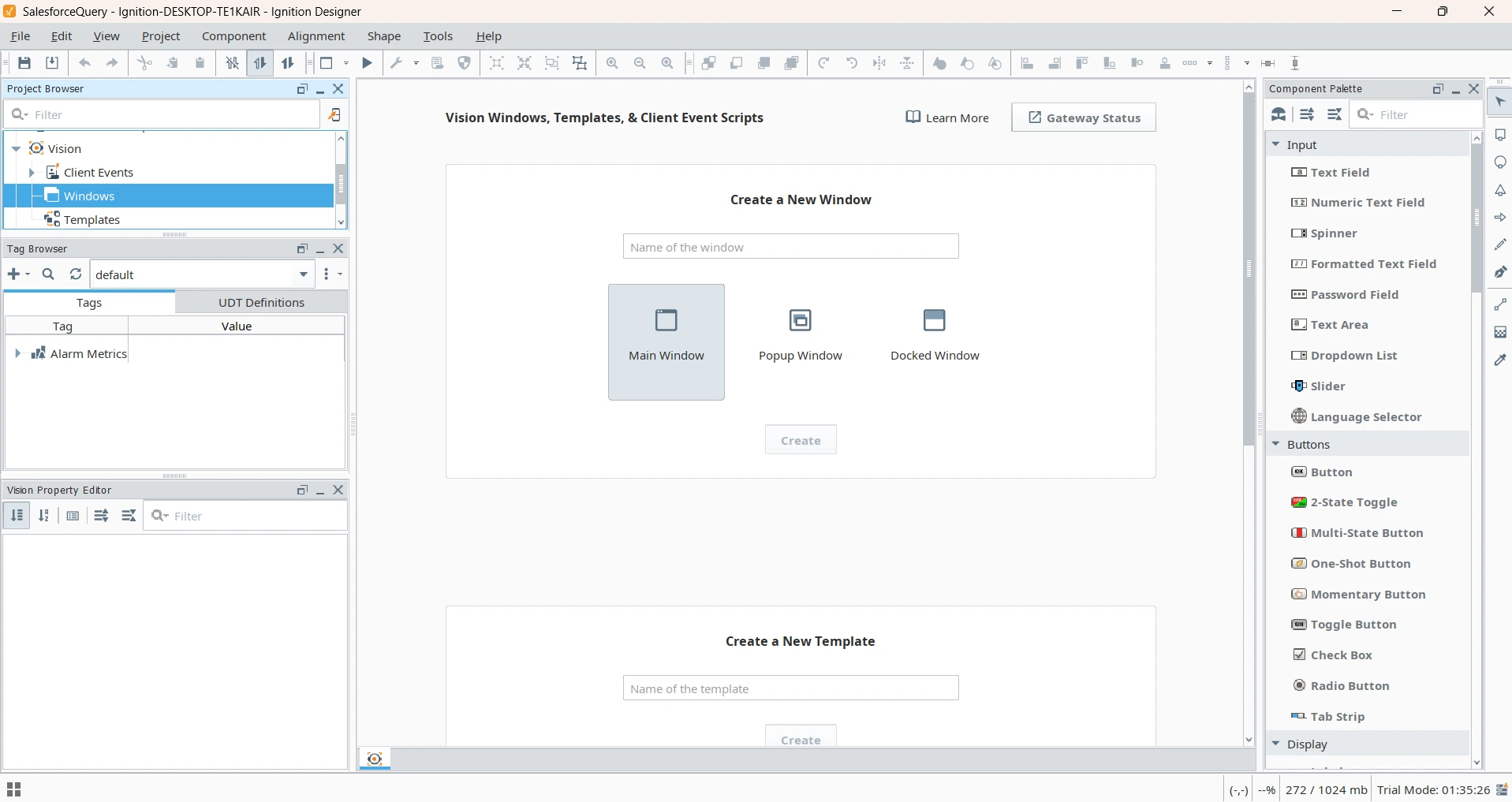
Open the Ignition Designer Launcher, select your Gateway (click Add Designer and enter http://localhost:8088 if it isn't listed), and click Open Designer. Log in with the Gateway administrator account.
-
Open or create a project. The Designer opens with the Project Browser, Tag Browser, and Component Palette panels.
-
In the Designer, go to Tools > Script Console. In the Multiline Buffer, enter a test query and click Execute. Replace Account with any table available in your Salesforce Data 360 connection:
print system.db.runQuery(
    "SELECT [Account ID], [Account Name] FROM Account LIMIT 10",
    "Salesforce Data 360")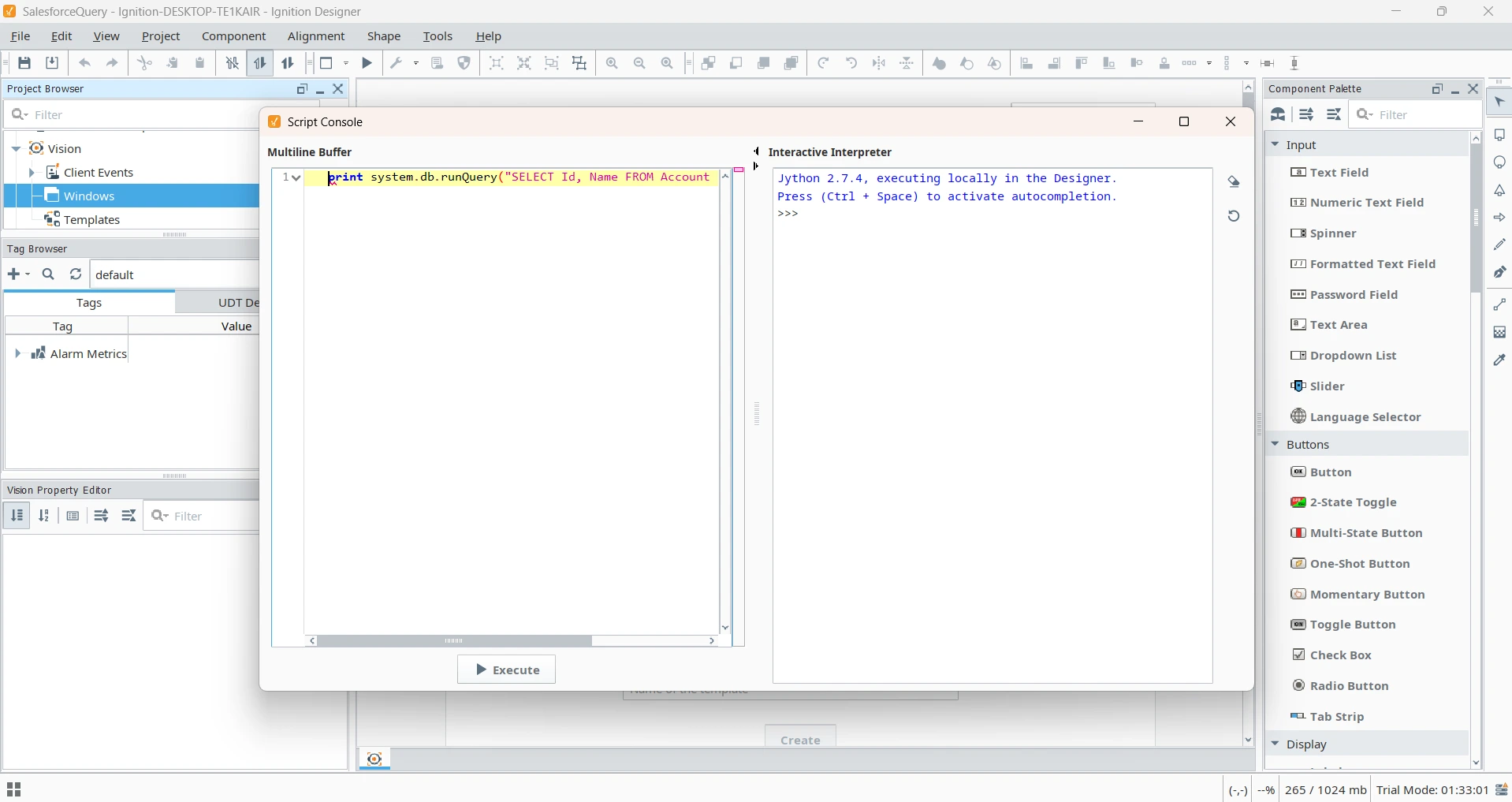
- A successful query prints PyDataset rows:10 cols:2 in the Interactive Interpreter panel, which confirms Ignition retrieved live data from Salesforce Data 360 through the CData JDBC Driver.
-
Print the rows and compare the values with the same records in Salesforce Data 360:
ds = system.db.runQuery("SELECT [Account ID], [Account Name] FROM Account LIMIT 10", "Salesforce Data 360") for row in ds: print row["[Account ID]"], row["[Account Name]"] - Optionally, run a second query against another table and a filtered query to confirm schema discovery and filtering.
- Optionally, restart the Gateway service and confirm the connection returns to VALID.
For other OAuth methods, including Web Applications and Headless Machines, refer to the Help documentation.
Note: If a password or token contains a semicolon, the connect URL breaks, so reset it to a value without one.
Step 4: Query live Salesforce Data 360 data from Ignition
With the connection valid, you can query live Salesforce Data 360 data from the Designer.
Note: The connection name in the script must match the name you gave the connection in Step 3.
Step 5: Verify the results
Troubleshooting
| Symptom | Likely cause and fix |
|---|---|
| Driver status shows ERROR | The classname is wrong, or the JAR file hasn't been uploaded through Manage JAR files. |
| Connection status shows FAULTED | The credentials are wrong, outbound web traffic (HTTPS) is blocked, or the CData license isn't found. Click the status to read the error. |
| Error: Could not find a valid license | The Gateway runs as a Windows service and can't read a license stored in your user profile. In an administrator command prompt, run java -jar cdata.jdbc.salesforcedatacloud.jar --license from the driver's lib folder, copy the generated .lic file to C:\Windows\system32\config\systemprofile\.CData\, and restart the Gateway service. |
| Database connection not found | The connection name in the script doesn't match the Gateway connection name exactly. |
Test the driver outside Ignition
To confirm the driver works independently of the Gateway, run this standalone Java example. The cdata.jdbc.salesforcedatacloud.jar and cdata.jdbc.salesforcedatacloud.lic files must be in the same directory and on the classpath.
import java.sql.Connection;
import java.sql.DriverManager;
import java.sql.ResultSet;
import java.sql.Statement;

public class CDataExample {
    public static void main(String[] args) throws Exception {
        Class.forName("cdata.jdbc.salesforcedatacloud.SalesforceDataCloudDriver");
        String connectionString = "jdbc:salesforcedatacloud:InitiateOAuth=GETANDREFRESH;";
        try (Connection conn = DriverManager.getConnection(connectionString)) {
            Statement stmt = conn.createStatement();
            ResultSet rs = stmt.executeQuery("SELECT [Account ID], [Account Name] FROM Account LIMIT 10");
            while (rs.next()) {
                System.out.println(rs.getString("[Account ID]") + ", " + rs.getString("[Account Name]"));
            }
        }
    }
}
Build live, governed Salesforce Data 360 connectivity in Ignition with CData
With the CData JDBC Driver for Salesforce Data 360 registered, your team can query live Salesforce Data 360 data from Ignition without ETL infrastructure, manual exports, or custom integration code, and reuse the same connection in tags, SQL Bridge, and Perspective or Vision screens.
Start your free trial today to see how you can give Ignition live, secure access to hundreds of external systems with CData.
Ready to get started?
Download a free trial of the Salesforce Data Cloud Driver to get started:
Download NowLearn more:
 Salesforce Data 360 JDBC Driver
Rapidly create and deploy powerful Java applications that integrate with Salesforce Data 360 data including DataGraph, DataLakeObject, DataModelObjects, CalculatedInsights, and more!