




Context that learns your business
Every question answered, correction made, and definition curated becomes context your AI keeps. Each answer starts smarter than the last.







Give agents understanding, not just access
Connecting an agent to your systems is the easy part. AI programs succeed when agents understand your data, your systems, and your business.
Four kinds of context, one graph
All four kinds of context are unified into one graph any model can use so every model answers from the same understanding.
Unify your context in one place
Integrate four kinds of context across structured and unstructured sources into one place for a full picture of what agents need to know.
System context
Every system’s schemas, objects, and relationships, carried by the connectors and known on day one, including the hard ones.
Data model
Curated live datasets, joins, aggregates, and lineage that span sources, modeled once and virtualized over live data rather than replicated.
Semantic definitions
Import existing semantic models or create official metric definitions and business terminology in an AI-guided process.
Company knowledge
Expert judgment and team know-how, imported from documents and captured as people work with agents, reviewed, and approved once into shared company context.
An editable, open format
Stored in a normalized format: one markdown file per concept, holding its schemas, joins, and business logic.
Reviewable diffs
A definition change is a diff. Data owners approve it the way they approve code, before an agent starts answering with it.
Portable knowledge
Markdown and YAML structure means context can be used by any model you choose to route to.
Human readable
The same file an analyst reads is the file the model retrieves. No translation step where meaning is misinterpreted.
Precise retrieval
Not a flat list of descriptions—a graph the agent can walk. Directory position and typed links form the edges the engine and the agent both traverse.
How agents retrieve context
The agent walks the graph from the matched concept, pulling only what the question needs, so answers stay precise and the context window stays small.
{
  "matched": {
    "path": "virtual_schemas/revenue/metrics/arr.md",
    "content": "... formula, filter, source ..."
  },
  "related": [
    { "path": "virtual_schemas/revenue/tables/opportunities.md", "relation": "derived_from" },
    { "path": "virtual_schemas/revenue/tables/invoices.md", "relation": "joined_with" },
    { "path": "global/glossary/revenue_terms.md", "relation": "parent_concept" }
  ]
}
The agent or AI tool calls search_context
search_context is a tool CData Connect AI gives any agent or AI tool over MCP. It searches the context engine, where your metric definitions, business rules, and table relationships live. It returns the concepts that match the prompt and the links out of each one, so the first response stays small.
The agent gets the matched concept
The context engine returns arr.md as the best match for the prompt. For most questions, that concept is enough to answer on its own.
It sees what that concept connects to, and why
The related array names each linked concept and the relationship type, so the agent never has to guess whether following a link is worth the tokens.
It goes deeper only if the question requires it
“What’s our ARR” is answered from the matched concept alone. “Why doesn’t ARR match the Salesforce number” follows the joined_with edge to invoices.md and reconciles—one extra hop instead of scanning the bundle.
It learns to answer before you ask
Because it sees outcomes, the engine goes beyond injecting definitions. Each half of the loop feeds the other, so context is always improving.
Conversational signals.
When a user asks for ARR, gets the wrong cut, and corrects it, Connect AI links that intent to the query that finally worked and updates the concept file behind it.
Query mining.
Commonly queried tables, frequent join paths, and popular filters surface over time, enriching concept files with real usage signal that sharpens retrieval.
Connected knowledge sources.
Wikis, catalogs, and documentation flow into the bundle as new concept files—and an agent watching designated Slack or Teams channels flags definition and schema discussions as candidates to merge, catching decisions that were never written down.
AI refinement and reconciliation.
Connect AI periodically self-reviews the whole bundle—identifying conflicts, redundancies, and gaps, then reconciling and restructuring so the model stays consistent as sources evolve.
Human in the loop.
When the engine hits something it cannot resolve—two definitions of the same metric, a renamed field with no owner—it asks the right person, and folds the answer back in.
Every correction you make, made everywhere
Fix something once and every agent gets it right from then on. Your agents grow more accurate with every request, without anyone re-teaching them.
Learn from every request
Captures vocabulary and corrections from conversations—when a user gets the wrong cut and fixes it, the loop links that intent to the query that worked.
Recurring joins, filters, and popular tables surface over time and become hints and synonyms that sharpen retrieval.
Records the tool-call patterns that succeed, so agents repeat what works instead of rediscovering it.
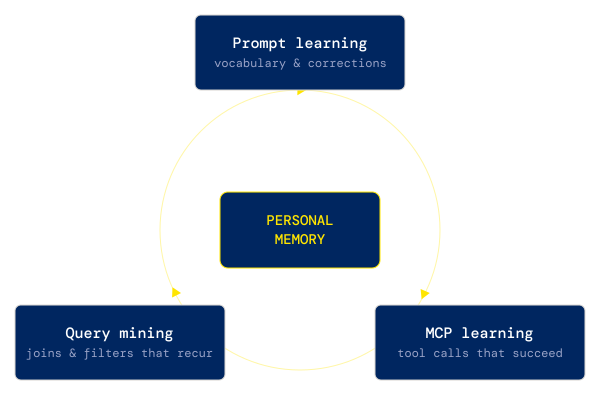
Personal memory becomes company knowledge
When several people log the same fact independently, it moves to shared company knowledge automatically.
Promoted knowledge is governed, not exposed by default—owners control what becomes shared.
A correction made once in support improves the finance agent too—the graph’s value grows with every team on it.
logged independently
check
& approves
knowledge
inherits it
Every agent inherits it next time
Promoted knowledge feeds the context graph, so the next request from any agent applies it—grounded against live data.
The graph lives in the gateway, not inside any one model—swap models and every agent keeps what it learned.
 on Claude
 on GPT
 on Gemini
The context layer decides
Two CData Labs studies, one conclusion: accuracy and cost are determined by the layer that connects AI to your systems, not by the model.
98.5%
correct through Connect AI
The difference is the context engine: Connect AI grounds every request in your schema and business context before it reaches the model. Based on internal testing by CData Software (Q4 2025). No independent third-party verification. Actual accuracy gaps varied among platforms and MCP approaches, testing conducted using sandbox accounts containing known data sets that mirror production account structures. Results may not be representative of performance in live production environments, and results may vary. Organizations should conduct their own independent testing before making purchasing or implementation decisions. 75% range of average accuracy across platforms, results differ by MCP approach.
Get the Report
178×
cost spread for the same correct answer
With context controlling accuracy, even inexpensive models return the correct answer—so model choice becomes a cost decision. Based on internal testing by CData Software (Q3 2026). No independent third-party verification. Actual cost gaps varied among models, testing conducted using sandbox accounts containing known data sets that mirror production account structures. Results may not be representative of performance in live production environments, and results may vary. Organizations should conduct their own independent testing before making purchasing or implementation decisions.
Get the Report
Database Administrator

FAQ
Questions teams ask
- How do you define context?
- How is this different from a semantic layer or a data catalog?
- Do you integrate with data catalogs and semantic layers?
- Do we have to define everything before we get value?
- Will it change our definitions without us knowing?
- Where does a human sit in the learning loop?
- What if a business term means different things in different systems?
- Can context span multiple systems?
- Does adding all this context slow things down or cost more tokens?
- Does this lock us into one AI assistant or model provider?
- Can we use a cheaper model if the context is good enough?
Give every agent or individual the context to be right
More trustworthy agents, consistently higher accuracy, and lower token spend, transferable across every LLM, MCP, semantic provider, and data platform.