



Access Live SAP SuccessFactors LMS Data in AWS Lambda

AWS Lambda is a compute service that lets you build applications that respond quickly to new information and events. AWS Lambda functions can work with live SAP SuccessFactors LMS data when paired with the CData JDBC Driver for SAP SuccessFactors LMS. This article describes how to connect to and query SAP SuccessFactors LMS data from an AWS Lambda function built in Eclipse.
At the time this article was written (June 2022), Eclipse version 2019-12 and Java 8 were the highest versions supported by the AWS Toolkit for Eclipse.
With built-in optimized data processing, the CData JDBC Driver offers unmatched performance for interacting with live SAP SuccessFactors LMS data. When you issue complex SQL queries to SAP SuccessFactors LMS, the driver pushes supported SQL operations, like filters and aggregations, directly to SAP SuccessFactors LMS and utilizes the embedded SQL engine to process unsupported operations client-side (often SQL functions and JOIN operations). In addition, its built-in dynamic metadata querying allows you to work with and analyze SAP SuccessFactors LMS data using native data types.
Gather Connection Properties and Build a Connection String
SAP SuccessFactors LMS uses OAuth authentication. Before connecting, you must configure an OAuth application tied to your SAP SuccessFactors LMS account.
To establish a connection, set the following properties:
- User: Your SAP SuccessFactors LMS username.
- CompanyId: Your SAP SuccessFactors company identifier.
- Url: The SAP SuccessFactors API URL (e.g., https://api4.successfactors.com).
- OAuthClientId: The client Id assigned when you registered your custom OAuth application.
- OAuthClientSecret: The client secret assigned when you registered your custom OAuth application.
See the Getting Started chapter of the help documentation for a guide to creating a custom OAuth app and using OAuth.
NOTE: To use the JDBC driver in an AWS Lambda function, you will need a license (full or trial) and a Runtime Key (RTK). For more information on obtaining this license (or a trial), contact our sales team.
Built-in Connection String Designer
For assistance constructing the JDBC URL, use the connection string designer built into the SAP SuccessFactors LMS JDBC Driver. Double-click the JAR file or execute the jar file from the command line.
java -jar cdata.jdbc.sapsuccessfactorslms.jar

Fill in the connection properties (including the RTK) and copy the connection string to the clipboard.
Create an AWS Lambda Function
- Download the CData JDBC Driver for SAP SuccessFactors LMS installer, unzip the package, and run the JAR file to install the driver.
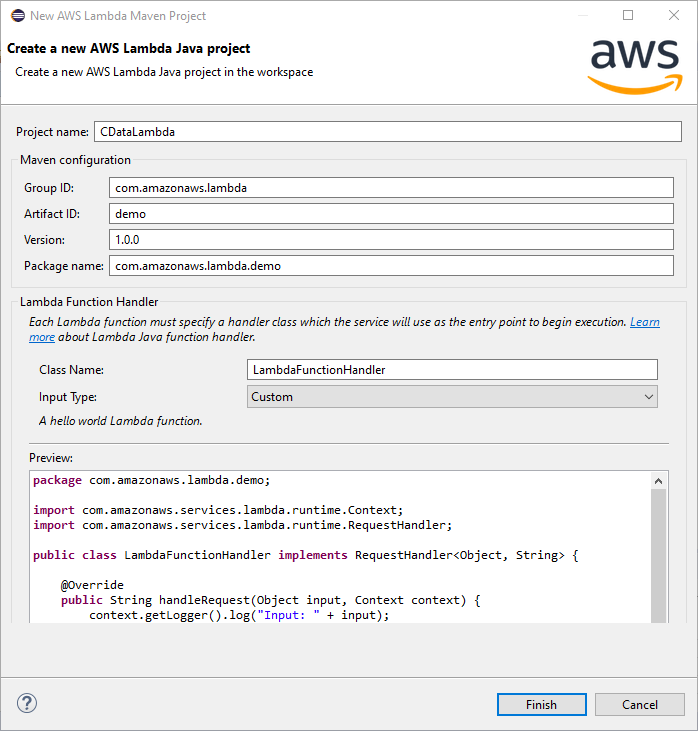
Create a new AWS Lambda Java Project in Eclipse using the AWS Toolkit for Eclipse. You can follow the tutorial from AWS (amazon.com).
For this article, set the Input Type for the project to "Custom" so we can enter a table name as the input.
- Add the CData JDBC Driver for SAP SuccessFactors LMS JAR file (cdata.jdbc.sapsuccessfactorslms.jar) to the build path. The file is found in INSTALL_PATH\lib\.
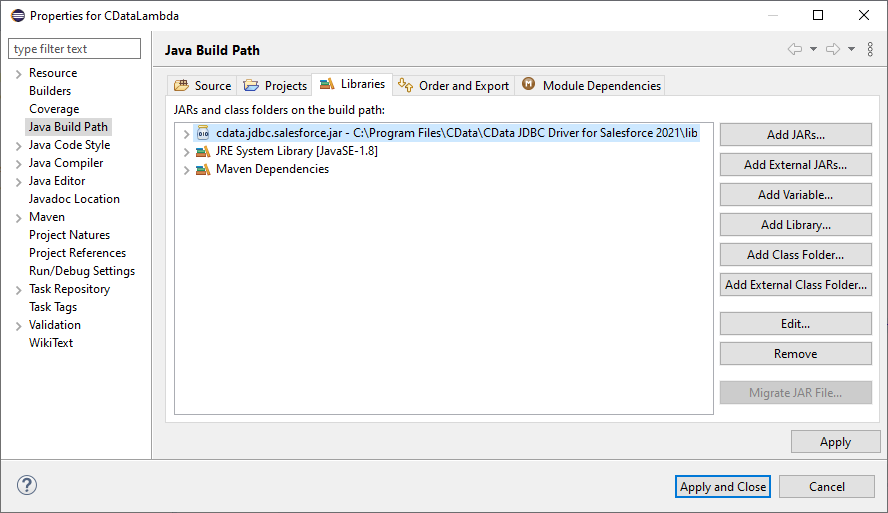
- Add the following import statements to the Java class:
import java.sql.Connection;
import java.sql.DriverManager;
import java.sql.ResultSet;
import java.sql.ResultSetMetaData;
import java.sql.SQLException;
import java.sql.Statement;
Replace the body of the handleRequest method with the code below. Be sure to fill in the connection string in the DriverManager.getConnection method call.
String query = "SELECT * FROM " + input;

try {
	Class.forName("cdata.jdbc.sapsuccessfactorslms.SAPSuccessFactorsLMSDriver");
} catch (ClassNotFoundException ex) {
	context.getLogger().log("Error: class not found");
}

Connection connection = null;

try {
	connection = DriverManager.getConnection("jdbc:cdata:sapsuccessfactorslms:RTK=52465...;User=username;CompanyId=CompanyId;Url=https://api4.successfactors.com;InitiateOAuth=GETANDREFRESH;");
} catch (SQLException ex) {
	context.getLogger().log("Error getting connection: " + ex.getMessage());
} catch (Exception ex) {
	context.getLogger().log("Error: " + ex.getMessage());
}

if(connection != null)
{
	context.getLogger().log("Connected Successfully!\n");
}

ResultSet resultSet = null;
try
{
	//executing query
	Statement stmt = connection.createStatement();
	resultSet = stmt.executeQuery(query);

	ResultSetMetaData metaData = resultSet.getMetaData();
	int numCols = metaData.getColumnCount();

	//printing the results
	while(resultSet.next())
	{
		for(int i = 1; i <= numCols; i++)
		{
			System.out.printf("%-25s", (resultSet.getObject(i) != null) ? resultSet.getObject(i).toString().replaceAll("\n", "") : null );
		}
		System.out.print("\n");
	}
}
catch (SQLException ex)
{
	System.out.println("SQL Exception: " + ex.getMessage());
}
catch (Exception ex)
{
	System.out.println("General exception: " + ex.getMessage());
}

String output = "query: " + query + " complete";
return output;
Deploy and Run the Lambda Function
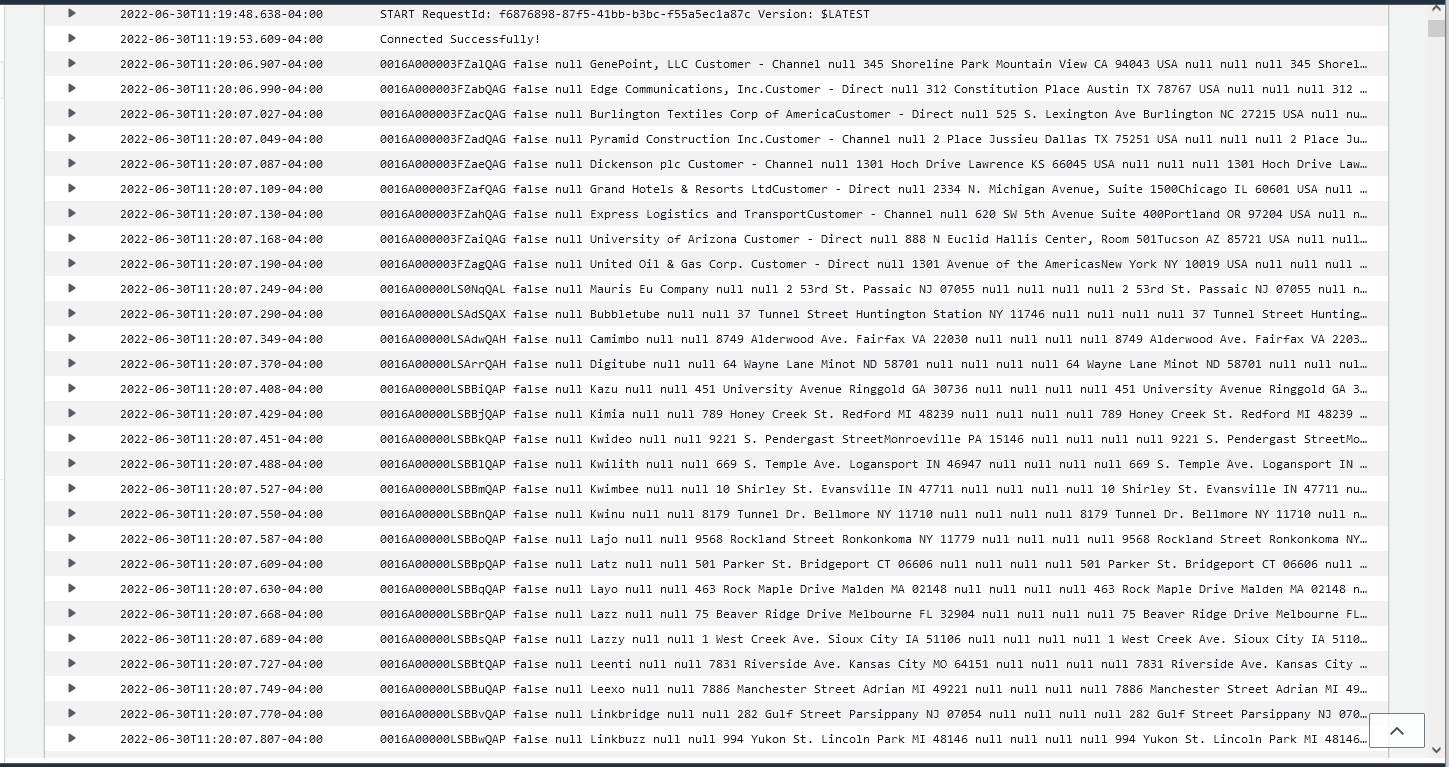
Once you build the function in Eclipse, you are ready to upload and run the function. In this article, the output is written to the AWS logs, but you can use this is a template to implement you own custom business logic to work with SAP SuccessFactors LMS data in AWS Lambda functions.
- Right-click the Package and select Amazon Web Services -> Upload function to AWS Lamba.
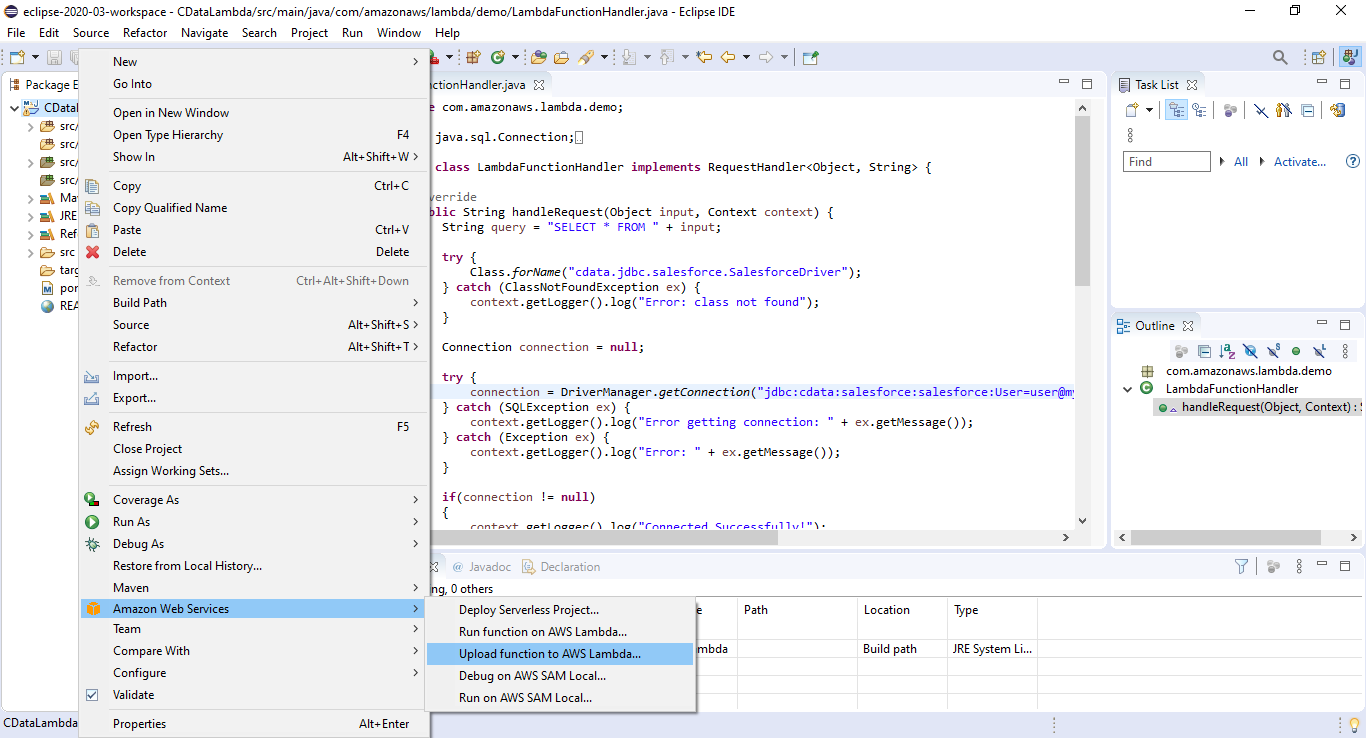
- Name the function, select an IAM role, and set the timeout value to a high enough value to ensure the function completes (depending on the result size of your query).
- Right-click the Package and select Amazon Web Services -> Run function on AWS Lambda and set the input to the name of the SAP SuccessFactors LMS object you wish to query (i.e. "Items").
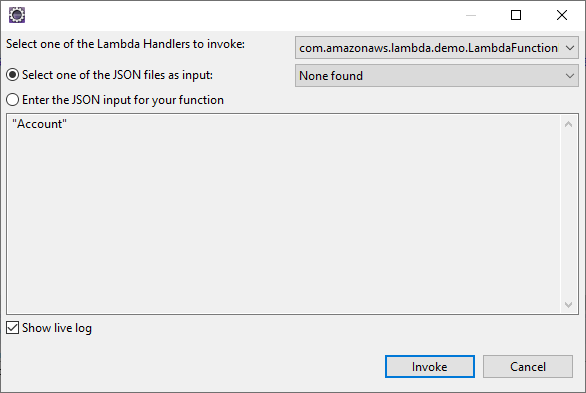
- After the job runs, you can view the output in the CloudWatch logs.
Free Trial & More Information
Download a free, 30-day trial of the CData JDBC Driver for SAP SuccessFactors LMS and start working with your live SAP SuccessFactors LMS data in AWS Lambda. Reach out to our Support Team if you have any questions.
Ready to get started?
Download a free trial of the SAP SuccessFactors LMS Driver to get started:
Download NowLearn more:
 SAP SuccessFactors LMS JDBC Driver
Rapidly create and deploy powerful Java applications that integrate with SAP SuccessFactors LMS.
