





Build Voice Agents in ElevenLabs with access to Live SingleStore Data

ElevenLabs is a leading AI audio platform that enables developers to build conversational voice agents capable of natural, human-like interactions. The ElevenLabs Conversational AI platform allows you to create voice-powered assistants that can reason through tasks, respond dynamically, and interact with external systems in real time.
By integrating ElevenLabs with CData Connect AI through the MCP (Model Context Protocol), your voice agents gain the ability to query, analyze, and act on live SingleStore data during conversations. This integration bridges ElevenLabs' conversational AI framework with the governed enterprise connectivity of CData Connect AI, ensuring all data access runs securely against authorized sources without manual data movement.
This article outlines the steps to configure SingleStore connectivity in Connect AI, generate the required authentication credentials, register the Connect AI MCP Server in ElevenLabs, and verify that your voice agent can successfully interact with live SingleStore data during conversations.
Step 1: Configure SingleStore connectivity for ElevenLabs
Connectivity to SingleStore from ElevenLabs is made possible through CData Connect AI's Remote MCP Server. To interact with SingleStore data from your voice agents, start by creating and configuring a SingleStore connection in CData Connect AI.
- Log into Connect AI, click Sources, and then click Add Connection
- Select SingleStore from the Add Connection panel
-
Enter the necessary authentication properties to connect to SingleStore.
The following connection properties are required in order to connect to data.
- Server: The host name or IP of the server hosting the SingleStore database.
- Port: The port of the server hosting the SingleStore database.
- Database (Optional): The default database to connect to when connecting to the SingleStore Server. If this is not set, tables from all databases will be returned.
Connect Using Standard Authentication
To authenticate using standard authentication, set the following:
- User: The user which will be used to authenticate with the SingleStore server.
- Password: The password which will be used to authenticate with the SingleStore server.
Connect Using Integrated Security
As an alternative to providing the standard username and password, you can set IntegratedSecurity to True to authenticate trusted users to the server via Windows Authentication.
Connect Using SSL Authentication
You can leverage SSL authentication to connect to SingleStore data via a secure session. Configure the following connection properties to connect to data:
- SSLClientCert: Set this to the name of the certificate store for the client certificate. Used in the case of 2-way SSL, where truststore and keystore are kept on both the client and server machines.
- SSLClientCertPassword: If a client certificate store is password-protected, set this value to the store's password.
- SSLClientCertSubject: The subject of the TLS/SSL client certificate. Used to locate the certificate in the store.
- SSLClientCertType: The certificate type of the client store.
- SSLServerCert: The certificate to be accepted from the server.
Connect Using SSH Authentication
Using SSH, you can securely login to a remote machine. To access SingleStore data via SSH, configure the following connection properties:
- SSHClientCert: Set this to the name of the certificate store for the client certificate.
- SSHClientCertPassword: If a client certificate store is password-protected, set this value to the store's password.
- SSHClientCertSubject: The subject of the TLS/SSL client certificate. Used to locate the certificate in the store.
- SSHClientCertType: The certificate type of the client store.
- SSHPassword: The password that you use to authenticate with the SSH server.
- SSHPort: The port used for SSH operations.
- SSHServer: The SSH authentication server you are trying to authenticate against.
- SSHServerFingerPrint: The SSH Server fingerprint used for verification of the host you are connecting to.
- SSHUser: Set this to the username that you use to authenticate with the SSH server.

- Click Save & Test
- Navigate to the Permissions tab and update user-based permissions



Add a Personal Access Token
A Personal Access Token (PAT) is used to authenticate the connection to Connect AI from ElevenLabs. It is best practice to create a separate PAT for each integration to maintain granular access control.
- Click the gear icon () at the top right of the Connect AI app to open Settings
- On the Settings page, go to the Access Tokens section and click Create PAT
- Give the PAT a descriptive name (e.g., "ElevenLabs Voice Agent") and click Create
- Copy the token when displayed and store it securely. It will not be shown again

With the SingleStore connection configured and a PAT generated, ElevenLabs can now connect to SingleStore data through Connect AI.
Step 2: Add the Connect AI MCP Server in ElevenLabs
ElevenLabs supports connecting to external MCP servers that use SSE (Server-Sent Events) or HTTP streamable transport. The CData Connect AI Remote MCP Server is compatible with this integration.
-
Log into the ElevenLabs platform and navigate to your agent dashboard
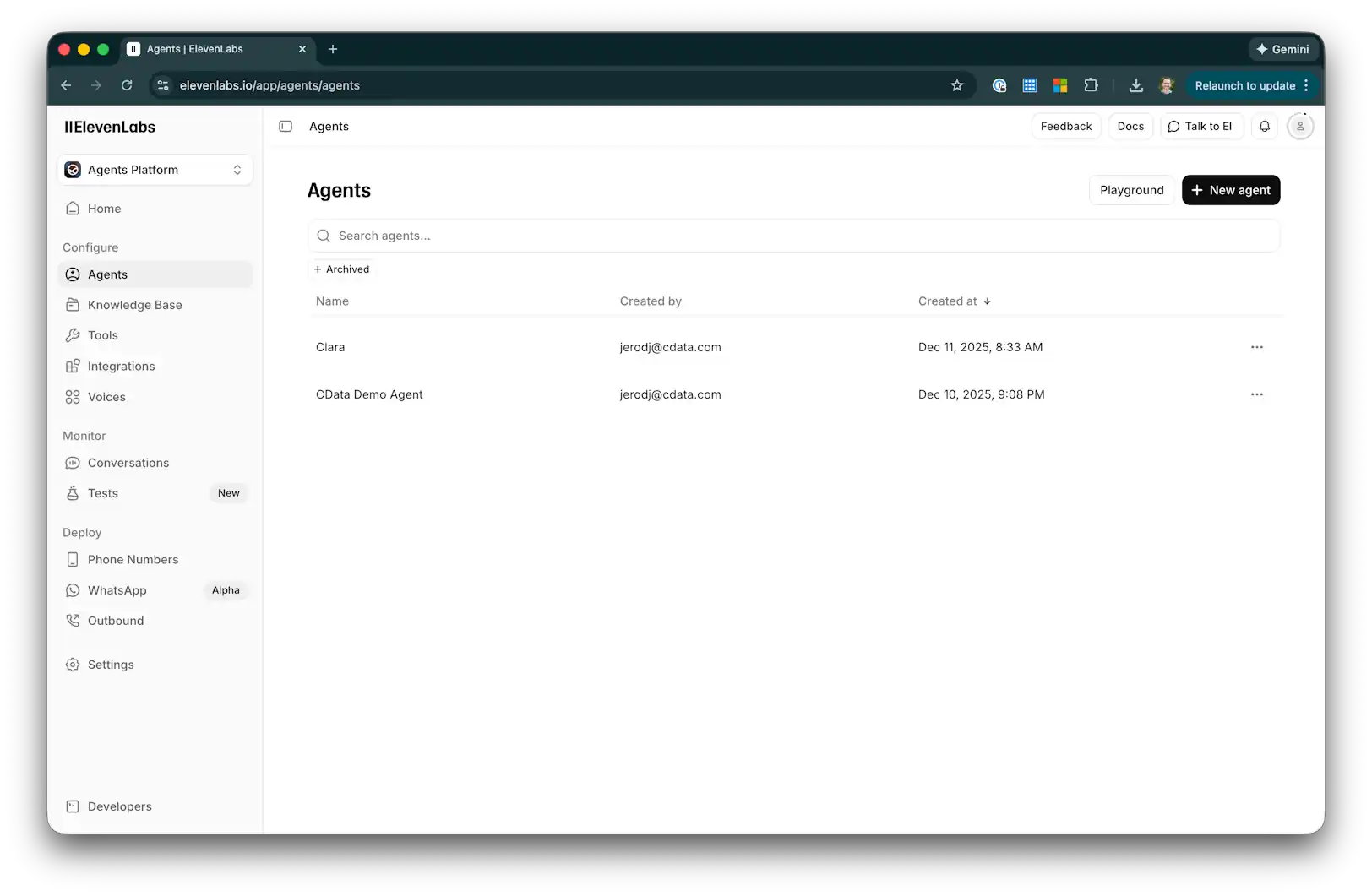
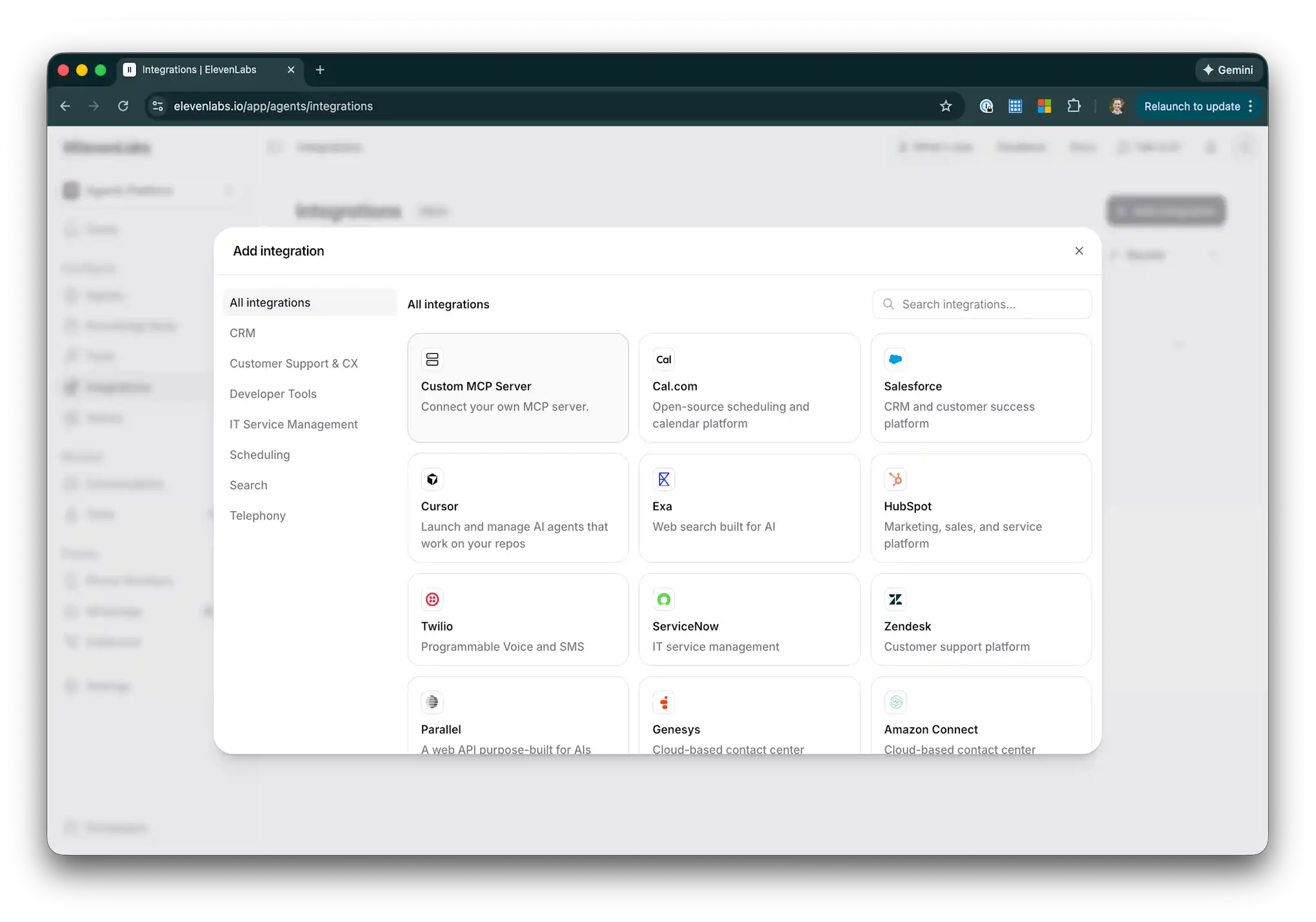
- Go to Integrations and click + Add Integration to access the MCP server integrations section
-
Click on Custom MCP Server to add a new integration
-
Enter the following configuration:
- Name: CData Connect AI
- Description: Access live enterprise data from 350+ sources
- Server URL: https://mcp.cloud.cdata.com/sse
- Secret Token: Leave empty (authentication is handled via headers)
- HTTP Headers: Add a header with key Authorization and value Basic your_email:your_PAT
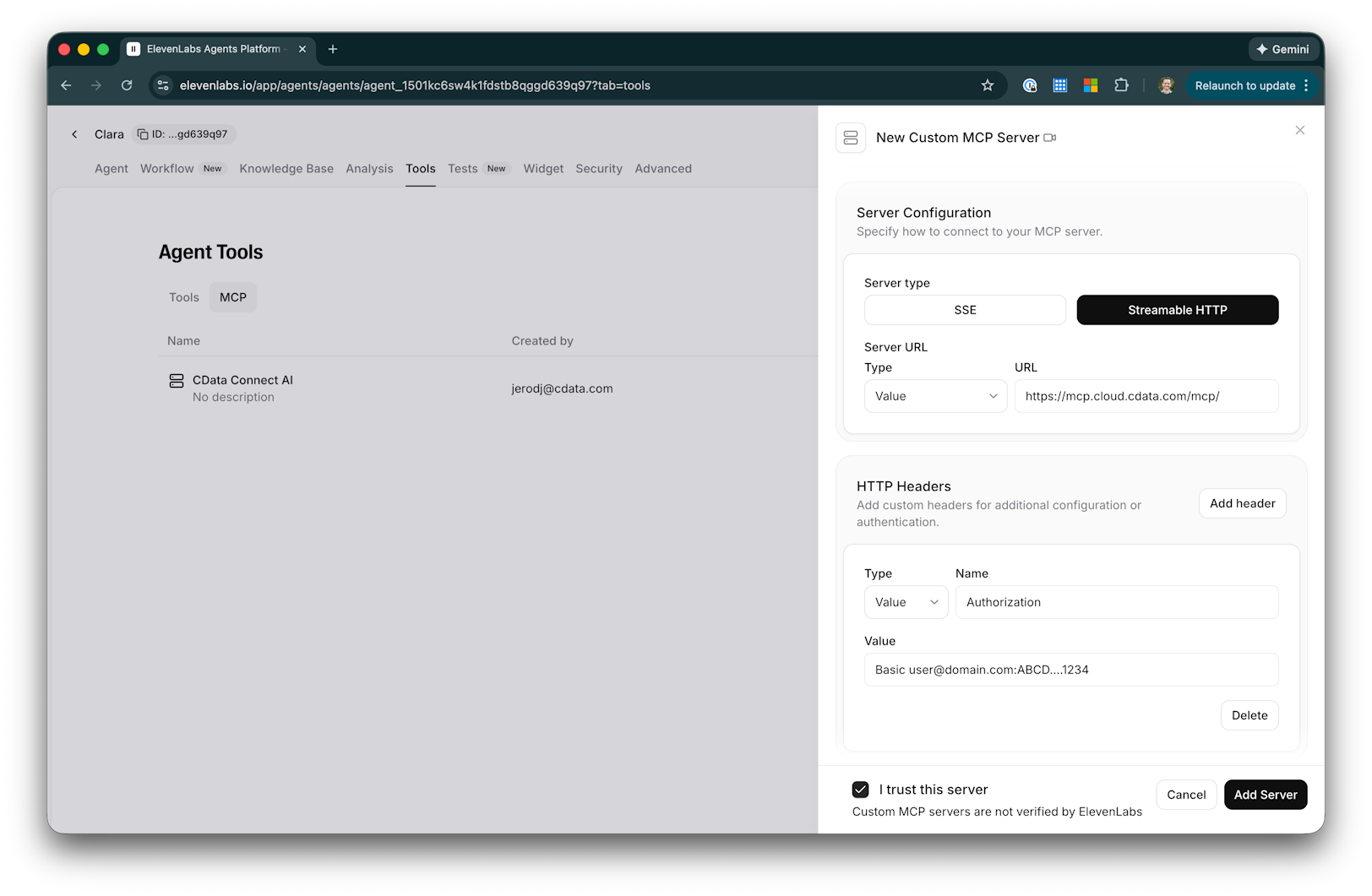
- Replace your_email:your_PAT with your Connect AI login email and the Personal Access Token you created earlier. For example: Basic [email protected]:ABC123...XYZ789
- Click Save to test the connection and retrieve available tools from Connect AI
- The CData Connect AI MCP server is now available to assign to your voice agents
Step 3: Configure your Voice Agent to use Connect AI
With the MCP server registered, you can now add it to your ElevenLabs voice agents to enable real-time data access during conversations.
- Create a new agent or edit an existing agent in the ElevenLabs dashboard
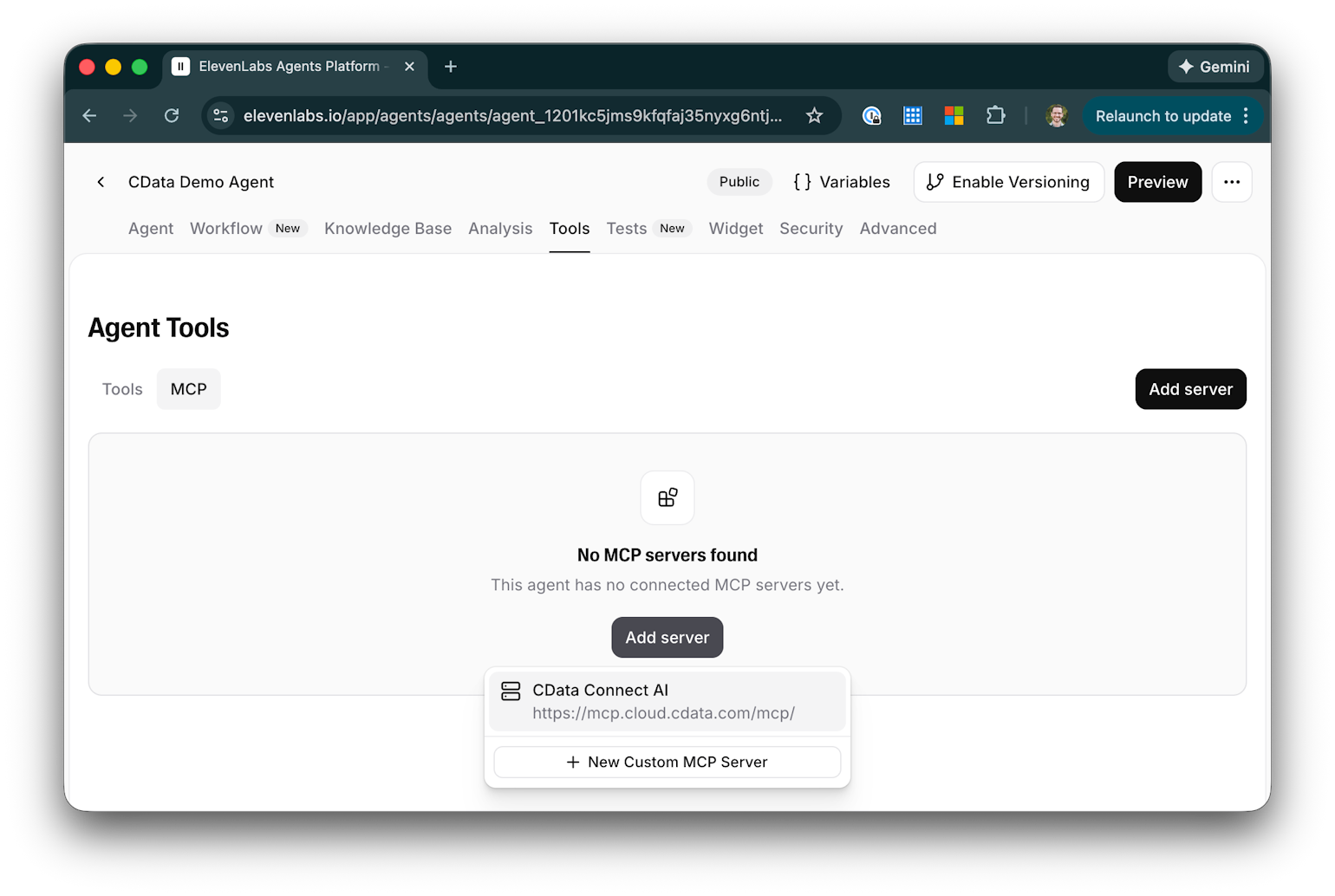
- In the agent configuration, navigate to the Tools section
-
Add the CData Connect AI MCP server you configured in Step 2
-
Configure the tool approval mode based on your requirements:
- Always Ask: The agent will request permission before each data query (recommended for sensitive data)
- Fine-Grained: Set approval requirements per tool/action
- No Approval: The agent can query data autonomously
- Save your agent configuration
Step 4: Interact with live data through your Voice Agent
Your ElevenLabs voice agent can now access and query live SingleStore data through the CData Connect AI MCP Server during conversations.
-
Start a conversation with your voice agent
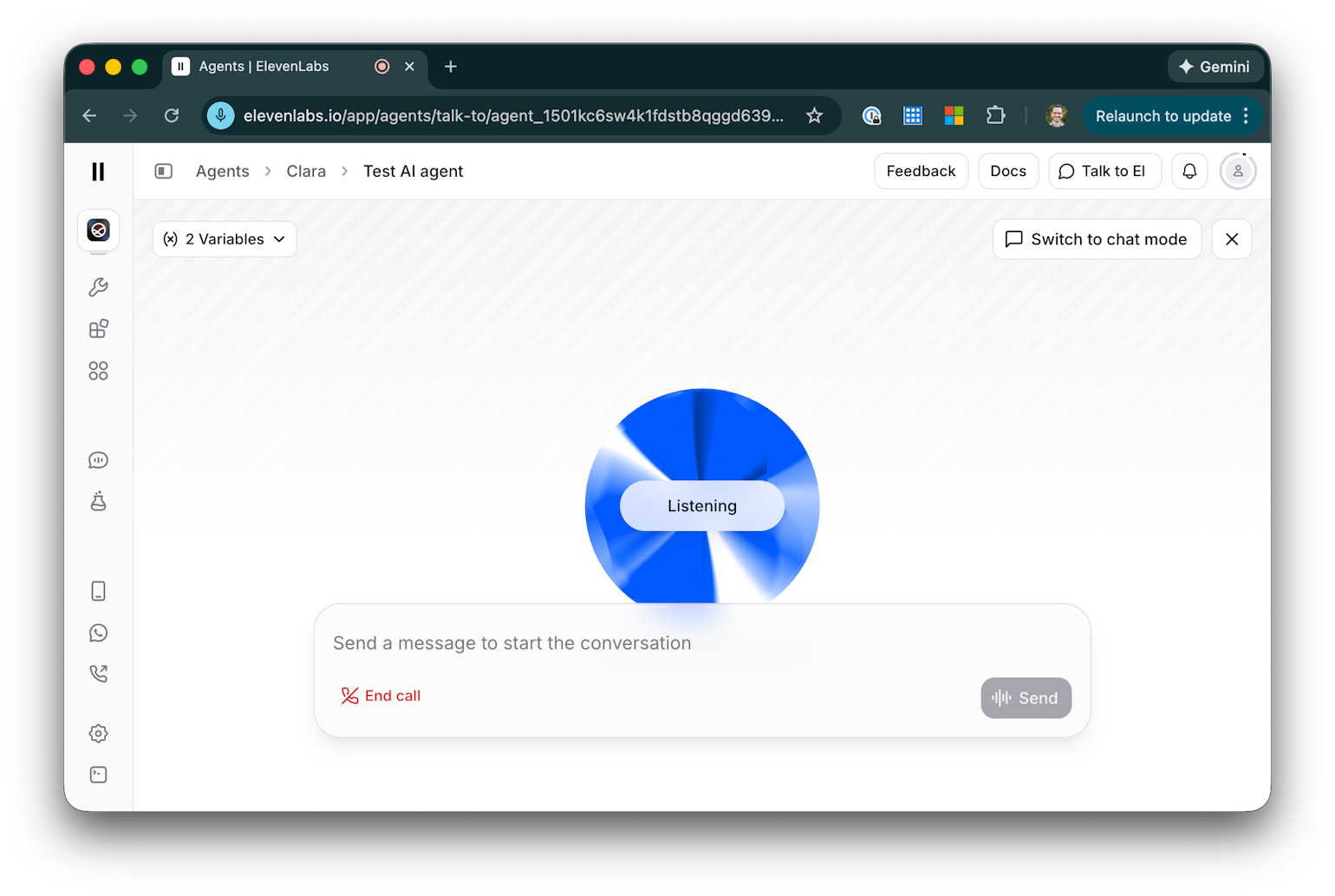
-
Ask your agent data-related questions such as:
- "What connections are available?"
- "Show me the schemas for SingleStore"
- "Query recent records from SingleStore data"
- "Summarize our latest Data"
-
The agent will use the Connect AI MCP tools to retrieve live data and respond conversationally
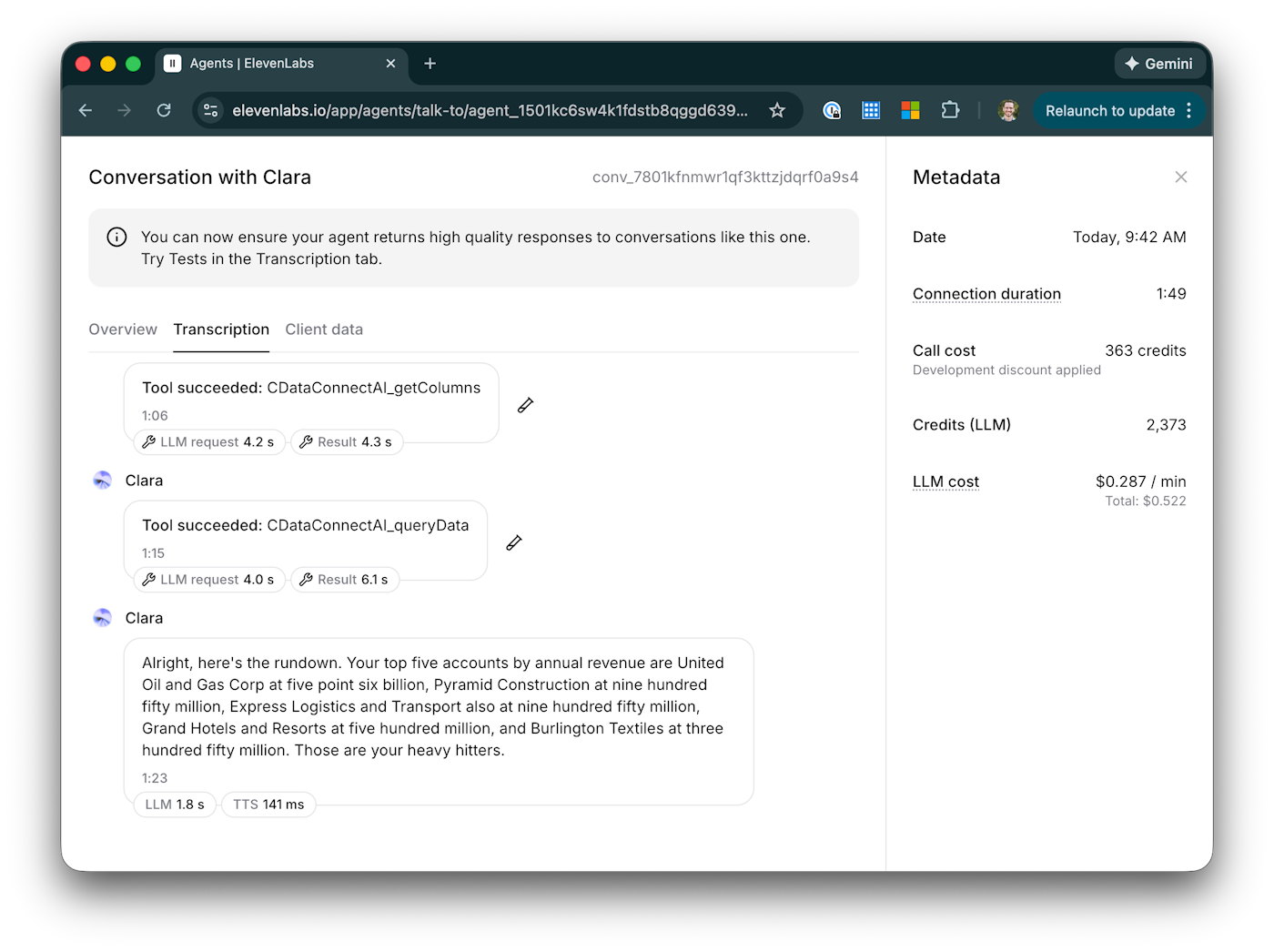
Your ElevenLabs voice agent is now fully configured to access and query live SingleStore data through the CData Connect AI Remote MCP Server, enabling real-time, data-driven voice interactions for your users.
Get CData Connect AI
To access 350+ SaaS, Big Data, and NoSQL sources through secure, AI-ready interfaces, try CData Connect AI today.