






Getting Started with the CData Tableau Connector for Teradata

This guide explains everything you need to get started with the CData Tableau Connector for Teradata. You'll learn how to install and license the connector, configure your first connection, and explore next steps for working with Teradata data in your applications.
This setup guide applies to Tableau Desktop, Tableau Prep, and Tableau Server environments.
Installation & Licensing
The CData Tableau Connector for Teradata enables Tableau Desktop, Tableau Prep, and Tableau Server to connect directly to live Teradata data. This section details installation prerequisites, platform support, connector deployment, and licensing requirements.
System Requirements
The connector is supported in environments where Tableau Desktop, Tableau Prep, or Tableau Server are available. The CData Tableau Connector for Teradata supports both Windows and macOS platforms.
Operating System Support
Windows
- Windows 10 (64-bit)
- Windows 11 (64-bit)
- Windows Server 2016, 2019, or 2022 (for Tableau Server deployments)
macOS
- macOS 10.14 or later
Tableau Components
- Tableau Desktop 2020.3 or later (for automatic installation); Tableau Desktop 2020.1 or later (with manual registration)
- Tableau Prep Builder 2020.4.1 or later
- Tableau Server 2020.1 or later
For older versions of Tableau, use the CData ODBC Driver or JDBC Driver for Teradata instead.
Software Dependencies
- Java Runtime Environment (JRE) - an up-to-date version of Java is required
Installing the Tableau Connector
Windows
- Download the CData Tableau Connector for Teradata.
- Run the installer and follow the installation wizard.
- The installer deploys the connector to the default installation directory: C:\Program Files\CData\CData Tableau Connector for Teradata 20XX.
- If you have Tableau Desktop 2020.3 or later, the setup automatically installs the connector into your personal Tableau repository.
- Once the installation is complete, click Finish.
Note: If you are using Tableau Prep or an earlier version of Tableau Desktop (before 2020.3), the setup will not detect your Tableau installation, and you will need to register the connector manually (see Manual Registration below).
macOS
- Download the CData Tableau Connector for Teradata.
- Run the installer package and follow the installation wizard.
- The installer deploys the connector to: /Applications/CData Tableau Connector for Teradata 20XX.
- If you have Tableau Desktop 2020.3 or later, the setup automatically installs the connector into your personal Tableau repository.
- Once the installation is complete, click Finish.
Manual Registration (Tableau Desktop or Tableau Prep)
If automatic registration did not occur, follow these steps:
- Find the connector install directory:
- Windows: C:\Program Files\CData\CData Tableau Connector for Teradata 20XX
- macOS: /Applications/CData Tableau Connector for Teradata 20XX
- Find your Tableau repository:
- Windows: Documents\My Tableau Repository (or "My Tableau Prep Repository" for Prep)
- macOS: /Users/[username]/Documents/My Tableau Repository
- Open the connector install directory and navigate to the lib folder.
- Copy cdata.teradata.legacy.taco into the Connectors directory within your Tableau repository.
Note: As of Tableau Prep 21.2 and above versions, standard .taco files are supported instead of legacy .taco files.
Activating Your License
The CData Tableau Connector for Teradata uses file-based licensing rather than license key activation. The license file is included in the installation package.
If not, you should have received your license key via email from the CData Orders Team. The license key looks like this: XXXX-XXXX-XXXX-XXXX-XXXX
Licensing Steps
- Navigate to the lib folder in your connector installation directory:
- Windows: C:\Program Files\CData\CData Tableau Connector for Teradata 20XX\lib
- macOS: /Applications/CData Tableau Connector for Teradata 20XX/lib
- Locate the license file: cdata.tableau.teradata.lic
- Place the .lic file in the same folder as the connector's JAR file (cdata.tableau.teradata.jar).
The automatic install process attempts to register both the driver JAR and the license file. The JAR file is copied to one of these locations:
- Windows: C:\Users[username]\My Tableau Repository\Drivers
- macOS: /Users/[username]/Documents/My Tableau Repository/Drivers
Note: If you are running a trial, the trial license file is included with the installer. No additional activation steps are required.
Deploying to Tableau Server
Windows
- Install the CData Tableau Connector for Teradata on the Tableau Server machine.
- Locate the connector file: cdata.teradata.taco
- Copy the .taco file to the Tableau Server connectors directory: [TableauServerRoot]\data absvc\vizqlserver\Connectors
- In most cases, TableauServerRoot is located under "C:\ProgramData"
- Ensure the JAR file (cdata.tableau.teradata.jar) and license file (cdata.tableau.teradata.lic) are in the Tableau Server drivers directory.
- Restart Tableau Server.
Linux
- Unpack the setup.zip archive. Creating a directory such as "/opt/cdata/.teradata" is recommended.
- Navigate to the lib subdirectory under the install directory.
- Generate a license file by running the licensing tool and following the prompts:
java -jar cdata.tableau.teradata.jar -l
- Copy cdata.tableau.teradata.jar and cdata.tableau.teradata.lic into the drivers directory: /opt/tableau/tableau_driver/jdbc
- Copy cdata.teradata.taco into the connectors directory: /var/opt/tableau/tableau_server/data/tabsvc/vizqlserver/Connectors
- Restart Tableau Server.
Note: If you cannot execute the java command, you will need to install a Java Runtime Environment (JRE).
Common Licensing Questions
Can I use my license on multiple machines?
Yes, depending on your subscription tier. Check your order confirmation or contact your account representative for details. If you are unsure of who your account representative is, contact [email protected].
I lost my license key. How do I retrieve it?
Email [email protected] with your order number, and we'll resend your license key.
Can I transfer my license to a different machine?
Yes. When transferring the license to a different machine, you will need to submit a License Transfer Request on our site linked below:
https://www.cdata.com/lic/transfer/
After the License Transfer Request is submitted and successfully processed, an activation will be added to your Product Key, and you will be able to activate the full license on the other machine. Once this process is finished, the license on the previous machine will be invalid.
For additional licensing questions, contact [email protected]. Viewing and upgrading your license can now be done through our self-service portal at portal.cdata.com.
Connection Configuration
After installing the connector, you can connect and create a Data Source for Teradata data.
Complete the following steps to connect to the data:
- Open Tableau Desktop.
- Under Connect | To a Server, click More...
- Select the data source called Teradata by CData.
- Enter the information required for the connection.
- Click Sign In.
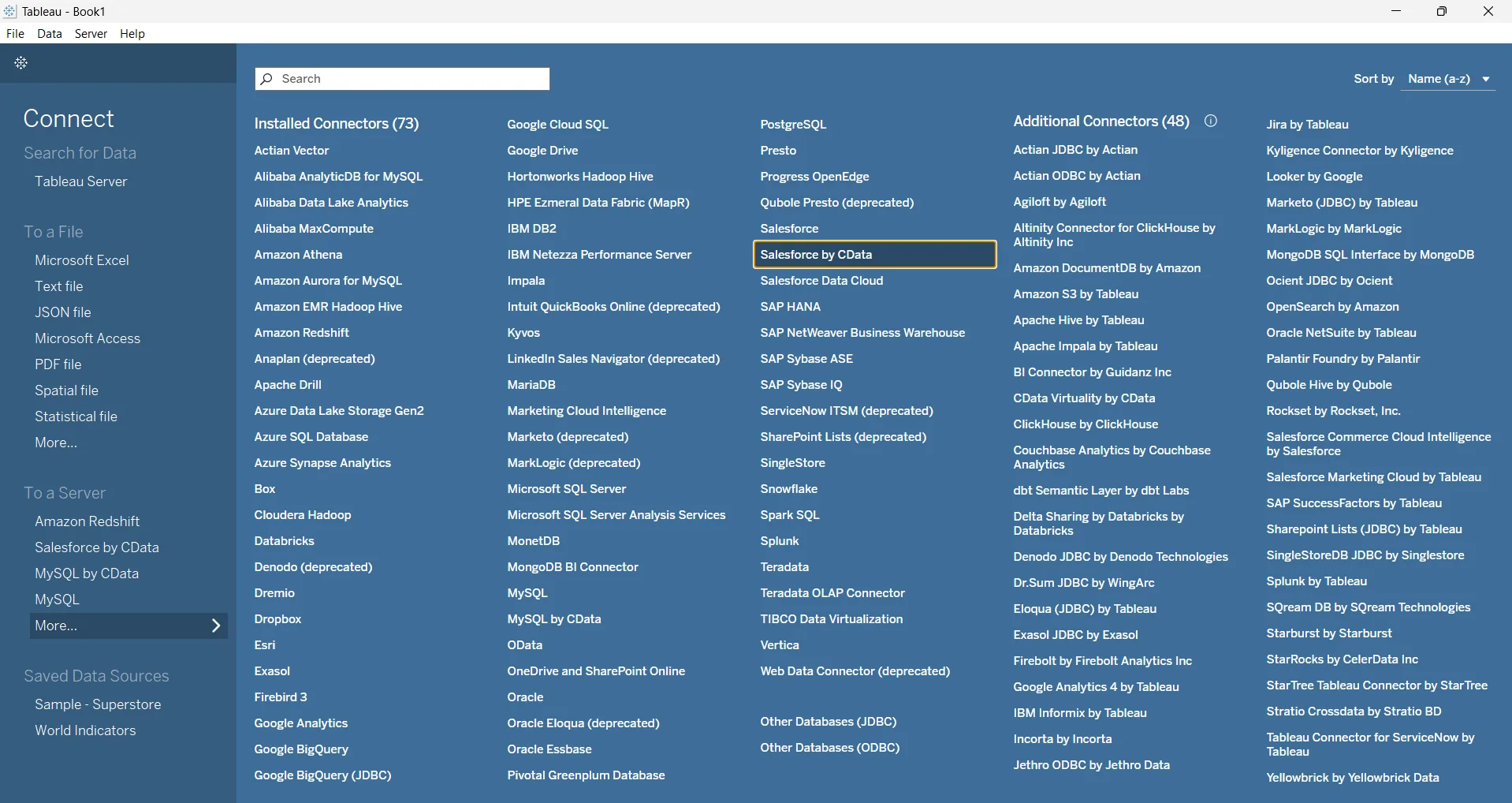
The connector makes the most common connection properties available directly in Tableau. However, if you need to use more advanced settings or troubleshoot connection issues, the connector includes a separate connection builder that allows you to create and test connections outside of Tableau.
There are two ways to access the connection builder:
- On Windows, use a shortcut called Connection Builder in the Start menu, under the "CData Tableau Connector for Teradata" folder.
- Navigate to the driver install directory (by default, C:/Program Files/CData/CData Tableau Connector for Teradata) and run the .jar file in the lib directory.
In the connection builder, you can set values for connection properties and click Test Connection to validate that they work. You can also use the Copy to Clipboard button to save the connection string. This connection string can be given to the Connection String option included in the connector connection window in Tableau.
Configuring Connection Properties
To connect to Teradata, provide authentication information and specify the database server name.
- User: Set this to the username of a Teradata user.
- Password: Set this to the password of the Teradata user.
- DataSource: Specify the Teradata server name, DBC Name, or TDPID.
- Port: Specify the port the server is running on.
- Database: Specify the database name. If not specified, the default database is used.
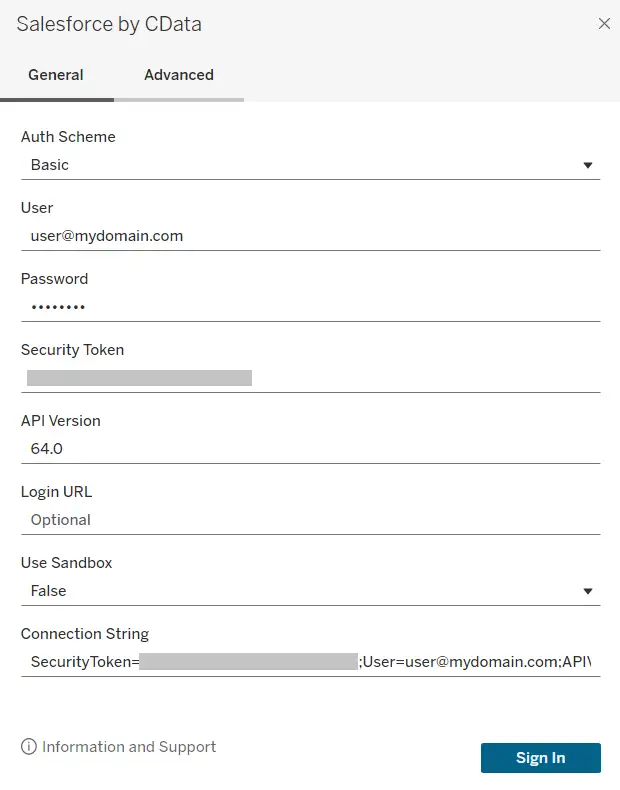
Getting Teradata Data in Tableau Desktop or Tableau Prep Builder
Once you establish the connection to Teradata data, you can configure which entities to visualize:
- Drag the tables and views you wish to visualize onto the join area. You can include multiple tables.
- Select Update Now or Automatically Update:
- Update Now lets you preview the first 10,000 rows of the data source (or enter the number of rows you want to see in the Rows text box).
- Automatically Update automatically reflects the changes in the preview area.
Creating Visualizations in Tableau Desktop
With the data source configured, you are ready to create visualizations:
- Click the tab for your worksheet.
- Columns are listed as Dimensions and Measures, depending on the data type. The CData Tableau Connector discovers data types automatically, allowing you to leverage the powerful data processing and visualization features of Tableau.
- Drag a field from the Dimensions or Measures area to Rows or Columns. Tableau creates column or row headers.
- Select one of the chart types from the Show Me tab.
- Tableau displays the chart type that you selected.
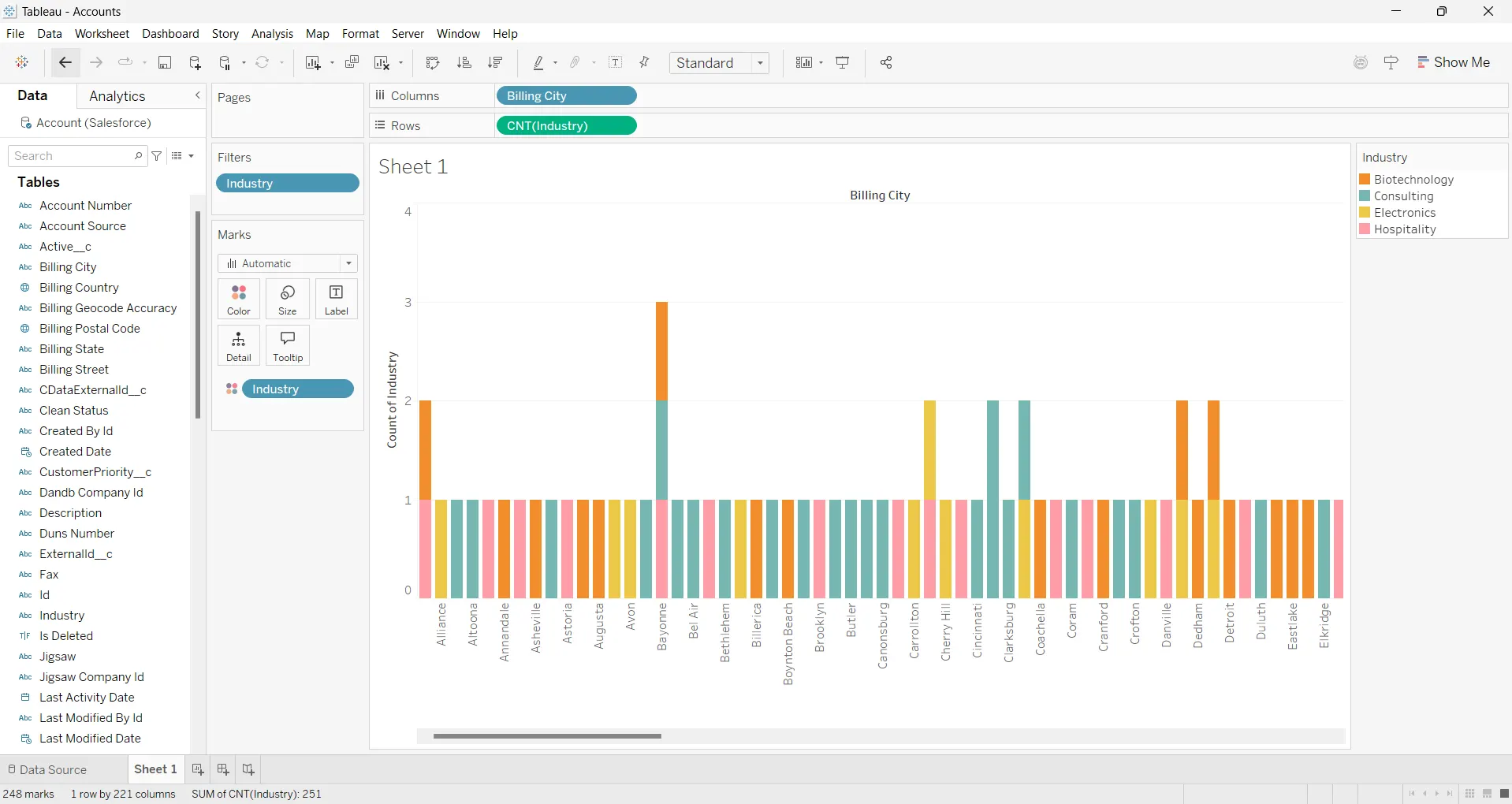
You can also use Custom SQL queries to further customize the exact Teradata data pulled. Click New Custom SQL in the data source pane and enter your SQL query to retrieve specific data from Teradata.
Preparing Data in Tableau Prep Builder
With the CData Tableau Connector for Teradata installed, you can build data preparation flows in Tableau Prep Builder:
- Open Tableau Prep Builder and click Connect to Data.
- Search for Teradata by CData in the connector list.
- Configure the connection by entering your authentication credentials and click Sign In. The connector supports Login, OAuth, and SSO authentication methods.
- Once connected, drag tables from the Connections pane to the flow canvas to add them as input steps.
- Use Tableau Prep's built-in tools to clean, shape, and transform your Teradata data by adding steps for filters, calculated fields, aggregations, pivots, or joins.
- Add an Output step to save your prepared data as a hyper extract, published data source, or CSV file.
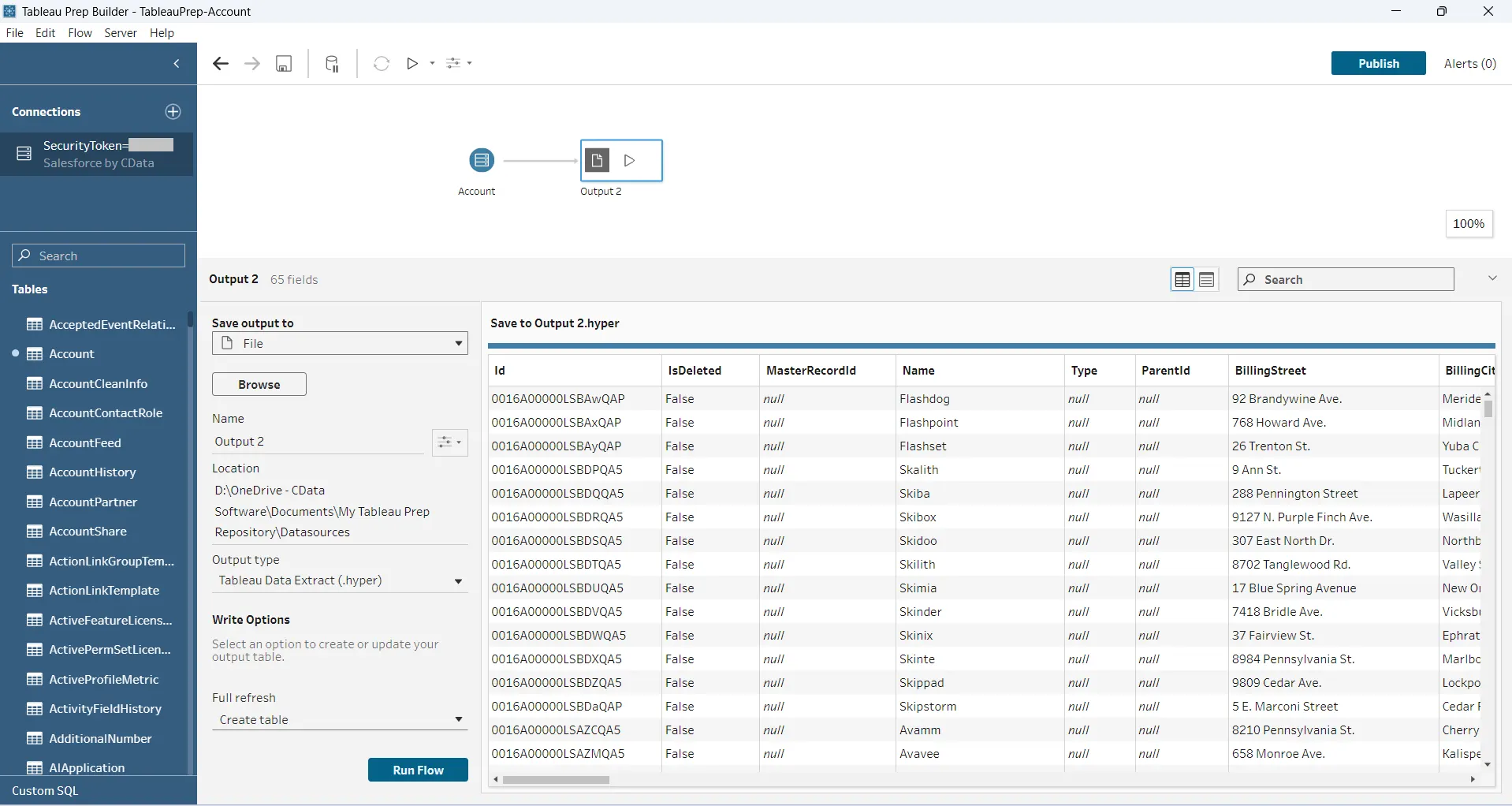
Tableau Prep Builder allows you to join, cleanse, filter, and aggregate Teradata data into reusable, repeatable flows. You can also use Custom SQL queries to define the exact Teradata data pulled into your flow by clicking New Custom SQL when adding an input step.
Common Connection Issues
Authentication Failed
Solution: Verify your credentials are current. For OAuth authentication, you may need to re-authorize CData in your Teradata Connected Apps settings. If using Basic authentication, ensure your Security Token is valid; tokens must be reset when passwords change. Contact [email protected] for authorization assistance.
Cannot Reach Server
Solution: Check firewall and proxy settings. Ensure outbound HTTPS (port 443) access to Teradata endpoints is allowed. You can configure proxy settings using the ProxyServer, ProxyPort, and ProxyUser connection properties. Contact [email protected] for specific port requirements.
Connector Not Appearing in Tableau
Solution: Ensure the TACO file is properly installed. For Tableau Desktop 2020.3+, the installer should automatically place it in your "My Tableau Repository/Connectors" folder. For manual installation, copy "cdata.teradata.legacy.taco" from the connector's lib directory to your Tableau Connectors folder. Restart Tableau after installation.
For additional connection troubleshooting, contact [email protected] with your specific error message.
What's Next
Now that you have installed, licensed, and configured the connector, here are some scenarios you can use to explore our Tableau Connectors:
| Tableau | Article Title |
|---|---|
| Tableau | Visualize Teradata in Tableau Desktop |
| Tableau Server | Publish Teradata-Connected Dashboards in Tableau Server |
Installation & Licensing
Do I need administrator rights to install the connector?
Yes. Administrator rights are required to install the CData Tableau Connector, as the installer writes to system directories and registers the required components.
Is the connector available for both Windows and Mac?
Yes. The CData Tableau Connector for Teradata is available for both Windows and macOS platforms. The connector appears directly in Tableau's native connector gallery for streamlined access to your Teradata data.
What versions of Tableau are supported?
The CData Tableau Connectors require Tableau Desktop 2020.3 or later and Tableau Prep Builder 2020.4.1 or later. For older versions of Tableau, use the CData ODBC Driver or JDBC Driver for Teradata instead.
Where do I place the license file?
Place the bundled .lic file (cdata.tableau.teradata.lic from the lib folder of the installation directory) in the same folder as the connector's JAR file.
Get Support
If you need assistance at any point:
- Technical Support: [email protected]
- Community Forum: CData Community Site
- Help Documentation: Installed locally and available online
Connecting
Can I use the Connection Builder to test my connection?
Yes. The connector includes a separate Connection Builder tool that allows you to create and test connections outside of Tableau. Access it via the Start menu shortcut (Windows) or by running the .jar file in the connector's lib directory. Use the Test Connection button to validate your settings.
How do I connect to multiple Teradata accounts?
Create separate data sources in Tableau, each configured with different Teradata credentials. When using OAuth, each connection will prompt for authentication with the respective Teradata account. Each data source stores its own connection settings independently.
Can I connect through a proxy server?
Yes. Proxy settings can be configured using the following connection properties:
- ProxyServer: The hostname or IP address of your proxy server
- ProxyPort: The TCP port of your proxy server
- ProxyUser and ProxyPassword: Authentication credentials if required
- ProxyAuthScheme: The authentication scheme (BASIC, DIGEST, NTLM, etc.)
By default, the connector uses the system proxy. Set ProxyAutoDetect to false to use a different proxy. For SOCKS proxies, use FirewallServer, FirewallPort, and set FirewallType to SOCKS5.
Refer to the Firewall & Proxy section of the documentation for required properties and supported proxy scenarios.
Performance & Troubleshooting
Why are my queries slow?
Check the following:
- Use Extract mode if you are working with large datasets or performing heavy transformations. Extract mode caches data locally and reduces the number of live API calls.
- Use Live Connection only when real-time data is required, as it sends every query to Teradata in real time.
- Apply filters in Tableau to reduce the size of the dataset before loading.
- Avoid selecting all columns if only a subset is needed - drag only the required tables/fields.
- Monitor Teradata API limits, which can throttle performance.
- Enable ServerSideAggregation to push aggregation operations to Teradata servers.
Contact [email protected] for help with query optimization and best practices.
How do I enable logging for troubleshooting?
Logging can be enabled through the connector's connection properties in the Connection Builder or directly in Tableau.
Set the following properties:
- Logfile: A filepath that designates the name and location of the log file (e.g., C:\logs[rootadoname|tolower].log)
- Verbosity: A numerical value (1-5) that determines the amount of detail in the log
- MaxLogFileSize: Maximum log file size (default is 100 MB)
- MaxLogFileCount: Maximum number of log files to retain
Verbosity Levels:
- 1 - Errors only (recommended for normal operation)
- 2 - Warnings and errors
- 3 - Informational messages, including full request/response bodies
- 4-5 - Debug-level detail, including binary transfer data
Note: Verbosity should not be set to greater than 1 for normal operation. Higher verbosity levels log substantial amounts of data and may delay execution times. Verbosity 3 and above may capture sensitive information.
Be prepared to upload the log file when contacting [email protected] for analysis.
What ports does the connector need access to?
Most Teradata connections require outbound HTTPS (port 443) access. Ensure your firewall allows outbound secure traffic to Teradata endpoints.
For environments using proxies or additional security layers, consult the Firewall & Proxy section of the connector documentation.
Can I use the connector in a Linux container or Docker?
Yes, with some considerations. The CData Tableau Connector for Teradata can be used on Linux for Tableau Server deployments.
For Tableau Server on Linux:
- Copy the connector files to "/opt/tableau/connectors" or "/var/opt/tableau_server/data/tabsvc/vizqlserver/Connectors/".
- Generate a license file by running the licensing tool in the lib subdirectory.
- Restart Tableau Server.
Note: Tableau Desktop runs only on Windows and macOS. For Tableau Cloud connectivity, use CData Connect Cloud.
General
Where can I find the complete list of supported SQL operations?
Refer to the SQL Compliance section of the Teradata connector documentation. The connector supports comprehensive ANSI-92 SQL including filtering, GROUP BY, JOINs, and aggregations. The connector pushes supported SQL operations directly to Teradata and uses an embedded SQL engine for client-side processing of unsupported operations.
What's the difference between Live Connection and Extract in Tableau?
Live Connection: Queries Teradata in real-time for every interaction. Best for dashboards requiring up-to-the-second data accuracy. It may be slower for large datasets due to API calls.
Extract: Creates a local snapshot of the data in Tableau's high-performance data engine. Best for large datasets, complex calculations, or when working offline. Schedule refreshes to keep data current. Reduces API calls and improves performance.
How often is the connector updated?
CData releases major updates to the Tableau Connector annually, with periodic maintenance updates as needed. Check your CData Account Portal or contact [email protected] for the latest version.
Can I use Custom SQL in Tableau with this connector?
Yes. You can use Custom SQL queries to further customize the exact Teradata data pulled. Click New Custom SQL in the data source pane and enter your SQL query. The connector supports standard SQL syntax and will translate queries to retrieve data from Teradata.
For questions not covered in this FAQ, contact [email protected].
Ready to get started?
Download a free trial of the Teradata Tableau Connector to get started:
Download NowLearn more:
 Teradata Tableau Connector
The fastest and easiest way to connect Tableau to Teradata data. Includes comprehensive high-performance data access, real-time integration, extensive metadata discovery, and robust SQL-92 support.
