




Give agents the right sized toolkit
CData gives AI agents a compact, tailored action set—cutting token costs up to 95% and ensuring reliable behaviors.










Fit Check
Built to support any AI stack
A compact action layer that plugs into the AI platforms, tool types, and deployment models your teams already use.
Claude • ChatGPT • Copilot Studio • Gemini CLI • LangChain • n8n • LangGraph • crewAI • LlamaIndex • Cursor • Windsurf • Databricks Agent Bricks • Mistral Le Chat
Universal tools • Custom tools • Source tools • Toolkits
Cloud • Hybrid
Read • Write • Update • Delete • Aggregate • Bulk operate • Inspect metadata
The Problem
Too many tools make agents worse, not better.
Exposing every API endpoint as a separate tool forces agents to reason over thousands of actions—driving up latency, cost, and unpredictability.
Without boundaries between what an agent should do and what it could do, simple deployments become security and compliance concerns.
Every API or schema change creates maintenance work. More custom tools means more surface area to break.
How It Works
A compact action layer across every connected system.
One managed MCP endpoint, a right-sized universal toolset, and scoped custom tools—leveraged across every supported AI platform
Agent connects to CData through a single MCP endpoint that can cover all connected systems.
Agent reasons over a compact set of universal tools instead of thousands of endpoint-specific actions.
Where tighter scope is required, custom tools define exactly what the agent can do, including built-in logic and access boundaries.
Source tools map directly to approved system actions for predictable execution in production.
Toolkits package the right tools for each agent use case and deploy as dedicated MCP servers.
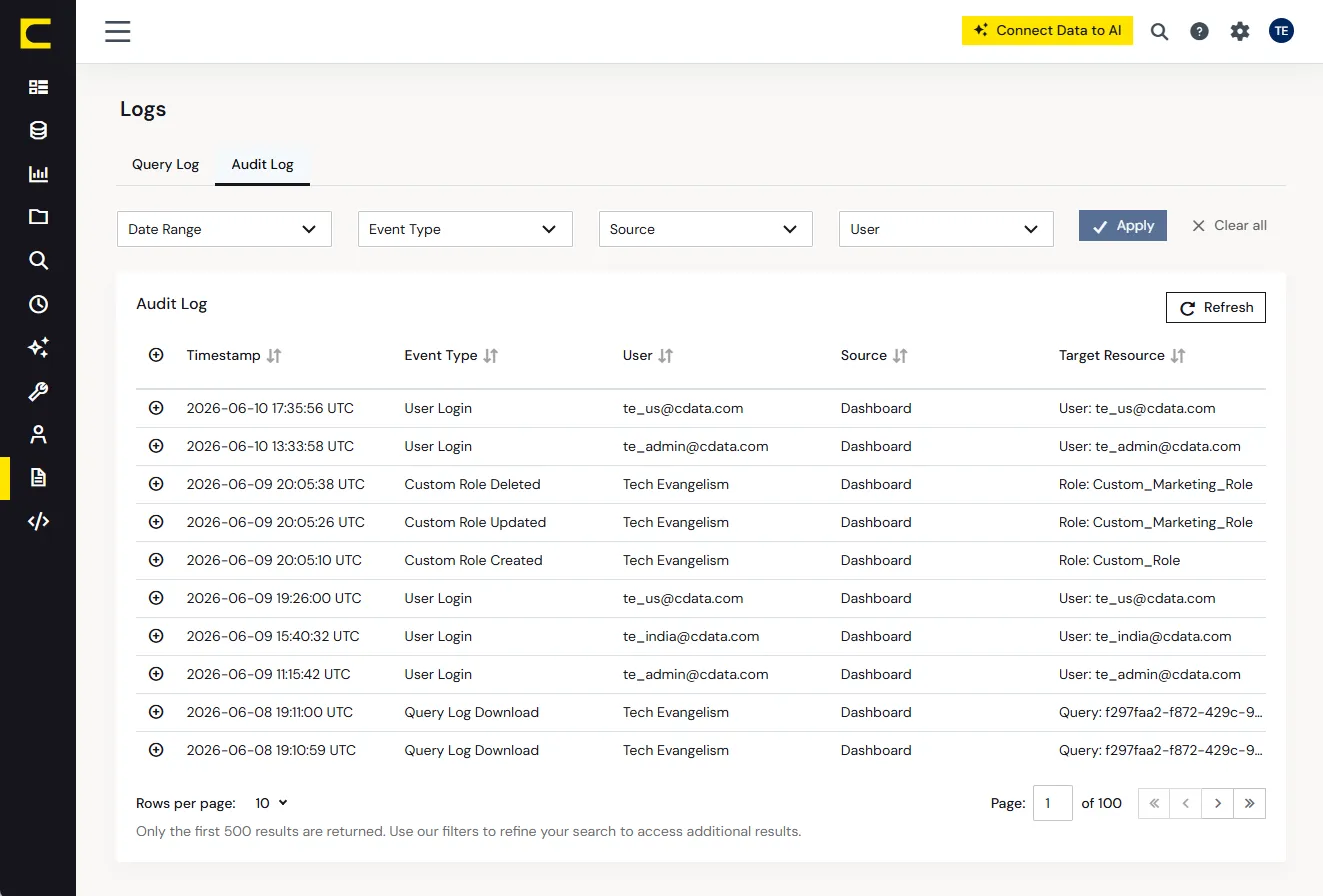
Every tool call is logged with full metadata for review, debugging, and governance.
Fewer tools. Tighter scope. Predictable agents.
Key Capabilities
Compact tooling, tighter scope, and more reliable execution.
Universal tools
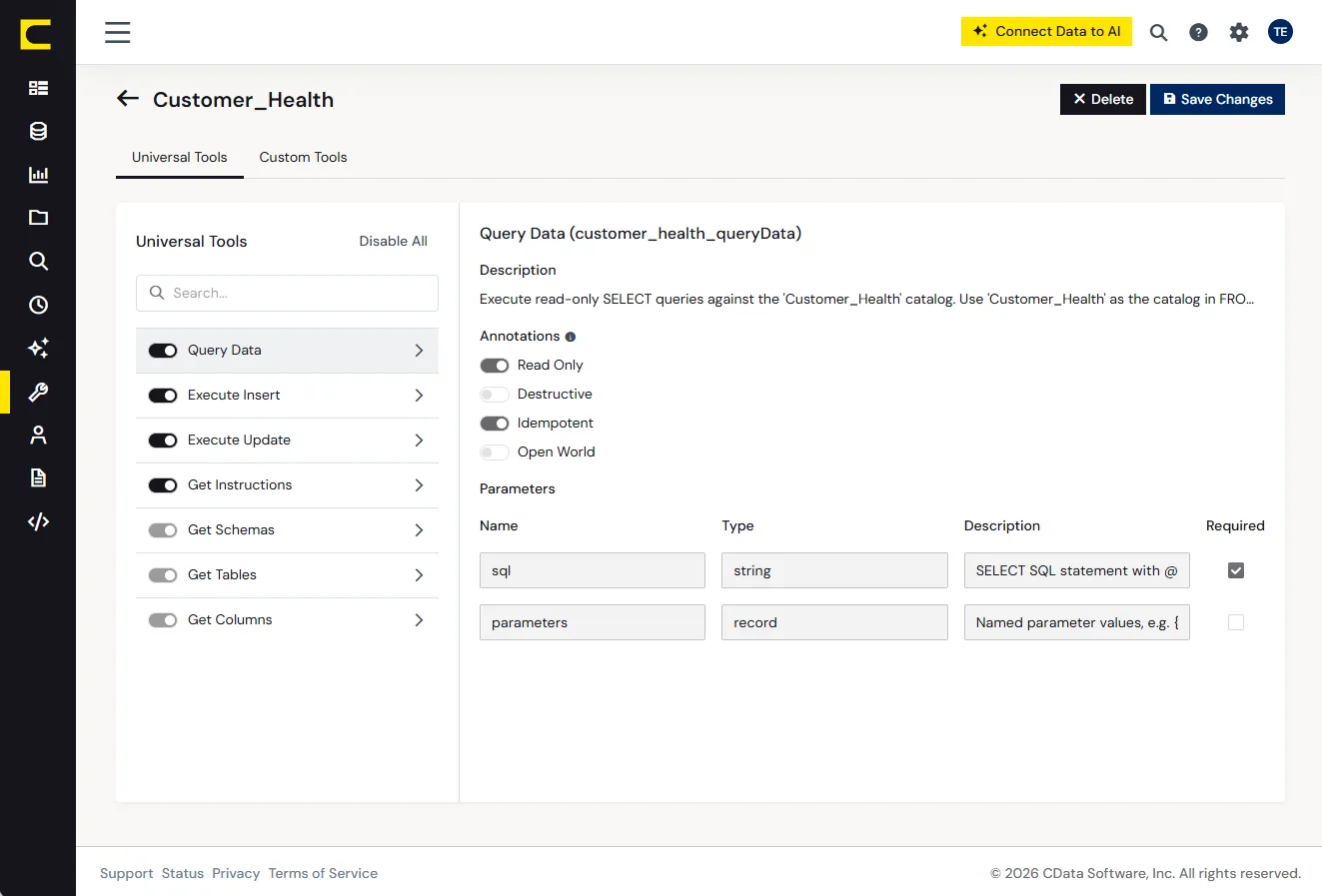
Agents work from a compact universal toolset
An efficient set of 8 reusable universal actions works across hundreds of connected systems, so agents complete tasks faster without wasted effort choosing tools.
Approved actions
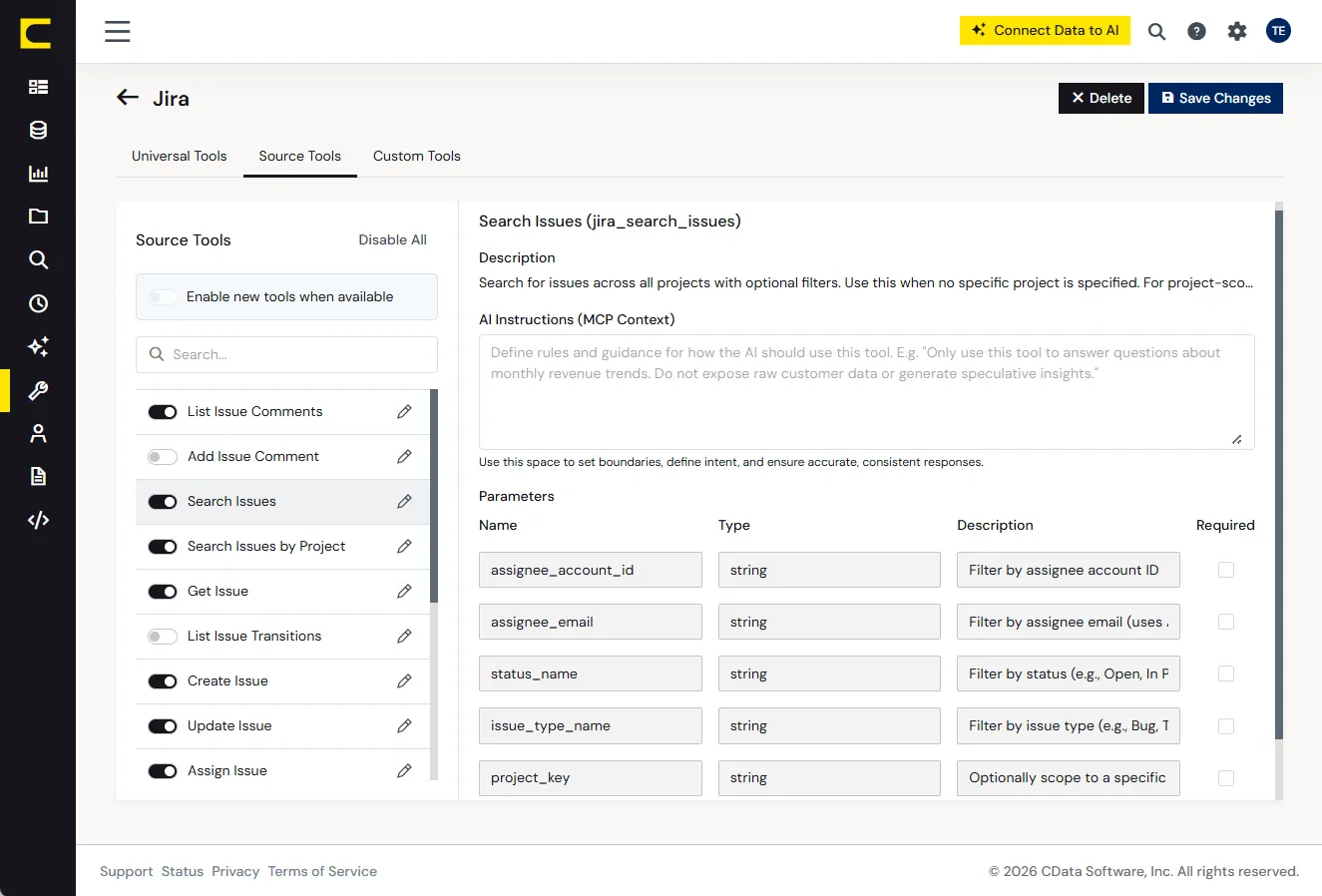
Production actions stay predictable and auditable
Source tools map directly to approved system actions, making execution tighter, easier to reason about, and easier to review.
Scoped logic
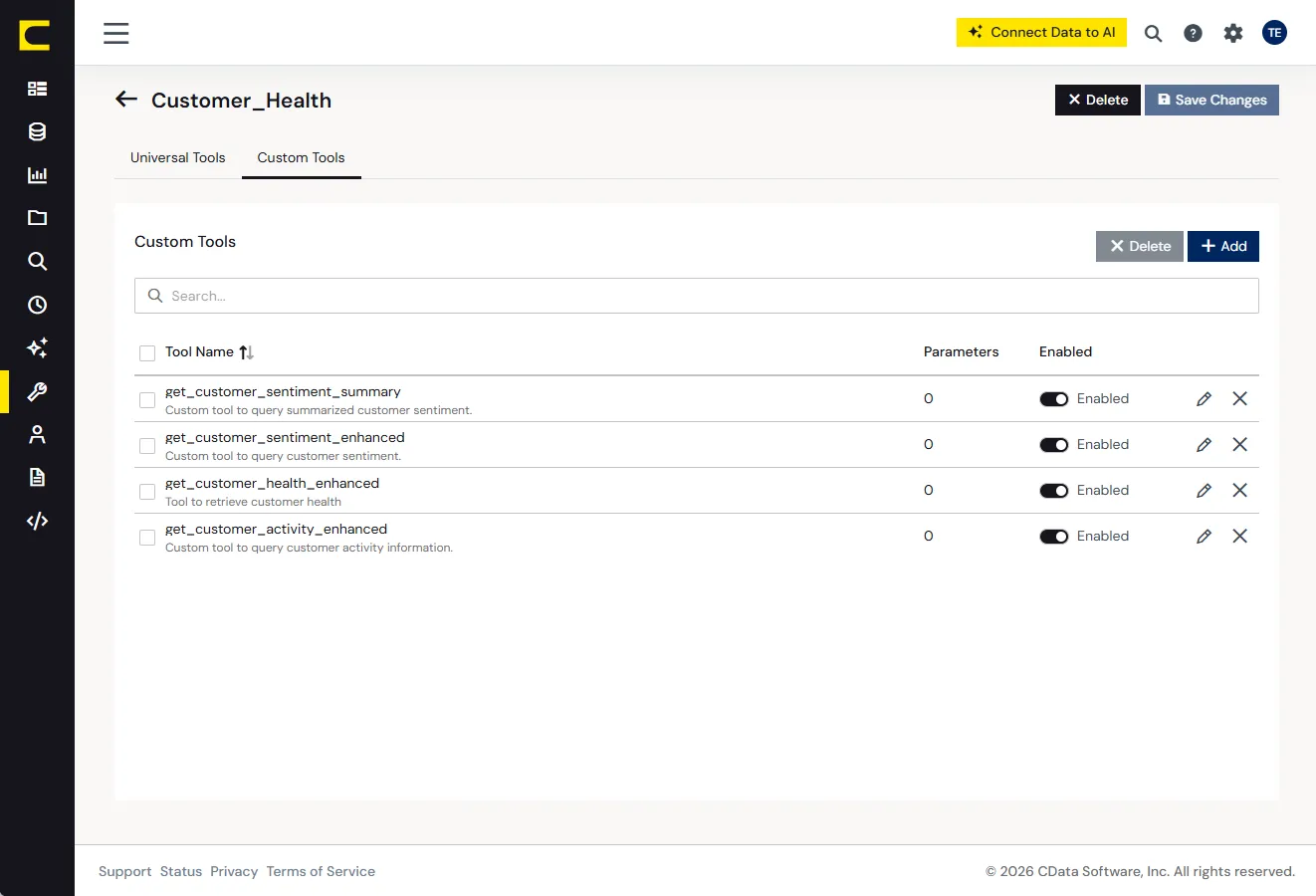
Each use case can get its own purpose-built tools
Custom tools combine specific operations, built-in business logic, and access limits so agents get exactly what they need and nothing more.
Per-agent boundary
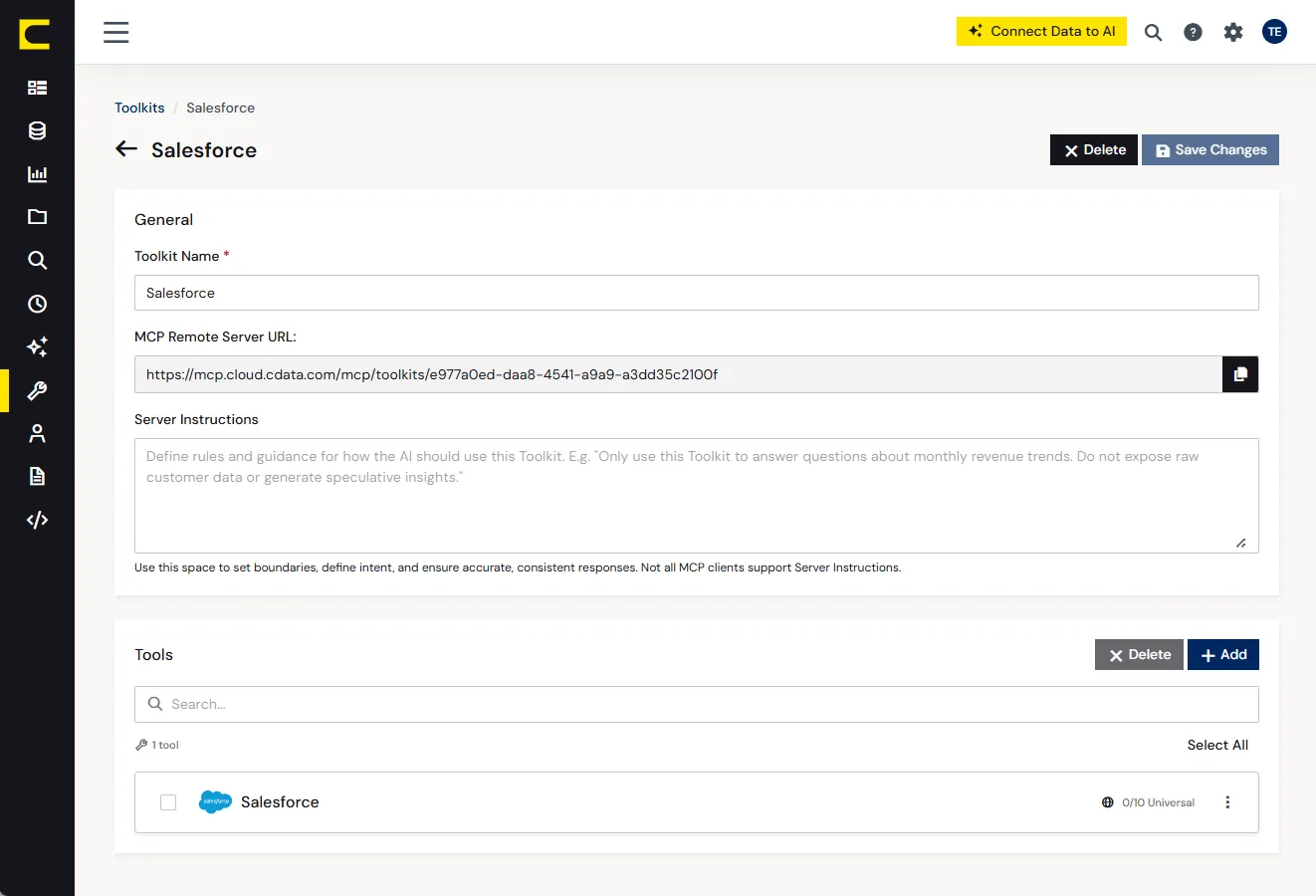
Toolkits define the action boundary once
Package the right set of tools for each agent and deploy them as a dedicated MCP server, then reuse that toolkit across supported AI platforms.
Full metadata
Every tool call is visible
Tool-level audit logging shows which tool ran, which user and agent invoked it, what parameters were passed, and what came back.
Tools in action
Smaller, simpler, and cheaper to run
Agents reason more reliably when the toolset is built for production.
8 universal tools across hundreds of sources, replacing thousands of endpoint-specific actions. The result is a smaller action surface, lower token cost, and more predictable agent behavior.
A consistent toolset across connectors simplifies agent development, testing, and debugging. Teams do not need to learn or maintain a different tool model for each connected system.
Implementation Path
Agent tools live in days
Connect & validate
Connect priority sources and validate universal tools across the systems the agent needs.
Milestone: The agent operates against a compact, consistent toolset, and the token-cost baseline is understood.
Scope custom tools
Build custom tools for priority workflows and define access boundaries at the tool layer.
Milestone: Each agent use case has the right action scope and built-in logic for production behavior.
Package & audit
Package toolkits per agent, deploy as dedicated MCP servers, and activate tool-level audit logging.
Milestone: Each production agent runs with its own scoped tooling boundary and a full audit trail.
Security & compliance
Tooling that is governed by design.
- Passthrough identity on all tool calls — every operation scoped to the requesting user's source-system permissions.
- Access limits enforced at the tool layer — custom tools define boundaries independent of raw credential scope.
- Tool-level audit logging — every call logged with agent, user, tool name, parameters, and response metadata.
- Dedicated MCP server deployment per toolkit — each agent can run inside its own scoped tooling boundary.
- No endpoint sprawl — fewer custom implementations means less surface area to manage.
- Agent-specific service account — each agent gets its own customizable, traceable, and revocable identity and permissions
- SOC 2 Type II — Completed.
- ISO/IEC 27001:2022 — Completed.
- Granular kill switches — disable specific tools, connections, workspaces, or full accounts instantly.
FAQ
Questions teams ask first.
- How does a universal tool differ from a custom tool?
- What happens if an agent tries to use a tool to access data it is not allowed to see?
- How does the toolset stay stable when source APIs change?
- Can the same toolkit be reused across multiple AI platforms?
- How many tools does a typical production agent need?
Agents reason more reliably when the toolset is built for production.
Talk to our team about scoping your agent tooling architecture and deploying a smaller, more reliable action layer.