




The engine powering enterprise AI
The CData platform provides the unifying data layer granting enterprise AI controlled access to your existing sources and applications.










Unified Platform
One data layer for all your AI tools
Governed read and write execution across the operations, AI frameworks, and source systems your teams already use.
Read • Write • Update • Delete • Aggregate • Cross-system joins
MCP • LangChain • LlamaIndex • LangGraph • crewAI • n8n • Cursor • Windsurf
Hundreds of SaaS, databases, cloud platforms, APIs, internal systems
Cloud • On-premises • Hybrid
The Problem
Many AI systems can retrieve data. Few can execute correctly.
Many MCP servers and gateways can act on one source at a time, but fail if needing to federate across multiple systems.
Rate limits, pagination, and bulk APIs are the norm in enterprise systems, but basic MCP approaches handle them poorly, causing slow, failed, or incomplete results.
Updating a record, closing a ticket, or triggering a workflow still requires custom API work—maintained separately for every source, API, or model change.
How It Works
From business prompt to governed execution.
Context resolution and execution happen at the data layer, not inside model memory, where filtering, sorting, and aggregation become inconsistent, costly, and hard to trust.
An AI agent or human user submits a request in natural language.
CData resolves the business meaning of the request, including terms, dates, and cross-system relationships, then builds an execution plan.
The query runs at the source layer using source-aware optimization, including pushdown operations, bulk endpoints, rate-limit handling, and federated joins where needed.
The result or write action is returned under governance, with passthrough identity and audit logging applied throughout.
Business prompt in. Governed answers and actions out.
Key Capabilities
What enterprise execution requires.
Federation
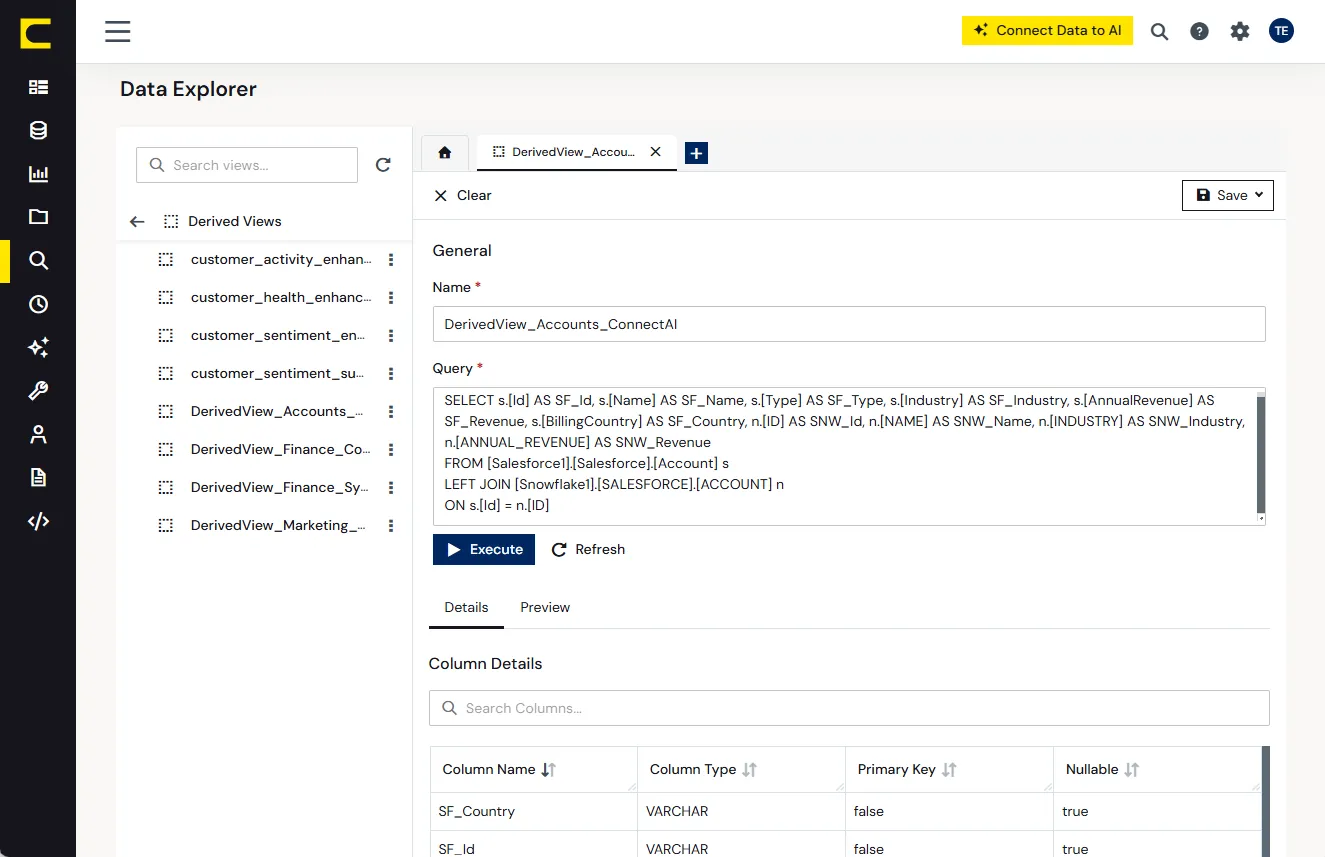
Prompt across systems in one operation
Federate and join data across enterprise sources without replication, middleware, or manual stitching.
Natural language
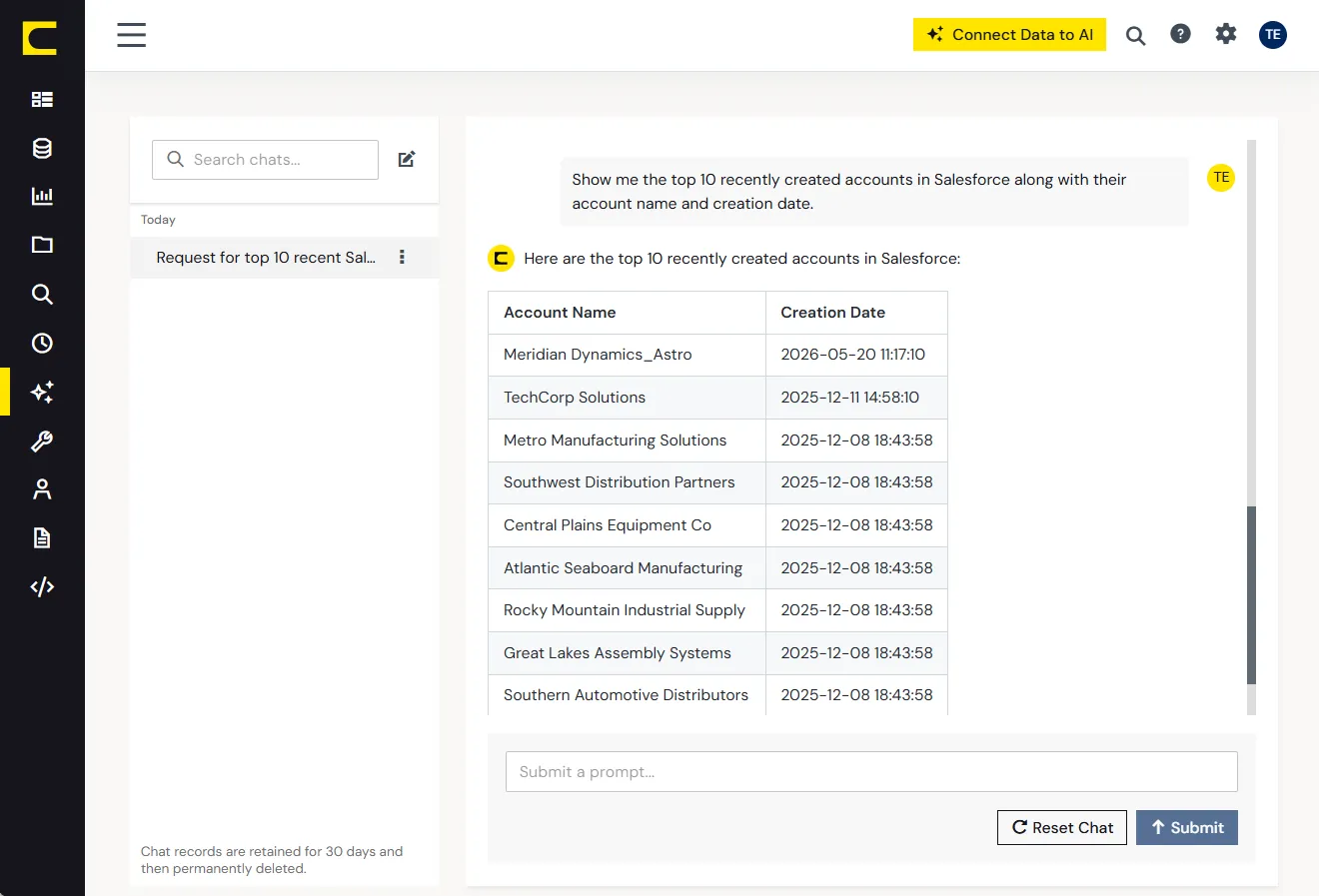
Business questions turn into executable queries
Resolve business terms, dates, and intent automatically so users do not have to write system-specific syntax.
Performance
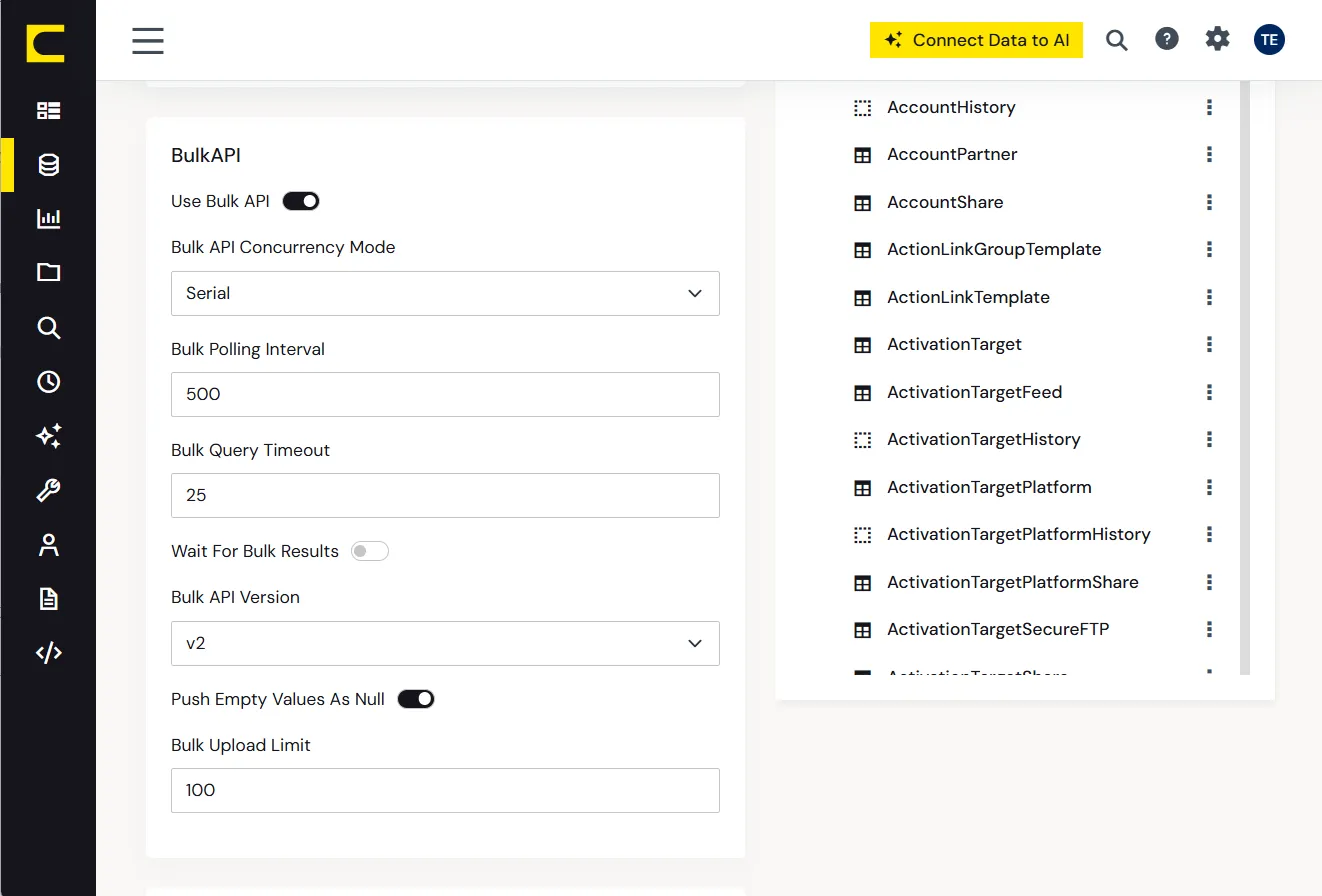
Performance holds up under enterprise conditions
Adapt to rate limits, pagination, bulk APIs, and source constraints so complex queries do not fall apart in production.
Read & write
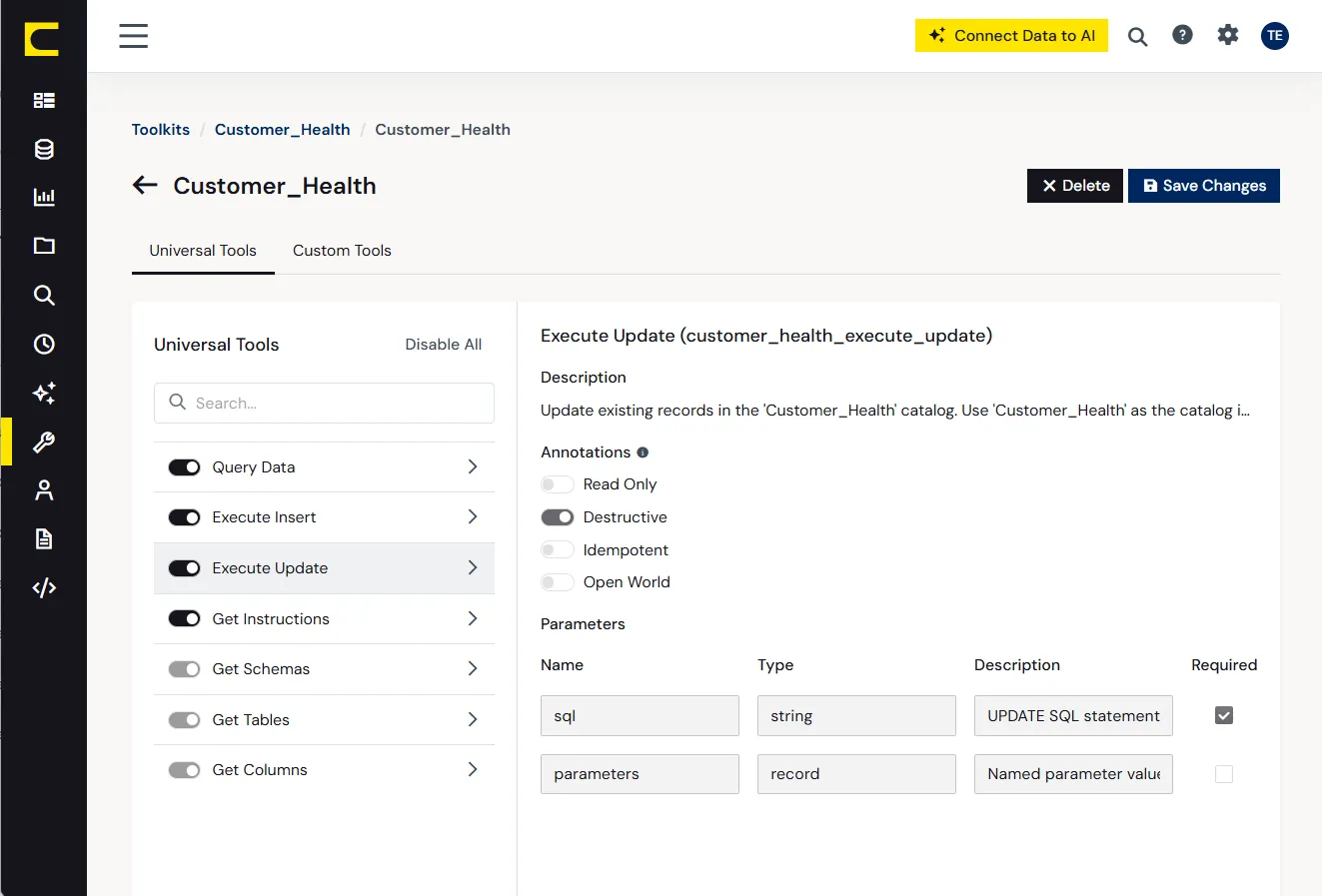
Agents can act, not just read
Support governed read, write, update, and delete operations so workflows can complete instead of stopping at retrieval.
Cost control
Tool sprawl and token waste stay under control
Use a compact execution model that reduces redundant calls and keeps costs more predictable.
Pushdown accuracy
Accuracy stays high as execution gets harder
Pushdown execution and a consistent relational layer help preserve correctness as complexity increases.
Benchmark
Accuracy matters most when no one is checking the answer.
98.5%
vs. 65–75% with basic MCP providers Based on internal testing by CData Software (Q4 2025). No independent third-party verification. Actual accuracy gaps varied among platforms and MCP approaches, testing conducted using sandbox accounts containing known data sets that mirror production account structures. Results may not be representative of performance in live production environments, and results may vary. Organizations should conduct their own independent testing before making purchasing or implementation decisions. 75% range of average accuracy across platforms, results differ by MCP approach.
CData's benchmark covered 378 queries across CRM, ERP, project management, and data warehouse systems.
50-65%
where competing approaches landed on complex queries
The gap widens as queries get more complex. On complex enterprise queries, competing approaches fell into the 50–65% range. CData stayed consistent.
Security & compliance
Data control that preserves governance.
- Passthrough identity on reads and writes
- MCP Platform-level role-based access control (RBAC)
- Agent-specific service accounts to set, audit, and revoke agent permissions
- Query-level audit logging for every operation
- No data movement required
- Pushdown execution reduces unnecessary exposure
- Granular kill switches — by user, connection, workspace, or account
- SOC 2 Type II — Completed.
- ISO/IEC 27001:2022 — Completed.
- AES-256 at rest · TLS 1.3 — in transit.
FAQ
Questions teams ask first.
- How does CData handle a query where the business term doesn't map to a single field?
- How is processing at the data layer different from processing in AI memory?
- Does CData support write operations across all 350+ connectors?
- How does federated querying work without copying data?
- What makes the 98.5% accuracy possible at the execution layer?
Turn business questions into governed execution across live enterprise data.
Talk to our team about connecting your first source systems and enabling governed read and write operations. Or explore how Data Access & Action fits into the broader CData platform.