




Context AI can clearly understand
CData gives each connector the context AI needs to interpret prompts, fields, and business logic correctly.










The Problem
Accessing data is one thing. Enabling AI to understand how it works is the real test.
Basic MCP gateways can turn prompts into API calls, but without understanding rules and relationships, responses look credible and are still wrong.
AI learns each system by failing through it — more tool calls, more tokens, slower responses, lower accuracy.
Custom fields, internal definitions, and proprietary systems hold the real business logic. If AI can't interpret that context, it can't answer reliably.
Systems that fail to synthesize the right context confuse their LLMs and run up costs.
How It Works
How CData turns access into understanding.
CData resolves source-specific meaning before the query runs — so AI plans the right call instead of failing through trial and error.
Interpret the request in the context of the source system
CData identifies the system behind the query and applies source-specific context such as field mappings, entity relationships, fiscal logic, and platform conventions
Build the right execution plan
Instead of guessing through trial and error, it selects the right fields, filters, and operations up front. For multi-source queries and workflows, CData federates and normalizes context across systems for consistent execution.
Hand off a contextualized request to the execution layer
Once the context is resolved, CData passes a fully-contextualized request to the execution layer for governed query execution. See Data Access and Action for how execution optimizes at the source.
Context first. Accurate answers, not plausible mistakes.
Key Capabilities
What semantic context fixes
Business terms
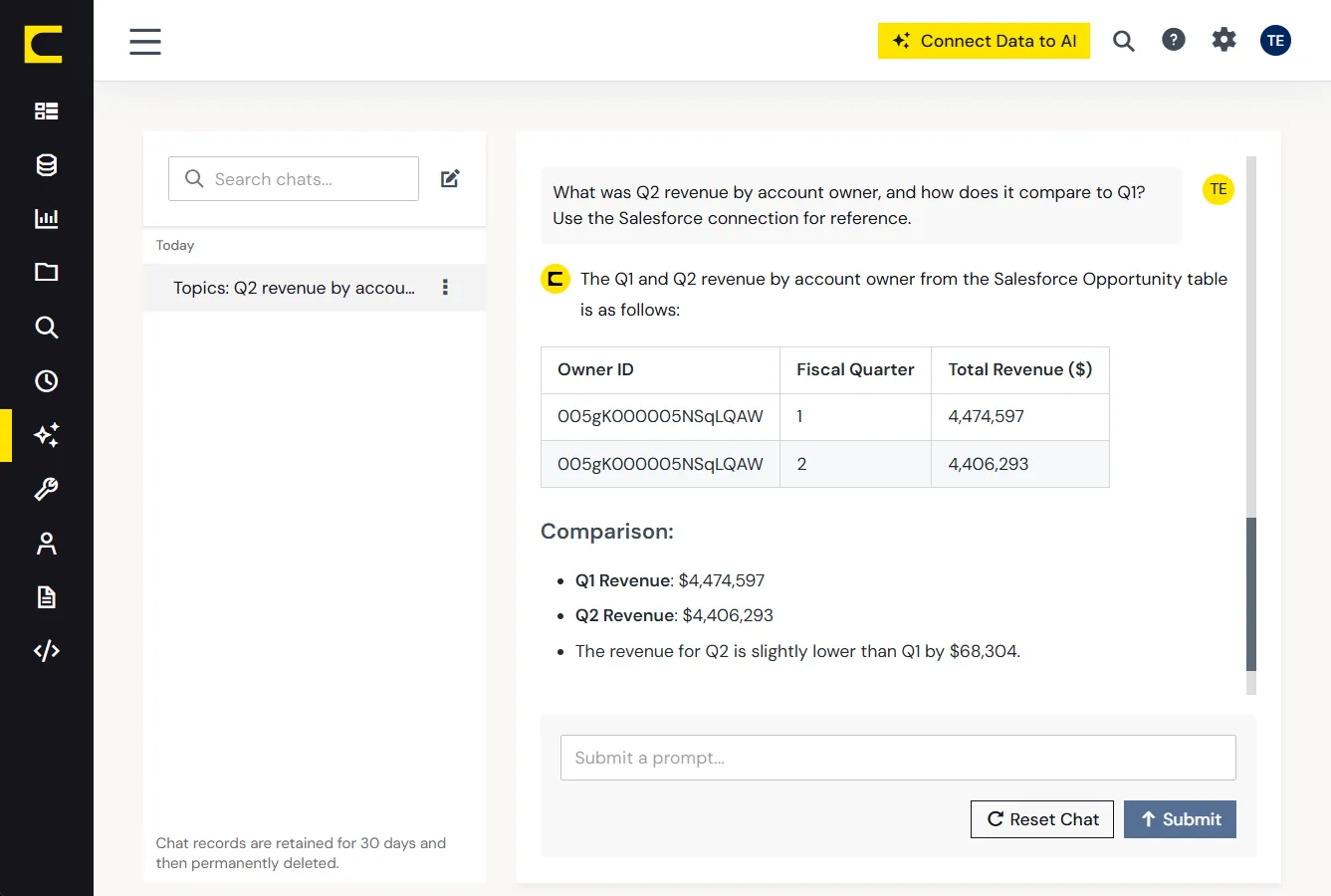
Business terms resolve correctly
“Q2 revenue” resolves to your calendar, your logic, and your fields, not a generic guess.
Complex queries
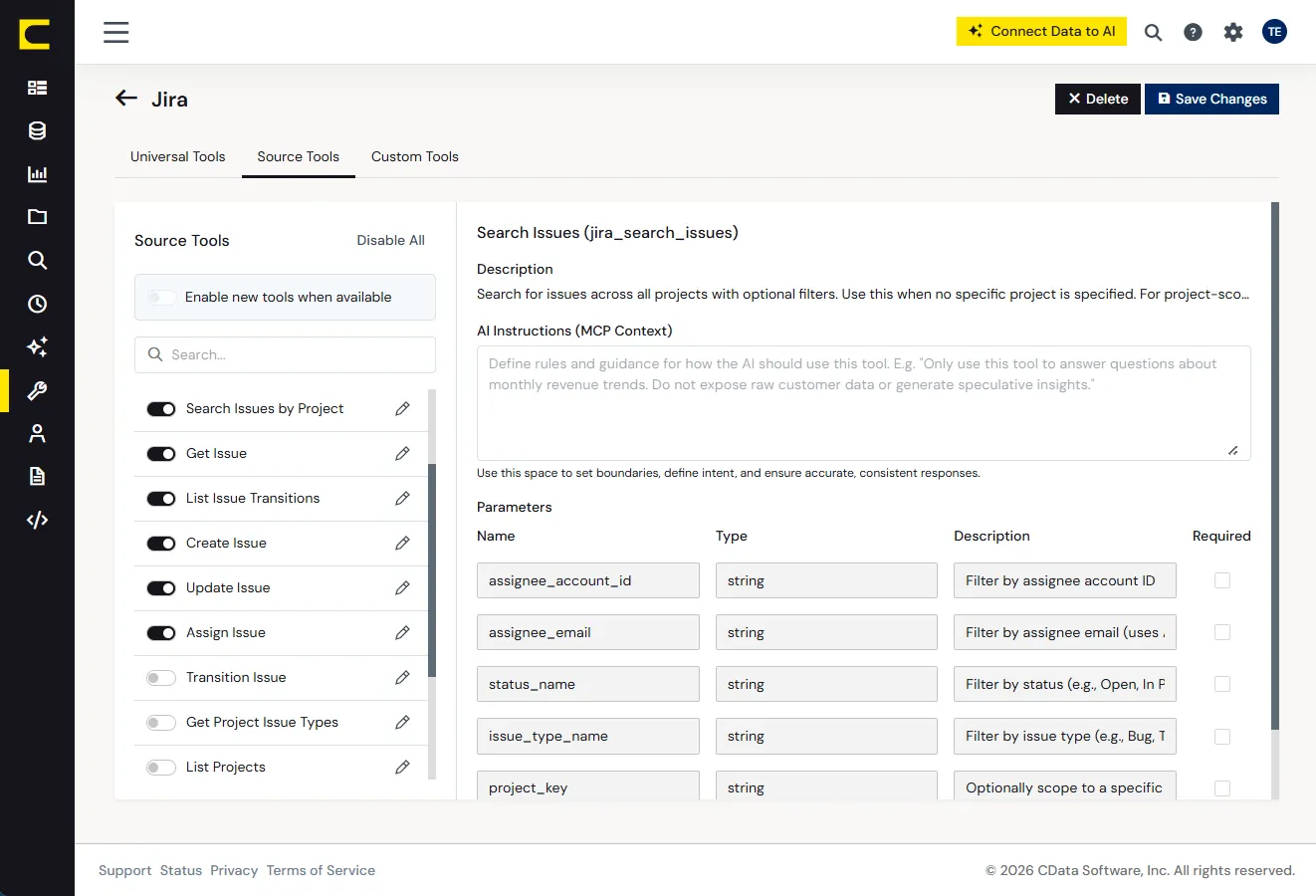
Accuracy holds up as queries get more complex
Give AI source-aware toolsets and query patterns upfront so it does not waste calls discovering them on the fly.
Custom data
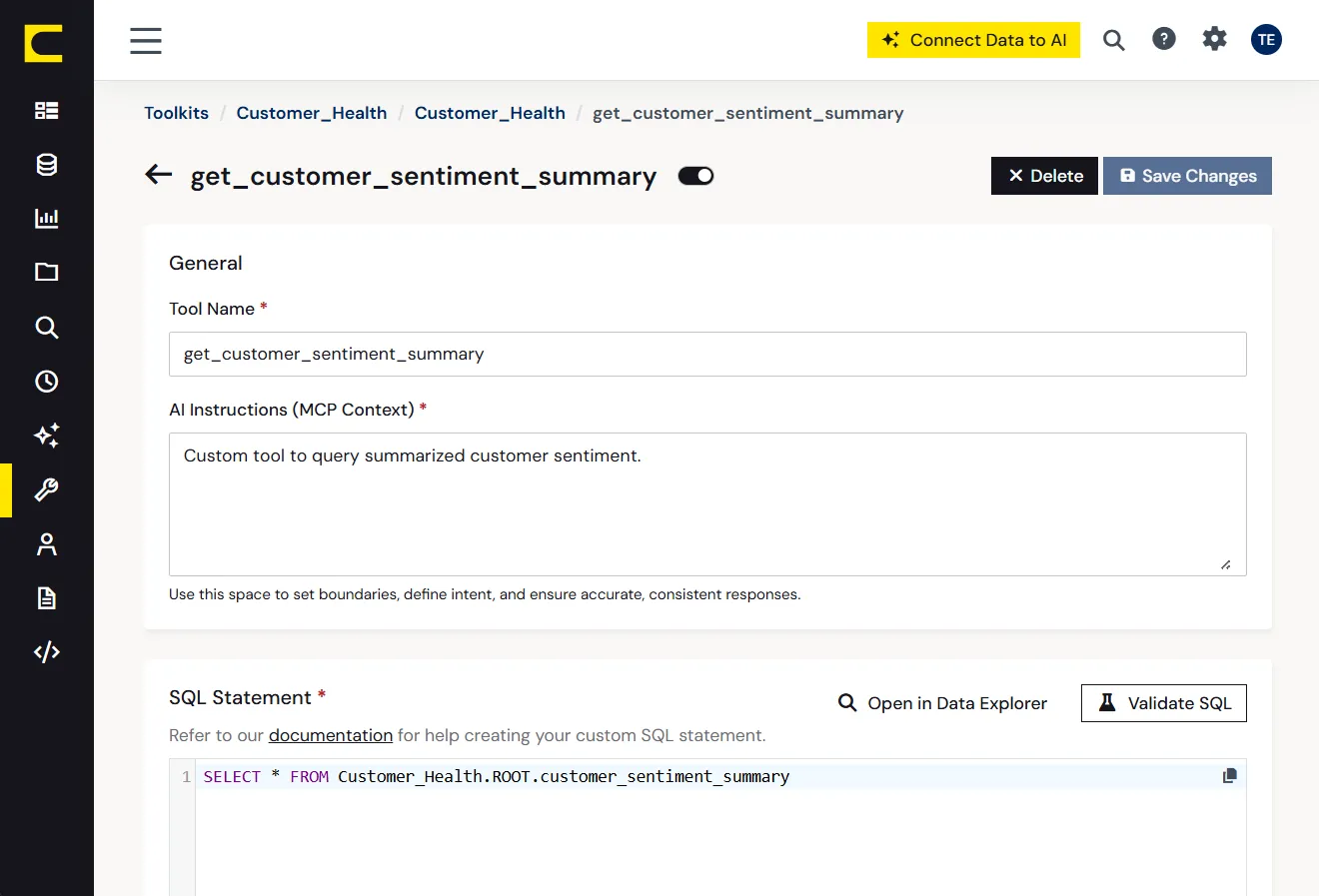
Custom and proprietary data becomes AI-readable
Add definitions for custom fields, proprietary systems, and internal terminology so AI can interpret your real data model.
Cross-system
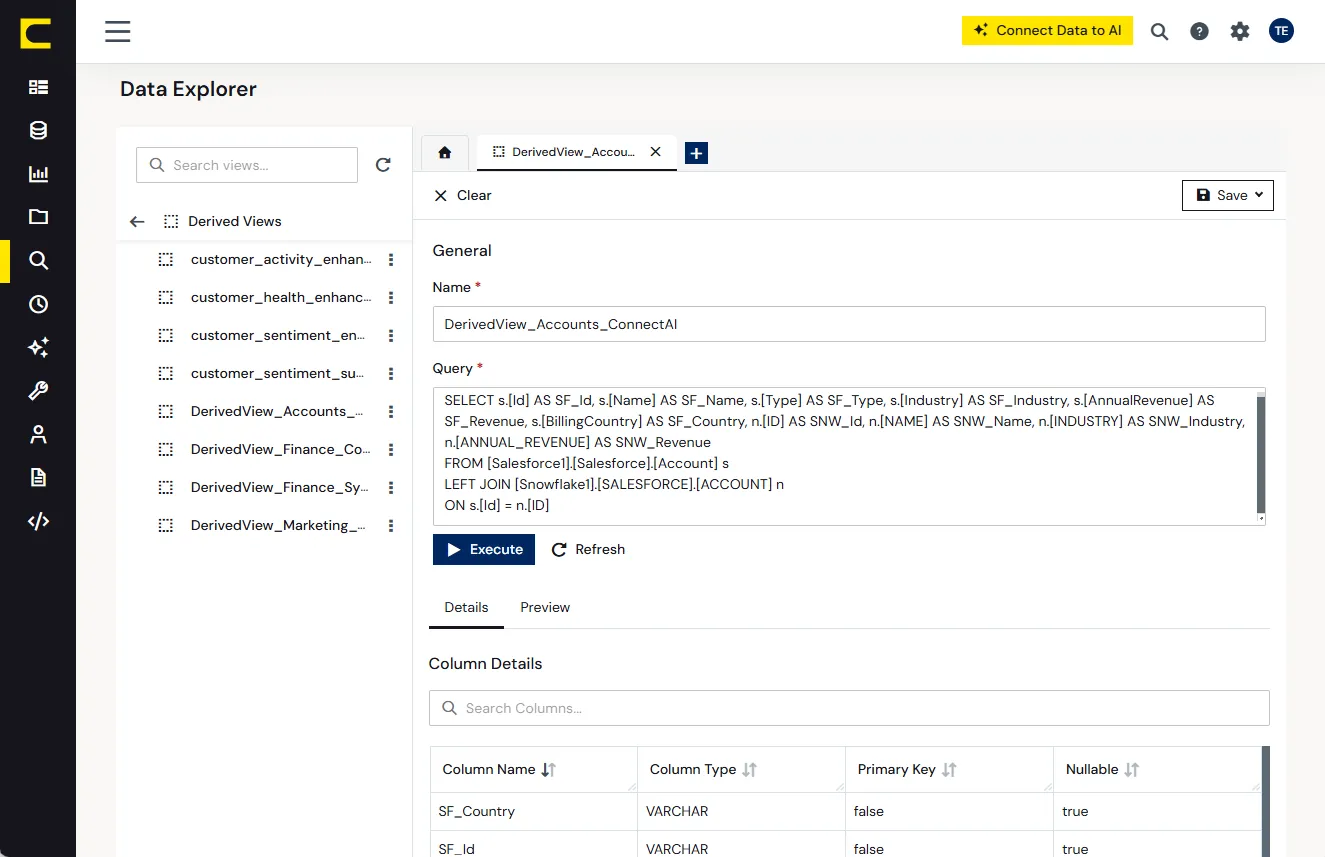
Results stay consistent across systems
Apply a consistent semantic context across CRM, ERP, data warehouse, and project systems without flattening each source into the same lowest-common-denominator model.
Benchmark
Proof that context improves accuracy.
0%
query accuracy across 378 enterprise queries
In the CData MCP Accuracy Benchmark, CData outperformed basic MCP approaches that scored between 65% and 75% across CRM, ERP, project management, and data warehouse scenarios. Based on internal testing by CData Software (Q4 2025). No independent third-party verification. Actual accuracy gaps varied among platforms and MCP approaches, testing conducted using sandbox accounts containing known data sets that mirror production account structures. Results may not be representative of performance in live production environments, and results may vary. Organizations should conduct their own independent testing before making purchasing or implementation decisions. 75% range of average accuracy across platforms, results differ by MCP approach.
0%
ERP was the clearest gap
In the same benchmark, the native NetSuite MCP server scored 0% on ERP queries. CData scored 100%.
Implementation Path
From AI access to understanding in days
Connect your first source
Apply source-specific context already built into the connector so AI can interpret fields, relationships, and conventions without manual prompting.
Owner: IT / Data infrastructure
Milestone: Your first connected system is live, and AI can answer queries against it with source-aware context already in place.
Add semantic context
Define internal field meanings, business rules, and company-specific terminology to drive the AI accuracy enterprises need.
Owner: Data team / Business analysts
Milestone: Custom fields and internal systems are now understandable to AI in business terms, not just technical schema terms.
Standardize governed definitions
Teams can now define reusable business metrics and logic to drive consistency across queries, dashboards, and applications.
Owner: Data team / Analytics / Platform owners
Milestone: Business-critical queries are defined once and answered consistently across users and systems.
Security & compliance
Data control that preserves governance.
- No data movement required
- Semantic context respects user permissions
- Every query is logged at the interaction level
- Customer-defined context is encrypted and isolated per account
- Run-time PII entity detection and masking
- SOC 2 Type II — Completed.
- ISO/IEC 27001:2022 — Completed.
FAQ
Questions teams ask first.
Give AI the context it needs before the first query.
Talk to our team about improving accuracy across your enterprise systems with source-level semantic context. Or explore how Semantic Context fits into the broader CData platform.