




The only gateway with context from your systems
Route every request to the right model at the right cost, informed by the data and access rules behind it.







Every provider, key, and dollar under control
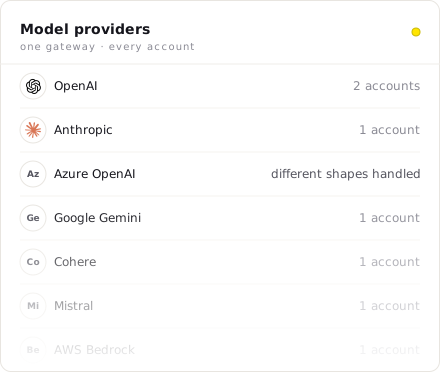
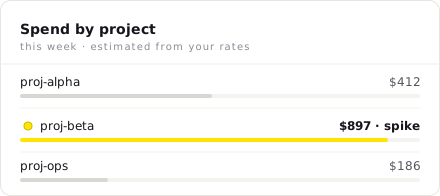
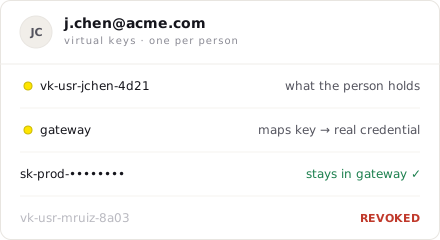
One endpoint in front of every provider — with virtual keys, hard budgets, rate limits, and per-person or agent spend attribution built in.
Manage routing, budgets, and failover in one place
Declare each policy once in the gateway and it applies at whatever level you manage AI, user, team, or department, on every request.
Set default models by department, team, or user.
Set a default model at any level—department, team, or user. Defaults cascade down and can be overridden below; change one once and every agent in scope inherits it.
Caps that stop spend before it happens.
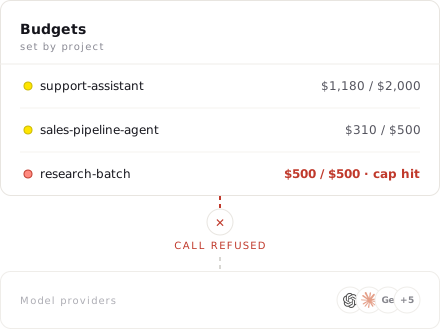
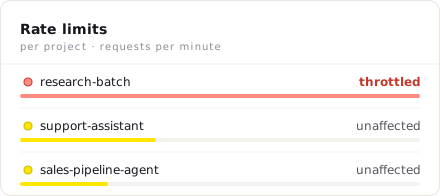
Give any department, team, or user its own budget and rate limit—hard or soft. One team's experiment never draws down another's, and no surprise ever reaches the invoice.
When a provider falters, no one notices.
Set the fallback order once. When a provider degrades, requests glide to a healthy model with context intact—the work continues as if nothing happened.
 gpt-5
DEGRADED
gpt-5
DEGRADED
 sonnet-4.5
SERVING
sonnet-4.5
SERVING

CIO, Anaqua

Governance enforced on every request
Every call resolves its scope, model, budget, and fallback in the gateway before it reaches a provider.
Cascading scopes
Govern thousands of agents with one change. Set a policy at the department, team, or user level and everything in scope inherits it instantly with no per-agent config to chase.
Separate ledgers
Never explain a surprise invoice again. Every scope keeps its own attributed ledger. Soft limits warn, hard limits stop spend before it happens.
Continuous health checks
Your agents stay up even when a provider goes down. The gateway watches every provider and reroutes the instant one degrades, so end users never feel the outage.
Drop-in compatible
Adopt it without rewriting a single agent. OpenAI- and Anthropic-compatible, so migrating is a base URL and API key change. It sits in front of every major provider and open-weight models.
Your business context, applied to any model
The gateway grounds each call in the Context Engine before it reaches a model, so you can spend fewer and cheaper tokens.
Context gathered in one graph
Schemas, data models, semantic definitions, and company knowledge, unified into one graph of what agents need to know.
Applied to every model
Context lives in the gateway, not any one model. The same understanding applies to Claude, GPT, or Gemini, and carries through every failover.
Processed in the engine, not the model
Data is processed in the platform, and the model gets only what the question needs: fewer tokens, no discovery phase.
How a request routes
Every call resolves scope, model, budget, and fallback in the gateway before it reaches a provider: four decisions inside a single request.
The gateway resolves who is calling
The request carries the caller's identity, and the gateway maps it to the scope hierarchy of user, team, and department before any model is chosen.
Routing rules pick the model
The most specific rule wins: a user pin beats a team override beats a department default. The decision and its source are recorded on the request.
The budget check runs before the call
The scope's ledger is checked before tokens are spent. Under a soft limit the request proceeds with a warning; at a hard limit it returns 402, with no invoice surprise.
The call goes out health-checked, with fallbacks armed
If the chosen provider is degraded, the request moves down the fallback list instantly. Shared context travels with it, so the answer holds on whichever model serves it.
It learns from every request
Because every request runs through the gateway, the context behind it keeps improving. It's a self-learning loop no pass-through gateway can close.
Explore the Context EngineConversational signals
When a user gets the wrong cut and corrects it, the loop links that intent to the query that finally worked and updates the concept behind it.
Query mining
Commonly queried tables, frequent join paths, and popular filters surface over time, sharpening retrieval with real usage signal.
Refined and reconciled, with humans in the loop
The engine periodically self-reviews for conflicts and gaps. Learned changes surface as reviewable diffs an owner approves, and unresolvable ones go to the right person.
More than a model gateway
The complete package for AI deployment
The model gateway is part of a platform built on controls and security, a context engine, and a live data layer—everything an AI deployment needs, in one platform, instead of assembled from parts.
Explore the AI Gateway Copilot
Claude
Copilot
Claude
 ChatGPT
 Perplexity
 Agentforce
 LangChain
 CrewAI
 n8n
n8n
Model, MCP, and Agent gateways—routing, guardrails, cost controls
Identity, policy, and guardrails enforced at every step
Company knowledge, semantics, and schema on every request
Real-time read/write to hundreds of enterprise sources
 Salesforce
 SAP
SAP
 Snowflake
 NetSuite
 Databricks
 HubSpot
Sonnet
GPT-5
HubSpot
Sonnet
GPT-5
 Gemini
 Grok
Grok
 DeepSeek
Put the gateway to work
One platform, two teams: IT teams that run AI safely, and business teams that get more productive with AI.
One endpoint. Every model. Full control.
Route by user, team, and department, cap spend at every level, and fail over across providers, all from the Model Gateway, with your context intact.