Introducing CData Connect AI Gateway
Over the past year, the work we're asked to support has changed. Agents now act for people across the systems a business runs on: they pull pipeline, reconcile invoices, and update records. The conversations I have with CIOs have changed too. A year ago, they asked how to connect AI to their business. Today they ask whether they can trust what it does once it's there, and whether they can control what it costs.
AI gateways have made real progress on routing, access, and spend. For agents to do real work, they also have to understand the systems they're working in: what a field means, whose permissions apply, and what an action will change. That understanding lives in the data layer of those systems.
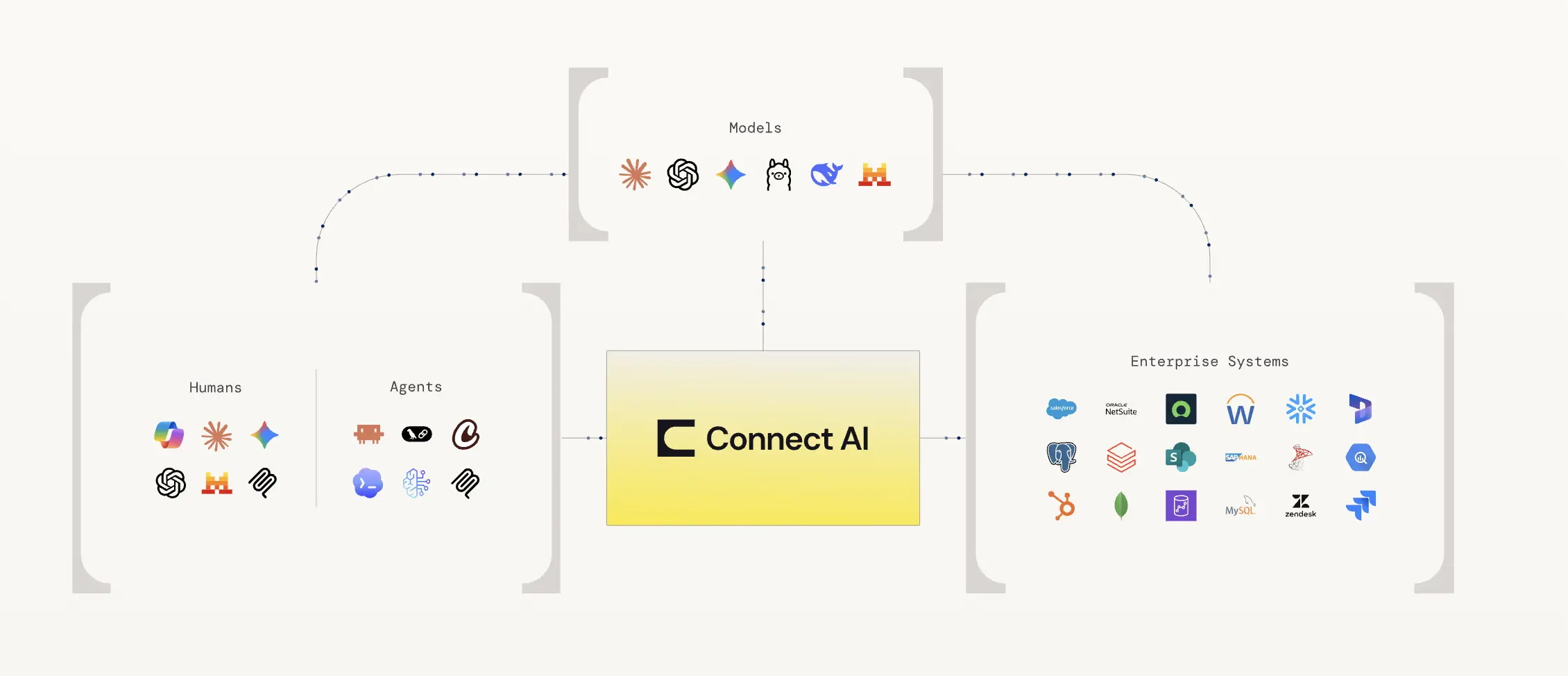
Today we're opening early access to CData Connect AI Gateway. It is one control point between AI and your systems, and it governs every step of a request: the model it routes to, the tools it loads, the identity it carries, the records it accesses, and the actions it takes. We built it on CData's data layer because semantic understanding already lives there.
Why the gateway starts at the data
CData's data layer powers products from Palantir, Google, and hundreds of ISVs, and is used by more than 10,000 organizations across hundreds of SaaS applications, databases, warehouses, and on-premises systems. Those connections know each system's schemas, relationships, customizations, and which of hundreds of fields matter. That knowledge decides whether AI succeeds or fails in production: whether the answer is right, whether the access is governed, and what each request costs.
Accuracy. A model handed a well-understood schema with the business context attached stops guessing what the data means. In our 25% Accuracy Gap study across 378 real-world prompts, Connect AI returned correct results 98.5% of the time, against 65% to 75% for the other Model Context Protocol (MCP) providers we tested. The failures that separated them were a failure of understanding.
Governance. Permissions and audit hold when they're enforced inside the source system, under the user's own identity, down to the record. In one of our studies, models given raw access changed records far beyond what they were expected to touch. Connect AI's governed tools limited models to the records they were authorized to access.
Cost. Tools that can model data (aggregate, join, filter) return the answer set rather than pulling records; so fewer tokens reach the model. The same study found that with better tools, the cheapest correct answers came from economy-tier models, at one 178th the cost of the most expensive.
What Connect AI Gateway adds
Connecting an agent to a system is the first step. The rest of the job is governing what it does once it's there: which model answers, what context is made available, what the request costs, what the agent is allowed to see and change, and what the company keeps from the interaction. Connect AI Gateway covers all of it in four layers.
Gateways. An LLM gateway and an MCP gateway with routing, controls, and observability. And audit across both. Enterprise MCP is built in: hundreds of CData-built connectors are exposed as governed tools, and any MCP server you already run is governed under the same policy. You define approved models and providers, set routing rules, and manage spend by user, agent, or model.
Controls and security. Policy applies at every step, from the model down to the record. Every request carries the identity of the person it serves and the agent acting for them, enforced in the source system, with actions validated against the system's own business rules before they commit.
Context engine. The largest addition. It holds three kinds of context and keeps them together. System context is what the connectors already know about each system: schemas, objects, relationships, and operations, available the day a system is connected. Company knowledge is what your teams have documented: metric definitions, business terminology, and the semantic models your data team maintains, imported or generated with AI assistance. Institutional knowledge is what nobody wrote down: which field Finance uses for revenue, why a pipeline stage is excluded from the forecast, which customer table is authoritative. The engine learns this from ongoing usage, and it compounds with every interaction. When an analyst corrects an assumption, the correction is proposed as shared context, approved by a person, and applied to every request after it. A resolved ambiguity doesn't get asked twice.
Data layer. The live connections to on-premise systems, SaaS applications, databases and warehouses Connect AI already offers, with stronger modeling and virtualization, so your data team defines business logic once and every agent inherits it.
Why these belong in one place
Each layer has information the others need. The connection knows the system, the prompt says what the user means, and identity determines what they're entitled to. Together, routing can weigh which model a request needs, context cuts the retries that come from guessing, and a compliance team can trace any figure in an answer back to the prompt, model, tool, records, and policy behind it. That gets much harder to guarantee when the gateway works from an indexed or synced copy. It depends on a direct connection to the source system.
And because CData doesn't sell a model or a data warehouse, the gateway has no reason to favor one over the other. Most companies already run several models and change the mix as new ones arrive. With Connect AI, Context is held in the gateway, independent of any model, so every model you route to works from the same definitions.
Get started
Agents will take on more of every company's work each quarter. The companies that get the most from them will be the ones that can trust what agents do and trace every action back to the source. That's the platform we're building, and we'd like early customers to help shape it. Early access opens today, and at Foundations on November 5, Raviv and I will share how the context engine works and where the platform goes next.
— Amit




