Enterprise data replication does more than move data. Used well, it makes legacy data a key consideration in your modern analytical stack, without migrating or disrupting the operational systems behind it. This is the architectural pattern that lets both environments evolve on their own terms.
The tension at the center of every modernization conversation
Ask a data or IT leader what they want from their infrastructure and you will hear two things that seem to be in conflict. They want modern, cloud-native analytics: Snowflake, Databricks, Microsoft Fabric, Power BI, the tools that make self-service reporting and machine learning tractable at enterprise scale. And the data that needs to feed those platforms lives in Oracle, DB2, AS/400, SAP, and other operational systems that the organization likely has no intention of replacing.
Those systems are running the business. They process transactions, manage inventory, generate invoices, and track customer orders. The data inside them represents years or decades of operational history. Migrating those systems carries a risk profile that most organizations will not accept on any timeline that a modernization roadmap can realistically offer. But leaving that data isolated from the modern analytical stack means the organization is making decisions on an incomplete picture.
The result is a tension that most modernization frameworks don't address honestly: how do you make legacy data a first-class citizen in a modern analytical platform without touching the systems that hold it? The solution is a different architectural approach, not a better migration plan.
"What most teams actually need is a middle path - one where a single replication and orchestration solution works across both legacy and modern architectures, with CDC handling the near real-time demands of today's diverse data pipelines."
— Raji Narayanan, VP Product Management, CData Software
Connecting legacy data to the analytical layer
The architectural insight that resolves this tension is that operational systems and analytical systems have fundamentally different requirements, different change cadences, and different stakeholders. There is no technical reason they need to evolve together, and no reason legacy data should remain isolated from the modern analytical stack simply because the systems holding it aren't changing.
A replication layer positioned between operational sources and analytical destinations continuously captures changes from source databases and delivers them to analytical platforms, keeping the modern stack current with what the operational system contains right now. The source systems continue to run exactly as they always have. The analytical layer gains access to fresh operational data without any modification to the systems producing it.
The two layers are architecturally connected but independently evolvable: the analytical stack can be rebuilt, extended, or replaced without touching the operational systems, and the operational systems can be maintained or upgraded without coordinating with the analytical layer. Legacy data flows continuously into the modern stack, both environments stay current, and neither constrains the other's roadmap.
For use cases where near real-time data delivery matters, change data capture (CDC) is the mechanism that makes this architectural pattern work. Rather than executing queries against production tables, CDC reads directly from the database transaction log, capturing every committed change and delivering it to analytical destinations continuously, with the operational system unaware that replication is happening at all.
The architecture in practice
The pattern looks like this in practice. Operational and legacy source systems sit on the left: Oracle, DB2, AS/400, SQL Server, SAP, ERP and CRM platforms, and legacy databases that have been running production workloads for years. A CDC-based replication layer sits in the center, reading changes from source transaction logs and delivering them continuously to destinations. Analytical and cloud platforms sit on the right: Snowflake, Databricks, Microsoft OneLake, Azure Data Lake Storage, cloud warehouses, and the BI and AI tooling built on top of them.
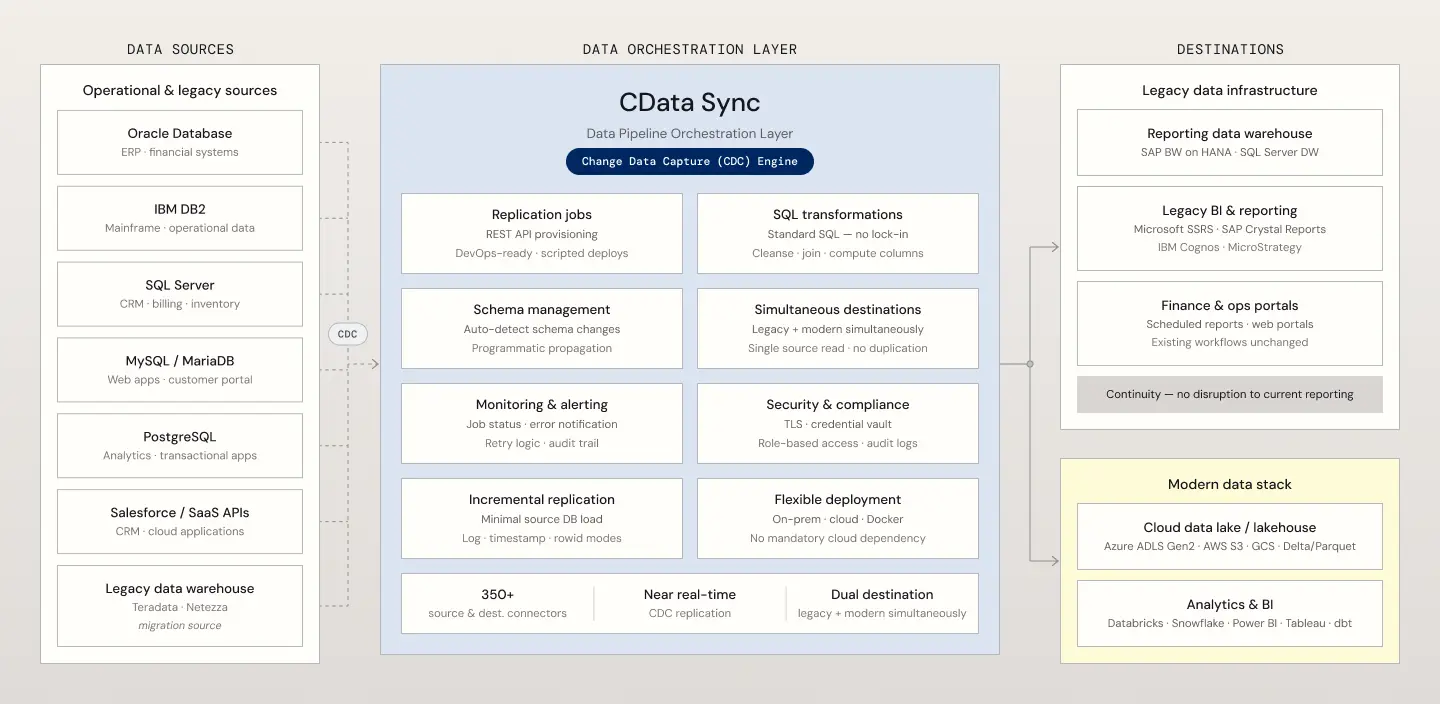
Figure 1. CData Sync as the data orchestration layer between operational sources and analytical destinations. CData Sync and CDC drives continuous replication from legacy and modern sources, including Oracle, IBM DB2, SQL Server, and Salesforce, serving legacy and modern data stack destinations simultaneously. Example configuration; sources, destinations, and applications vary by organization.
One architectural consequence follows immediately: the analytical stack operates on a completely independent roadmap from the operational stack. A team can migrate from an on-premises data warehouse to Databricks without any involvement from the ERP team. A data science team can begin building ML models against fresh operational data without waiting for a system migration that may be years away. The operational system owners never need to know that the analytical architecture changed.
There's a second consequence that gets less attention. Because CDC reads from the transaction log rather than querying tables, the source system bears essentially no additional load from replication. An Oracle or DB2 instance processing millions of transactions a day continues to operate exactly as it did before the replication layer was introduced. This matters for systems where performance headroom is limited and any additional I/O overhead has operational consequences.
Why this pattern is more relevant now, not less
The rise of AI and machine learning as enterprise priorities has made the data freshness question more acute. Training a model or populating a feature store on yesterday's data produces different results than doing the same on data that reflects what happened in the last few minutes. For use cases like demand forecasting, fraud detection, and customer churn prediction, CDC-delivered data produces a model that reflects current conditions; batch-delivered data doesn't.
At the same time, the pressure on operational systems to support analytical use cases directly is growing. Business users want real-time dashboards, finance teams want intraday reporting, and supply chain teams want live inventory visibility. Serving these use cases by querying production operational databases directly is not a sustainable approach; the query load competes with the transactional workload the system was built for. CDC replication provides a path: analytical queries run against a continuously updated destination instead.
Modern cloud platforms already handle the query side of real-time data at scale. The real barrier is the replication layer between operational and analytical systems, and specifically whether that layer can handle the sources those enterprises actually run.
The sources that most replication tools can't reach
The replication architecture described above works in theory for any source system. In practice, it works only as well as the replication layer's ability to connect to the sources the organization actually runs. This is where most modern replication tools fall short.
Cloud-native replication tools are built for cloud-native sources: Postgres, MySQL, Salesforce, modern SaaS APIs. They cover the top of the market well. What they frequently lack is deep support for the databases that have been running enterprise operational workloads for twenty or thirty years: IBM DB2 and AS/400 (iSeries), Oracle with LogMiner-based CDC, IBM Informix, Sybase, and the ERP systems built on top of them. These platforms still run a large share of the global enterprise market, concentrated in manufacturing, logistics, financial services, and regulated industries, for example.
A replication layer that cannot reach these sources, cannot connect legacy data to the modern data stack for the organizations running them. The pattern requires connector coverage that matches the sources enterprises actually run, not the ones that are easiest to support. This is one of the reasons CData has continued investing specifically in AS/400, deeper Oracle and DB2 support, ERP and CRM connectors alongside modern Delta and modern open-table format destinations. The value of this architecture depends on the ability to connect operational reality to analytical ambition, and operational reality often runs on legacy hardware.
Source / destination | Example systems | Replication method |
Relational databases | Oracle, SQL Server, IBM DB2, PostgreSQL, MySQL, SAP HANA | CDC · timestamp · rowid |
Cloud data warehouses | Snowflake, BigQuery, Redshift, Azure Synapse, Microsoft Fabric | Full · incremental |
SaaS platforms | Salesforce, SAP, Dynamics 365, ServiceNow, HubSpot, Workday | API-based · incremental |
File & cloud storage | CSV, JSON, XML, S3, ADLS Gen2, SFTP | Full · file-watch |
Legacy / specialty | IBM Informix, Sybase ASE, Progress OpenEdge | CDC · timestamp · full |
CData Sync as the replication and orchestration layer
CData Sync implements this architectural pattern as a trusted pipeline orchestration layer designed for exactly the mix of legacy and modern systems described above: operational sources that have been running for decades feeding analytical destinations that are being built and evolved now. Jobs are configured per source-to-destination pair and run independently, which means a single Sync environment can orchestrate replication from multiple disparate source systems into multiple destination environments simultaneously, each on its own schedule and with its own transformation logic.
Transformations are written in standard SQL inside the job definition, keeping the logic readable and maintainable by the engineers and analysts who already work in SQL for reporting. Schema changes in source systems are detected automatically and propagated to destinations via the API, eliminating the manual effort of updating jobs across many source instances when a table changes. For teams managing dozens or hundreds of source databases across business units or geographies, this replication automation is essential to keep teams operations with refreshed data, not nightly batch feeds with latent data.
And pipeline configurations connect natively to Git for version control, auditability and peace of mind. Jobs can be provisioned at scale through the Sync API, which matters when standing up replication across many source instances without manual configuration for each.
What this means for each role
Data architects
Adding a new destination environment, migrating from a warehouse to a lakehouse, or changing the transformation logic for a specific analytical domain does not require coordination with the teams managing operational source systems. The replication layer absorbs the complexity of keeping both sides current.
Data engineers
Schema drift, job provisioning, and environment parameterization are handled programmatically. Pipeline configurations are version-controlled natively in Git.
Data analysts and data scientists
Analytical platforms receive data that reflects what the operational system contains now, not what it contained last night. For use cases where data freshness matters, ML feature pipelines, real-time dashboards, intraday financial reporting, CDC-based replication keeps analytical destinations current without requiring changes to the operational systems feeding them.
IT leaders
Replication runs from the transaction log (CDC) with no additional query load on source databases. Sync runs on-prem, in AWS or Azure, or as a hosted service, without inbound firewall rules or VPN changes. And predictable pricing helps ensure your data is continuing to deliver value, not padding your bill.
The bottom line
The most productive enterprise data architecture connects the operational systems running the business to the analytical systems serving it through a data replication orchestration layer that keeps both current, without forcing either to change on the other's timeline or requiring a single legacy system to be replaced.
This pattern requires four things:
A replication mechanism that reads from operational transaction logs (CDC) without adding source load.
Connector coverage that reaches the databases enterprises run, not just the databases that are easy to connect to, or most popular.
A robust orchestration layer to manage all of this at scale, across many sources, many destinations, and many teams.
Cost-effective, predictable pricing – not a row-based or consumption model that makes your bill unpredictable as data volumes grow (and they usually do over time).
These are the challenges CData Sync is built to solve.
See how CData Sync fits your architecture
Whether you're running Oracle, DB2, SQL Server, or something else entirely, CData Sync connects to wherever your data is needed. Visit cdata.com/sync to learn more, take a guided product tour, start a Free Trial, or talk to a solutions engineer.