






Getting Started: Connect ChatGPT to Your Data with CData Connect AI
ChatGPT is an AI chatbot developed by OpenAI, launched in November 2022. Based on large language models (LLMs), it enables users to refine and steer conversations through natural language processing. ChatGPT's developer mode, available to Plus and Pro subscribers, provides full Model Context Protocol (MCP) support for connecting to external data sources and tools.
When combined with CData Connect AI, you can use ChatGPT to query and analyze live data from sources like Google Sheets using natural language, getting real-time insights without writing SQL or code.
In this article, we'll guide you through connecting ChatGPT to a sample Google Sheet containing customer data, then show you how to ask questions about accounts, sales opportunities, support tickets, and product usage.
Prerequisites
You need the following to follow along with this guide:
- A ChatGPT Plus or Pro subscription (required for developer mode)
- A Google account (if you do not have one, create one here)
- A CData Connect AI account (sign up for a free trial)
Overview
Here's a quick overview of the steps:
- Copy the sample Google Sheet with customer data
- Sign up for CData Connect AI and configure Google Sheets connection
- Connect ChatGPT to CData Connect AI via Remote MCP
- Start exploring your data with natural language
Step 1: Copy the Sample Google Sheet
We'll start by copying a sample Google Sheet that contains customer data including accounts, opportunities, support tickets, and product usage information.
- Navigate to the sample customer health spreadsheet in your browser.
- Click File > Make a copy to save a copy to your Google Drive.
NOTE: Remember the name you give to the copy (e.g., "demo_organization"). You'll need this name when configuring the connection in Connect AI.
The spreadsheet contains four sheets with related customer data:
- account: Company information including name, industry, revenue, and employee count
- opportunity: Sales opportunities with stage, amount, probability, and close dates
- tickets: Customer support tickets with priority, status, and descriptions
- usage: Product usage metrics including job runs, records processed, and revenue data
Step 2: Configure Google Sheets Connectivity in Connect AI
Now we'll set up the connection to your Google Sheet in CData Connect AI.
Sign up or Log in to Connect AI
- Navigate to https://www.cdata.com/ai/signup/ to create a new account, or https://cloud.cdata.com/ to log in to your existing account.
- Complete the sign-up process or log in with your credentials.
Add a Google Sheets Connection
- Once logged in to Connect AI, click Sources in the left navigation menu and click Add Connection.

- Select Google Sheets from the Add Connection panel.

- In the connection configuration:
- Set the Spreadsheet property to the name of your copied Google Sheet (e.g., "demo_organization")
- Click Sign in to authenticate with Google using OAuth

- After successful authentication, navigate to the Permissions tab and configure user-based permissions as needed.

Step 3: Connect ChatGPT to CData Connect AI
Follow these steps to add a CData Connect AI connector in ChatGPT:
- Sign in to ChatGPT with a Plus or Pro subscription.
- Navigate to Settings > Connectors.
- Under the "Advanced settings" section, toggle on Developer mode.
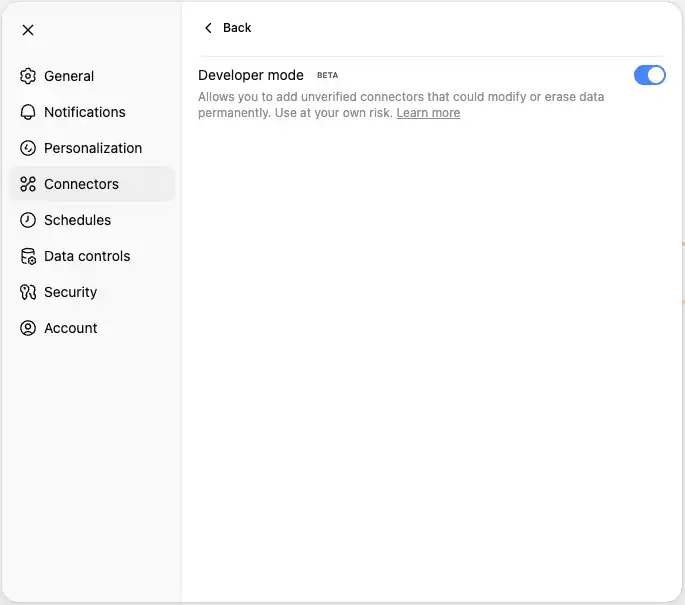
- Once developer mode is enabled, return to the Connectors page and click Create.
- Enter a name for the connector (such as Connect AI MCP).
- In the Remote MCP server URL field, enter:
https://mcp.cloud.cdata.com/mcp
- Set Authentication to "OAuth."
- Check I trust this application and click Create.
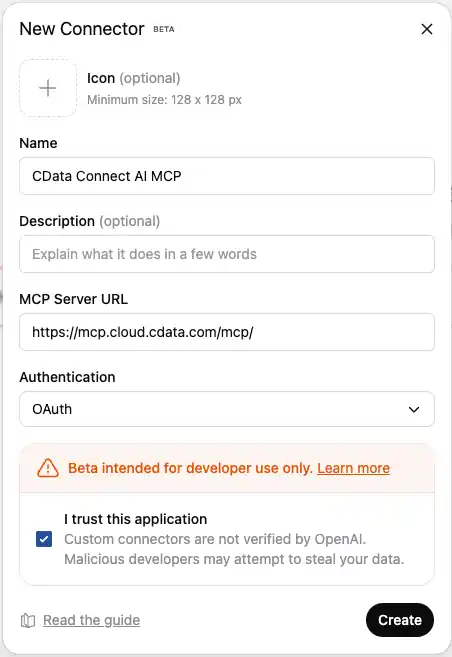
- You will be redirected to CData Connect AI's OAuth authorization page. Sign in with your Connect AI credentials.
- Review the permissions requested and click Authorize to grant ChatGPT access to your Connect AI resources.
- After successful authorization, you will be redirected back to ChatGPT.
- The Connect AI MCP Server will now appear in your available connectors list where you can manage the connector and enable/disable actions (tools).

IMPORTANT: ChatGPT's developer mode provides full read/write MCP access. Be cautious when allowing write operations to your data sources. Always review and confirm any data modifications before allowing them to proceed.
NOTE: Developer mode is in beta and only available to ChatGPT Plus and Pro subscribers. Refer to OpenAI's documentation for the latest setup information.
Step 4: Explore Your Data with Natural Language
Now it's time to start asking questions about your data.
- Start a new conversation in ChatGPT.
- In the tool picker, enable "Developer Mode."
- Enable your Connect AI MCP Server.
- Try asking questions like:
- "Show me a picture of the health for Aurora Healthcare Systems"
- "Which customers have high support ticket volume but low product usage?"
- "Analyze the top 5 accounts by revenue and identify any health risks"
- "What accounts have open opportunities but also critical support tickets?"
- ChatGPT will use the Connect AI MCP server to query your Google Sheets data and provide insights and recommendations.

Example: Analyzing Customer Data
When you ask ChatGPT to "summarize the health of Aurora Healthcare Systems", it will:
- Query the account table for company information
- Analyze opportunities to understand the sales pipeline
- Review support tickets for any issues or trends
- Examine product usage metrics to gauge adoption
- Synthesize all data into a comprehensive summary with actionable insights
Refer to CData's prompt library for more prompt ideas.
Next Steps
Now that you have ChatGPT connected to your data, you can:
- Connect additional data sources beyond Google Sheets (Salesforce, Zendesk, Snowflake, etc.)
- Ask more sophisticated questions that combine data across multiple tables
- Use Connect AI's integration capabilities to connect ChatGPT to your production data
Get Started with CData Connect AI
To get live data access to 300+ SaaS, Big Data, and NoSQL sources directly from your AI applications, try CData Connect AI today!
