






Integrating LlamaIndex with BigQuery Data via CData Connect AI
LlamaIndex is a data framework for building LLM applications — agents, RAG pipelines, and structured workflows that reason over external data. By integrating LlamaIndex with CData Connect AI through the built-in MCP Server, your agents can discover and query live BigQuery data as native tools without writing custom connectors.
CData Connect AI offers a secure, low-code environment to connect BigQuery and other data sources, removing the need for complex ETL and enabling seamless automation across business applications with live data.
This article outlines how to configure BigQuery connectivity in CData Connect AI, register the MCP server with LlamaIndex, and build a ReAct agent that queries BigQuery data in real time.
Prerequisites
- An account in CData Connect AI
- Python version 3.10 or higher, to install the LlamaIndex packages
- Generate and save an OpenAI API key
- Install Visual Studio Code in your system
About BigQuery Data Integration
CData simplifies access and integration of live Google BigQuery data. Our customers leverage CData connectivity to:
- Simplify access to BigQuery with broad out-of-the-box support for authentication schemes, including OAuth, OAuth JWT, and GCP Instance.
- Enhance data workflows with Bi-directional data access between BigQuery and other applications.
- Perform key BigQuery actions like starting, retrieving, and canceling jobs; deleting tables; or insert job loads through SQL stored procedures.
Most CData customers are using Google BigQuery as their data warehouse and so use CData solutions to migrate business data from separate sources into BigQuery for comprehensive analytics. Other customers use our connectivity to analyze and report on their Google BigQuery data, with many customers using both solutions.
For more details on how CData enhances your Google BigQuery experience, check out our blog post: https://www.cdata.com/blog/what-is-bigquery
Getting Started
Step 1: Configure BigQuery Connectivity for LlamaIndex
Before LlamaIndex can access BigQuery, a BigQuery connection must be created in CData Connect AI. This connection is then exposed to LlamaIndex through the remote MCP server.
- Log in to Connect AI, click Sources, and then click + Add Connection

- From the available data sources, choose BigQuery

-
BigQuery uses OAuth to authenticate. Click "Sign in" to authenticate with BigQuery
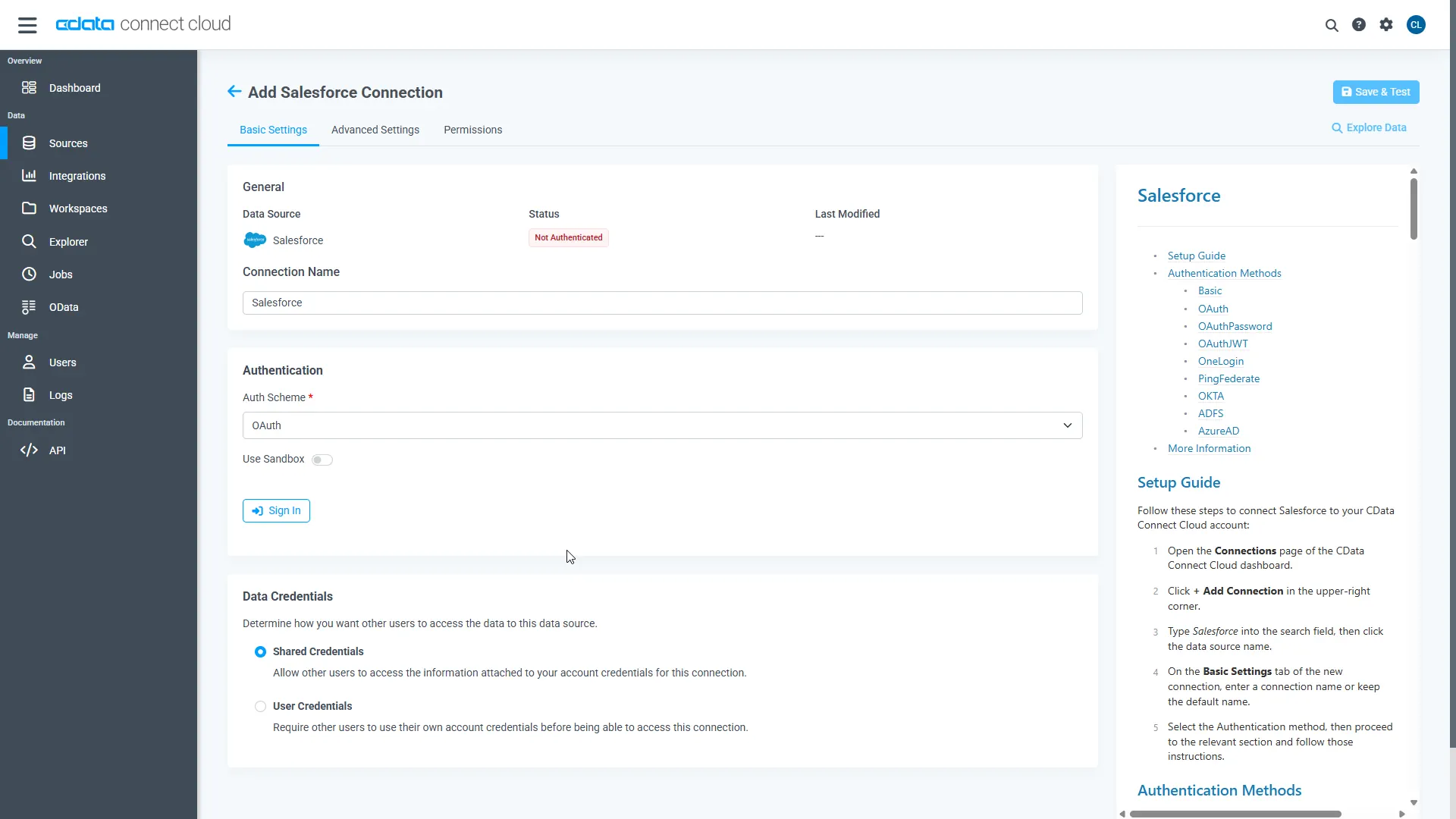
- Once authenticated, open the Permissions tab in the BigQuery connection and configure user-based permissions as required

Generate a Personal Access Token (PAT)
LlamaIndex authenticates to Connect AI using an account email and a Personal Access Token (PAT). Creating separate PATs for each integration is recommended to maintain access control granularity.
- In Connect AI, select the Gear icon in the top-right to open Settings
- Under Access Tokens, select Create PAT
- Provide a descriptive name for the token and select Create

- Copy the token and store it securely. The PAT will only be visible during creation
With the BigQuery connection configured and a PAT generated, LlamaIndex is prepared to connect to BigQuery data through the CData MCP server.
Step 2: Connect to the MCP server in LlamaIndex
To connect LlamaIndex with CData Connect AI Remote MCP Server and use OpenAI for reasoning, configure your MCP server endpoint and authentication in a
config.pyfile. These values let LlamaIndex’s MCP tool spec call the MCP server tools, while OpenAI handles the natural language reasoning.
- Create a folder for the LlamaIndex MCP project
- Create two Python files within the folder:
config.py
andllamaindex_agent.py
- In
config.py
, define your MCP server URL and your Base64-encoded CData Connect AI email and PAT (obtained in the prerequisites):class Config: MCP_BASE_URL = "https://mcp.cloud.cdata.com/mcp" # MCP Server URL MCP_AUTH = "base64encoded(EMAIL:PAT)" # Base64 encoded Connect AI Email:PATNote: You can create the base64 encoded version of MCP_AUTH using any Base64 encoding tool.
- In
llamaindex_agent.py
, wire up the MCP tool spec and a ReAct agent:""" Integrates a LlamaIndex ReAct agent with the CData Connect AI MCP server. The script discovers MCP tools, wraps them as LlamaIndex tools, and runs an agent loop driven by OpenAI for reasoning. """ import asyncio from llama_index.tools.mcp import BasicMCPClient, McpToolSpec from llama_index.core.agent.workflow import ReActAgent from llama_index.llms.openai import OpenAI from config import Config async def main(): # Initialize the MCP client pointed at Connect AI mcp_client = BasicMCPClient( Config.MCP_BASE_URL, headers={"Authorization": f"Basic {Config.MCP_AUTH}"}, ) # Discover tools the MCP server exposes (getCatalogs, queryData, etc.) tool_spec = McpToolSpec(client=mcp_client) tools = await tool_spec.to_tool_list_async() print("Discovered MCP tools:", [t.metadata.name for t in tools]) # Configure the LLM that drives the ReAct loop llm = OpenAI( model="gpt-4o", temperature=0.2, api_key="YOUR_OPENAI_API_KEY", # https://platform.openai.com/ ) # Build the agent with the MCP-backed tools agent = ReActAgent(tools=tools, llm=llm) user_prompt = "How many tables are available in GoogleBigQuery1?" # Change as needed print(f" User prompt: {user_prompt}") response = await agent.run(user_prompt) print("Agent final response:", response) if __name__ == "__main__": asyncio.run(main())
Step 3: Install the LlamaIndex packages
Since this workflow uses LlamaIndex together with the CData Connect AI MCP server and OpenAI for reasoning, install the required Python packages.
Run the following command in your project terminal:
pip install llama-index llama-index-tools-mcp llama-index-llms-openai
Step 4: Prompt BigQuery using LlamaIndex (via the MCP server)
- When the installation finishes, run
python llamaindex_agent.py
to execute the script - The script connects to the MCP server and discovers the CData Connect AI MCP tools available for querying your connected data
- Supply a prompt (e.g., "How many tables are available in BigQuery?")
- The agent reasons over the available tools, calls
queryData
against BigQuery, and responds with the result
Get CData Connect AI
To get live data access to hundreds of SaaS, Big Data, and NoSQL sources directly from your cloud applications, try CData Connect AI today!