




Connect to CleverPush Data from PowerBuilder via JDBC

The CData JDBC driver for CleverPush is a standards-based control that can be used from any platform or development technology that supports JDBC, including PowerBuilder. This article shows how to use the CData JDBC Driver for CleverPush in PowerBuilder.
This article shows how to create a basic PowerBuilder application that uses the CData JDBC Driver for CleverPush to retrieve data.
Connect to CleverPush Data from PowerBuilder
Follow the steps below to use the Database Painter tool to create a database profile based on an JDBC URL for CleverPush. You can use a database profile to save connection properties. In the Database Painter, you can graphically manipulate data as well as execute SQL queries.
Add the driver JAR to the PowerBuilder classpath. Set the CLASSPATH system environment variable to the path to the driver JAR, located in the lib subfolder of the installation directory.
Note: If you are using PowerBuilder Classic, you can also add the path to the driver JAR by clicking Tools -> System Options -> Java.
- Click Tools -> Database Painter.
- Right-click the JDBC node and click New Profile.
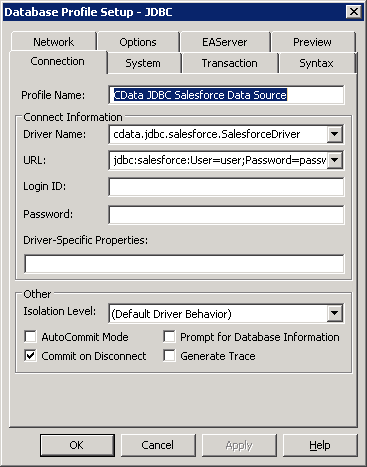
- In the Database Profile Setup dialog, enter the following:
- Profile Name: Enter a user-friendly name for the profile.
- Driver Name: Enter the class name of the driver, cdata.jdbc.api.APIDriver
- URL: Enter the JDBC URL.
Start by setting the Profile connection property to the location of the Cleverpush Profile on disk (e.g. C:\profiles\Cleverpush.apip). Next, set the ProfileSettings connection property to the connection string for Cleverpush (see below).
Cleverpush API Profile Settings
CleverPush uses private API keys to authenticate requests. Your API key is passed as the Authorization request header value on every API call.
You can find your private API key in the CleverPush dashboard under Settings > API. Use the private key (not the public key) for server-side access.
After setting the following connection properties, you are ready to connect:
- AuthScheme: Set this to APIKey.
- APIKey: Set this to your CleverPush private API key.
Optional Connection Properties
- ChannelId: Set this to your default CleverPush channel identifier. Most tables require a channel filter. Setting this property allows queries without specifying ChannelId in every WHERE clause.
Built-in Connection String Designer
For assistance in constructing the JDBC URL, use the connection string designer built into the CleverPush JDBC Driver. Either double-click the JAR file or execute the jar file from the command-line.
java -jar cdata.jdbc.api.jarFill in the connection properties and copy the connection string to the clipboard. A typical JDBC URL is below:
jdbc:api:Profile=C:\profiles\Cleverpush.apip;ProfileSettings='APIKey=my_api_key';
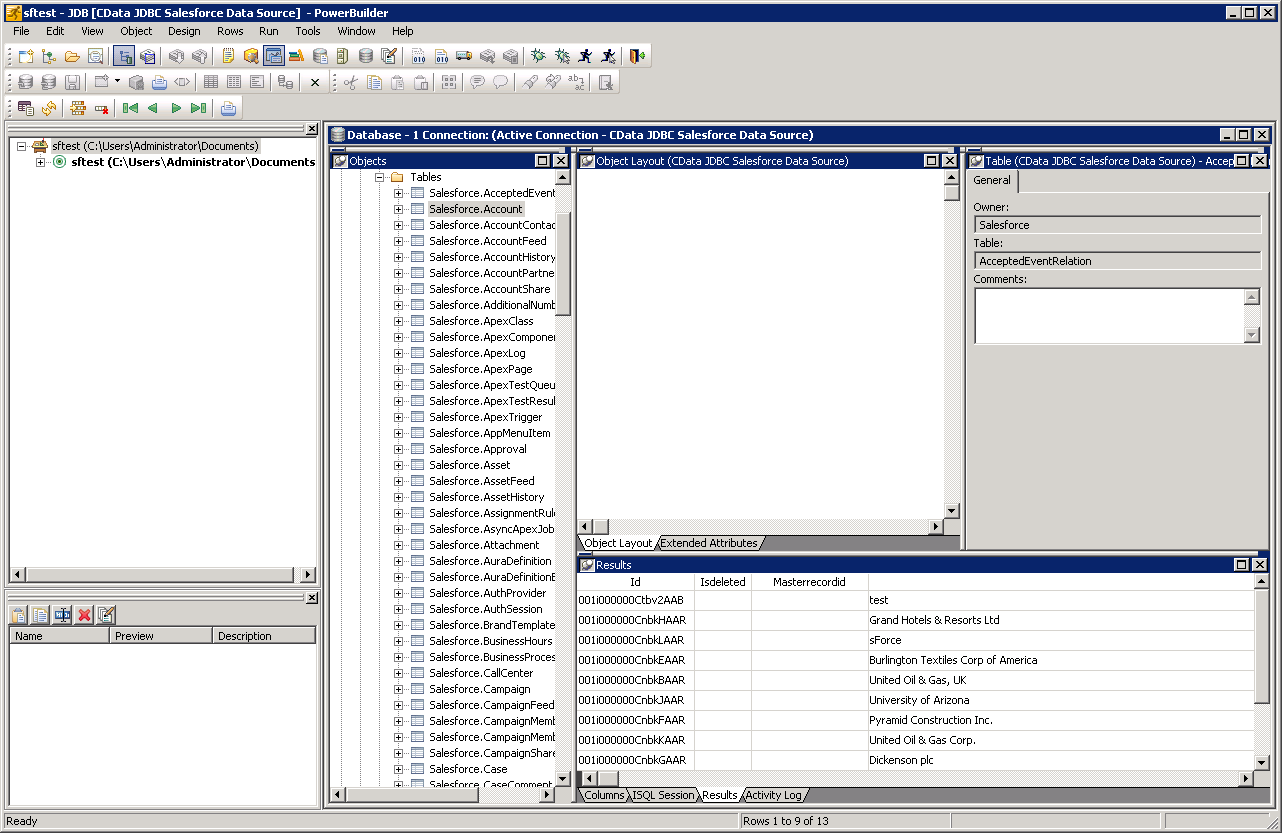
- To view and modify a table, right-click a table and then click Edit Data -> Grid.
Using CleverPush Data with PowerBuilder Controls
You can use standard PowerBuilder objects to connect to JDBC data sources and execute queries. The following example shows how to retrieve CleverPush data into a DataWindow. You can add the following code to the open method:
SQLCA.DBMS = "JDBC"
SQLCA.AutoCommit = False
SQLCA.DBParm = "Driver='cdata.jdbc.api.APIDriver',URL='jdbc:api:Profile=C:\profiles\Cleverpush.apip;ProfileSettings='APIKey=my_api_key';";
CONNECT USING SQLCA;
dw_segments.SetTransObject(SQLCA);
dw_segments.Retrieve();