



How to Connect to Live Databricks Data in n8n Workflows and Agents (via CData Connect AI)

n8n is an open-source workflow automation tool that allows you to connect various applications and services to automate tasks and processes. When combined with CData Connect AI Remote MCP, you can leverage n8n to interact with your Databricks data in real-time. This article outlines the process of connecting to Databricks using Connect AI Remote MCP and creating a basic workflow in n8n to interact with your Databricks data.
CData Connect AI offers a dedicated cloud-to-cloud interface for connecting to Databricks data. The CData Connect AI Remote MCP Server enables secure communication between n8n and Databricks. This allows you to ask questions and take actions on your Databricks data using n8n, all without the need for data replication to a natively supported database. With its inherent optimized data processing capabilities, CData Connect AI efficiently channels all supported SQL operations, including filters and JOINs, directly to Databricks. This leverages server-side processing to swiftly deliver the requested Databricks data.
In this article, we show how to build a simple chat agent in n8n to conversational explore (or Vibe Query) your data. The connectivity principals apply to any n8n workflow. With Connect AI you can build workflows and agents with access to live Databricks data, plus hundreds of other sources.
About Databricks Data Integration
Accessing and integrating live data from Databricks has never been easier with CData. Customers rely on CData connectivity to:
- Access all versions of Databricks from Runtime Versions 9.1 - 13.X to both the Pro and Classic Databricks SQL versions.
- Leave Databricks in their preferred environment thanks to compatibility with any hosting solution.
- Secure authenticate in a variety of ways, including personal access token, Azure Service Principal, and Azure AD.
- Upload data to Databricks using Databricks File System, Azure Blog Storage, and AWS S3 Storage.
While many customers are using CData's solutions to migrate data from different systems into their Databricks data lakehouse, several customers use our live connectivity solutions to federate connectivity between their databases and Databricks. These customers are using SQL Server Linked Servers or Polybase to get live access to Databricks from within their existing RDBMs.
Read more about common Databricks use-cases and how CData's solutions help solve data problems in our blog: What is Databricks Used For? 6 Use Cases.
Getting Started
Step 1: Configure Databricks Connectivity for n8n
Connectivity to Databricks from n8n is made possible through CData Connect AI Remote MCP. To interact with Databricks data from n8n, we start by creating and configuring a Databricks connection in CData Connect AI.
- Log into Connect AI, click Sources, and then click Add Connection
- Select "Databricks" from the Add Connection panel
-
Enter the necessary authentication properties to connect to Databricks.
To connect to a Databricks cluster, set the properties as described below.
Note: The needed values can be found in your Databricks instance by navigating to Clusters, and selecting the desired cluster, and selecting the JDBC/ODBC tab under Advanced Options.
- Server: Set to the Server Hostname of your Databricks cluster.
- HTTPPath: Set to the HTTP Path of your Databricks cluster.
- Token: Set to your personal access token (this value can be obtained by navigating to the User Settings page of your Databricks instance and selecting the Access Tokens tab).

- Click Save & Test
-
Navigate to the Permissions tab in the Add Databricks Connection page and update the User-based permissions.



Add a Personal Access Token
A Personal Access Token (PAT) is used to authenticate the connection to Connect AI from n8n. It is best practice to create a separate PAT for each service to maintain granularity of access.
- Click on the Gear icon () at the top right of the Connect AI app to open the settings page.
- On the Settings page, go to the Access Tokens section and click Create PAT.
-
Give the PAT a name and click Create.

- The personal access token is only visible at creation, so be sure to copy it and store it securely for future use.
With the connection configured and a PAT generated, we are ready to connect to Databricks data from n8n.
Step 2: Connect n8n to CData Connect AI
Follow these steps to connect to CData Connect AI in n8n:
- Sign in to n8n.io or create a new account.
-
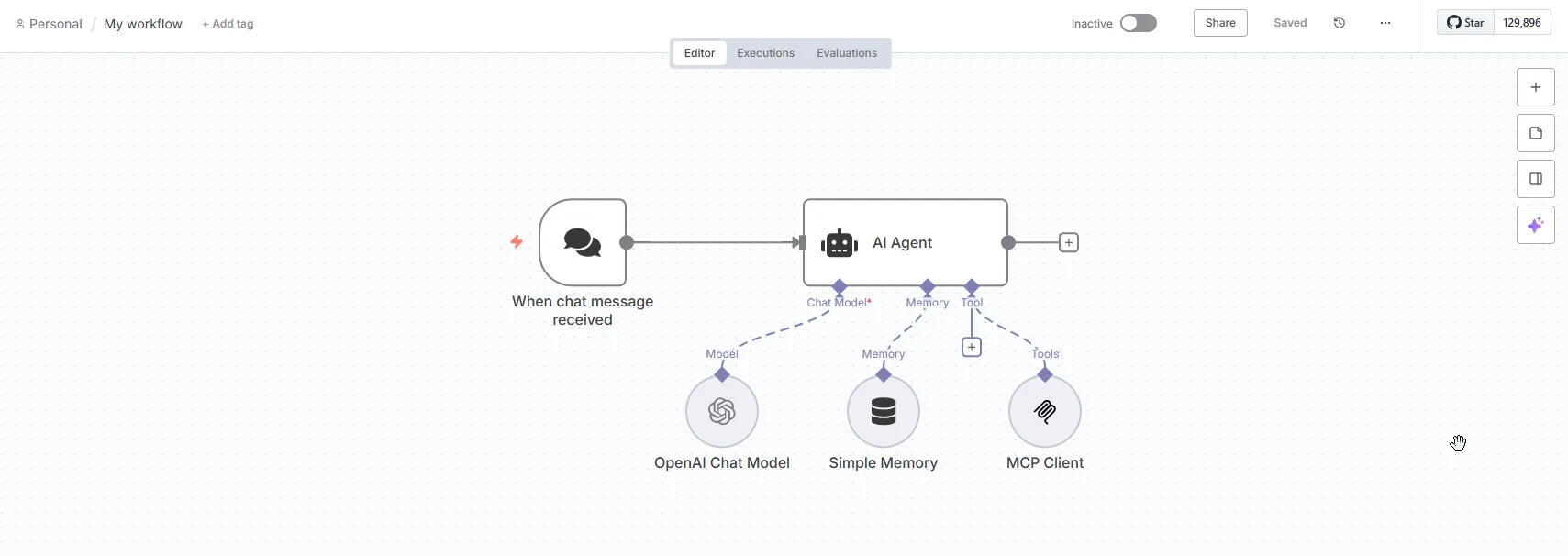
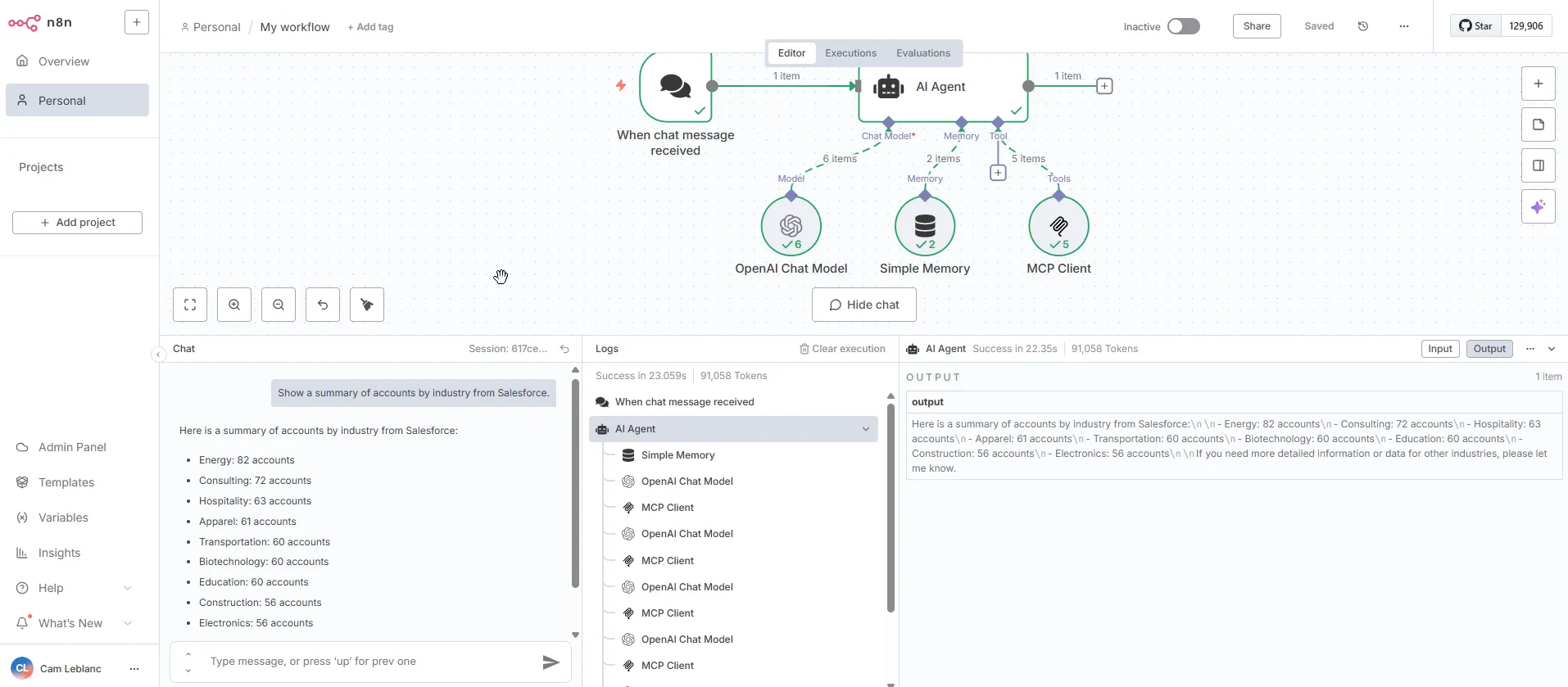
Create a Workflow in n8n that uses the MCP Client tool. The example Workflow below acts as a chatbot. OpenAI was used as the Chat Model, and Simple Memory was used for the Memory.
-
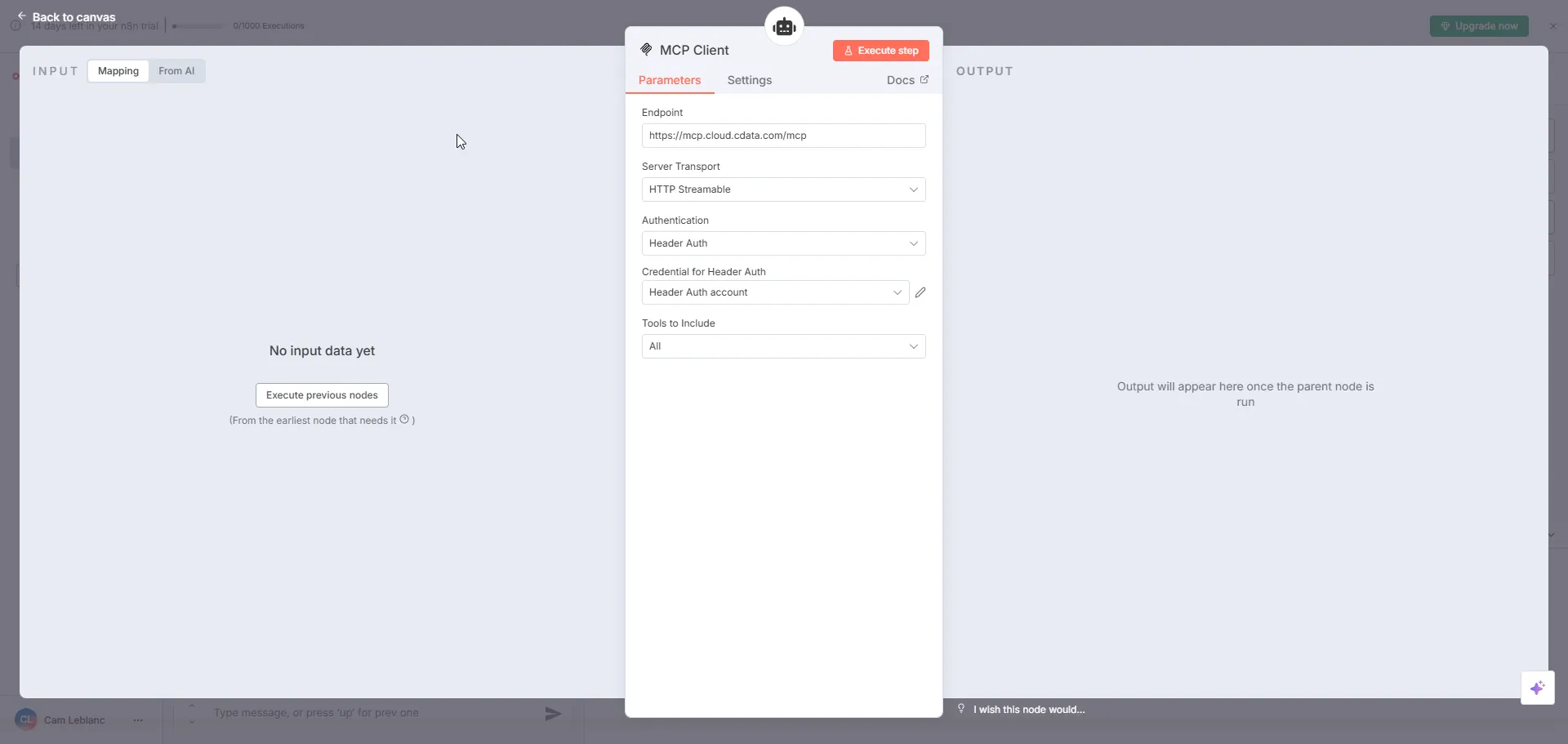
Configure the MCP Client node in the Workflow:
- Set Endpoint to https://mcp.cloud.cdata.com/mcp (found in the "Connect Data to AI" ribbon in Connect AI)
- Set Server Transport to HTTP Streamable
-
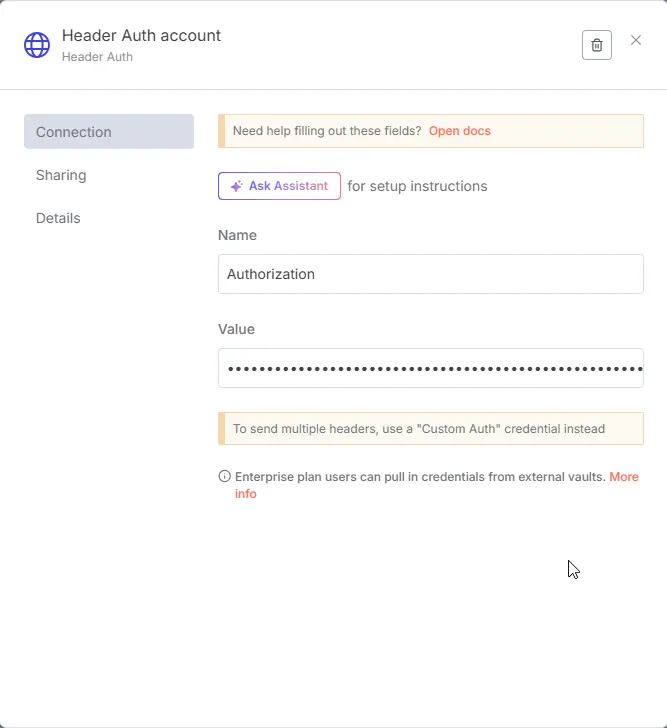
Set Authentication to Header Auth and set the following properties to use Basic authentication:
- Set Name to Authorization
- Set Value to Basic EMAIL:PAT, replacing the EMAIL and PAT with your Connect AI email address and the PAT created previously. For example: Basic [email protected]:Uu90pt5vEO..."
Optional Step: Give the AI Agent context
This step establishes the AI Agent's role and provides context for the conversation through the System Message parameter in the AI Agent node. By providing a system message that explicitly informs the agent about its role as an MCP Server expert and lists the available tools, you can enhance the agent's understanding and response accuracy. For example, you can set the System Message to:
You are an expert at using the MCP Client tool connected which is the CData Connect AI MCP Server. Always search thoroughly and use the most relevant MCP Client tool for each query. Below are the available tools and a description of each:
queryData: Execute SQL queries against connected data sources and retrieve results. When you use the queryData tool, ensure you use the following format for the table name: catalog.schema.tableName
getCatalogs: Retrieve a list of available connections from CData Connect AI. The connection names should be used as catalog names in other tools and in any queries to CData Connect AI. Use the `getSchemas` tool to get a list of available schemas for a specific catalog.
getSchemas: Retrieve a list of available database schemas from CData Connect AI for a specific catalog. Use the `getTables` tool to get a list of available tables for a specific catalog and schema.
getTables: Retrieve a list of available database tables from CData Connect AI for a specific catalog and schema. Use the `getColumns` tool to get a list of available columns for a specific table.
getColumns: Retrieve a list of available database columns from CData Connect AI for a specific catalog, schema, and table.
getProcedures: Retrieve a list of stored procedures from CData Connect AI for a specific catalog and schema
getProcedureParameters: Retrieve a list of stored procedure parameters from CData Connect AI for a specific catalog, schema, and procedure.
executeProcedure: Execute stored procedures with parameters against connected data sources
Step 3: Explore Live Databricks Data with n8n
With the Workflow created in n8n and the MCP Client connected, you can now interact with your Databricks data using n8n. The MCP Client node allows you to send queries and receive responses from the Databricks data source in real-time.
Open the Workflow in n8n and execute it to start interacting with your Databricks data. You can ask questions, retrieve data, and perform actions on your Databricks data using the MCP Client node:
Get CData Connect AI
To get live data access to 300+ SaaS, Big Data, and NoSQL sources directly from your cloud applications, try CData Connect AI today!
