




How to Access Live Databricks Data in Visual Studio Code via Cline

Cline is an autonomous coding agent right in your IDE, capable of creating/editing files, running commands, using the browser, and more with your permission every step of the way. When paired with the CData MCP Server for Databricks, you get live access to CRM data within your IDE, enabling you to build, test, and validate data-driven features using real-time schema and records without ever leaving your development environment.
This article outlines how to run the CData MCP Server for Databricks on WSL (Windows Subsystem for Linux) and connect to it from the Cline extension in Visual Studio Code on Windows.
Background
CData MCP Servers are typically designed for clients like Claude Desktop. However, when attempting to use the server via the Cline extension in Windows VS Code, the following error occurred:
MCP error -32000: Connection closed
This issue is suspected to be caused by I/O handling problems in the stdio transport implementation on the Windows version of the Cline extension.
- Related GitHub Issue: https://github.com/cline/cline/issues/3464
- Additionally, environment variables such as PATH may not be inherited correctly when launching processes like Java or Node.
Prerequisites
- Visual Studio Code installed on Windows
- Cline extension installed and configured in VS Code
- Windows Subsystem for Linux (WSL) installed with a working Linux distribution (e.g., Ubuntu)
- Java 21+ JRE installed in WSL
- CData MCP Server for Databricks installed on Windows
Step 1: Authenticate with Databricks (on Windows)
Before running the MCP Server in WSL, you must complete authentication flow in a Windows environment. This ensures all necessary credentials are generated and stored properly. Find and run the "CData MCP Server for Databricks" or execute the MCP Server JAR file to open the configuration wizard.
java -jar "C:\Program Files\CData\CData MCP Server for Databricks 2024\lib\cdata.mcp.databricks.jar"
Connecting to Databricks
To connect to a Databricks cluster, set the properties as described below.
Note: The needed values can be found in your Databricks instance by navigating to Clusters, and selecting the desired cluster, and selecting the JDBC/ODBC tab under Advanced Options.
- Server: Set to the Server Hostname of your Databricks cluster.
- HTTPPath: Set to the HTTP Path of your Databricks cluster.
- Token: Set to your personal access token (this value can be obtained by navigating to the User Settings page of your Databricks instance and selecting the Access Tokens tab).
Configuring the CData MCP Server
Name your MCP Server (e.g. cdatadatabricks), enter the required connection properties, and click "Connect."
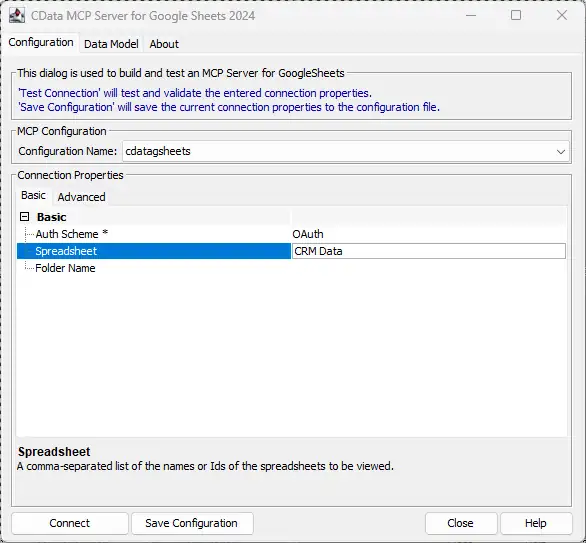
Upon successful connection, the following directory and files will be created:
C:\Users\<username>\AppData\Roaming\CData\databricks Provider\
 |-- cdatadatabricks.mcp
 |-- (other supporting config files)
Step 2: Copy the MCP Server Configuration into WSL
Next, copy the entire configuration folder from Windows into your WSL environment.
mkdir -p ~/.config/CData/
cp -r /mnt/c/Users/<username>/AppData/Roaming/CData/"databricks Provider" ~/.config/CData/
Ensure the destination path matches exactly: ~/.config/CData/databricks Provider/.
Step 3: Install the MCP Server on WSL
Install Java and place the MCP Server JAR in the desired location within WSL:
sudo apt update
sudo apt install openjdk-21-jre-headless
sudo mkdir -p /opt/cdata/mcp_databricks/lib
sudo cp /mnt/c/Program\ Files/CData/CData\ MCP\ Server\ for\ Databricks\ 2024/lib/cdata.mcp.databricks.jar /opt/cdata/mcp_databricks/lib/
Step 4: Configure Cline
Now, configure the Cline extension to launch the MCP Server inside WSL using the wsl command.
Create or update cline_mcp_settings.json with the following content:
{
  "mcpServers": {
    "cdatadatabricks": {
      "autoApprove": ["*"],
      "disabled": false,
      "timeout": 60,
      "type": "stdio",
      "command": "wsl",
      "args": [
        "-d",
        "Ubuntu", // Replace with your installed WSL distro name
        "--",
        "/usr/bin/java",
        "-jar",
        "/opt/cdata/mcp_databricks/lib/cdata.mcp.databricks.jar",
        "cdatadatabricks"
      ],
      "env": {
        "JAVA_TOOL_OPTIONS": "-Xmx2g"
      }
    }
  }
}
Note: Replace Ubuntu with your actual WSL distribution name (e.g., Ubuntu-22.04). Run wsl -l in PowerShell or CMD to confirm.
Step 5: Interact with Live Data in Cline
From within Visual Studio Code, you can now run MCP commands through the Cline extension.
cdatadatabricks_get_tables
cdatadatabricks_get_columns Customers
If configured correctly, these commands will return a list of available Databricks objects and metadata, allowing you to interact with your CRM schema in real time.
Try natural language prompts like:
- "Generate a React form to create a new Databricks Lead."
- "Write a Python function to pull Opportunities closed this quarter."
Connect your AI to your data today!
CData MCP Servers make it easier than ever for LLMs to work with live enterprise data. To explore the technology hands-on, download a free, 30-day trial or visit the CData Community to share insights, ask questions, and help shape the future of enterprise-ready AI.
Ready to get started?
Download a free Databricks MCP Server to get started:
Download NowLearn more:
 Databricks MCP Server
The CData MCP Server for Databricks allows you to connect with live Databricks data, directly from LLMs that support MCP.
