Excel Spreadsheet Automation on Datadog Data with the QUERY Formula

The CData Excel Add-In for Datadog provides formulas that can query Datadog data. The following three steps show how you can automate the following task: Search Datadog data for a user-specified value and then organize the results into an Excel spreadsheet.
The syntax of the CDATAQUERY formula is the following:
=CDATAQUERY(Query, [Connection], [Parameters], [ResultLocation]);
This formula requires three inputs:
- Query: The declaration of the Datadog data records you want to retrieve, written in standard SQL.
Connection: Either the connection name, such as APIConnection1, or a connection string. The connection string consists of the required properties for connecting to Datadog data, separated by semicolons.
Start by setting the Profile connection property to the location of the Datadog Profile on disk (e.g. C:\profiles\Datadog.apip). Next, set the ProfileSettings connection property to the connection string for Datadog (see below).
Datadog API Profile Settings
In your Datadog account, navigate to Organization Settings > API Keys to create an API Key, and Organization Settings > Application Keys to create an Application Key. Both are required.
- ResultLocation: The cell that the output of results should start from.
Pass Spreadsheet Cells as Inputs to the Query
The procedure below results in a spreadsheet that organizes all the formula inputs in the first column.
- Define cells for the formula inputs. In addition to the connection inputs, add another input to define a criterion for a filter to be used to search Datadog data, such as IsEnabled.
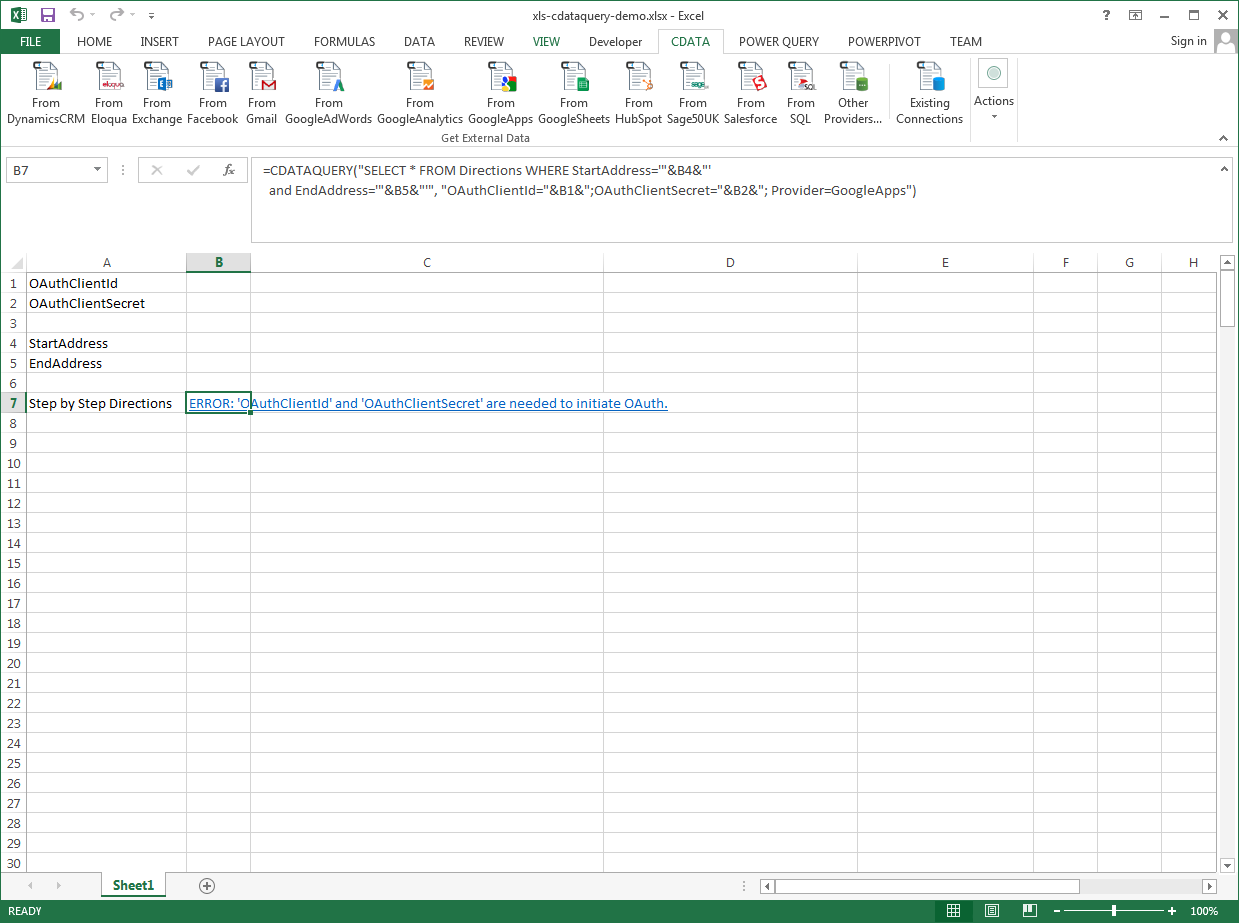
- In another cell, write the formula, referencing the cell values from the user input cells defined above. Single quotes are used to enclose values such as addresses that may contain spaces.
- Change the filter to change the data.
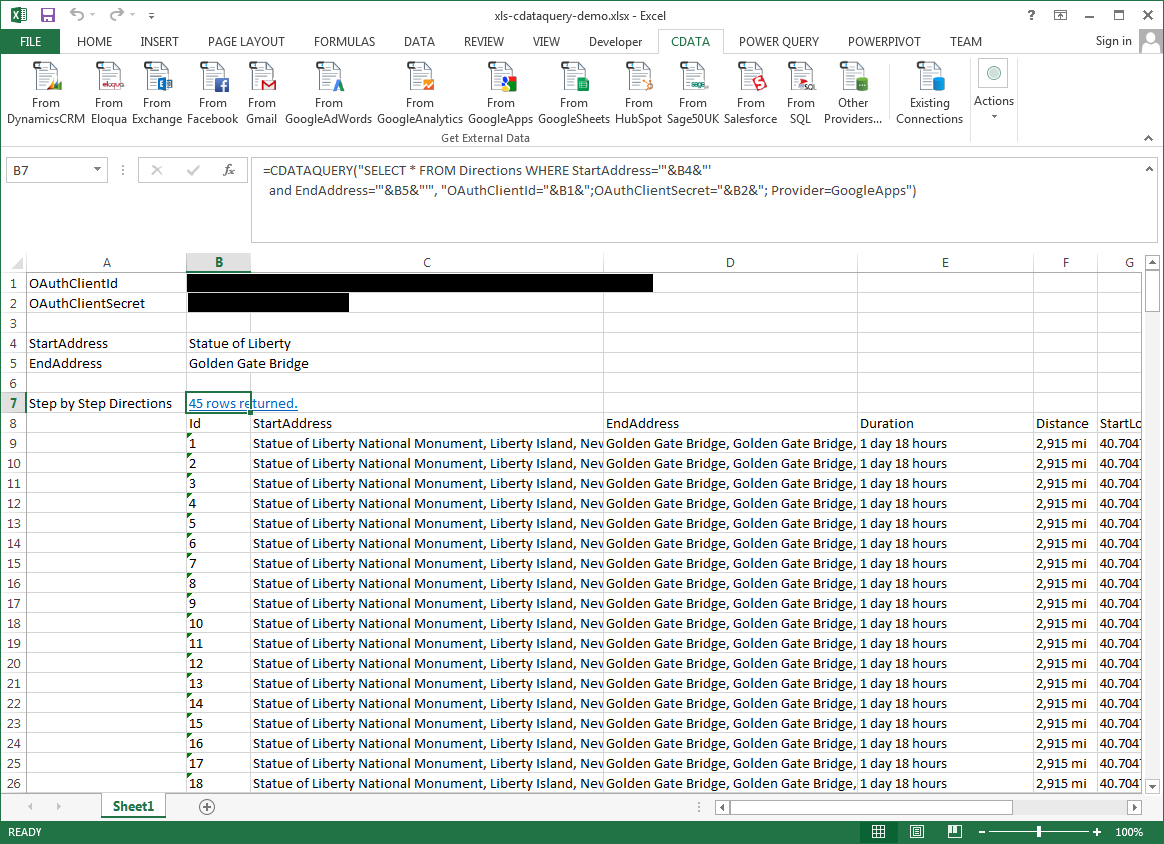
=CDATAQUERY("SELECT * FROM APMRetentionFilters WHERE IsEnabled = '"&B5&"'","Profile="&B1&";ProfileSettings="&B2&";ApplicationKey="&B3&";Provider=API",B6)