



Use ChatGPT to Talk to Your Elasticsearch Data via CData Connect AI

ChatGPT is an AI chatbot developed by OpenAI, launched in November 2022. Based on large language models (LLMs), it enables users to refine and steer conversations through natural language processing. ChatGPT's developer mode, available to Plus and Pro subscribers, provides full Model Context Protocol (MCP) support for connecting to external data sources and tools.
CData Connect AI offers a dedicated cloud-to-cloud interface for connecting to Elasticsearch data. The CData Connect AI Remote MCP Server enables secure communication between ChatGPT and Elasticsearch. This allows you to ask questions and take actions on your Elasticsearch data using ChatGPT, all without the need for data replication to a natively supported database. With its inherent optimized data processing capabilities, CData Connect AI efficiently channels all supported SQL operations, including filters and JOINs, directly to Elasticsearch. This leverages server-side processing to swiftly deliver the requested Elasticsearch data.
About Elasticsearch Data Integration
Accessing and integrating live data from Elasticsearch has never been easier with CData. Customers rely on CData connectivity to:
- Access both the SQL endpoints and REST endpoints, optimizing connectivity and offering more options when it comes to reading and writing Elasticsearch data.
- Connect to virtually every Elasticsearch instance starting with v2.2 and Open Source Elasticsearch subscriptions.
- Always receive a relevance score for the query results without explicitly requiring the SCORE() function, simplifying access from 3rd party tools and easily seeing how the query results rank in text relevance.
- Search through multiple indices, relying on Elasticsearch to manage and process the query and results instead of the client machine.
Users frequently integrate Elasticsearch data with analytics tools such as Crystal Reports, Power BI, and Excel, and leverage our tools to enable a single, federated access layer to all of their data sources, including Elasticsearch.
For more information on CData's Elasticsearch solutions, check out our Knowledge Base article: CData Elasticsearch Driver Features & Differentiators.
Getting Started
Step 1: Configure Elasticsearch Connectivity for ChatGPT
Connectivity to Elasticsearch from ChatGPT is made possible through CData Connect AI Remote MCP. To interact with Elasticsearch data from ChatGPT, we start by creating and configuring a Elasticsearch connection in CData Connect AI.
- Log into Connect AI, click Sources, and then click Add Connection
- Select "Elasticsearch" from the Add Connection panel
-
Enter the necessary authentication properties to connect to Elasticsearch.
Set the Server and Port connection properties to connect. To authenticate, set the User and Password properties, PKI (public key infrastructure) properties, or both. To use PKI, set the SSLClientCert, SSLClientCertType, SSLClientCertSubject, and SSLClientCertPassword properties.
The data provider uses X-Pack Security for TLS/SSL and authentication. To connect over TLS/SSL, prefix the Server value with 'https://'. Note: TLS/SSL and client authentication must be enabled on X-Pack to use PKI.
Once the data provider is connected, X-Pack will then perform user authentication and grant role permissions based on the realms you have configured.

- Click Save & Test


With the connection configured, we are ready to connect to Elasticsearch data from ChatGPT.
Step 2: Connect ChatGPT to CData Connect AI
Follow these steps to add a CData Connect AI connector in ChatGPT:
- Sign in to ChatGPT with a Plus or Pro subscription.
- Navigate to Settings > Connectors.
- Under the "Advanced settings" section, toggle on Developer mode.
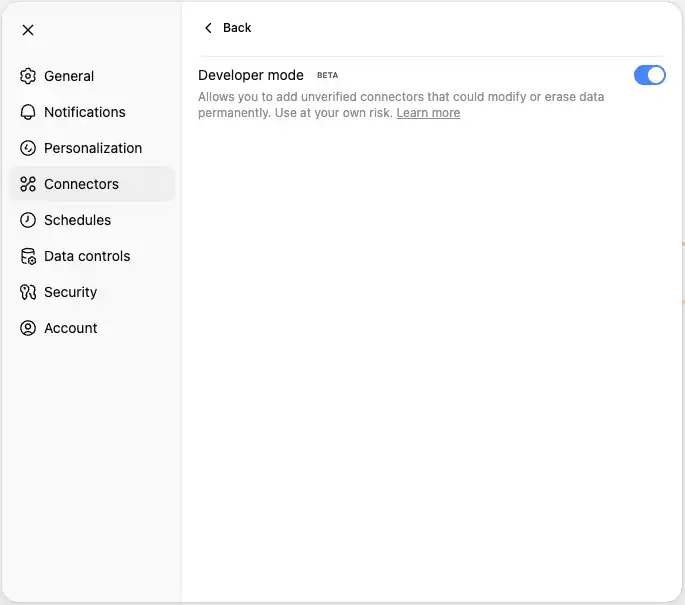
- Once developer mode is enabled, return to the Connectors page and click Create.
- Enter a name for the connector (such as Connect AI MCP).
- In the Remote MCP server URL field, enter:
https://mcp.cloud.cdata.com/mcp
- Set Authentication to "OAuth."
- Check I trust this application and click Create
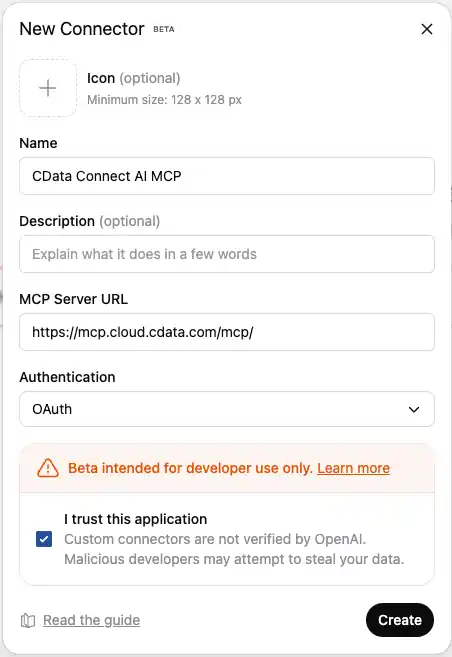
- You will be redirected to CData Connect AI's OAuth authorization page. Sign in with your Connect AI credentials.
- Review the permissions requested and click Authorize to grant ChatGPT access to your Connect AI resources.
- After successful authorization, you will be redirected back to ChatGPT.
- The Connect AI MCP Server will now appear in your available connectors list where you can manage the connector and enable/disable actions (tools).

Step 3: Explore Live Elasticsearch Data with ChatGPT
- Start a new conversation in ChatGPT.
- In the tool picker, enable "Developer Mode."
- Enable your Connect AI MCP Sever.
- You can now start exploring your data with natural language prompts. ChatGPT will use the Connect AI MCP server to query your live Elasticsearch data. Example prompts:
- "Show me all customers from the last 30 days"
- "What are my top performing products?"
- "Analyze sales trends for this quarter"
- "List all active projects and their current status"

- ChatGPT will translate your natural language queries into SQL and execute them against your Elasticsearch data through the Connect AI MCP server.
IMPORTANT: ChatGPT's developer mode provides full read/write MCP access. Be cautious when allowing write operations to your Elasticsearch data. Always review and confirm any data modifications before allowing them to proceed.
NOTE: Developer mode is in beta and only available to ChatGPT Plus and Pro subscribers. Refer to OpenAI's documentation for the latest setup information.
Get CData Connect AI
To get live data access to 300+ SaaS, Big Data, and NoSQL sources directly from your cloud applications, try CData Connect AI today!
