





Excel Spreadsheet Automation on Oracle Eloqua Reporting Data with the QUERY Formula

The CData Excel Add-In for Oracle Eloqua Reporting provides formulas that can query Oracle Eloqua Reporting data. The following three steps show how you can automate the following task: Search Oracle Eloqua Reporting data for a user-specified value and then organize the results into an Excel spreadsheet.
The syntax of the CDATAQUERY formula is the following:
=CDATAQUERY(Query, [Connection], [Parameters], [ResultLocation]);
This formula requires three inputs:
- Query: The declaration of the Oracle Eloqua Reporting data records you want to retrieve, written in standard SQL.
Connection: Either the connection name, such as OracleEloquaReportingConnection1, or a connection string. The connection string consists of the required properties for connecting to Oracle Eloqua Reporting data, separated by semicolons.
Oracle Eloqua Reporting supports the following authentication methods:
- Basic authentication (User and Password)
- OAuth 2.0 code grant flow
- OAuth 2.0 password grant flow
Basic Authentication (User and Password)
To perform authentication with a user and password, specify these properties:
- AuthScheme: Basic.
- Company: The company name associated with your Oracle Eloqua Reporting account.
- User: Your login account name.
- Password: Your login password.
OAuth Authentication (Code Grant Flow)
To authenticate with the OAuth code grant flow, you must set AuthScheme to OAuth and create a custom OAuth application. For information about how to create a custom OAuth application, see the Help documentation.
Then set the following properties:
- InitiateOAuth: GETANDREFRESH. Used to automatically get and refresh the OAuthAccessToken.
- OAuthClientId: The client Id assigned when you registered your application.
- OAuthClientSecret: The client secret that was assigned when you registered your application.
- CallbackURL: The redirect URI that was defined when you registered your application.
When you connect, the driver opens Oracle Eloqua Reporting's OAuth endpoint in your default browser. Log in and grant permissions to the application. When the access token expires, the driver refreshes it automatically.
OAuth Authentication (Password Grant Flow)
With the OAuth password grant flow, you can use your OAuth application's credentials alongside your user credentials to authenticate without the need to grant permission manually via a browser prompt. You must create an OAuth app (see the Help documentation) to use this authentication method.
Set the following properties:
- AuthScheme: OAuthPassword
- Company: The company's unique identifier.
- User: Your login account name.
- Password: Your login password.
- OAuthClientId: The client Id assigned when you registered your custom OAuth application.
- OAuthClientSecret: The client secret assigned when you registered your custom OAuth application.
- ResultLocation: The cell that the output of results should start from.
Pass Spreadsheet Cells as Inputs to the Query
The procedure below results in a spreadsheet that organizes all the formula inputs in the first column.
- Define cells for the formula inputs. In addition to the connection inputs, add another input to define a criterion for a filter to be used to search Oracle Eloqua Reporting data, such as .
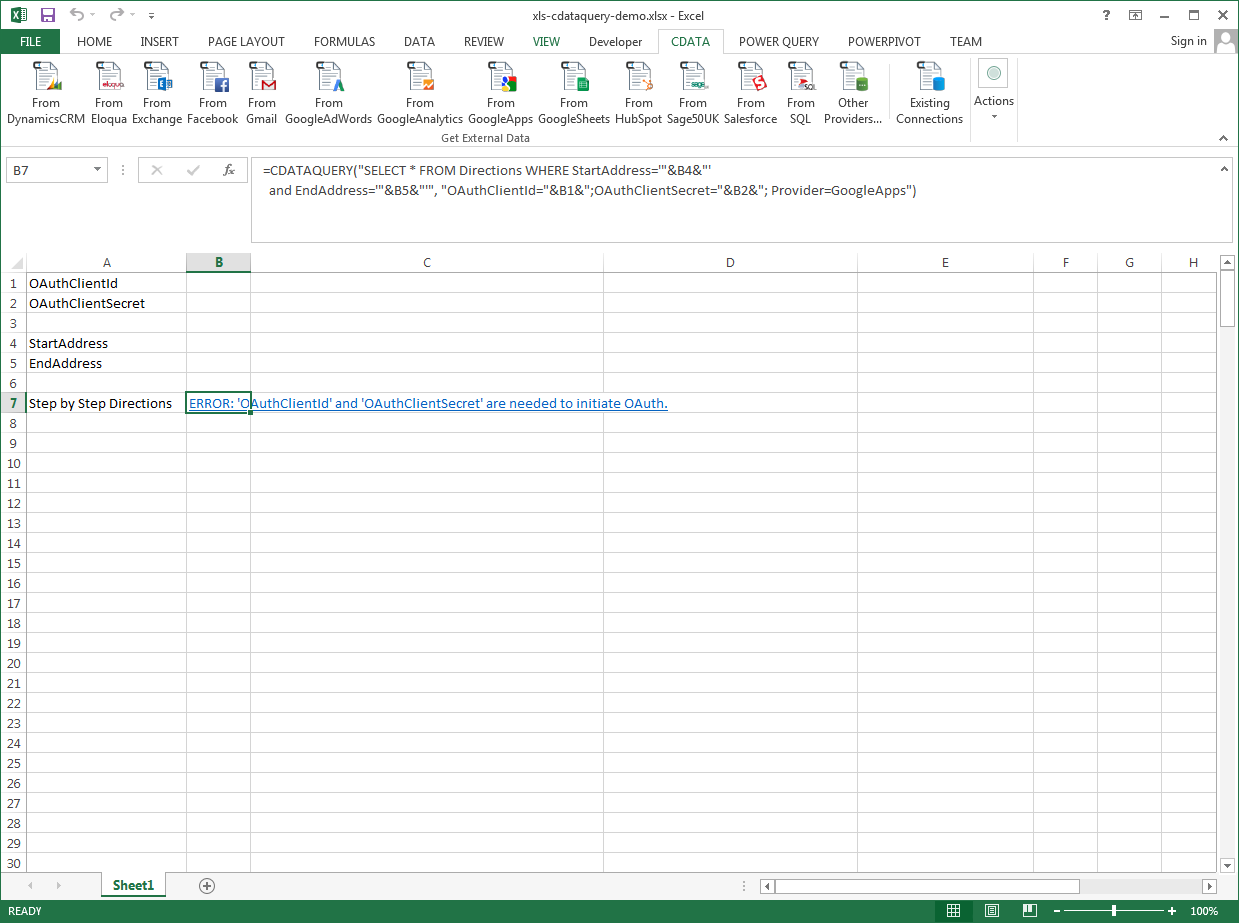
- In another cell, write the formula, referencing the cell values from the user input cells defined above. Single quotes are used to enclose values such as addresses that may contain spaces.
- Change the filter to change the data.
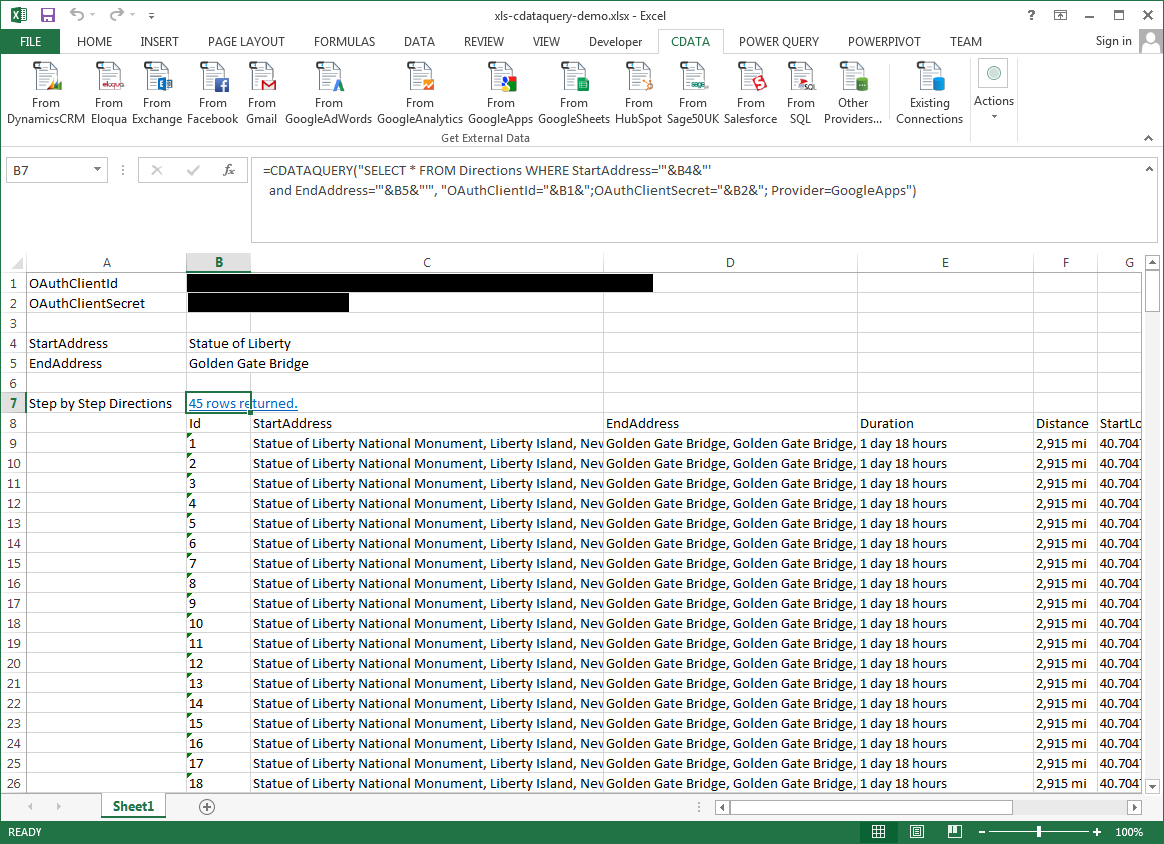
=CDATAQUERY("SELECT * FROM WHERE = '"&B5&"'","AuthScheme="&B1&";User="&B2&";Password="&B3&";Company="&B4&";Provider=OracleEloquaReporting",B6)
Ready to get started?
Download a free trial of the Excel Add-In for Oracle Eloqua Reporting to get started:
Download NowLearn more:
 Excel Add-In for Oracle Eloqua Reporting
The Oracle Eloqua Reporting Excel Add-In is a powerful tool that allows you to connect with live Oracle Eloqua Reporting data, directly from Microsoft Excel.
Use Excel to read, write, and update Oracle Eloqua Reporting 0, etc. Perfect for mass imports / exports / updates, data cleansing & de-duplication, Excel based data analysis, and more!
