






How to import Oracle Eloqua Reporting Data into Apache Solr

The Apache Solr platform is a popular, blazing-fast, open source enterprise search solution built on Apache Lucene.
Apache Solr is equipped with the Data Import Handler (DIH), which can import data from databases and, XML, CSV, and JSON files. When paired with the CData JDBC Driver for Oracle Eloqua Reporting, you can easily import Oracle Eloqua Reporting data to Apache Solr. In this article, we show step-by-step how to use CData JDBC Driver in Apache Solr Data Import Handler and import Oracle Eloqua Reporting data for use in enterprise search.
Create an Apache Solr Core and a Schema for Importing Oracle Eloqua Reporting
- Run Apache Solr and create a Core.
> solr create -c CDataCore
For this article, Solr is running as a standalone instance in the local environment and you can access the core at this URL: http://localhost:8983/solr/#/CDataCore/core-overview - Create a schema consisting of "field" objects to represent the columns of the Oracle Eloqua Reporting data to be imported and a unique key for the entity. LastModifiedDate, if it exists in Oracle Eloqua Reporting, is used for incremental updates. If it does not exist, you cannot do the deltaquery in the later section. Save the schema in the managed-schema file created by Apache Solr.
- Install the CData Oracle Eloqua Reporting JDBC Driver. Copy the JAR and license file (cdata.oracleeloquareporting.jar and cdata.jdbc.oracleeloquareporting.lic) to the Solr directory.
- CData JDBC JAR file: C:\Program Files\CData\CData JDBC Driver for Oracle Eloqua Reporting ####\lib
- Apache Solr: solr-8.5.2\server\lib
OracleEloquaReportingUniqueKey
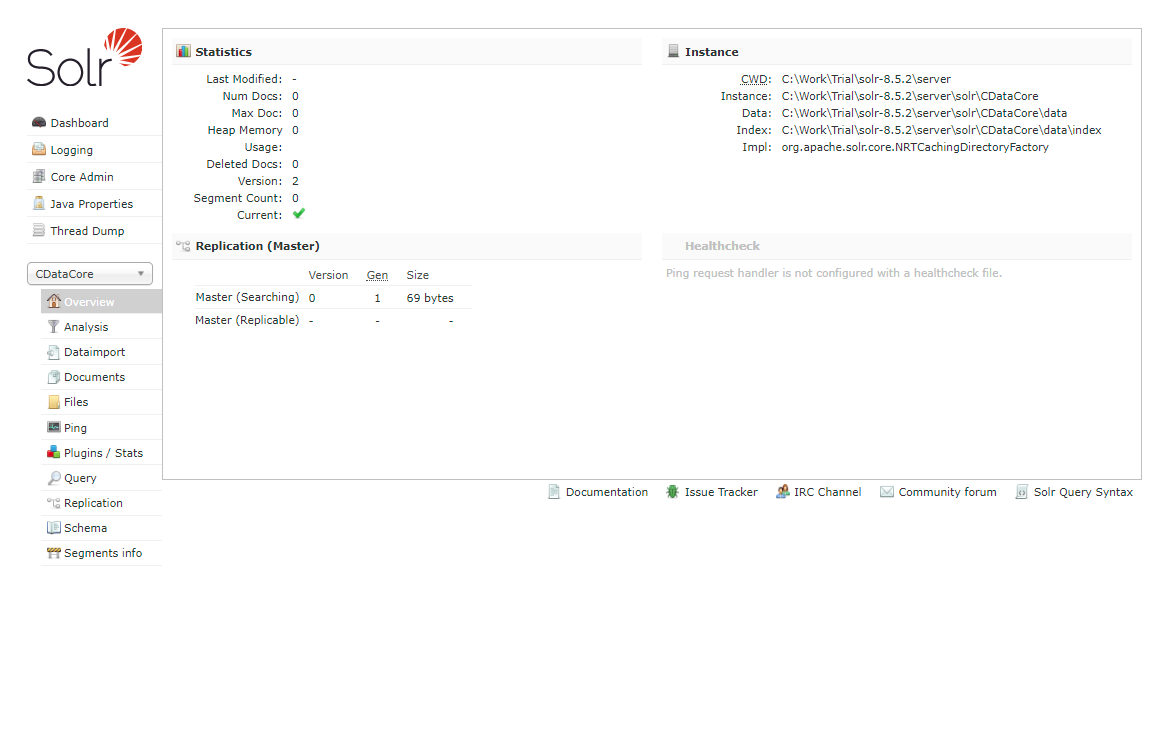
Now we are ready to use Oracle Eloqua Reporting data in Solr.
Define an Import of Oracle Eloqua Reporting to Apache Solr
In this section, we walk through configuring the Data Import Handler.
- Modify the Config file of the created Core. Add the JAR file reference and add the DIH RequestHander definition.
<lib dir="${solr.install.dir:../../../..}/dist/" regex="solr-dataimporthandler-.*\.jar" /> <requestHandler name="/dataimport" class="org.apache.solr.handler.dataimport.DataImportHandler"> <lst name="defaults"> <str name="config">solr-data-config.xml</str> </lst> </requestHandler> - Next, create a solr-data-config.xml at the same level. In this article, we retrieve a table from Oracle Eloqua Reporting, but you can use a custom SQL query to request data as well. The Driver Class and a sample JDBC Connection string are in the sample code below.
<dataConfig> <dataSource driver="cdata.jdbc.oracleeloquareporting.OracleEloquaReportingDriver" url="jdbc:oracleeloquareporting:AuthScheme=Basic;User=user;Password=password;Company=MyCompany;"> </dataSource> <document> <entity name="" query="SELECT Id,OracleEloquaReportingColumn1,OracleEloquaReportingColumn2,OracleEloquaReportingColumn3,OracleEloquaReportingColumn4,OracleEloquaReportingColumn5,OracleEloquaReportingColumn6,OracleEloquaReportingColumn7,LastModifiedDate FROM " deltaQuery="SELECT Id FROM where LastModifiedDate >= '${dataimporter.last_index_time}'" deltaImportQuery="SELECT Id,OracleEloquaReportingColumn1,OracleEloquaReportingColumn2,OracleEloquaReportingColumn3,OracleEloquaReportingColumn4,OracleEloquaReportingColumn5,OracleEloquaReportingColumn6,OracleEloquaReportingColumn7,LastModifiedDate FROM where Id=${dataimporter.delta.Id}"> <field column="Id" name="Id" ></field> <field column="OracleEloquaReportingColumn1" name="OracleEloquaReportingColumn1" ></field> <field column="OracleEloquaReportingColumn2" name="OracleEloquaReportingColumn2" ></field> <field column="OracleEloquaReportingColumn3" name="OracleEloquaReportingColumn3" ></field> <field column="OracleEloquaReportingColumn4" name="OracleEloquaReportingColumn4" ></field> <field column="OracleEloquaReportingColumn5" name="OracleEloquaReportingColumn5" ></field> <field column="OracleEloquaReportingColumn6" name="OracleEloquaReportingColumn6" ></field> <field column="OracleEloquaReportingColumn7" name="OracleEloquaReportingColumn7" ></field> <field column="LastModifiedDate" name="LastModifiedDate" ></field> </entity> </document> </dataConfig> - In the query section, set the SQL query that select the data from Oracle Eloqua Reporting. deltaQuery and deltaImportquery define the ID and the conditions when using incremental updates from the second import of the same entity.
- After all settings are done, restart Solr.
	> solr stop -all
	> solr start
Run a DataImport of Oracle Eloqua Reporting Data.
- Execute DataImport from the URL below:
http://localhost:8983/solr/#/CDataCore/dataimport//dataimport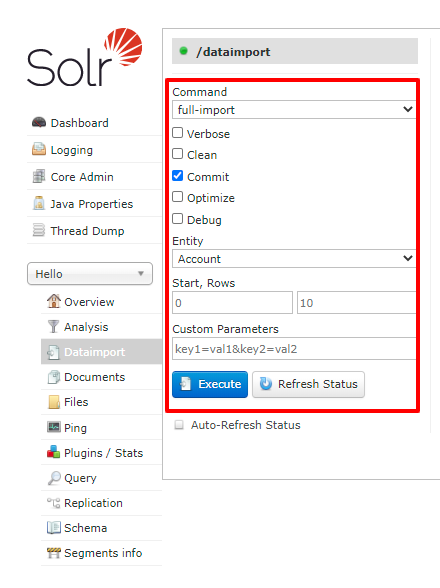
- Select the "full-import" Command, choose the table from Entity, and click "Execute."
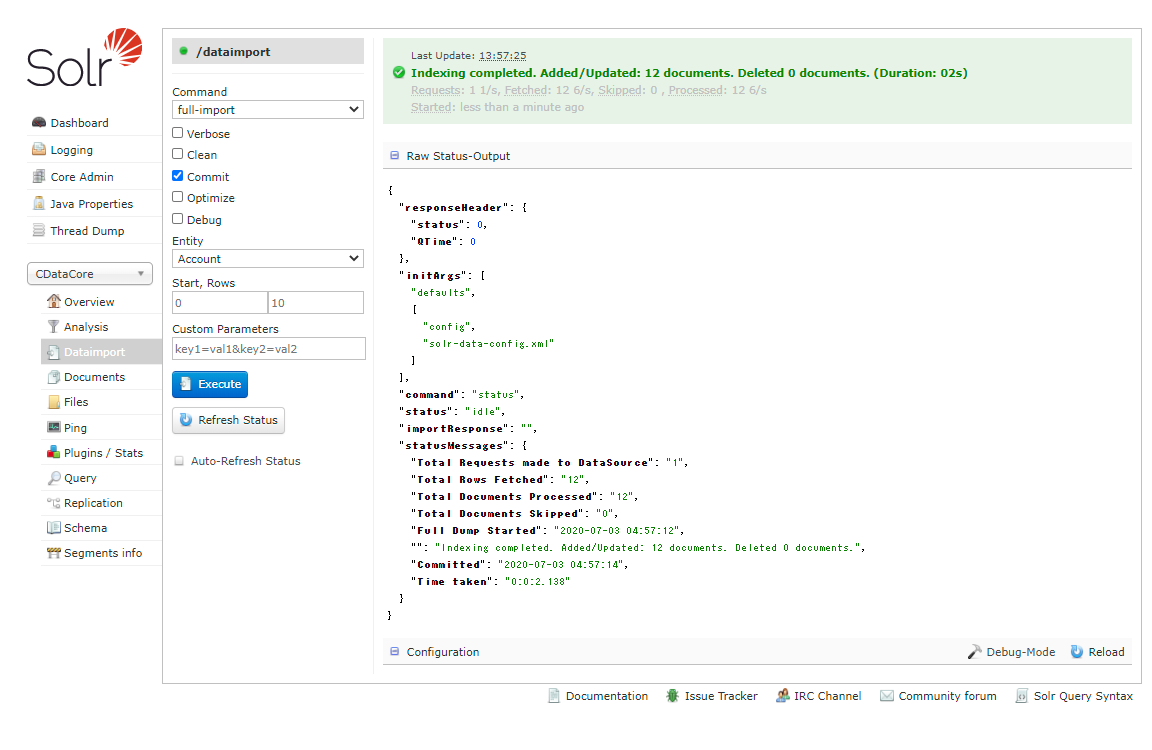
- Check the result of the import from the Query.
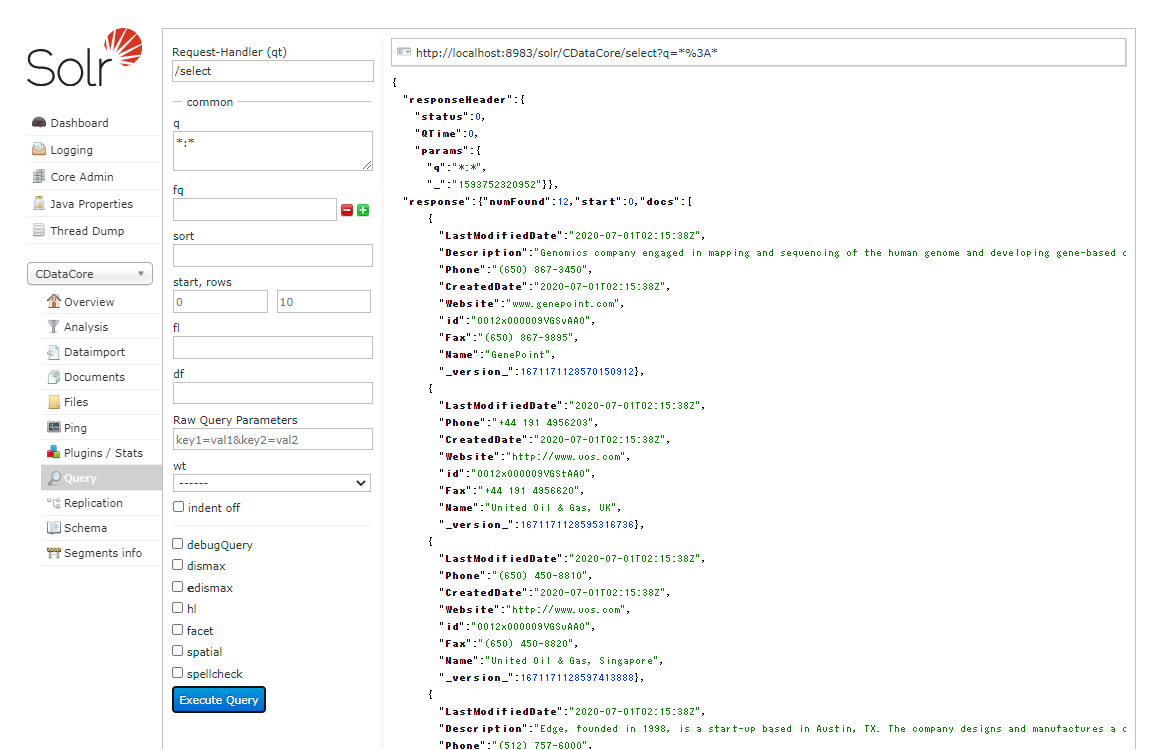
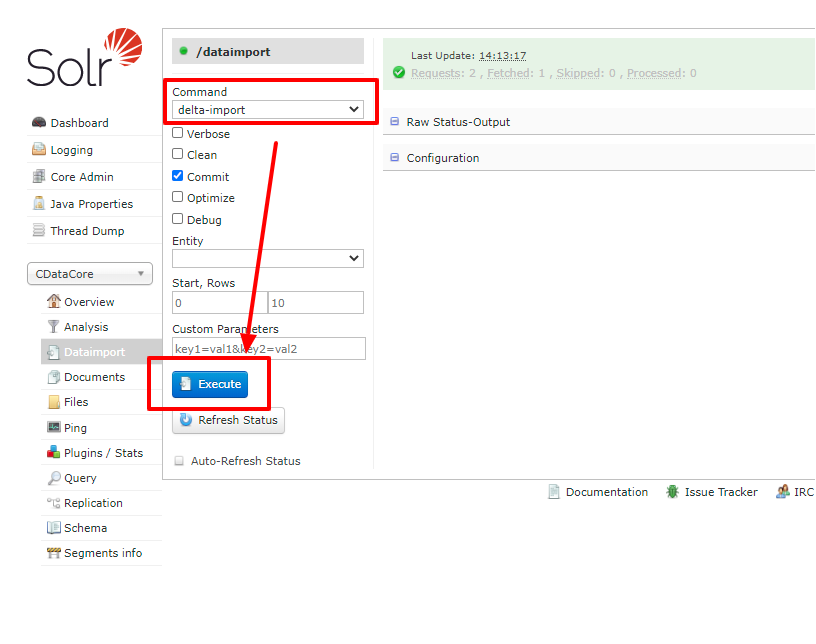
- Try an incremental update using deltaQuery. Modify some data in the original Oracle Eloqua Reporting data set. Select the "delta-import" command this time from DataImport window and click "Execute."
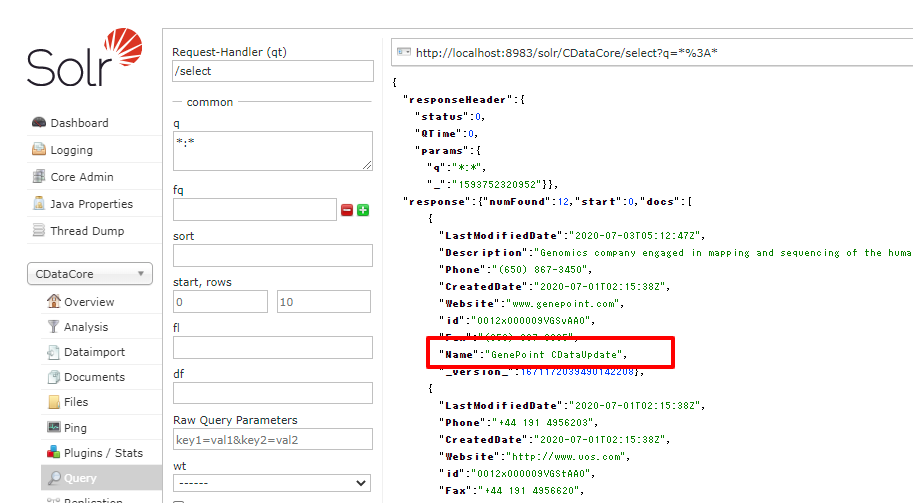
- Check the result of the incremental update.
Using the CData JDBC Driver for Oracle Eloqua Reporting you are able to create an automated import of Oracle Eloqua Reporting data into Apache Solr. Download a free, 30 day trial of any of the 200+ CData JDBC Drivers and get started today.
Ready to get started?
Download a free trial of the Oracle Eloqua Reporting Driver to get started:
Download NowLearn more:
 Oracle Eloqua Reporting JDBC Driver
Rapidly create and deploy powerful Java applications that integrate with Oracle Eloqua Reporting.
