






Analyze Oracle Eloqua Reporting Data with Power Pivot

The ODBC protocol is used by a wide variety of Business Intelligence (BI) and reporting tools to get access to different databases. The CData ODBC Driver for Oracle Eloqua Reporting brings the same power and ease of use to Oracle Eloqua Reporting data. This article uses the driver to import Oracle Eloqua Reporting data into Power Pivot.
Connect to Oracle Eloqua Reporting as an ODBC Data Source
If you have not already, first specify connection properties in an ODBC DSN (data source name). This is the last step of the driver installation. You can use the Microsoft ODBC Data Source Administrator to create and configure ODBC DSNs.
Oracle Eloqua Reporting supports the following authentication methods:
- Basic authentication (User and Password)
- OAuth 2.0 code grant flow
- OAuth 2.0 password grant flow
Basic Authentication (User and Password)
To perform authentication with a user and password, specify these properties:
- AuthScheme: Basic.
- Company: The company name associated with your Oracle Eloqua Reporting account.
- User: Your login account name.
- Password: Your login password.
OAuth Authentication (Code Grant Flow)
To authenticate with the OAuth code grant flow, you must set AuthScheme to OAuth and create a custom OAuth application. For information about how to create a custom OAuth application, see the Help documentation.
Then set the following properties:
- InitiateOAuth: GETANDREFRESH. Used to automatically get and refresh the OAuthAccessToken.
- OAuthClientId: The client Id assigned when you registered your application.
- OAuthClientSecret: The client secret that was assigned when you registered your application.
- CallbackURL: The redirect URI that was defined when you registered your application.
When you connect, the driver opens Oracle Eloqua Reporting's OAuth endpoint in your default browser. Log in and grant permissions to the application. When the access token expires, the driver refreshes it automatically.
OAuth Authentication (Password Grant Flow)
With the OAuth password grant flow, you can use your OAuth application's credentials alongside your user credentials to authenticate without the need to grant permission manually via a browser prompt. You must create an OAuth app (see the Help documentation) to use this authentication method.
Set the following properties:
- AuthScheme: OAuthPassword
- Company: The company's unique identifier.
- User: Your login account name.
- Password: Your login password.
- OAuthClientId: The client Id assigned when you registered your custom OAuth application.
- OAuthClientSecret: The client secret assigned when you registered your custom OAuth application.
Connect from Power Pivot
Follow the steps below to connect to the DSN in Power Pivot.
- In Excel, click the Power Pivot Window icon on the Power Pivot tab to open Power Pivot.
- Launch the Table Import Wizard: Click the Get External Data from Other Data Sources button.
- Select the OLEDB/ODBC source option.
- Click Build to open the Data Link Properties dialog.
- In the Provider tab, select the Microsoft OLEDB Provider for ODBC Drivers option.
- In the Connection tab, select the Use Data Source Name option and then select the Oracle Eloqua Reporting DSN in the menu.
Select and Filter Tables and Views
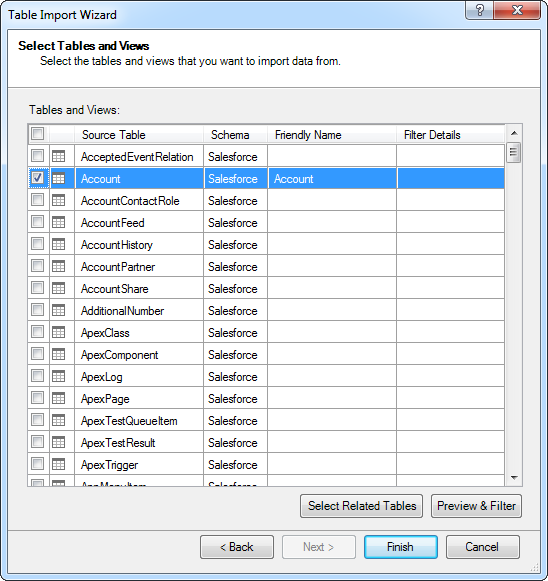
Follow the steps below to use the wizard to import Oracle Eloqua Reporting tables. As you use the wizard to select, filter, and sort columns of Oracle Eloqua Reporting tables, Power Pivot generates the query to be executed.
-
After selecting the DSN in the Table Import Wizard, select the option to select from a list of tables.
Click Preview & Filter to select specific columns, sort data, and visually build filters. To include or exclude columns, select and clear the option next to the column name.
To filter based on column values, click the down arrow button next to the column name. In the resulting dialog, select or clear the column values you want to filter. Alternatively, click Number Filters or Text Filters and then select a comparison operator. In the resulting dialog, build the filter criteria.
- Return to the Select Tables and Views page of the wizard. You can access filters by clicking the Applied Filters link in the Filter Details column.
Import and Filter with SQL
You can also import with an SQL query. The driver supports the standard SQL, allowing Excel to communicate with Oracle Eloqua Reporting APIs.
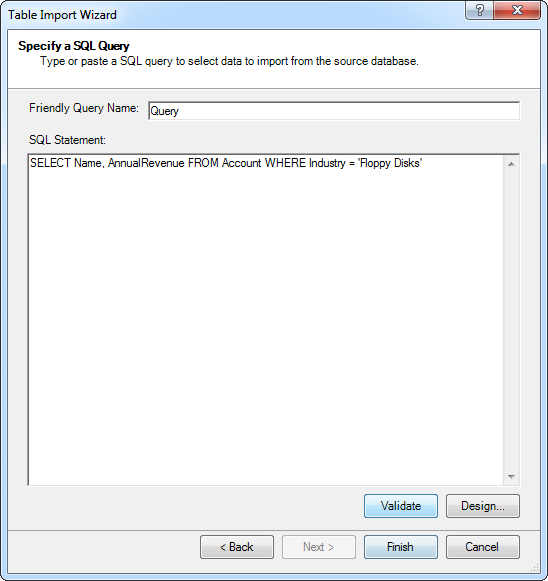
- After selecting the DSN in the Table Import Wizard, select the option to write a query.
In the SQL Statement box, enter the query. Click Validate to check that the syntax of the query is valid. Click Design to preview the results and adjust the query before import.
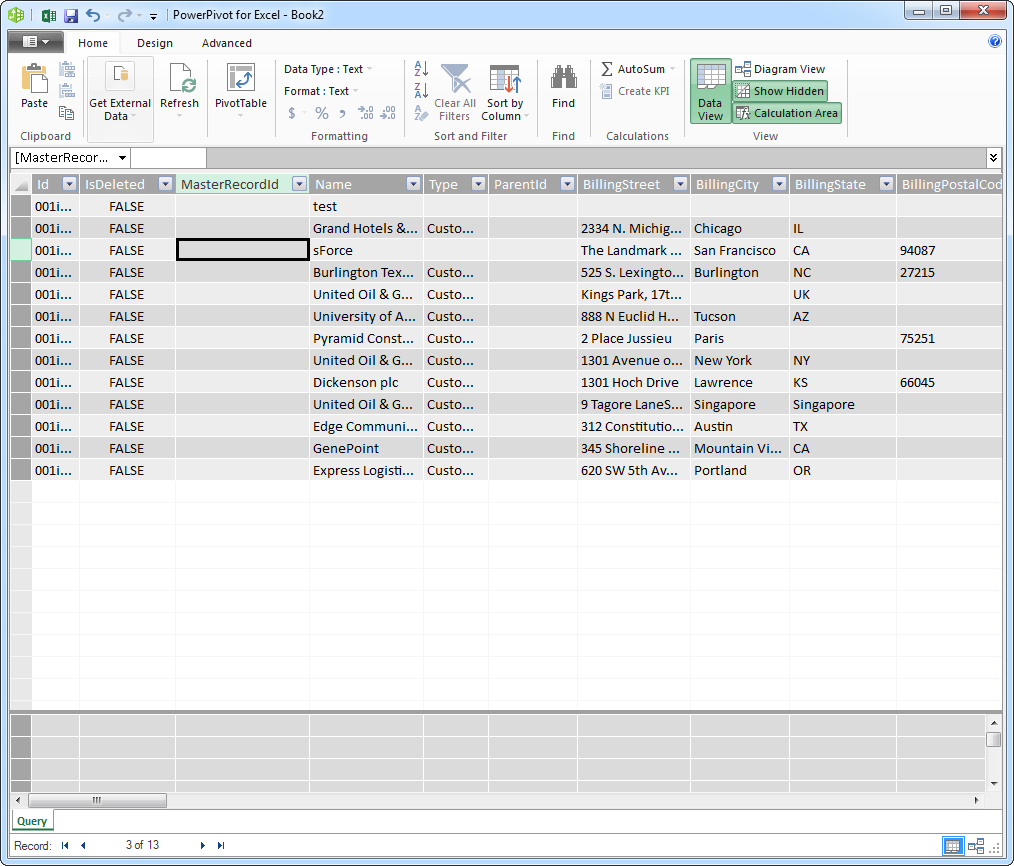
- Finish the wizard to import the data for your chosen query.
Refresh On Demand
Connectivity to Oracle Eloqua Reporting APIs enables real-time analysis. To immediately update your workbook with any changes, click Refresh.
Ready to get started?
Download a free trial of the Oracle Eloqua Reporting ODBC Driver to get started:
Download NowLearn more:
 Oracle Eloqua Reporting ODBC Driver
The Oracle Eloqua Reporting ODBC Driver is a powerful tool that allows you to connect with live data from Oracle Eloqua Reporting, directly from any applications that support ODBC connectivity.
Access Oracle Eloqua Reporting data like you would a database - read, write, and update Oracle Eloqua Reporting 0, etc. through a standard ODBC Driver interface.
