






Getting Started with the CData ADO.NET Provider for EnterpriseDB
This guide explains everything you need to work with the CData ADO.NET Provider for EnterpriseDB. You will learn how to install the provider, set up a connection to your EnterpriseDB data, and run simple commands in your .NET applications using familiar ADO.NET patterns.
Whether you are building desktop apps, web apps, or background services, the provider enables secure, high-performance connectivity to live EnterpriseDB data without needing to manage API details manually.
Installation and Licensing
System Requirements
- Windows: Windows 10/11 or Windows Server 2016+
- .NET Versions: .NET Framework 4.0+, .NET 6+, .NET Standard assemblies
- IDE: Visual Studio 2017 or later
Installing the ADO.NET Provider
Windows Installation
- Download the ADO.NET provider installer from your CData account or the evaluation page.
- Run the installer and follow the installation wizard to completion.
- The installer registers the provider and places all assemblies in the appropriate CData installation folders.
-
You will be prompted for your license key during installation:
XXXX-XXXX-XXXX-XXXX-XXXX- Note: If you are using a trial, select Trial Key instead.
Activating your License
Licensing behavior varies depending on whether you are developing with the .NET Framework or .NET Standard. Use the steps below to activate the provider in your environment.
.NET Framework (Windows)
On Windows using the .NET Framework, no extra action is required. The installer or NuGet package automatically installs your development license.
.NET Standard (Windows/Mac/Linux)
For .NET Standard platforms like .NET Core, Mono, or Xamarin, you must install a license manually before using the provider.
Using the Install-License Tool
The toolkit includes an install-license utility in the
lib/netstandard2.0folder for applying trial or full licenses.
To install a trial license:
dotnet ./install-license.dll
To activate a full product license:
dotnet ./install-license.dll
After running the tool, your development machine is licensed and ready to use the provider in .NET applications.
Runtime Licensing
When deploying applications, specify the Runtime Key (RTK) in your connection string to enable redistribution.
| Property | Description |
|---|---|
| RTK | Your Runtime Key used for deployed ADO.NET applications. |
Common Licensing Questions
Can I use my license on multiple machines?
Yes, depending on your subscription tier. If unsure, review your order confirmation or contact [email protected].
I lost my license key. How do I retrieve it?
Email [email protected] with your order number.
Can I transfer my license to another machine?
Submit a License Transfer Request:
https://www.cdata.com/lic/transfer/
Once approved, an activation is added to your product key and the previous installation becomes invalid.
For more licensing support, visit portal.cdata.com or email [email protected].
Connection Configuration
Once installed, the next step is to configure a connection to EnterpriseDB. Connections are created using ADO.NET connection strings in your .NET application's code or configuration file.
Creating a connection manager
- Open Visual Studio.
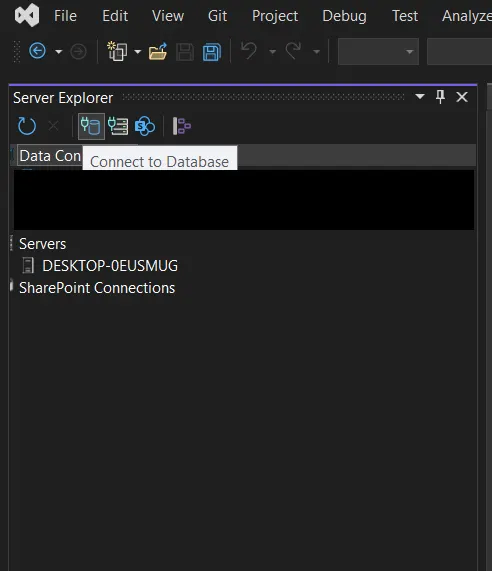
- Navigate to View, select Server Explorer.
-
Click Connect to Database from the left sidebar.
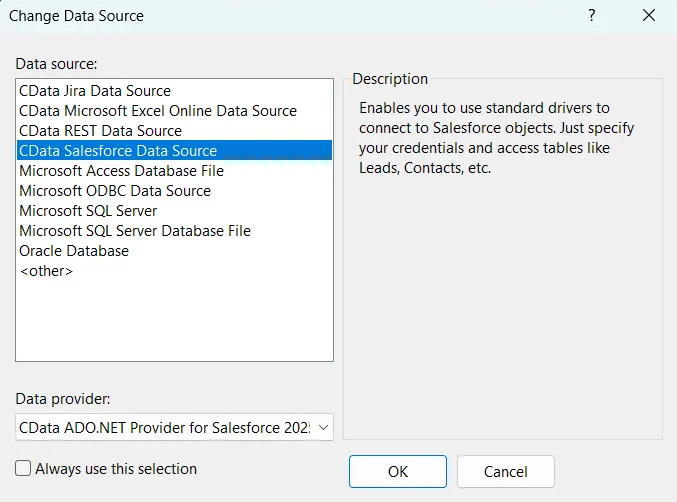
- In the Add Connection dialog, click Change.
-
Choose CData EnterpriseDB data source, then click OK.
Configuring Connection Properties
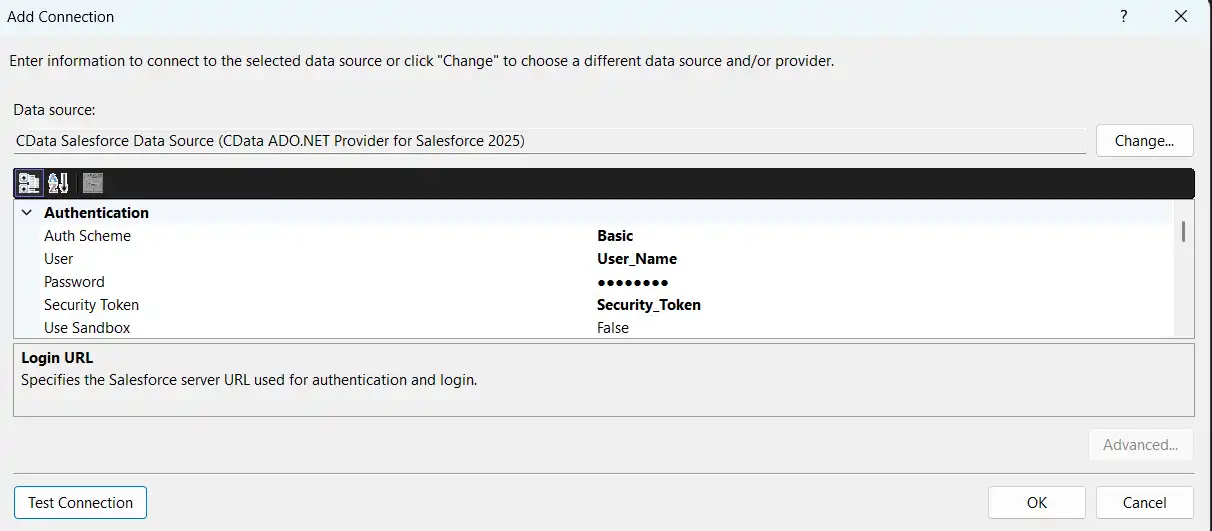
The following connection properties are required in order to connect to data.
- Server: The host name or IP of the server hosting the EnterpriseDB database.
- Port: The port of the server hosting the EnterpriseDB database.
You can also optionally set the following:
- Database: The default database to connect to when connecting to the EnterpriseDB Server. If this is not set, the user's default database will be used.
Connect Using Standard Authentication
To authenticate using standard authentication, set the following:
- User: The user which will be used to authenticate with the EnterpriseDB server.
- Password: The password which will be used to authenticate with the EnterpriseDB server.
Connect Using SSL Authentication
You can leverage SSL authentication to connect to EnterpriseDB data via a secure session. Configure the following connection properties to connect to data:
- SSLClientCert: Set this to the name of the certificate store for the client certificate. Used in the case of 2-way SSL, where truststore and keystore are kept on both the client and server machines.
- SSLClientCertPassword: If a client certificate store is password-protected, set this value to the store's password.
- SSLClientCertSubject: The subject of the TLS/SSL client certificate. Used to locate the certificate in the store.
- SSLClientCertType: The certificate type of the client store.
- SSLServerCert: The certificate to be accepted from the server.
Test your connection
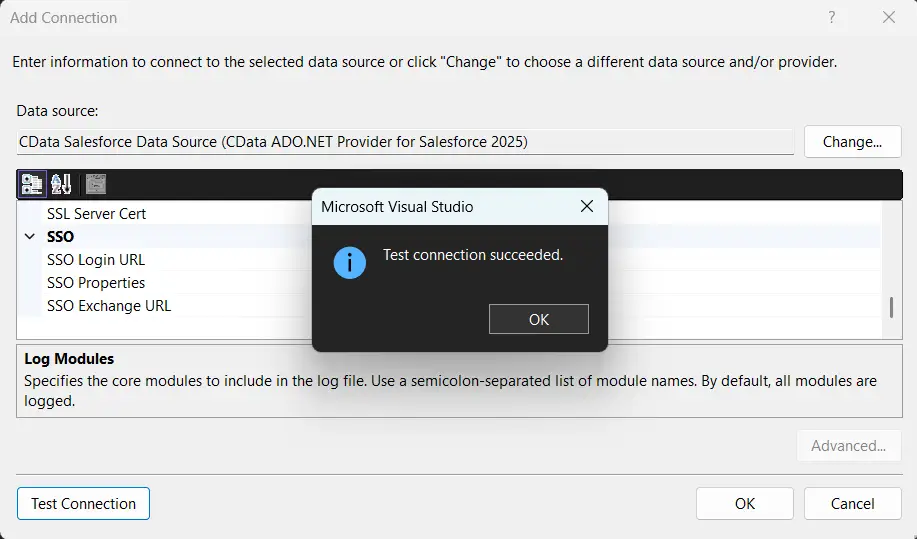
- Click Test Connection.
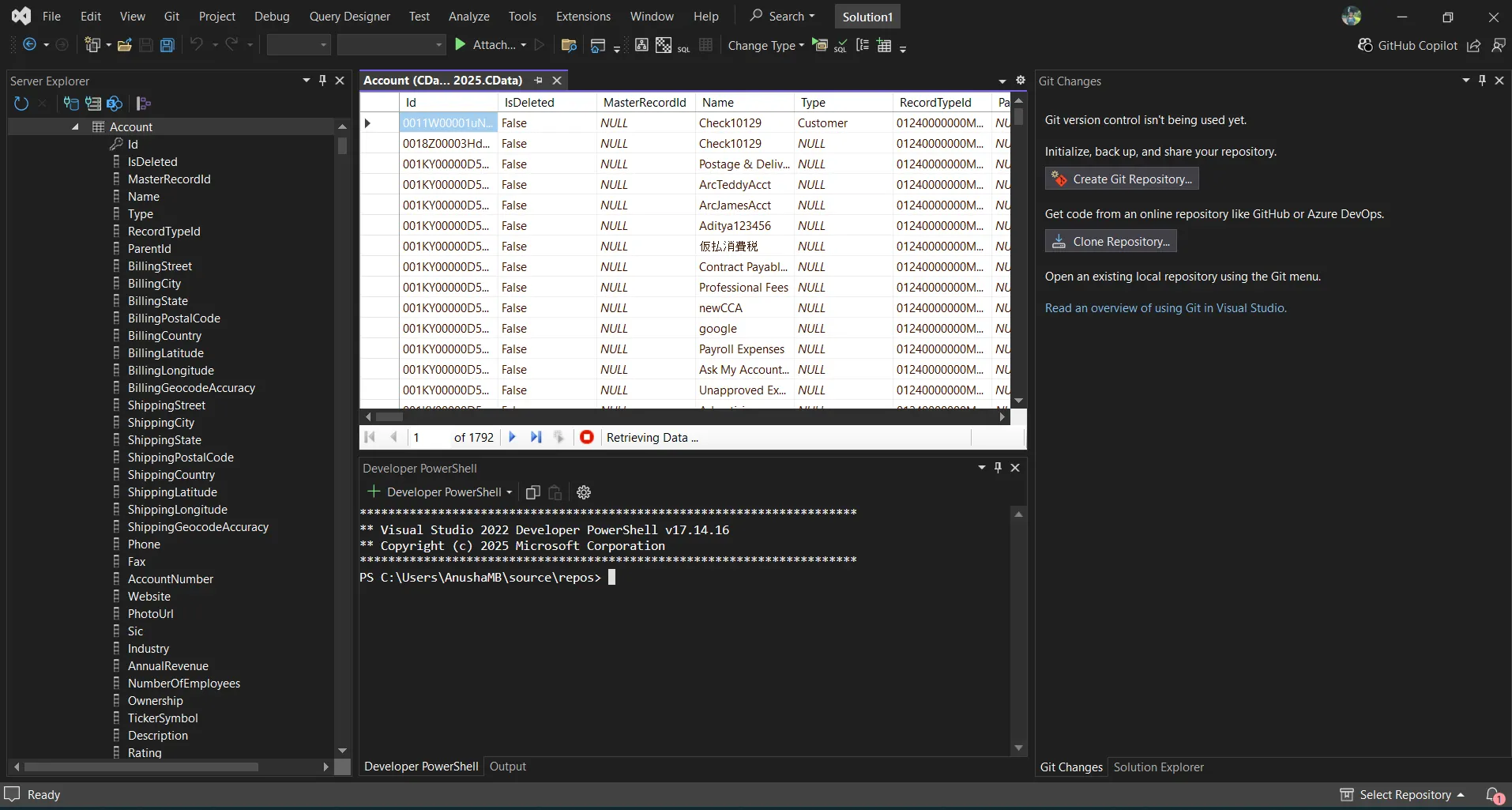
- Once the connection is successful, you can explore the data inside Visual Studio.
Common Connection Issues
Authentication Failed
Solution: Verify OAuth settings, client IDs, secrets, or token permissions for your EnterpriseDB. Contact [email protected] for assistance.
Cannot Reach Server
Solution: Check firewall, proxy, and VPN configurations. Contact [email protected] for required port information.
Table Not Found
Solution: Confirm you selected the correct schema or database when querying EnterpriseDB.
What's Next
Now that you have installed, licensed, and configured the ADO.NET provider, here are scenarios you can use to explore our ADO.NET tools:
| ADO.NET Providers | Article Title |
|---|---|
| LINQPad | Working with EnterpriseDB in LINQPad |
| Microsoft SSAS | Build an OLAP Cube in SSAS from EnterpriseDB |
| TIBCO Spotfire | Visualize EnterpriseDB in TIBCO Spotfire through ADO.NET |
| .NET Charts | DataBind Charts to EnterpriseDB |
| DevExpress | DataBind EnterpriseDB to the DevExpress Data Grid |
| EF - Code First | Access EnterpriseDB with Entity Framework 6 |
| EF - LINQ | LINQ to EnterpriseDB |
| EF - MVC | Build MVC Applications with Connectivity to EnterpriseDB |
| PowerBuilder | Connect to EnterpriseDB from PowerBuilder |
Get Support
If you need assistance at any point:
- Technical Support: [email protected]
- Community Forum: CData Community Site
- Help Documentation: Installed locally and available online
FAQs
Installation and Licensing
-
Do I need administrator rights to install the ADO.NET Provider?
Yes, administrator rights are required to install components for use across Visual Studio. -
Do I need an RTK to deploy to Azure Data Factory?
Yes. Set the RTK property in your application's connection string before publishing.
Connecting
-
Can I use multiple EnterpriseDB accounts?
Create separate Connection =strings for each account. -
Can I connect through a proxy?
Yes. Configure proxy settings in the Connection string. -
How do I test my connection?
Click Test Connection in the Connection Manager UI.
Performance & Troubleshooting
-
How can I improve query performance
Apply filters, limit row counts, and leverage server-side paging properties. -
How do I enable logging?
Add the following to your connection manager:- Logfile: /path/to/logfile.log
- Verbosity: 3
Be prepared to securely upload the log file upon request when reaching out to [email protected] for troubleshooting analysis.
For questions not covered in this FAQ, contact [email protected].
Ready to get started?
Download a free trial of the EnterpriseDB Data Provider to get started:
Download NowLearn more:
 EnterpriseDB ADO.NET Provider
Rapidly create and deploy powerful .NET applications that integrate with EnterpriseDB.
