Integrate with Google Translate Data in JReport Designer

The CData JDBC Driver for Google Translate data enables access to live data from dashboards and reports as if Google Translate were a relational database, allowing you to query Google Translate data using familiar SQL queries. This article shows how to connect to Google Translate data as a JDBC data source and create reports based on Google Translate data in JReport Designer.
Connect to Google Translate Data
- Edit C:\JReport\Designer\bin\setenv.bat to add the location of the JAR file to the ADDCLASSPATH variable:
...
set ADDCLASSPATH=%JAVAHOME%\lib\tools.jar;C:\Program Files\CData\CData JDBC Driver for Google Translate 2016\lib\cdata.jdbc.api.jar;
...
- Create a new data source by clicking File New Data Source.
- In the resulting dialog, create a name for the data source (CData JDBC Driver for Google Translate), select JDBC, and click OK.
- In the Get JDBC Connection Information dialog you will configure your connection to the JDBC driver:
- Driver: Be sure that the Driver box is checked and fill in the name of the class for the driver:
cdata.jdbc.api.APIDriver
- URL: Enter the JDBC URL. This starts with jdbc:api: and is followed by a semicolon-separated list of connection properties.
Authentication
Google Cloud Translation API requires OAuth 2.0 authentication to ensure secure access to translation services, datasets, glossaries, and adaptive MT resources. This authentication method allows you to securely connect to your Google Cloud project and manage translation resources with proper authorization.
OAuth 2.0 Setup and Configuration
Step 1: Create Google Cloud Project and Enable API
To set up OAuth authentication:
- Visit the Google Cloud Console
- Create a new project or select an existing project
- Note down your Project ID (required for all API calls)
- Navigate to "APIs & Services" > "Library"
- Search for and enable the "Cloud Translation API"
- Go to "APIs & Services" > "Credentials"
- Click "Create Credentials" and select "OAuth Client ID"
- Configure the OAuth consent screen if prompted
- Select "Desktop application" or "Web application" as appropriate
- Set the authorized redirect URI (CallbackURL)
- Copy the Client ID and Client Secret for use in your connection
Required Connection Properties
- AuthScheme: Set this to OAuth (required)
- OAuthClientId: Client ID from Google Cloud Console (required)
- OAuthClientSecret: Client secret from Google Cloud Console (required)
- CallbackURL: Redirect URI specified in your OAuth application (required)
- InitiateOAuth: Set to GETANDREFRESH for automatic token management (recommended)
- ProjectId: Your Google Cloud project ID or project number (required for queries)
Required OAuth Scopes
The Google Cloud Translation API Profile requires the following OAuth scope:
- https://www.googleapis.com/auth/cloud-translation - Full access to Cloud Translation API resources including translation, datasets, glossaries, and adaptive MT
Built-in Connection String Designer
For assistance in constructing the JDBC URL, use the connection string designer built into the Google Translate JDBC Driver. Either double-click the JAR file or execute the jar file from the command-line.
java -jar cdata.jdbc.api.jar
Fill in the connection properties and copy the connection string to the clipboard.

When you configure the JDBC URL, you may also want to set the Max Rows connection property. This will limit the number of rows returned, which is especially helpful for improving performance when designing reports and visualizations.
Below is a typical JDBC URL:
jdbc:api:Profile=C:\profiles\GoogleTranslate.apip;AuthScheme=OAuth;InitiateOAuth=GETANDREFRESH;OAuthClientId=your_client_id;OAuthClientSecret=your_client_secret;CallbackUrl=your_callback_url;
- User: The username to authenticate with; typically left blank.
- Password: The password to authenticate with; typically left blank.
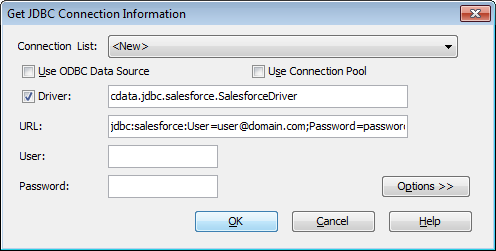
- Driver: Be sure that the Driver box is checked and fill in the name of the class for the driver:
In the Add Table dialog, select the tables you wish to include in your report (or in future reports using this data source) and click Add.
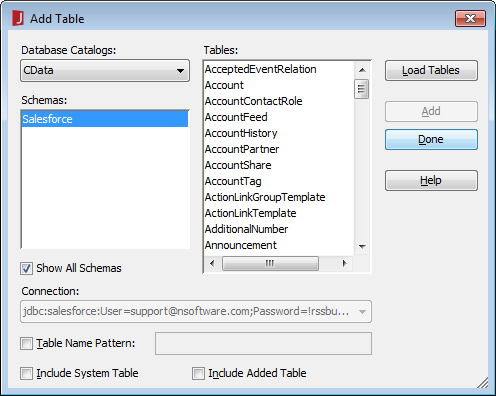
Click Done once the dialog has completed loading the tables.
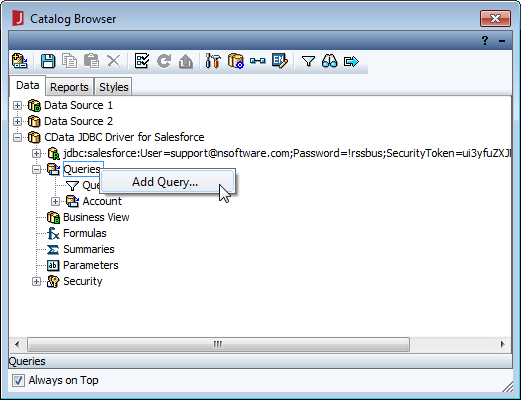
- In the Catalog Browser, you can create the queries that you will use to populate your reports. You can do this now, or after you create your report. In either case, expand () the data source (CData JDBC Driver for Google Translate), right-click on Queries, and select Add Query.
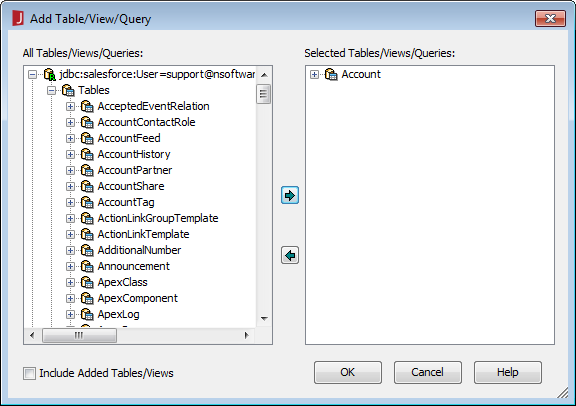
- In the Add Table/View/Query dialog, expand () the JDBC URL and Tables and select the table(s) you wish to use in the query and click OK.
- In the Query Editor dialog, you can select the columns you wish to include or simply click the SQL button and manually input your own query. For example:
SELECT LanguageCode, DisplayName FROM SupportedLanguages WHERE ProjectId = 'my-project-12345'
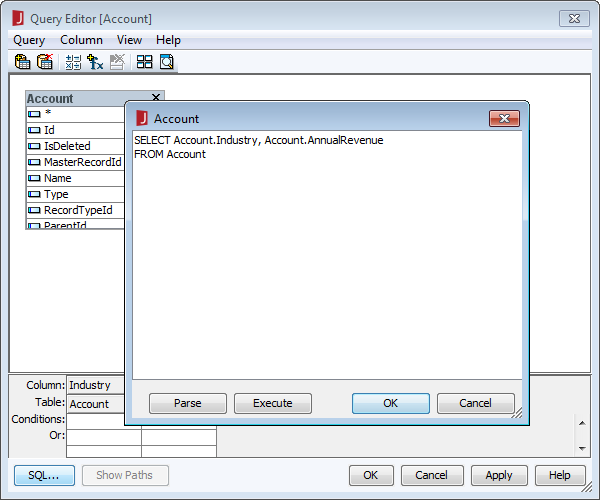
With the query built, click OK to close the Query Editor dialog. At this point you are ready to add Google Translate data to a new or existing report.
NOTE: Now that the query is built, you can create a Business View based on the query. With a Business View, you can create Web reports or library components based on the query. For more information on this, refer to the JReport tutorials.
Add Google Translate Data to a Report
You are now ready to create a report with Google Translate data.
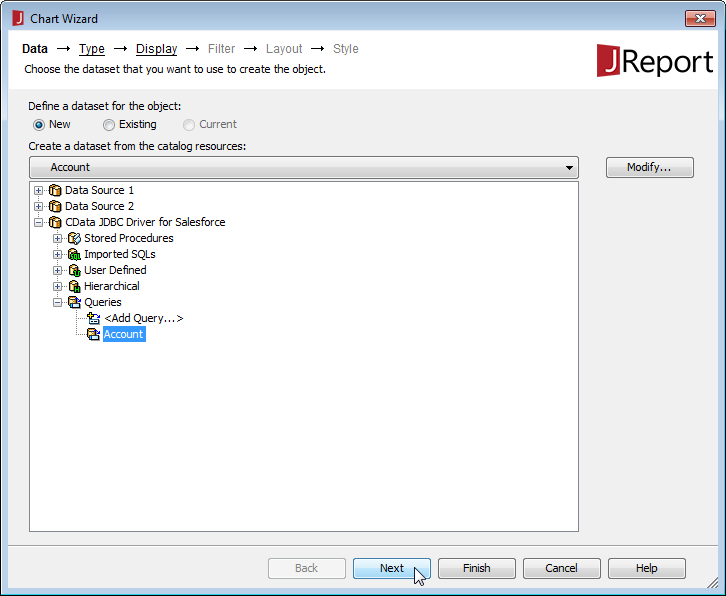
- Create a new report (File New Page Report) or open the Chart Wizard for an existing report.
- Select the Query (or create a new one; see above).
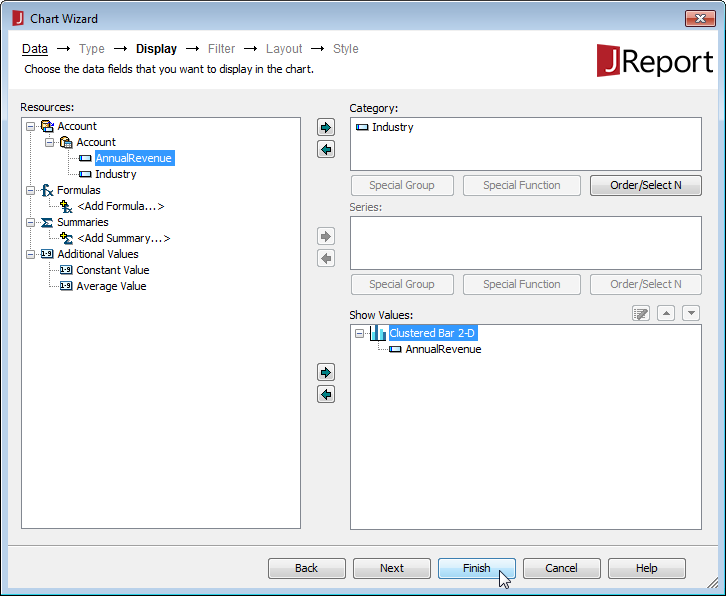
- Assign a Category and Value for the chart from the columns in your Query and click Finish.
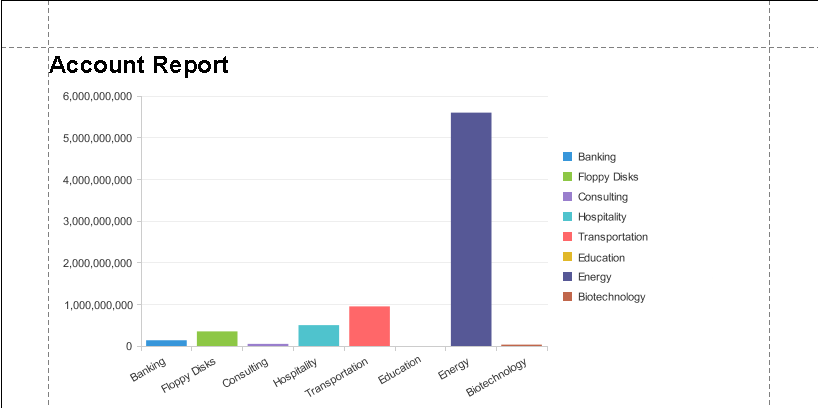
- Click the View tab for your report to see the chart.