Create an SAP BusinessObjects Universe on the CData JDBC Driver for Gumroad

This article shows how to use the CData JDBC Driver for Gumroad to connect to Gumroad from SAP BusinessObjects Business Intelligence applications. You will use the Information Design Tool to analyze Gumroad data and create a universe on the CData JDBC Driver for Gumroad. You will then connect to the universe from Web Intelligence.
Create the JDBC Connection to Gumroad
Follow the steps below to create a connection to the Gumroad JDBC data source in the Information Design Tool.
- Copy the CData JAR and .lic file into the following subfolder in the installation directory for BusinessObjects: dataAccess\connectionServer\jdbc\drivers\jdbc. The CData JAR is located in the lib subfolder of the installation directory.
- Right-click your project and click New -> New Relational Connection.
- In the wizard that results, click Generic -> Generic JDBC datasource -> JDBC Drivers.
- On the next page of the wizard enter the connection details.
On the next page, set the Authentication Mode option to "Use specified username and password". Enter the username, password, and JDBC URL. The JDBC URL begins with jdbc:api: and is followed by a semicolon-separated list of connection properties.
Using OAuth Authentication
To authenticate to Gumroad and connect to your own data or to allow other users to connect to their data, you can use the OAuth 2.0 standard. This is the recommended authentication method.
First you need to register an OAuth application with Gumroad. You can create an OAuth application by visiting your Gumroad account settings at https://app.gumroad.com/settings/advanced and navigating to the Applications section.
After setting the following connection properties, you are ready to connect:
- AuthScheme: Set this to OAuth.
- InitiateOAuth: Set this to GETANDREFRESH. The CData API Profile for Gumroad will automatically walk through the OAuth process in order to obtain the access token.
- OAuthClientID: Set this to the client_id that is specified in your app settings.
- OAuthClientSecret: Set this to the client_secret that is specified in your app settings.
- CallbackURL: Set this to the Redirect URI you specified in your app settings.
Example connection string
Profile=C:\profiles\Gumroad.apip;AuthScheme=OAuth;InitiateOAuth=GETANDREFRESH;OAuthClientId=your_client_id;OAuthClientSecret=your_client_secret;CallbackUrl=your_callback_url;
Built-in Connection String Designer
For assistance in constructing the JDBC URL, use the connection string designer built into the Gumroad JDBC Driver. Either double-click the JAR file or execute the jar file from the command-line.
java -jar cdata.jdbc.api.jar
Fill in the connection properties and copy the connection string to the clipboard.

When you configure the JDBC URL, you may also want to set the Max Rows connection property. This will limit the number of rows returned, which is especially helpful for improving performance when designing reports and visualizations.
A typical JDBC URL is below:
jdbc:api:Profile=C:\profiles\Gumroad.apip;AuthScheme=OAuth;InitiateOAuth=GETANDREFRESH;OAuthClientId=your_client_id;OAuthClientSecret=your_client_secret;CallbackUrl=your_callback_url;
- Enter the driver class: cdata.jdbc.api.APIDriver
- Finish the wizard with the default values for connection pooling and custom parameters.
Analyze Gumroad Data in the Information Design Tool
You can use the JDBC connection to analyze Gumroad data in the Information Design Tool.
- In the Local Projects view, double-click the connection (the .cnx file) to open the Gumroad data source.
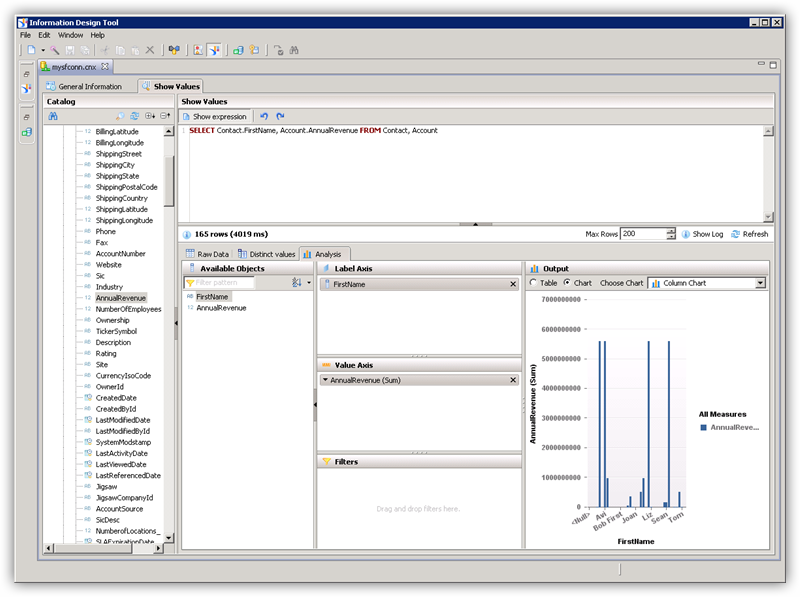
- On the Show Values tab, you can load table data and enter SQL queries. To view table data, expand the node for the table, right-click the table, and click Show Values. Values will be displayed in the Raw Data tab.
- On the Analysis tab, you can then analyze data by dragging and dropping columns onto the axes of a chart.
Publish the Local Connection
To publish the universe to the CMS, you additionally need to publish the connection.
- In the Local Projects view, right-click the connection and click Publish Connection to a Repository.
- Enter the host and port of the repository and connection credentials.
- Select the folder where the connection will be published.
- In the success dialog that results, click Yes to create a connection shortcut.
Create a Universe on the JDBC Driver for Gumroad
You can follow the steps below to create a universe on the JDBC driver. The universe in this example will be published to a repository, so it uses the published connection created in the previous step.
- In the Information Design Tool, click File->New Universe.
- Select your project.
- Select the option to create the universe on a relational data source.
- Select the shortcut to the published connection.
- Enter a name for the Data Foundation.
- Import tables and columns that you want to access as objects.
- Enter a name for the Business Layer.
Publish the Universe
You can follow the steps below to publish the universe to the CMS.
- In the Local Projects view, right-click the business layer and click Publish -> To a Repository.
- In the Publish Universe dialog, enter any integrity checks before importing.
- Select or create a folder on the repository where the universe will be published.
Query Gumroad Data in Web Intelligence
You can use the published universe to connect to Gumroad in Web Intelligence.
- Copy the cdata.jdbc.api.lic file to the following subfolder in the BusinessObjects installation directory: \dataAccess\connectionServer\jdbc\drivers\jdbc. The license file is located in the lib subfolder of the installation directory.
- Open Web Intelligence from the BusinessObjects launchpad and create a new document.
- Select the Universe option for the data source.
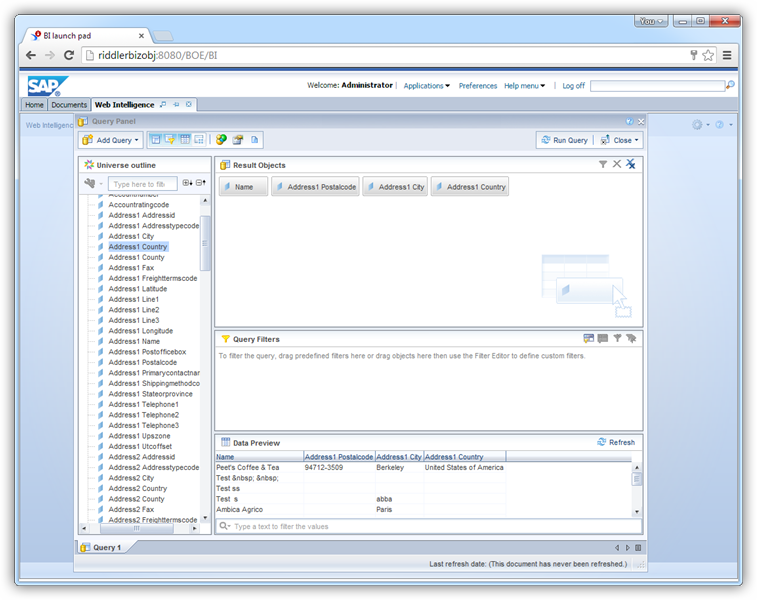
- Select the Gumroad universe. This opens a Query Panel. Drag objects to the Result Objects pane to use them in the query.