






Access Live Lakebase Data in AWS Lambda (with IntelliJ IDEA)

AWS Lambda is a compute service that lets you build applications that respond quickly to new information and events. AWS Lambda functions can work with live Lakebase data when paired with the CData JDBC Driver for Lakebase. This article describes how to connect to and query Lakebase data from an AWS Lambda function built with Maven in IntelliJ.
With built-in optimized data processing, the CData JDBC Driver offers unmatched performance for interacting with live Lakebase data. When you issue complex SQL queries to Lakebase, the driver pushes supported SQL operations, like filters and aggregations, directly to Lakebase and utilizes the embedded SQL engine to process unsupported operations client-side (often SQL functions and JOIN operations). In addition, its built-in dynamic metadata querying allows you to work with and analyze Lakebase data using native data types.
Step 1: Gather connection properties and build a connection string
Download the CData JDBC Driver for Lakebase installer, unzip the package, and run the JAR file to install the driver. Then gather the required connection properties.
To connect to Databricks Lakebase, start by setting the following properties:- DatabricksInstance: The Databricks instance or server hostname, provided in the format instance-abcdef12-3456-7890-abcd-abcdef123456.database.cloud.databricks.com.
- Server: The host name or IP address of the server hosting the Lakebase database.
- Port (optional): The port of the server hosting the Lakebase database, set to 5432 by default.
- Database (optional): The database to connect to after authenticating to the Lakebase Server, set to the authenticating user's default database by default.
OAuth Client Authentication
To authenicate using OAuth client credentials, you need to configure an OAuth client in your service principal. In short, you need to do the following:
- Create and configure a new service principal
- Assign permissions to the service principal
- Create an OAuth secret for the service principal
For more information, refer to the Setting Up OAuthClient Authentication section in the Help documentation.
OAuth PKCE Authentication
To authenticate using the OAuth code type with PKCE (Proof Key for Code Exchange), set the following properties:
- AuthScheme: OAuthPKCE.
- User: The authenticating user's user ID.
For more information, refer to the Help documentation.
NOTE: To use the JDBC driver in an AWS Lambda function, you will need a license (full or trial) and a Runtime Key (RTK). For more information on obtaining this license (or a trial), contact our sales team.
Built-in Connection String Designer
For assistance constructing the JDBC URL, use the connection string designer built into the Lakebase JDBC Driver. Double-click the JAR file or execute the jar file from the command line.
java -jar cdata.jdbc.lakebase.jar

Fill in the connection properties (including the RTK) and copy the connection string to the clipboard.
Step 2: Create a project in IntelliJ
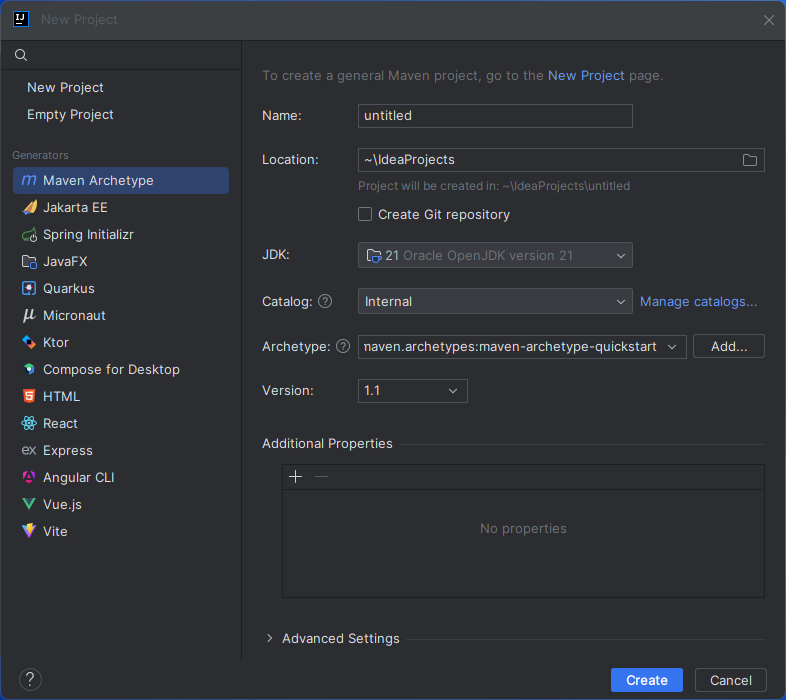
- In IntelliJ IDEA, click New Project.
- Select "Maven Archetype" from the Generators
- Name the project and select "maven.archetypes:maven-archetype-quickstart" Archetype.
- Click "Create"
Install the CData JDBC Driver for Lakebase JAR File
Use the following Maven command from the project's root folder to install JAR file in the project.
mvn install:install-file -Dfile="PATH/TO/CData JDBC Driver for Lakebase 20XX/lib/cdata.jdbc.lakebase.jar" -DgroupId="org.cdata.connectors" -DartifactId="cdata-lakebase-connector" -Dversion="23" -Dpackaging=jar
Add Dependencies
Within the Maven project's pom.xml file, add AWS and the CData JDBC Driver for Lakebase] as dependencies (within the <dependencies> element) using the following XML.
- AWS
<dependency>
   <groupId>com.amazonaws</groupId>
   <artifactId>aws-lambda-java-core</artifactId>
   <version>1.2.2</version> <!--Replace with the actual version-->
</dependency>
- CData JDBC Driver for Lakebase
<dependency>
   <groupId>org.cdata.connectors</groupId>
   <artifactId>cdata-lakebase-connector</artifactId>
   <version>25</version> <!--Replace with the actual version-->
</dependency>
- Maven Shade Plugin to create a fat JAR
<build>
  <plugins>
    <plugin>
      <groupId>org.apache.maven.plugins</groupId>
      <artifactId>maven-shade-plugin</artifactId>
      <version>3.4.1</version>
      <executions>
        <execution>
          <phase>package</phase>
          <goals>
            <goal>shade</goal>
          </goals>
          <configuration>
            <createDependencyReducedPom>false</createDependencyReducedPom>
            <transformers>
              <transformer implementation="org.apache.maven.plugins.shade.resource.ManifestResourceTransformer">
                <mainClass>com.example.CDataLambda</mainClass>
                  <!-- Change to your actual Lambda handler class -->
              </transformer>
            </transformers>
          </configuration>
        </execution>
      </executions>
    </plugin>
  </plugins>
</build>
Create an AWS Lambda Function
For this sample project, we create two source files: CDataLambda.java and CDataLambdaTest.java.
Lambda Function Definition
- Update CDataLambda to implement the RequestHandler interface from the AWS Lambda SDK. You will need to add the handleRequest method, which performs the following tasks when the Lambda function is triggered:
- Constructs a SQL query using the input
- Sets up AWS credentials and S3 configuration to store OAuth credentials.
- Registers the CData JDBC Driver for Lakebase
- Establishes a connection to Lakebase using JDBC
- Executes the SQL query on Lakebase
- Prints the results to the console
- Returns an output message
-
Use the complete Lambda class below, which includes the imports, class definition, and handleRequest method. Be sure to fill in your connection string values in the DriverManager.getConnection call.
package com.example;

import com.amazonaws.services.lambda.runtime.Context;
import com.amazonaws.services.lambda.runtime.RequestHandler;

import java.sql.Connection;
import java.sql.DriverManager;
import java.sql.ResultSet;
import java.sql.ResultSetMetaData;
import java.sql.SQLException;
import java.sql.Statement;
public class CDataLambda implements RequestHandler < Object, String > {

  @Override
  public String handleRequest(Object input, Context context) {
    String query = "SELECT * FROM " + input;

    String bucketName = "MY_AWS_BUCKET";
    String oauthSettings = "s3://" + bucketName + "/oauth/OAuthSettings.txt";
    String oauthConnection =
      "InitiateOAuth=REFRESH;" +
      "OAuthSettingsLocation=" + oauthSettings + ";";
    try {
      Class.forName("cdata.jdbc.lakebase.LakebaseDriver");
      cdata.jdbc.lakebase.LakebaseDriver driver = new cdata.jdbc.lakebase.LakebaseDriver();
      DriverManager.registerDriver(driver);
    } catch (SQLException ex) {
      // Registering the driver failed
      throw new RuntimeException("Failed to register JDBC driver", ex);
    } catch (ClassNotFoundException e) {
      // The driver class was not found in the classpath
      throw new RuntimeException("JDBC Driver class not found", e);

    }
    Connection connection = null;
    try {
      connection = DriverManager.getConnection("jdbc:cdata:lakebase:RTK=52465...;DatabricksInstance=lakebase;Server=127.0.0.1;Port=5432;Database=my_database;InitiateOAuth=GETANDREFRESH;" + oauthConnection + "");
    } catch (SQLException ex) {
      context.getLogger().log("Error getting connection: " + ex.getMessage());
    } catch (Exception ex) {
      context.getLogger().log("Error: " + ex.getMessage());
    }

    if (connection != null) {
      context.getLogger().log("Connected Successfully!
");
    }

    ResultSet resultSet = null;
    try {
      //executing query
      Statement stmt = connection.createStatement();
      resultSet = stmt.executeQuery(query);

      ResultSetMetaData metaData = resultSet.getMetaData();
      int numCols = metaData.getColumnCount();

      //printing the results
      while (resultSet.next()) {
        for (int i = 1; i <= numCols; i++) {
          System.out.printf("%-25s", (resultSet.getObject(i) != null) ? resultSet.getObject(i).toString().replaceAll("
", "") : null);
        }
        System.out.print("
");
      }
    } catch (SQLException ex) {
      System.out.println("SQL Exception: " + ex.getMessage());
    } catch (Exception ex) {
      System.out.println("General exception: " + ex.getMessage());
    }
    return "v24 query: " + query + " complete";
  }
}
Step 3: Deploy and run the lambda function
Once you build the function in Intellij, you are ready to deploy the entire Maven project as a single JAR file.
- In IntelliJ, use the mvn install command to build the SNAPSHOT JAR file.
Note: The Maven Shade Plugin generates two JARs in the target folder. Always upload the larger -shaded.jar file to AWS Lambda, as it contains all required dependencies.
- Create a new function in AWS Lambda (or open an existing one).
- Name the function, select an IAM role, and set the timeout value to a high enough value to ensure the function completes (depending on the result size of your query).
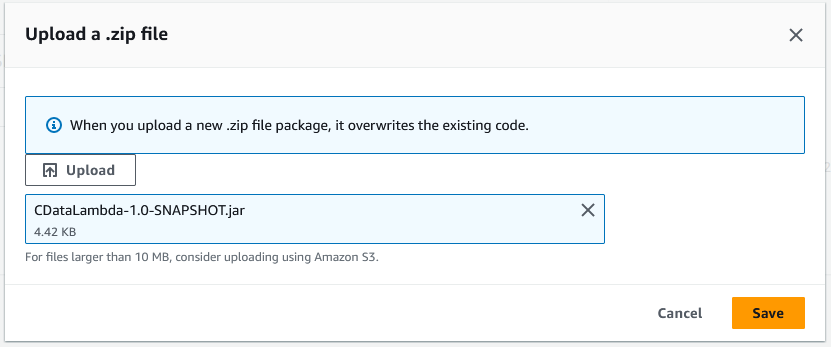
- Click "Upload from" -> ".zip file" and select your SNAPSHOT JAR file.
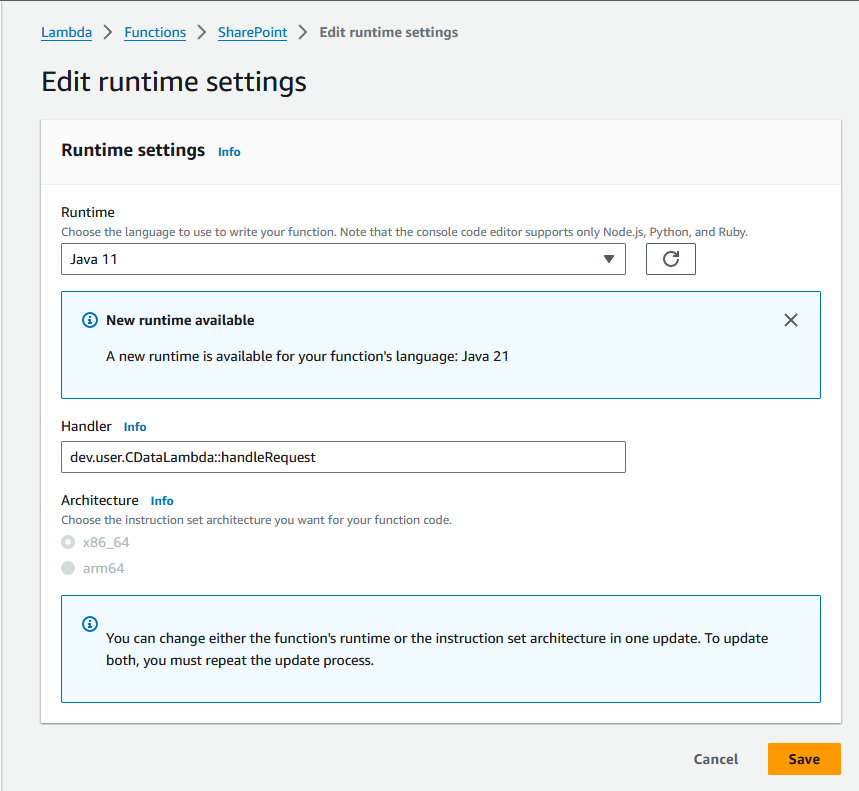
- In the "Runtime settings" section, click "Edit" and set Handler to your "handleRequest" method (e.g. package.class::handleRequest)
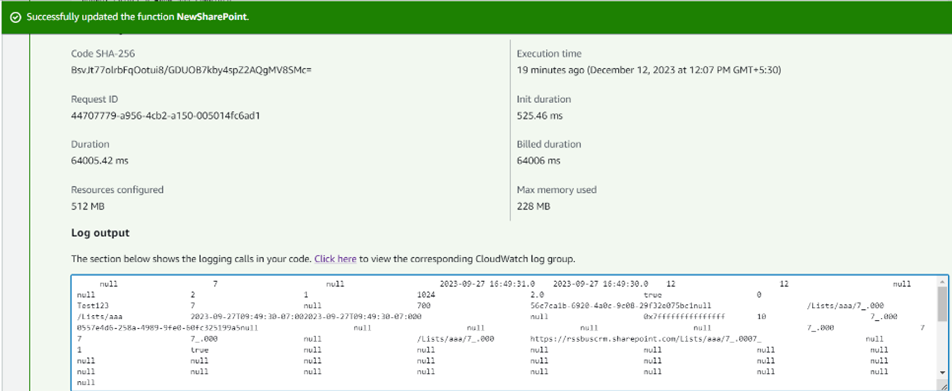
- You can now test the function. Set the "Event JSON" field to a table name and click, click "Test"
Free Trial & More Information
Download a free 30-day trial of the CData JDBC Driver for Lakebase and start working with your live Lakebase data in AWS Lambda. Reach out to our Support Team if you have any questions.
Ready to get started?
Download a free trial of the Lakebase Driver to get started:
Download NowLearn more:
 Lakebase JDBC Driver
Rapidly create and deploy powerful Java applications that integrate with Lakebase.
