



Connecting GenSpark with MongoDB Data via CData Connect AI MCP Server

GenSpark is built for developers and enterprise teams who want to create intelligent, conversational AI experiences powered by real-time data. It's flexible tooling and agentic capabilities make it easy to integrate LLMs, automate complex workflows, and build interactive applications that adapt to user intent. However, when these AI interactions require data beyond local context or predefined APIs, many implementations fall back on custom middleware, manual integrations, or scheduled ETL pipelines to sync information into local stores. This introduces unnecessary complexity, increases maintenance overhead, slows response times, and limits the real-time intelligence your GenSpark agents can provide.
CData Connect AI eliminates these barriers by delivering live, secure connectivity to more than 300 enterprise applications, databases, ERPs, and analytics platforms. Through CData Connect AI remote Model Context Protocol (MCP) Server, GenSpark agents can query, read, and act on real-time enterprise data without replication or custom integration code. The result is grounded, accurate responses, faster reasoning, and automated, cross-system decision-making all with stronger governance and fewer moving parts.
This guide outlines the steps required to configure CData Connect AI MCP connectivity, register the MCP Server in GenSpark, and enable your GenSpark agents to work seamlessly with live enterprise data in real time.
About MongoDB Data Integration
Accessing and integrating live data from MongoDB has never been easier with CData. Customers rely on CData connectivity to:
- Access data from MongoDB 2.6 and above, ensuring broad usability across various MongoDB versions.
- Easily manage unstructured data thanks to flexible NoSQL (learn more here: Leading-Edge Drivers for NoSQL Integration).
- Leverage feature advantages over other NoSQL drivers and realize functional benefits when working with MongoDB data (learn more here: A Feature Comparison of Drivers for NoSQL).
MongoDB's flexibility means that it can be used as a transactional, operational, or analytical database. That means CData customers use our solutions to integrate their business data with MongoDB or integrate their MongoDB data with their data warehouse (or both). Customers also leverage our live connectivity options to analyze and report on MongoDB directly from their preferred tools, like Power BI and Tableau.
For more details on MongoDB use case and how CData enhances your MongoDB experience, check out our blog post: The Top 10 Real-World MongoDB Use Cases You Should Know in 2024.
Getting Started
Prerequisites
Before starting, ensure you have:
- A CData Connect AI account
- Access to GenSpark
- Access to MongoDB
Credentials checklist
Ensure you have these credentials ready for the connection:
- USERNAME: Your CData email login
- PAT: Connect AI, go to Settings and click on Access Tokens (copy once)
- MCP_BASE_URL: https://mcp.cloud.cdata.com/mcp
Step 1: Configure MongoDB connectivity for GenSpark
Connectivity to MongoDB from GenSpark is made possible through CData Connect AI Remote MCP. To interact with MongoDB data from GenSpark, we start by creating and configuring a MongoDB connection in CData Connect AI.
- Log into Connect AI, click Sources, and then click Add Connection
- Select "MongoDB" from the Add Connection panel
-
Enter the necessary authentication properties to connect to MongoDB.
Set the Server, Database, User, and Password connection properties to connect to MongoDB. To access MongoDB collections as tables you can use automatic schema discovery or write your own schema definitions. Schemas are defined in .rsd files, which have a simple format. You can also execute free-form queries that are not tied to the schema.

- Click Save & Test
-
Navigate to the Permissions tab in the Add MongoDB Connection page and update the User-based permissions.



Add a Personal Access Token
A Personal Access Token (PAT) is used to authenticate the connection to Connect AI from GenSpark. It is best practice to create a separate PAT for each service to maintain granularity of access.
- Click on the Gear icon () at the top right of the Connect AI app to open the settings page.
- On the Settings page, go to the Access Tokens section and click Create PAT.
-
Give the PAT a name and click Create.

- The personal access token is only visible at creation, so be sure to copy it and store it securely for future use.
With the connection configured and a PAT generated, we are ready to connect to MongoDB data from GenSpark.
Step 2: Configure MCP Server in GenSpark
- Log in to GenSpark
- Below the chat interface, click the Tools icon
- Select Add new MCP server
Fill in the server configuration:
NOTE: Use Basic authentication, where you combine your Connect AI email address (e.g. [email protected]) with the PAT you generated earlier (e.g. AbC123...xYz890) with a colon (:) in the Authorization header.
Field Value Name CData MCP Server (or any name you prefer) Server Type SteamableHttp Server URL https://mcp.cloud.cdata.com/mcp Request Header {"Authorization": "Basic [email protected]:AbC123...xYz890"} - Click Add Server
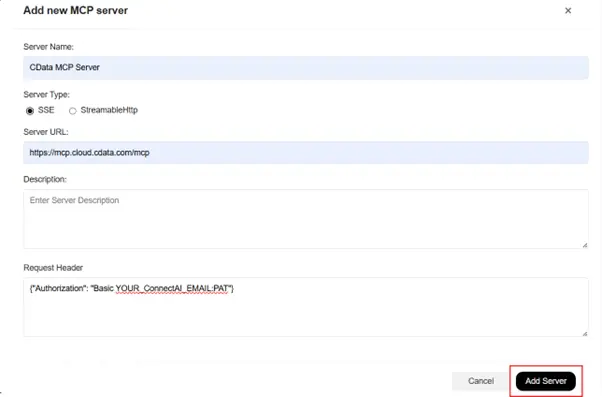
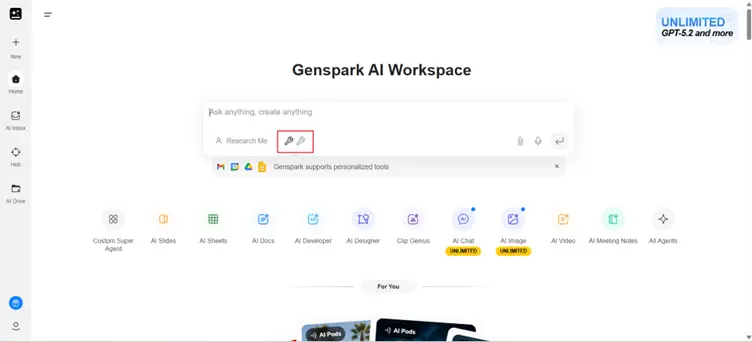
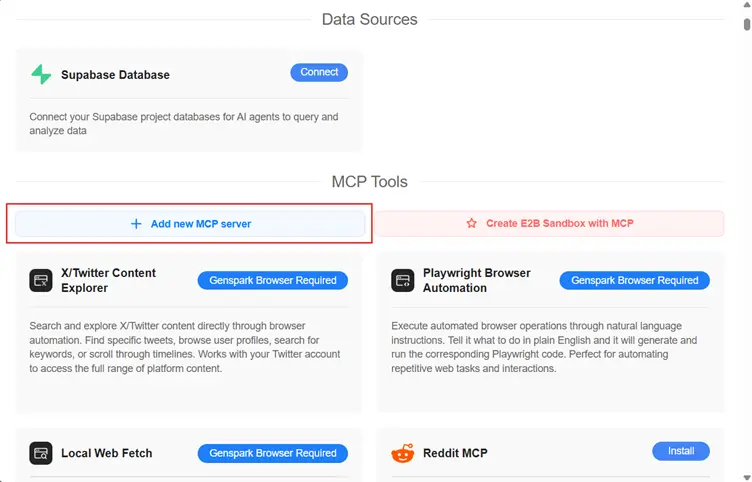
Once added, GenSpark will automatically load all MCP tools exposed through your Connect AI workspace.
Step 3: Query data in GenSpark
In GenSpark chat interface enter any sample prompt:
List the tools present in CData Connect AI MCP Server.
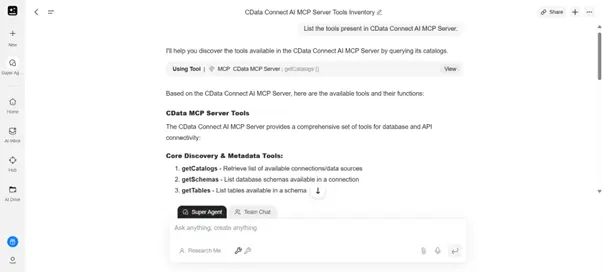
Build real-time, data-aware agents with GenSpark and CData
GenSpark and CData Connect AI together enable intelligent, AI-driven workflows where agents can securely access live enterprise data and operate with real-time awareness without ETL pipelines, data sync jobs, or custom integration logic. This streamlined approach delivers stronger governance, lower operational overhead, and faster, more grounded responses from your AI tools.
Start your free trial today to see how CData can empower GenSpark with live, secure access to 300+ external systems.
