






How to connect PolyBase to Nuclia

PolyBase for SQL Server allows you to query external data by using the same Transact-SQL syntax used to query a database table. When paired with the CData API Driver for ODBC, you get access to your Nuclia data directly alongside your SQL Server data. This article describes creating an external data source and external tables to grant access to live Nuclia data using T-SQL queries.
NOTE: PolyBase is only available on SQL Server 19 and above.
The CData ODBC drivers offer unmatched performance for interacting with live Nuclia data using PolyBase due to optimized data processing built into the driver. When you issue complex SQL queries from SQL Server to Nuclia, the driver pushes down supported SQL operations, like filters and aggregations, directly to Nuclia and utilizes the embedded SQL engine to process unsupported operations (often SQL functions and JOIN operations) client-side. And with PolyBase, you can also join SQL Server data with Nuclia data, using a single query to pull data from distributed sources.
Connect to Nuclia
If you have not already, first specify connection properties in an ODBC DSN (data source name). This is the last step of the driver installation. You can use the Microsoft ODBC Data Source Administrator to create and configure ODBC DSNs. To create an external data source in SQL Server using PolyBase, configure a System DSN (CData Nuclia Sys is created automatically).
Using API Key Authentication
Nuclia uses API key authentication for accessing Knowledge Box data. To obtain an API key:
- Log in to the Nuclia Cloud Dashboard at https://nuclia.cloud
- Navigate to your Knowledge Box settings
- Go to the Service Accounts section
- Create a new service account or copy an existing API key
After obtaining your API key, set the following connection properties:
- AuthScheme: Set this to APIKey.
- APIKey: Set this to your Nuclia service account API key.
- KbId: Set this to your Knowledge Box UUID.
- Zone: Set this to your Nuclia deployment zone (e.g., aws-us-east-2-1).
Example Connection String
Profile=C:\profiles\Nuclia.apip;AuthScheme=APIKey;APIKey=your_service_account_key;KbId=your_kb_uuid;Zone=aws-us-east-2-1;
Connecting to Nuclia
Once the authentication is configured, you can connect to Nuclia and query data from any of the available tables such as Resources, KnowledgeBox, LabelSets, and ProcessingStatus.
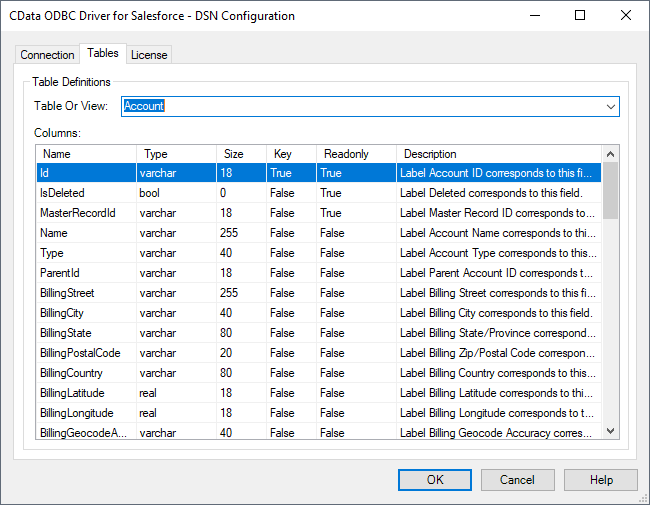
Click "Test Connection" to ensure that the DSN is connected to Nuclia properly. Navigate to the Tables tab to review the table definitions for Nuclia.
Create an External Data Source for Nuclia Data
After configuring the connection, you need to create a master encryption key and a credential database for the external data source.
Creating a Master Encryption Key
Execute the following SQL command to create a new master key, 'ENCRYPTION,' to encrypt the credentials for the external data source.
CREATE MASTER KEY ENCRYPTION BY PASSWORD = 'password';
Creating a Credential Database
Execute the following SQL command to create credentials for the external data source connected to Nuclia data.
NOTE: Since Nuclia does not require a User or Password to authenticate, you may use whatever values you wish for IDENTITY and SECRET.
CREATE DATABASE SCOPED CREDENTIAL api_creds
WITH IDENTITY = 'username', SECRET = 'password';
Create an External Data Source for Nuclia
Execute a CREATE EXTERNAL DATA SOURCE SQL command to create an external data source for Nuclia with PolyBase:
- Set the LOCATION parameter , using the DSN and credentials configured earlier.
For Nuclia, set SERVERNAME to the URL or address for your server (e.g. 'localhost' or '127.0.0.1' for local servers; the remote URL for remote servers). Leave PORT empty. PUSHDOWN is set to ON by default, meaning the ODBC Driver can leverage server-side processing for complex queries.
CREATE EXTERNAL DATA SOURCE cdata_api_source
WITH (
  LOCATION = 'odbc://SERVER_URL',
  CONNECTION_OPTIONS = 'DSN=CData Nuclia Sys',
  -- PUSHDOWN = ON | OFF,
  CREDENTIAL = api_creds
);
Create External Tables for Nuclia
After creating the external data source, use CREATE EXTERNAL TABLE statements to link to Nuclia data from your SQL Server instance. The table column definitions must match those exposed by the CData API Driver for ODBC. You can refer to the Tables tab of the DSN Configuration Wizard to see the table definition.
Sample CREATE TABLE Statement
The statement to create an external table based on a Nuclia KnowledgeBox would look similar to the following:
CREATE EXTERNAL TABLE KnowledgeBox(
   [nvarchar](255) NULL,
   [nvarchar](255) NULL,
  ...
) WITH (
  LOCATION='KnowledgeBox',
  DATA_SOURCE=cdata_api_source
);
Having created external tables for Nuclia in your SQL Server instance, you are now able to query local and remote data simultaneously. Thanks to built-in query processing in the CData ODBC Driver, you know that as much query processing as possible is being pushed to Nuclia, freeing up local resources and computing power. Download a free, 30-day trial of the ODBC Driver for Nuclia and start working with live Nuclia data alongside your SQL Server data today.