






Analyze Outlook Data in Slingshot with CData API Server

Slingshot (formerly known as Reveal BI) is a data-driven work management suite that brings together analytics, team and project coordination, content sharing, and communication in a single platform. With CData API Server, you can generate OData APIs for live Outlook data that are seamlessly consumable within Slingshot.
In this guide, we'll walk you through a step-by-step process to generate OData endpoints for Outlook using CData API Server, and bring those endpoints into Slingshot to create real-time dashboards and streamline data analysis.
Let's begin!
Prerequisites
- CData API Server: Download a free trial from here.
- Slingshot Account and App: Log in or sign up and download from here.
- An active Outlook account containing your data.
Overview
Here's an overview of the steps:
- Install the CData API Server, configure a connection to the Outlook, and generate OData API endpoints for Outlook data within the API Server for use in Slingshot.
- Connect these endpoints in Slingshot to build interactive dashboards and perform real-time analysis.
Step 1: Install, Configure, and Connect CData API Server to Outlook
1.1 Install the API Server
If you haven't already, download and install the CData API Server. Follow the installation wizard to complete the setup for your machine.
Once installed, you can start the server in the following ways:
- Windows: CData API Server runs as a service by default. Ensure the service is running, then open http://localhost:8080/ in your browser to access the API Server admin console.
- Linux/Mac: You can run the server manually or as a service. To start it manually, navigate to the installation directory and run java -jar apiserver.jar
- Alternatively, run service.sh with root privileges to set up API Server as a Linux system service.
1.2 Enable CORS
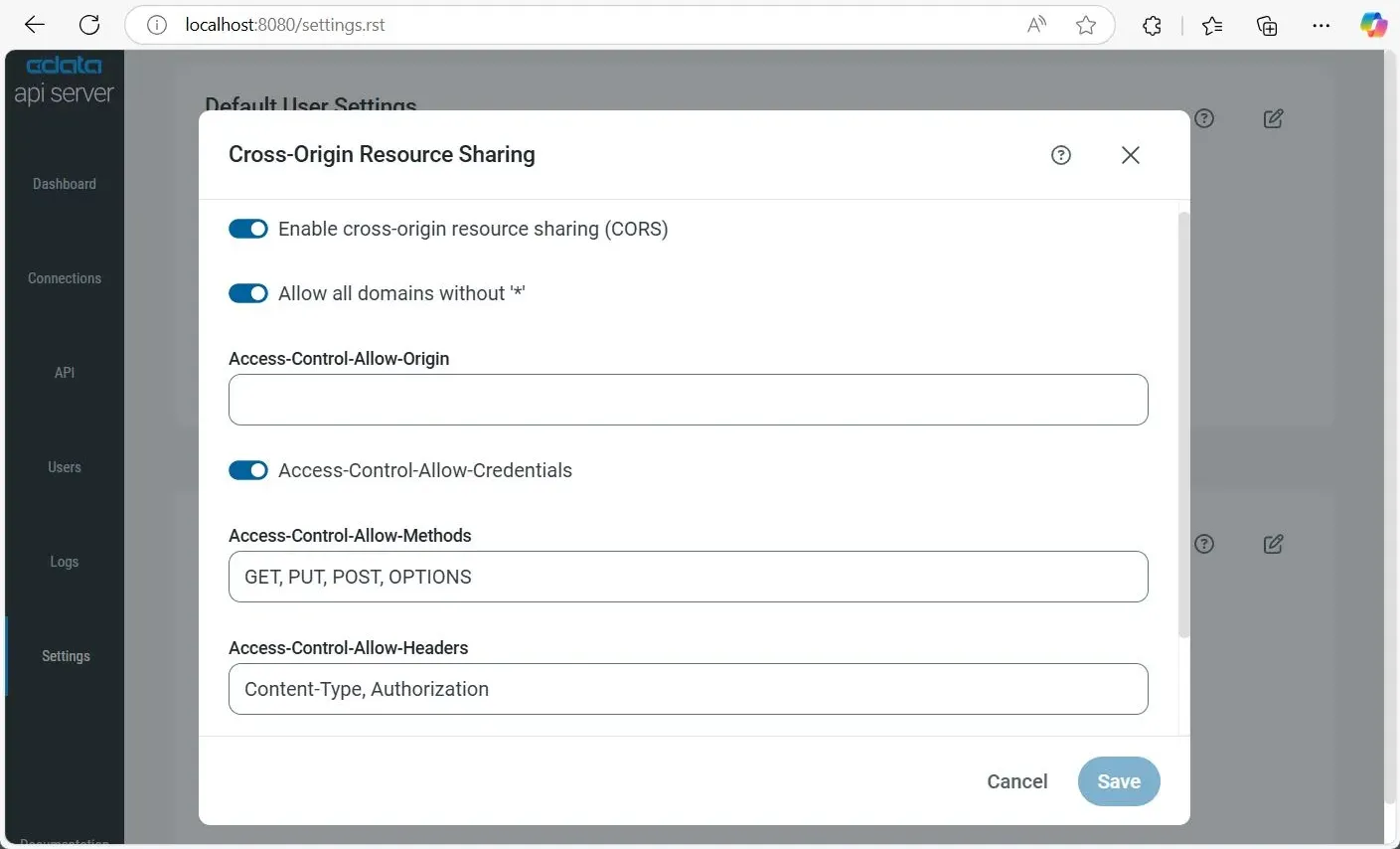
If the Slingshot app and API Server are hosted on different domains, CORS (Cross-Origin Resource Sharing) must be enabled to allow cross-domain communication. To enable CORS in the API Server:
- Go to Settings and click the icon to edit CORS settings.
- Enable Cross-Origin Resource Sharing (CORS).
- Enable Allow all domains without '*' to accept any origin.
- In Access-Control-Allow-Origin, enter your Outlook origin domain or use * to allow all domains. This is suitable for public APIs.
- Enable Access-Control-Allow-Credentials to allow cookies and auth headers.
- In Access-Control-Allow-Methods, enter GET, PUT, POST, OPTIONS.
- In Access-Control-Allow-Headers, enter Authorization, Content-Type.
- Set Access-Control-Max-Age (default: 3600 seconds) to cache preflight requests.
- Click Save.
1.3 Configure the Outlook Connection in API Server
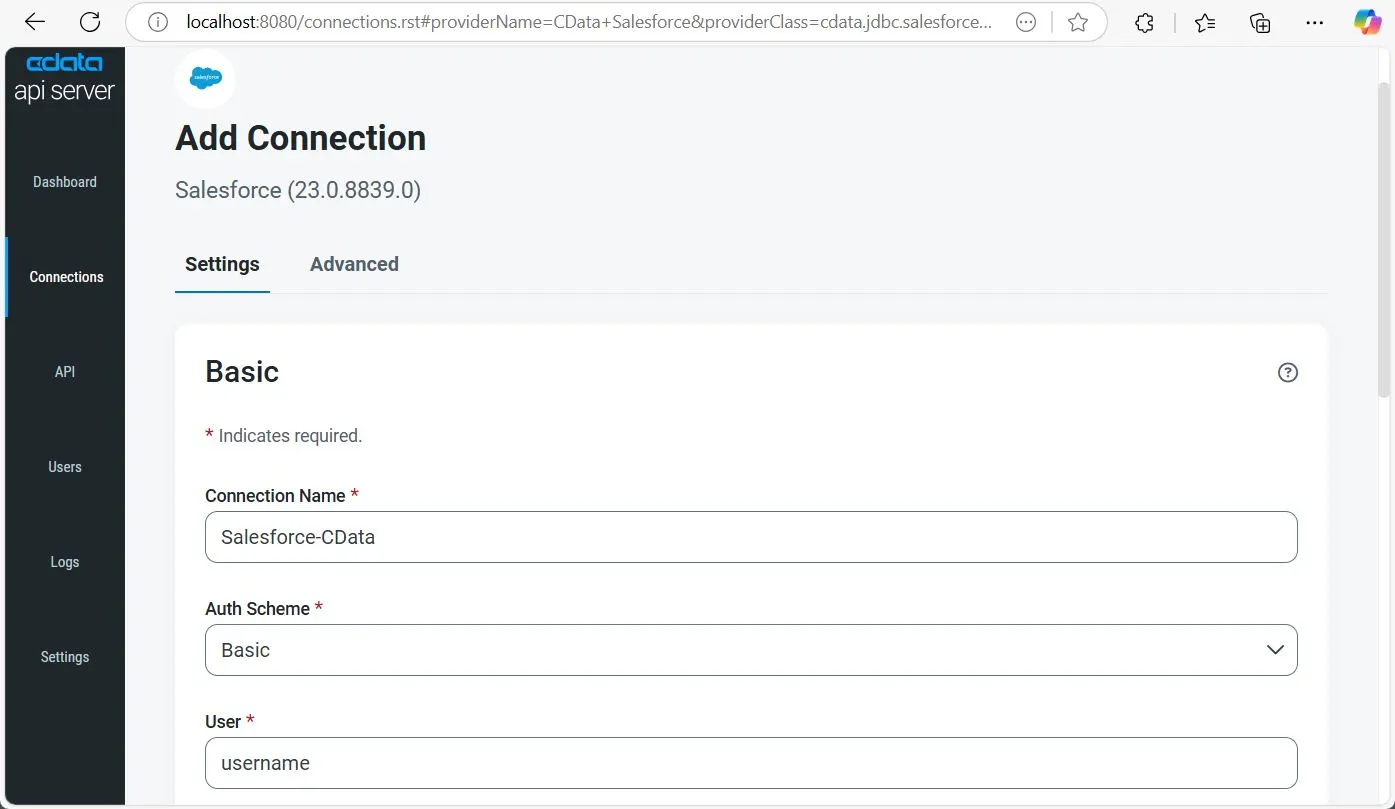
- Go to Settings and click Add Connection in the top-right.
- Select Outlook. If it's not visible, toggle off Only Installed to view all connectors.
- Click Install Connector to auto-install. For manual setup, choose Manual Install and upload the ZIP file.
- Once installed, click Outlook again to open its connection settings and configure using the details below.
- Log in to the Azure Portal.
- Navigate to Azure Active Directory > App registrations.
- Click New registration to create a new application.
- Enter an application name and select the appropriate account types.
- Set the Redirect URI to your application's callback URL (e.g., http://localhost:33333 for desktop apps).
- Click Register to create the application.
- On the application overview page, copy the Application (client) ID - this is your OAuthClientId.
- Navigate to Certificates & secrets and create a new client secret.
- Copy the client secret value - this is your OAuthClientSecret.
- Navigate to API permissions and add the required Microsoft Graph API permissions:
- Mail.Read - For accessing email messages
- Contacts.Read - For accessing contacts
- Calendars.Read - For accessing calendar events
- Tasks.Read - For accessing To Do tasks
- offline_access - For obtaining refresh tokens
- Click Grant admin consent to grant these permissions.
- AuthScheme: Set this to OAuth.
- InitiateOAuth: Set this to GETANDREFRESH. The CData API Profile for Outlook will automatically walk through the OAuth process in order to obtain the access token.
- OAuthClientId: Set this to the Application (client) ID from Azure Portal.
- OAuthClientSecret: Set this to the client secret value from Azure Portal.
- TenantId: Set this to your Azure AD tenant identifier (GUID or domain name like 'contoso.onmicrosoft.com').
- CallbackURL: Set this to the Redirect URI you specified in your app registration (e.g., http://localhost:33333 for desktop apps).
- Click Save & Test to validate and complete the connection setup.
Using OAuth Authentication
Microsoft Graph API uses OAuth 2.0 for authentication. You must register an application in the Microsoft Azure Portal to obtain OAuth credentials (Client ID and Client Secret).
Obtaining OAuth Credentials
Connecting with OAuth
After setting the following connection properties, you are ready to connect:
Example connection string
Profile=C:\profiles\Outlook.apip;AuthScheme=OAuth;InitiateOAuth=GETANDREFRESH;OAuthClientId=your_client_id;OAuthClientSecret=your_client_secret;TenantId=your_tenant_id;CallbackUrl=http://localhost:33333;
1.4. Add and Configure Users
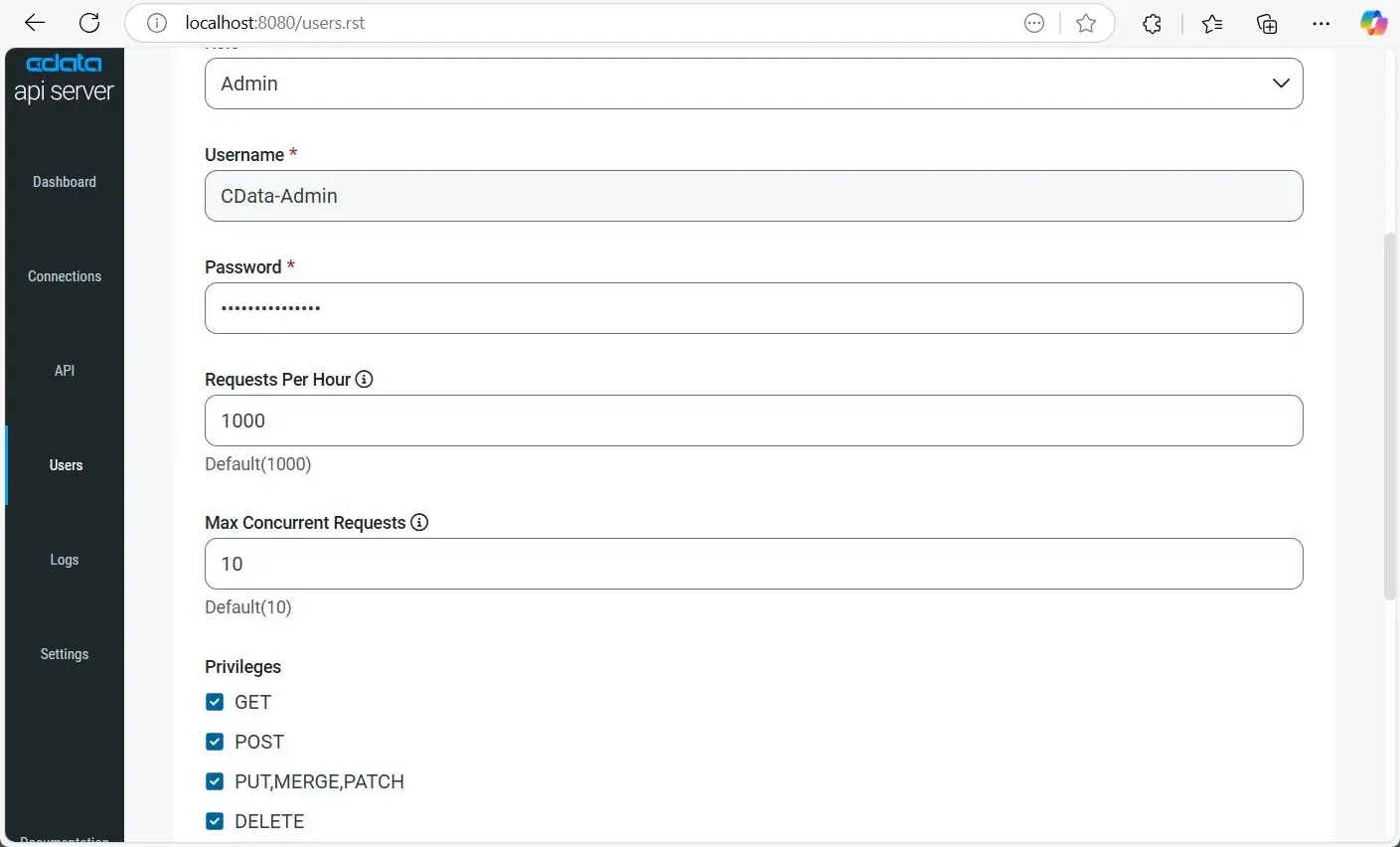
To allow secure access to the OData endpoints, you need to create and configure users in the CData API Server. Each user will have authentication credentials and role-based access control, ensuring that only authorized users can query the connected data.
- Go to Users from the navigation pane, then click Add User in the top-right corner.
- Enter a Username and set a secure Password for the user.
- Select a Role:
- Admin: Full access to all features including settings and connections.
- Query: Limited to data access via API endpoints (suitable for Slingshot use).
- (Optional) Configure rate limits:
- Requests Per Hour: Number of allowed API calls per hour (default: 1000).
- Max Concurrent Requests: Number of parallel API requests allowed (default: 10).
- Define Privileges for the user:
- GET: Allows data retrieval.
- POST: Allows creation of new records.
- PUT, MERGE, PATCH: Allows updates to existing records.
- DELETE: Allows deletion of records.
- Click Add User to save and activate the user account.
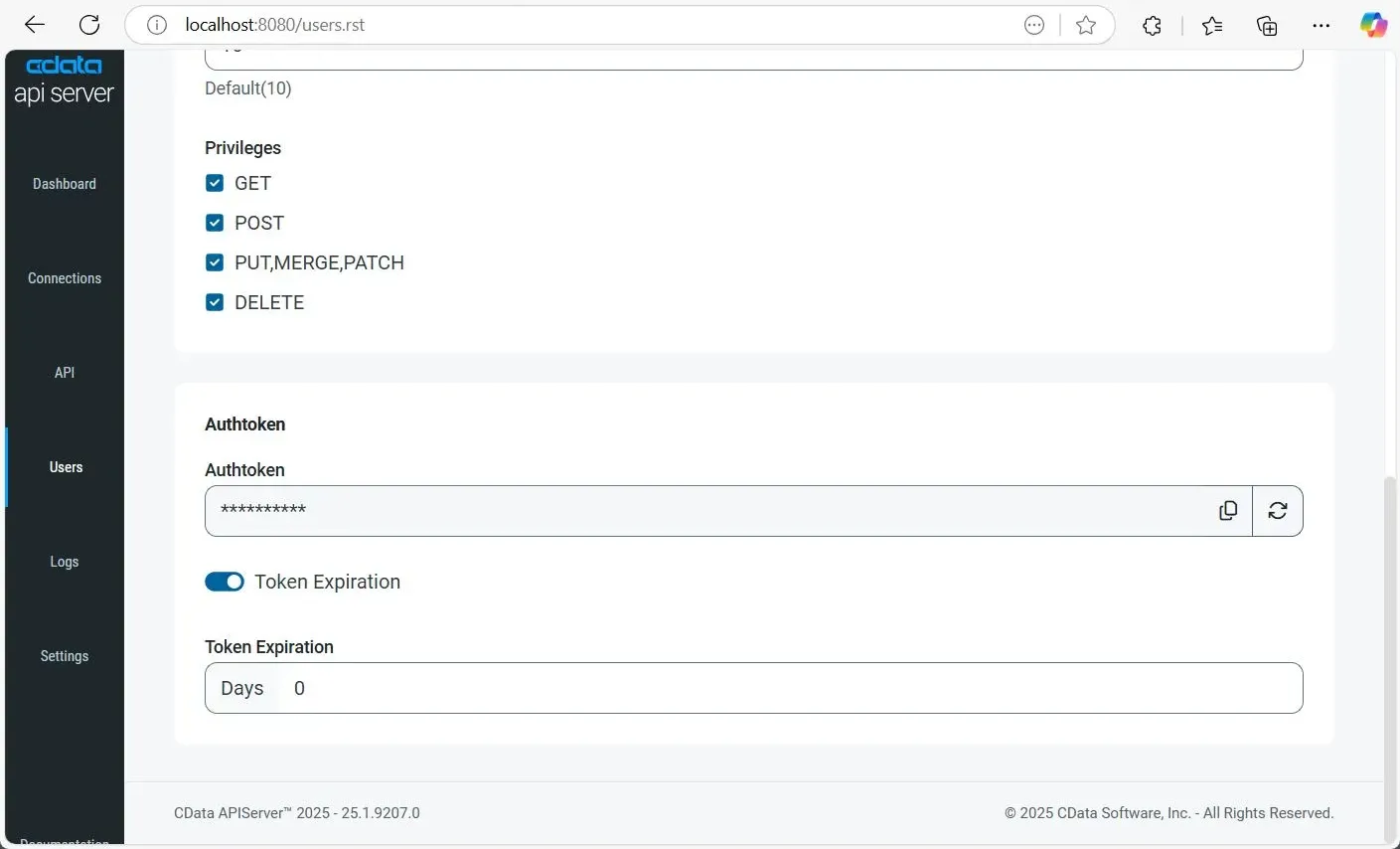
Once a user is created, an Authtoken is automatically generated. This token can be used in API requests as a secure authentication method in place of the password.
You can also refresh the Authtoken, disable it, or set expiration rules (e.g., number of days until expiry) by enabling the Token Expiration option in the user settings.
1.5. Add Tables for the Endpoint
To make your data available to Slingshot via OData, you need to expose your desired tables through the API Server:
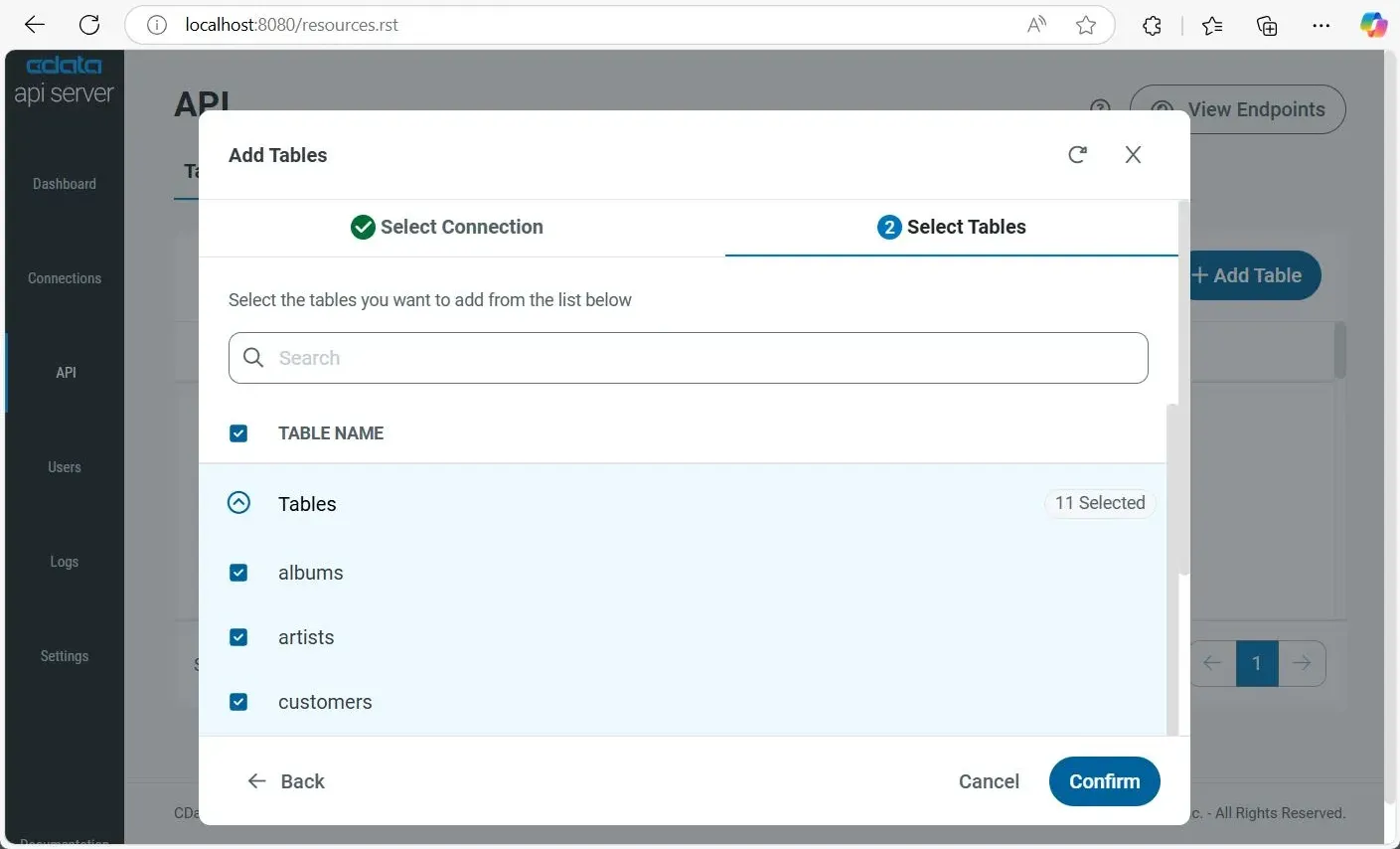
- In the CData API Server, go to API from the left navigation, then click Add Table at the top-right.
- Select the Outlook connection you configured earlier, then click Next.
- Browse available entities and schema by expanding the Tables section. Select individual tables or click the TABLE NAME checkbox on top to select all tables. Then, click Confirm.
1.6. Access and Use Endpoints in Slingshot
Now that your API is configured, Slingshot can connect to the OData endpoints to visualize live data. Use the following endpoint URL formats to access your API resources:
| Endpoint | URL | |
|---|---|---|
| Entity List | http://address:port/api.rsc/ | |
| Table Metadata (e.g., albums) | http://address:port/api.rsc/albums/$metadata?@json | |
| Table Data (e.g., albums) | http://address:port/api.rsc/albums |
These OData endpoints can now be consumed directly in Slingshot by creating a new data source using the URL. Slingshot supports OData, so once connected, you can build dashboards and visualizations using live data from Outlook.
For custom queries and filtered visualizations in Slingshot, append standard OData query parameters like $select, $filter, $orderby, $top, and $skip to your requests.
Step 2: Connect Outlook Endpoints in Slingshot to Analyze Data
Now that your OData API is ready, it's time to bring it into Slingshot and start analyzing your live Outlook data.
2.1 Add the OData Endpoint as a Data Source
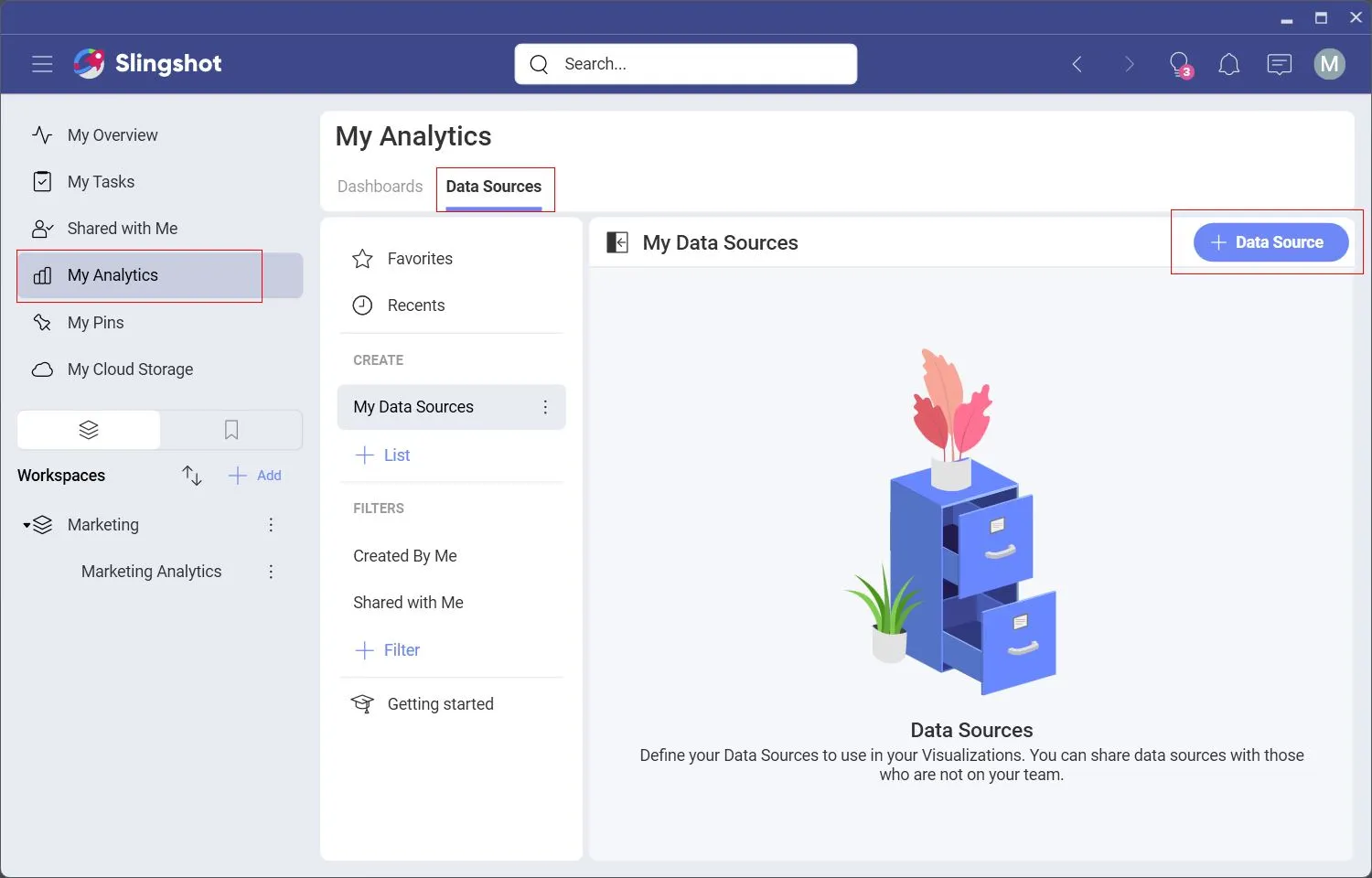
- Log in to your Slingshot account using the desktop app or by visiting https://my.slingshotapp.io/.
- Navigate to My Analytics on the left panel. Click Data Source on top, then click Data Source at the top-right.
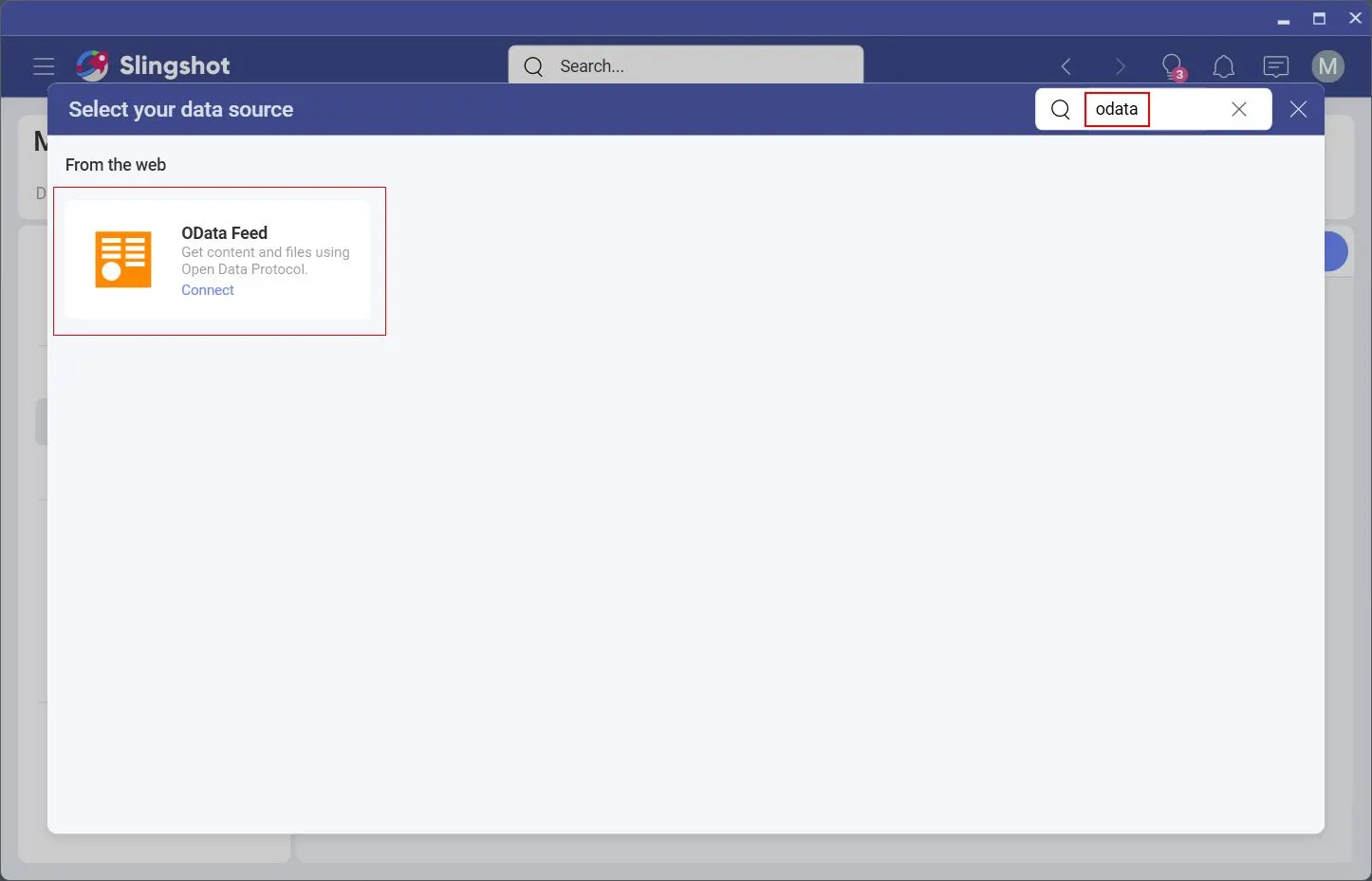
- Search for OData Feed and select it from the results.
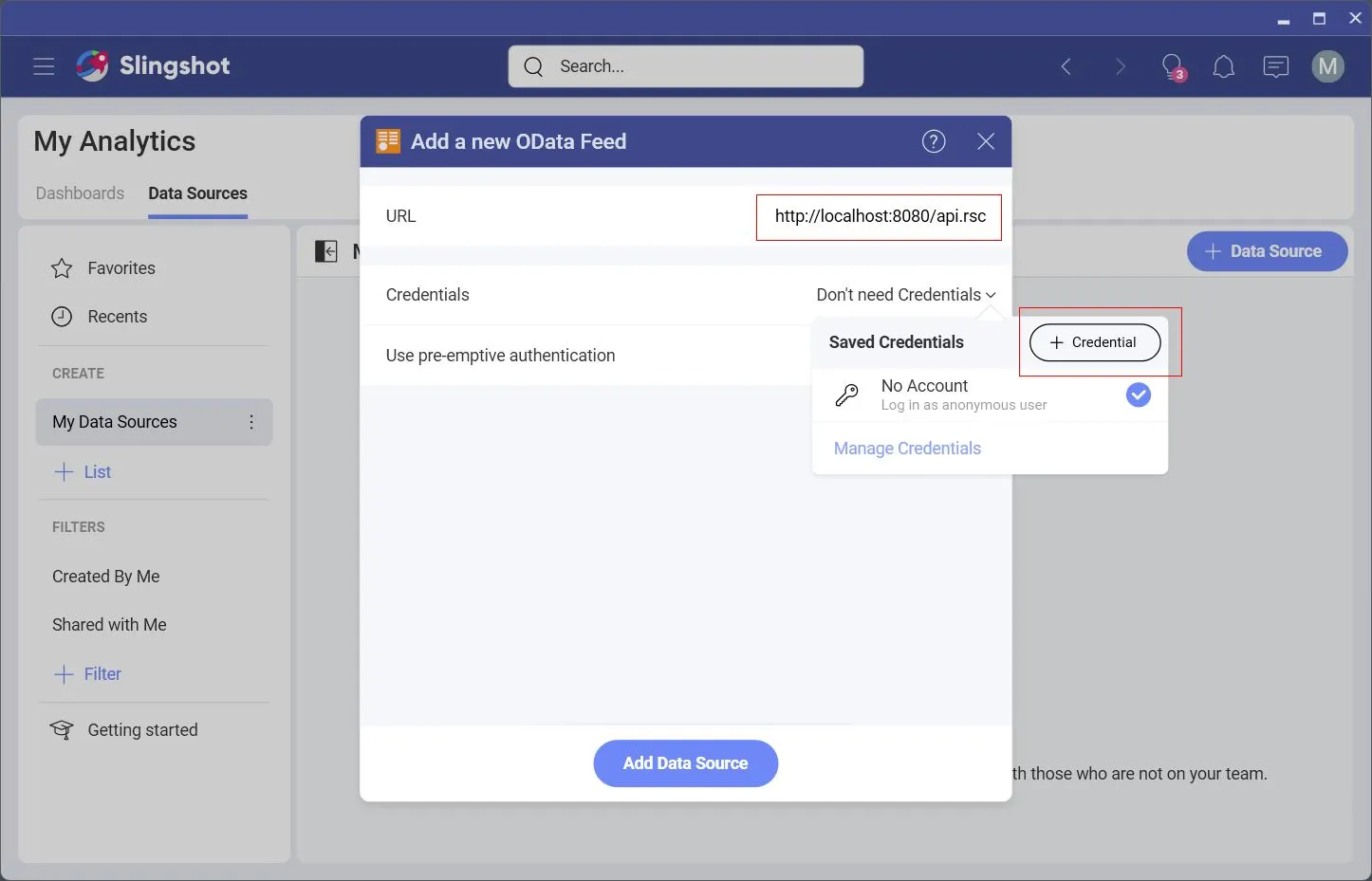
- In the URL field, enter the OData endpoint URL from your CData API Server. You can find it by navigating to API > View Endpoints in the top-right corner of the CData API Server dashboard.
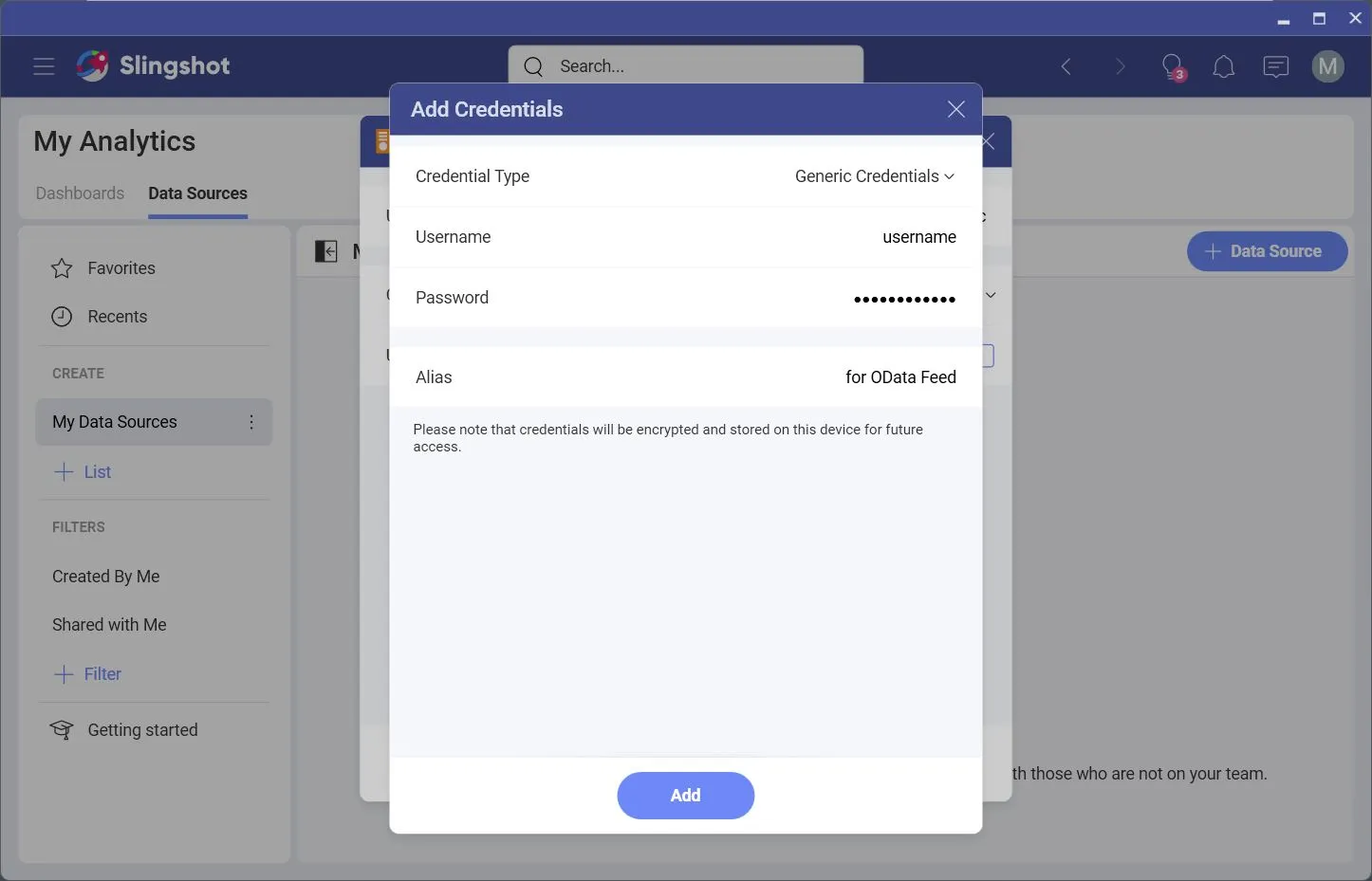
- Click on Credentials, then select the Credential button from the drop-down.
- Enter your Username and either the Password or the Auth Token of the user created in the CData API Server. Click Add, then click Add Data Source to finish.
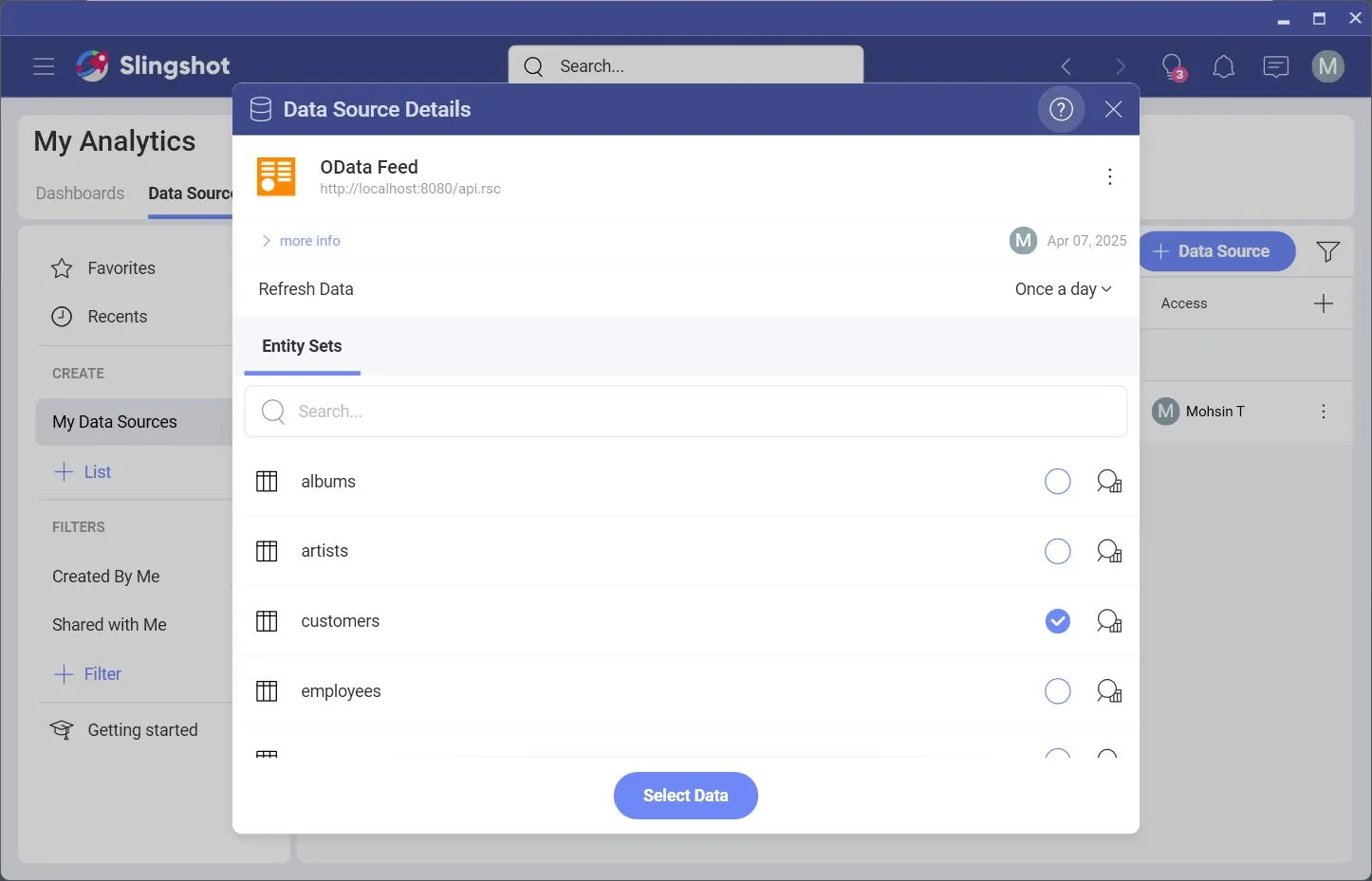
- Click the connected OData Feed, select the desired table, and click Select Data to start analyzing.
2.2 Analyze Data
Now that your OData feed is connected and available in Slingshot, you can start creating visualizations to explore and analyze your data in real-time.
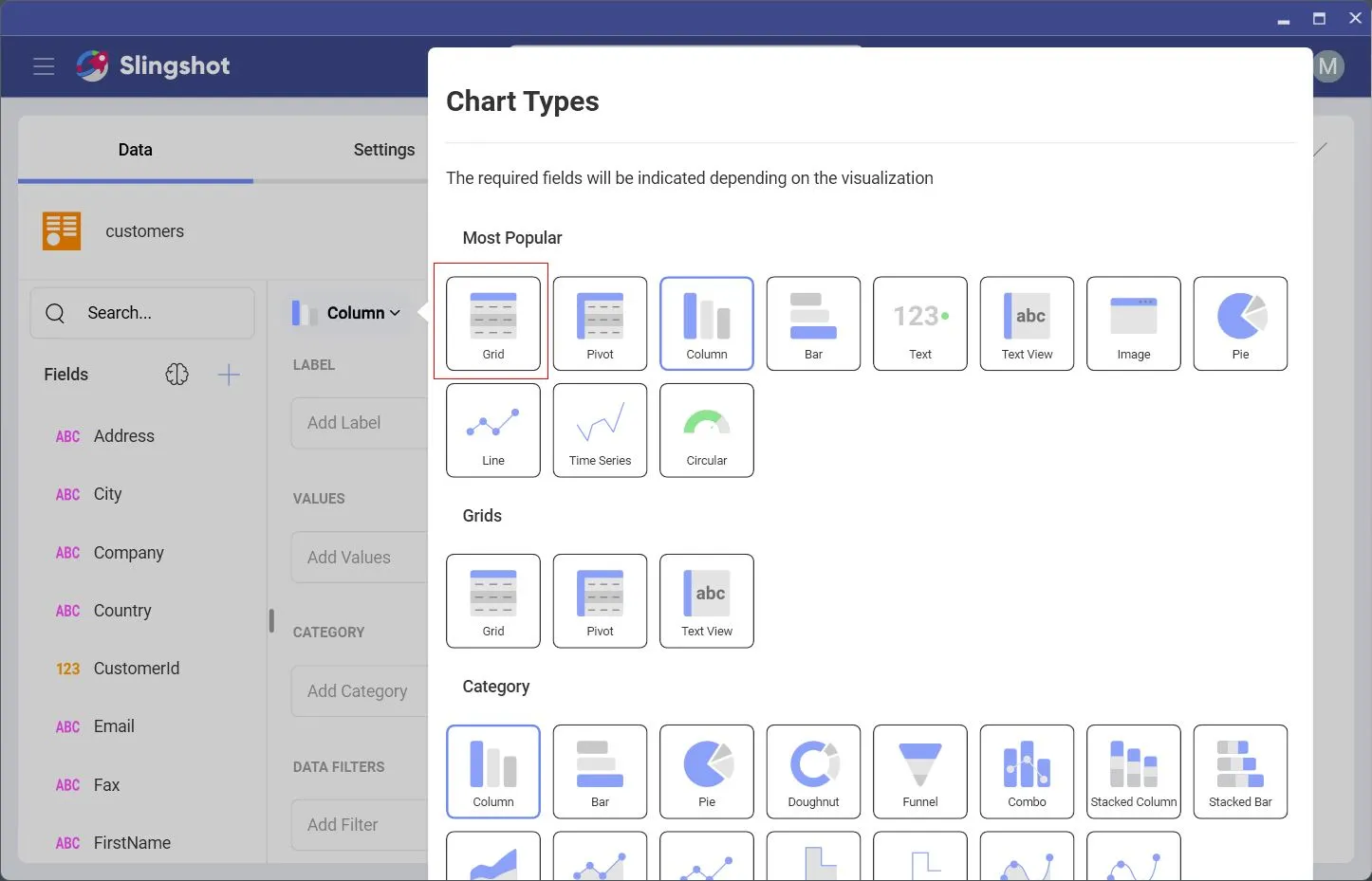
For our example, let's build a simple Grid visualization.
- Click on the Column drag-out panel, then select Grid.
- Drag and drop the desired columns from your table into the Grid. Slingshot will automatically create a live data view using those fields.
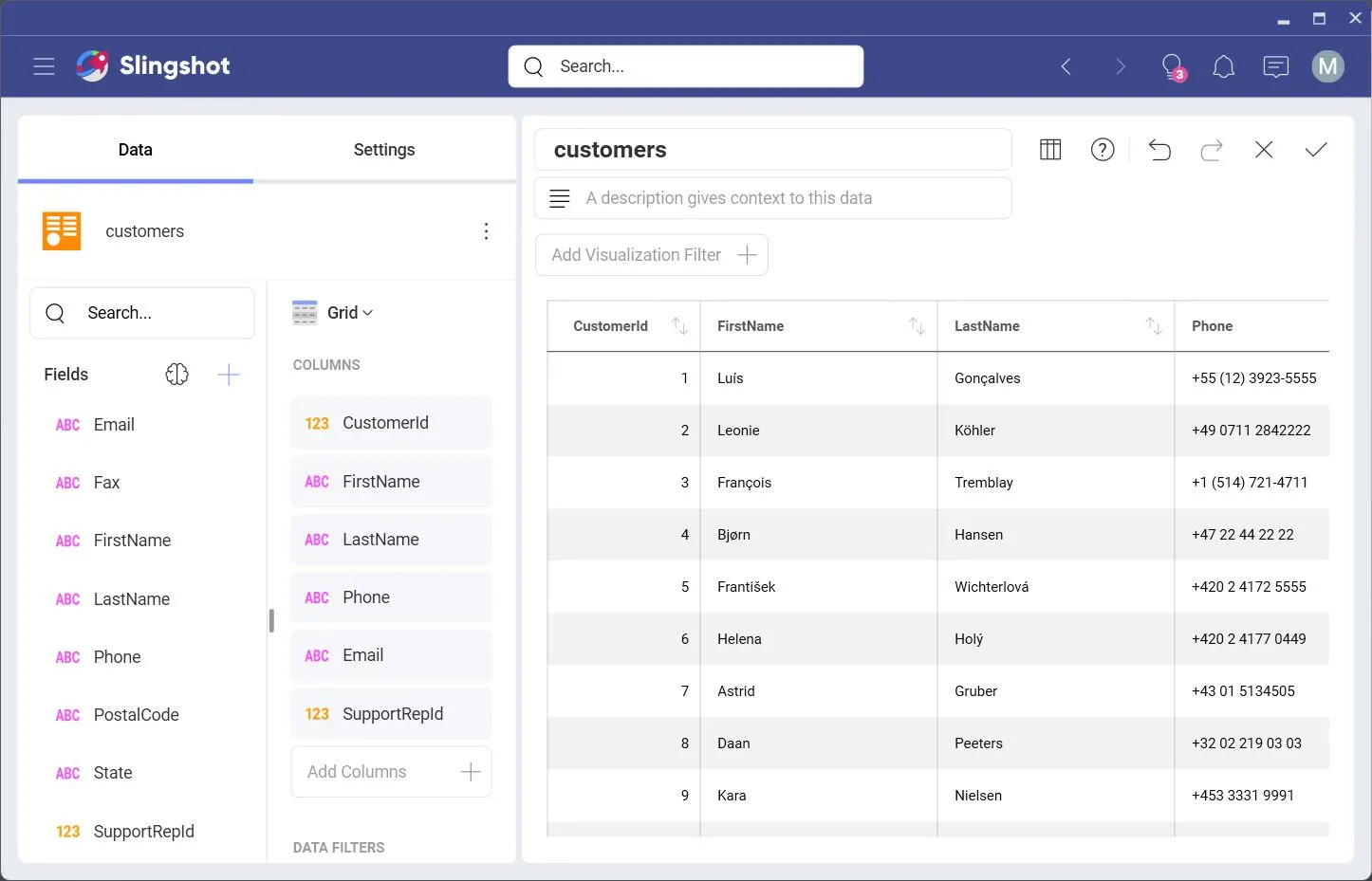
Similarly, you can create different visualizations like charts, tables, or pivot views by selecting the appropriate components from the panel. Just drag, drop, and configure as needed to explore your data from multiple angles.
You can also play with your data further by applying filters, sorting values, or grouping rows as needed. The possibilities are vast to tailor your dashboard exactly how you want it — powered by live Outlook data, connected data from your OData feed.
Try the CData API Server for 30 Days Free
The CData API Server offers the fastest way to build REST APIs from 270+ live data sources — with a no/low-code, plug-and-play approach that's ready for real-time app integrations!
Start your free trial and connect instantly with tools like Slingshot. Simplify how your team accesses and interacts with data today.