






Integrate Cursor with Live Paylocity Data via CData Connect AI

Cursor is an AI-powered code editor that embeds conversational and agent-style assistance alongside your development workflow. By extending Cursor with MCP (Model Context Protocol) tools, you can give its AI agents secure access to external systems such as APIs and databases.
Integrating Cursor with CData Connect AI via the built-in CData MCP Server allows the editor's AI to query, analyze, and act on live Paylocity data without copying data into the IDE. The result is a development experience where you can chat with your governed enterprise data directly from Cursor.
This article outlines how to configure Paylocity connectivity in Connect AI, generate the required access token, register the CData MCP Server in Cursor, and then use the AI chat pane to explore live Paylocity data.
Step 1: Configure Paylocity connectivity for Cursor
Connectivity to Paylocity from Cursor is made possible through CData Connect AI's Remote MCP Server. To interact with Paylocity data from Cursor, start by creating and configuring a Paylocity connection in CData Connect AI.
- Log into Connect AI, click Sources, and then click Add Connection
- Select Paylocity from the Add Connection panel
-
Enter the necessary authentication properties to connect to Paylocity.
Set the following to establish a connection to Paylocity:
- RSAPublicKey: Set this to the RSA Key associated with your Paylocity, if the RSA Encryption is enabled in the Paylocity account.
This property is required for executing Insert and Update statements, and it is not required if the feature is disabled.
- UseSandbox: Set to true if you are using sandbox account.
- CustomFieldsCategory: Set this to the Customfields category. This is required when IncludeCustomFields is set to true. The default value for this property is PayrollAndHR.
- Key: The AES symmetric key(base 64 encoded) encrypted with the Paylocity Public Key. It is the key used to encrypt the content.
Paylocity will decrypt the AES key using RSA decryption.
It is an optional property if the IV value not provided, The driver will generate a key internally. - IV: The AES IV (base 64 encoded) used when encrypting the content. It is an optional property if the Key value not provided, The driver will generate an IV internally.
Connect Using OAuth Authentication
You must use OAuth to authenticate with Paylocity. OAuth requires the authenticating user to interact with Paylocity using the browser. For more information, refer to the OAuth section in the Help documentation.
The Pay Entry API
The Pay Entry API is completely separate from the rest of the Paylocity API. It uses a separate Client ID and Secret, and must be explicitly requested from Paylocity for access to be granted for an account. The Pay Entry API allows you to automatically submit payroll information for individual employees, and little else. Due to the extremely limited nature of what is offered by the Pay Entry API, we have elected not to give it a separate schema, but it may be enabled via the UsePayEntryAPI connection property.
Please be aware that when setting UsePayEntryAPI to true, you may only use the CreatePayEntryImportBatch & MergePayEntryImportBatchgtable stored procedures, the InputTimeEntry table, and the OAuth stored procedures. Attempts to use other features of the product will result in an error. You must also store your OAuthAccessToken separately, which often means setting a different OAuthSettingsLocation when using this connection property.

- RSAPublicKey: Set this to the RSA Key associated with your Paylocity, if the RSA Encryption is enabled in the Paylocity account.
- Click Save & Test
- Navigate to the Permissions tab and update user-based permissions



Add a Personal Access Token
A Personal Access Token (PAT) is used to authenticate the connection to Connect AI from Cursor. It is best practice to create a separate PAT for each integration to maintain granular access control.
- Click the gear icon () at the top right of the Connect AI app to open Settings
- On the Settings page, go to the Access Tokens section and click Create PAT
- Give the PAT a descriptive name and click Create
- The personal access token is only visible at creation, so be sure to copy it and store it securely for future use

With the Paylocity connection configured and a PAT generated, Cursor can now connect to Paylocity data through the CData MCP Server.
Step 2: Configure the CData MCP Server in Cursor
Next, configure Cursor to use the CData MCP Server. Cursor reads MCP configuration from an mcp.json file in the user configuration directory and exposes the registered servers under the Tools & MCP settings. Once configured, Cursor's AI chat can call the tools exposed by CData Connect AI.
- Download the Cursor desktop application and complete the sign-up flow for your account
-
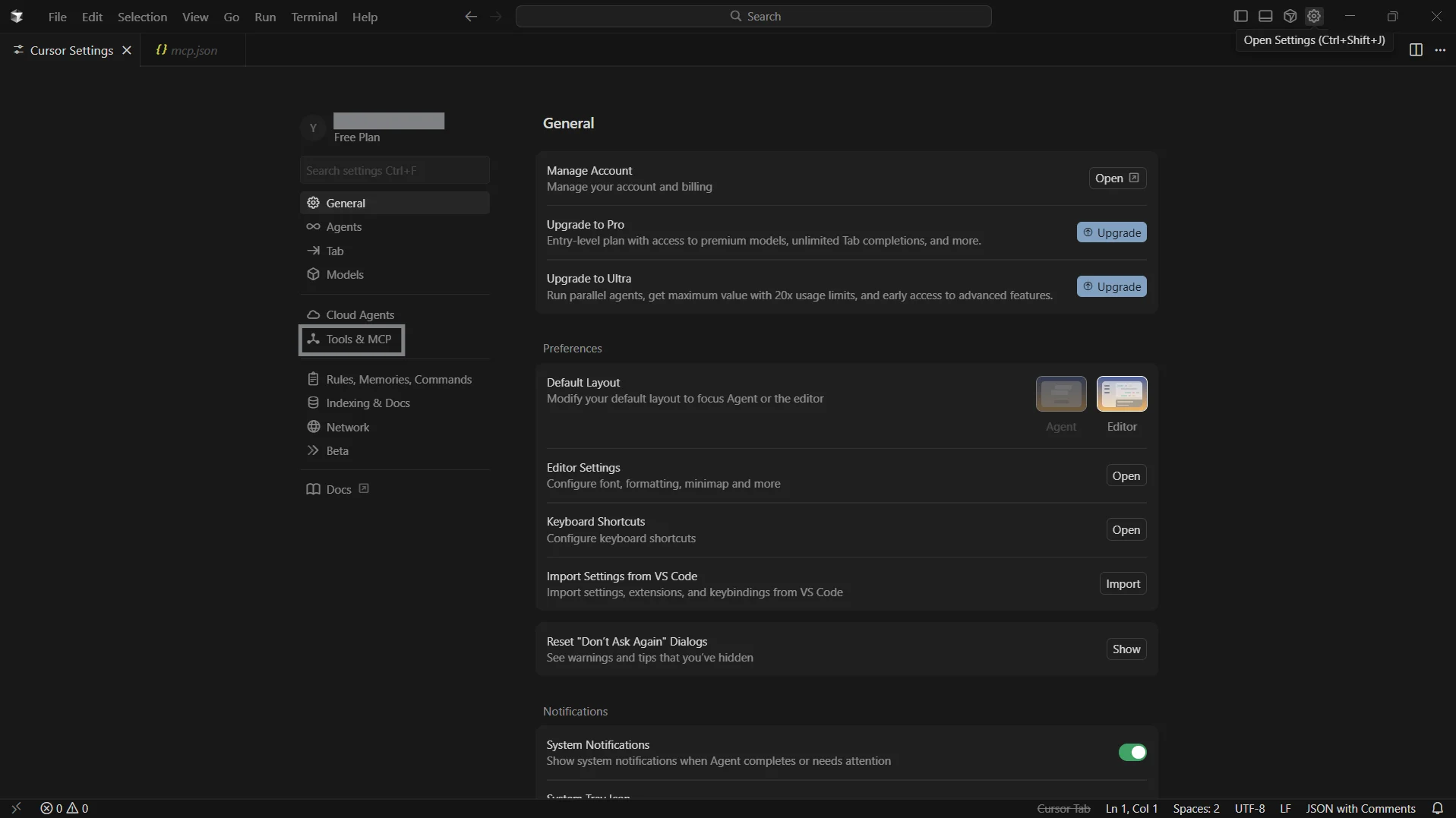
From the top menu, click Settings to open the settings panel
-
In the left navigation, open the Tools & MCP tab and click Add Custom MCP
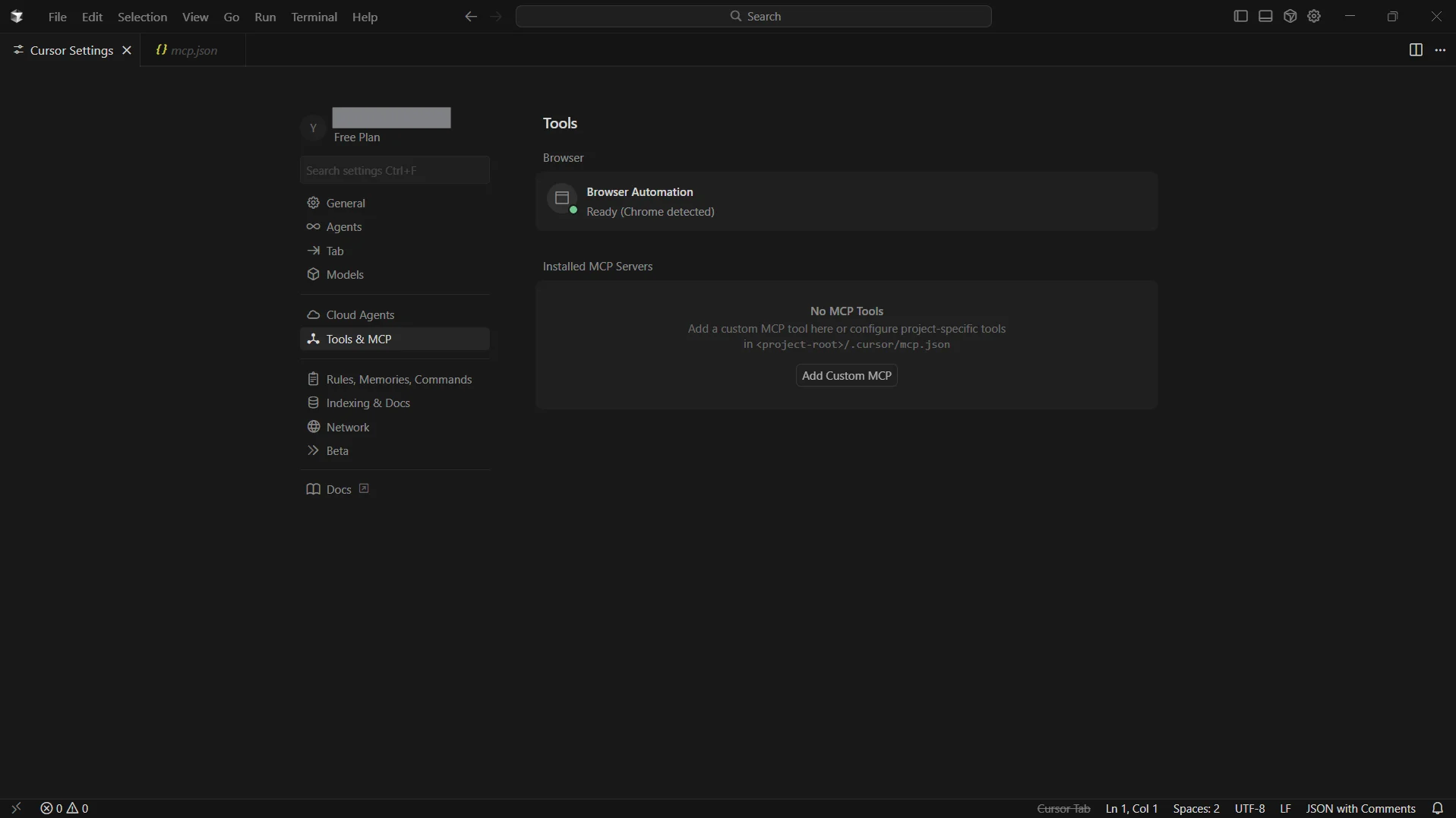
- Cursor opens an mcp.json file in the editor
-
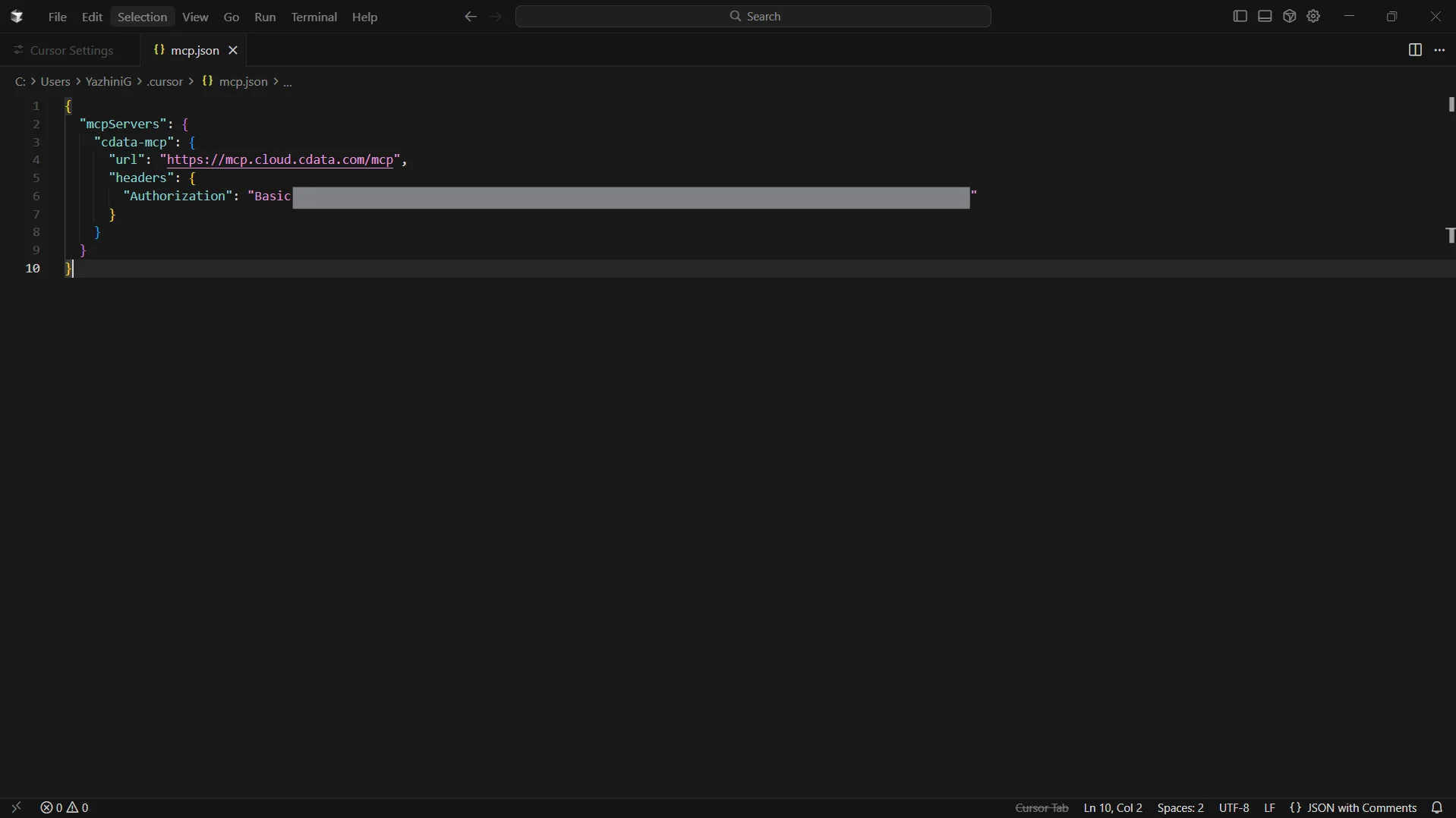
Add the following configuration. Make sure to base64-encode your email:PAT before inserting into the header:
{
  "mcpServers": {
    "cdata-mcp": {
      "url": "https://mcp.cloud.cdata.com/mcp",
      "headers": {
        "Authorization": "Basic your_base64_encoded_email_PAT"
      }
    }
  }
}
- Save the file
-
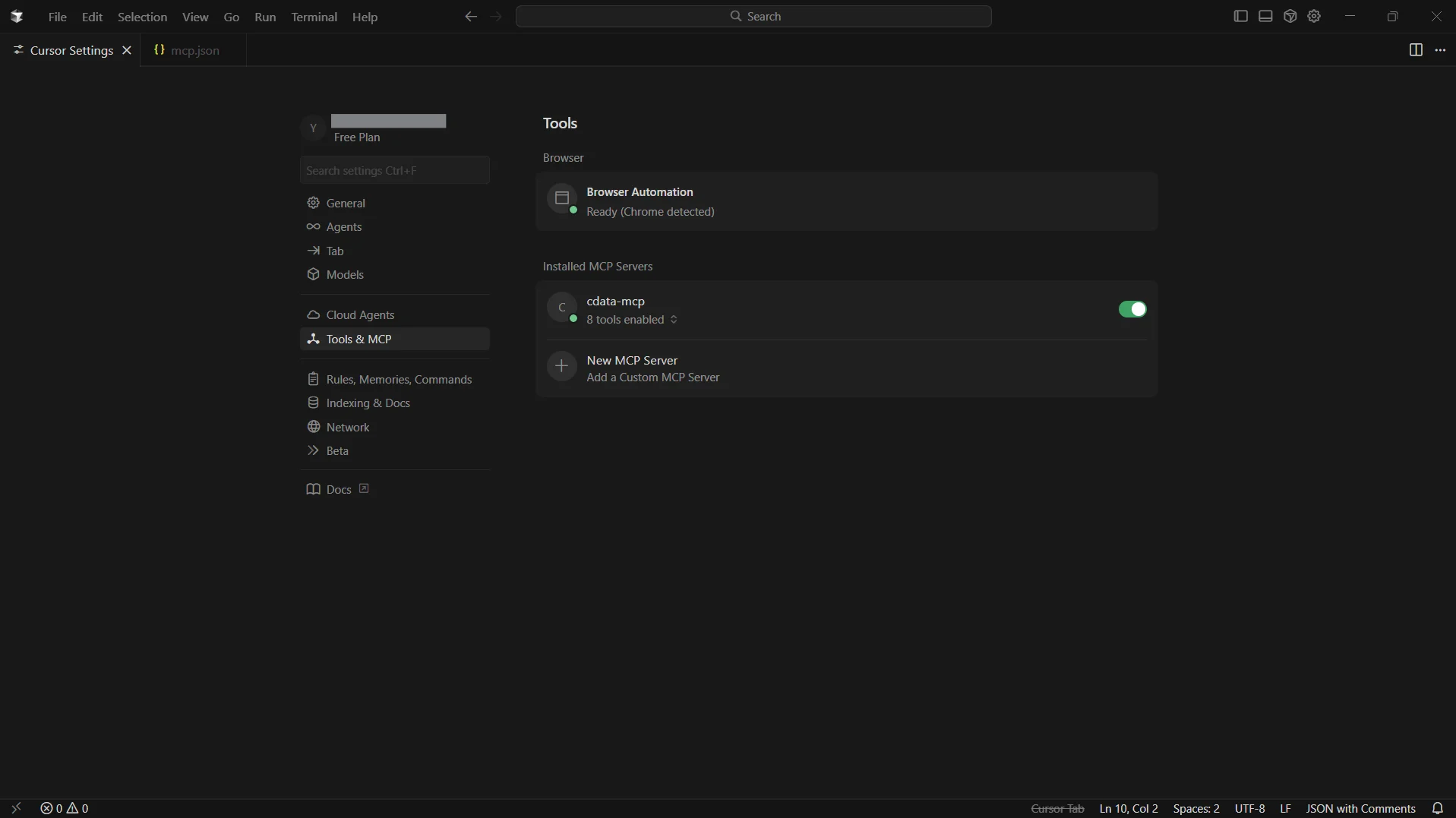
Return to Settings and then select Tools & MCP. You can now see cdata-mcp enabled with an active indicator
Step 3: Chat with CData Connect AI from Cursor
-
From the top bar, click Toggle AI Pane to open the chat window
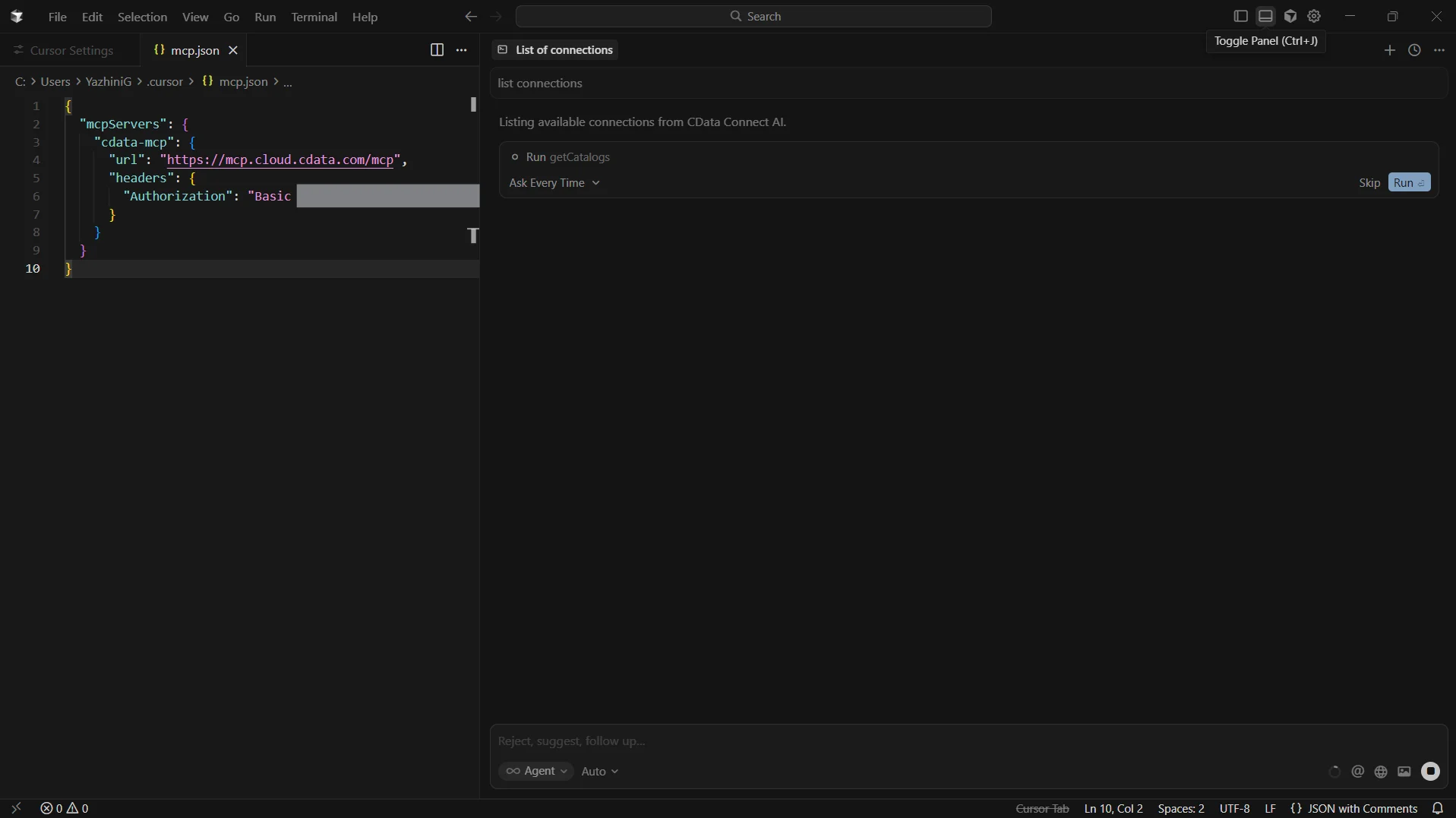
- Test the connection by entering "List connections"
-
You can also run queries like "Query Paylocity data and list the high priority accounts"
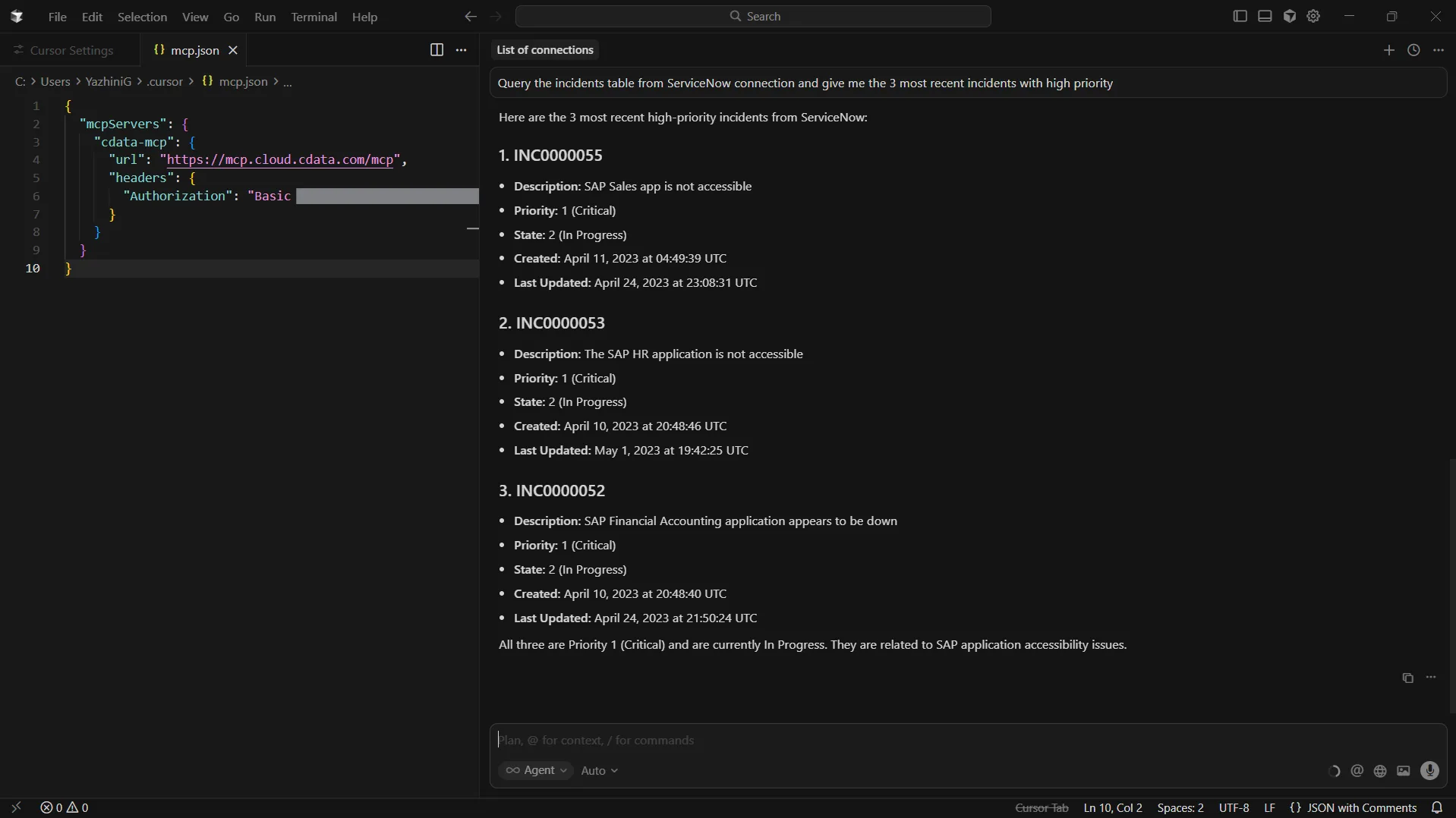
Cursor is now fully integrated with the CData Connect AI MCP Server and can act on live Paylocity data directly from the editor.
Get CData Connect AI
To access 300+ SaaS, Big Data, and NoSQL sources directly from your development tools, try CData Connect AI today!
