




Getting Started with the CData ODBC Driver for PingOne
This guide walks you through everything you need to get started with the CData ODBC Driver for PingOne. You'll learn how to install and license the driver, configure your first connection, and explore next steps for working with PingOne data in your applications.
Installation & Licensing
System Requirements
- Windows: Windows 10/11 or Windows Server 2016+
- Linux: Most modern distributions with UnixODBC
Installing the Driver
Windows Installation
- Download the ODBC driver installer from your CData account or the evaluation download page.
- Run the installer and follow the installation wizard.
- The installer will guide you through the setup process and automatically register the driver with the system.
- As part of the installation process, you will be prompted to input the license key in order to activate your license. You should have received your license key via email from the CData Orders Team. The license key looks like this:
XXXX-XXXX-XXXX-XXXX-XXXX.
- Note: If you are running a trial, just select the Trial Key option.
- Both 32-bit and 64-bit drivers are included. Install both if you use applications with different architectures.
Linux Installation
- Ensure UnixODBC is installed: sudo apt-get install unixodbc unixodbc-dev (Debian/Ubuntu) sudo yum install unixODBC unixODBC-devel (RHEL/CentOS)
- Extract the driver package to /opt/cdata/
- The driver will be automatically registered in /etc/odbcinst.ini
Activating Your License
You should have received your license key via email from the CData Orders Team. The license key looks like this: XXXX-XXXX-XXXX-XXXX-XXXX
Windows License Activation
Your license would typically be activated during installation. However, there are cases where you may need to activate it manually. The steps below walk you through manual activation:
- Open the ODBC driver application from the Start menu.
- Navigate to Help > Licensing
- Enter your license key in the provided field.
- Click Activate
- You should see "Licensed" status confirming successful activation.
Linux License Activation
- Navigate to the installation directory where you extracted the driver package. (i.e.cd /opt/cdata/cdata-odbc-driver-for-acumatica/bin/)
- Create a license file by running the following command sudo ./install-license.sh
- Replace
with your actual license key. - To activate a trial, omit the
input.
Common Licensing Questions
Can I use my license on multiple machines?
Yes, depending on your subscription tier. Check your order confirmation or contact your account representative for details. If you are unsure of who your account representative is, contact [email protected].
I lost my license key. How do I retrieve it?
Email [email protected] with your order number, and we'll resend your license key.
Can I transfer my license to a different machine?
Yes. When transferring the license to a different machine, you will need to submit a License Transfer Request on our site linked below:
https://www.cdata.com/lic/transfer/
After the License Transfer Request is submitted and successfully processed, an activation will be added to your Product Key and you will be able to activate the full license on the other machine. Once this process is finished, the license on the previous machine will be invalid.
For additional licensing questions, contact [email protected]. Viewing and upgrading your license can now be done through our self-service portal at portal.cdata.com.
Connection Configuration
Once your driver is installed and licensed, you're ready to configure a connection to PingOne. The ODBC driver uses a DSN (Data Source Name) to store connection properties.
Creating a DSN
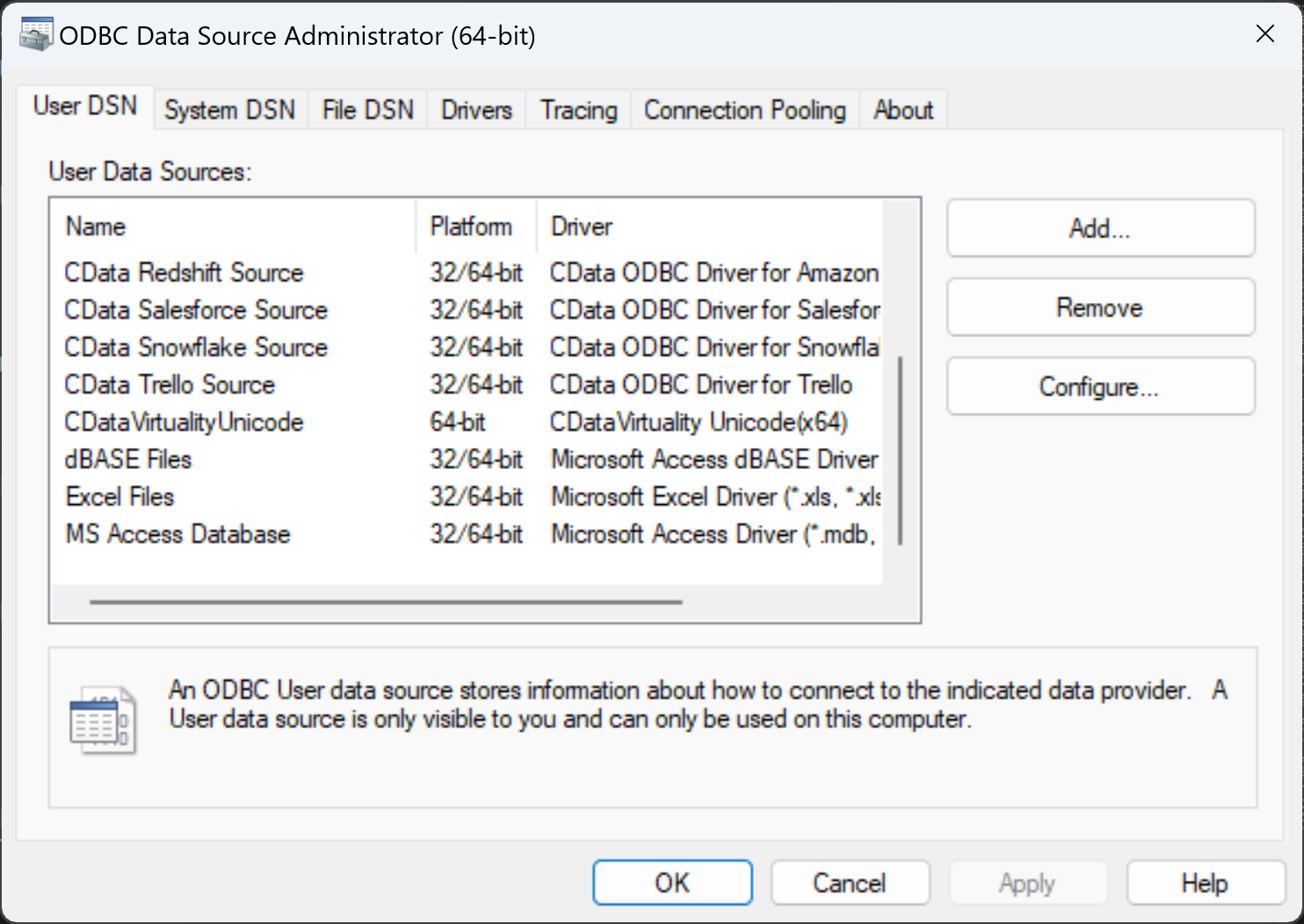
Windows: Using ODBC Data Source Administrator
- Open the ODBC Data Source Administrator (64-bit)
Note: Use the 64-bit version for 64-bit applications and the 32-bit version for 32-bit applications.- Search for "ODBC" in the Windows Start menu
- Or navigate to: Control Panel > Administrative Tools > ODBC Data Sources
- Click the System DSN or User DSN tab
- System DSN: Available to all users on the machine (recommended for services)
- User DSN: Available only to the current user
- Select CData ODBC Driver for PingOne from the list, or click Add to create a new data source.
- Click OK or Finish to open the connection configuration dialog.
Linux: Editing Config Files (odbcinst.ini & odbc.ini)
- Register the Driver by adding the section below to the odbcinst.ini file. [CData ODBC Driver for PingOne] Driver=/opt/cdata/cdata-odbc-driver-for-pingone/lib/libpingoneodbc.x64.so Description=CData ODBC Driver for PingOne
- Save the file.
- Create the DSN by adding the entry below to the odbc.ini file: [CData PingOne Source] Driver=/opt/cdata/cdata-odbc-driver-for-pingone/lib/libpingoneodbc.x64.so ConnectionProperty1=Value1 ConnectionProperty2=Value2 AuthScheme = OAuth WorkerAppEnvironmentId = eebc33a8-xxxx-4f3a-yyyy-d3e5262fd49e Region = NA OAuthClientId = client_id OAuthClientSecret = client_secret InitiateOAuth = GETANDREFRESH
- Save the file.
Configuring Connection Properties
To connect to PingOne, configure these properties:
- Region: The region where the data for your PingOne organization is being hosted.
- AuthScheme: The type of authentication to use when connecting to PingOne.
- Either WorkerAppEnvironmentId (required when using the default PingOne domain) or AuthorizationServerURL, configured as described below.
Configuring WorkerAppEnvironmentId
WorkerAppEnvironmentId is the ID of the PingOne environment in which your Worker application resides. This parameter is used only when the environment is using the default PingOne domain (auth.pingone). It is configured after you have created the custom OAuth application you will use to authenticate to PingOne, as described in Creating a Custom OAuth Application in the Help documentation.
First, find the value for this property:
- From the home page of your PingOne organization, move to the navigation sidebar and click Environments.
- Find the environment in which you have created your custom OAuth/Worker application (usually Administrators), and click Manage Environment. The environment's home page displays.
- In the environment's home page navigation sidebar, click Applications.
- Find your OAuth or Worker application details in the list.
-
Copy the value in the Environment ID field.
It should look similar to:
WorkerAppEnvironmentId='11e96fc7-aa4d-4a60-8196-9acf91424eca'
Now set WorkerAppEnvironmentId to the value of the Environment ID field.
Configuring AuthorizationServerURL
AuthorizationServerURL is the base URL of the PingOne authorization server for the environment where your application is located. This property is only used when you have set up a custom domain for the environment, as described in the PingOne platform API documentation. See Custom Domains.
Authenticating to PingOne with OAuth
PingOne supports both OAuth and OAuthClient authentication. In addition to performing the configuration steps described above, there are two more steps to complete to support OAuth or OAuthCliet authentication:
- Create and configure a custom OAuth application, as described in Creating a Custom OAuth Application in the Help documentation.
- To ensure that the driver can access the entities in Data Model, confirm that you have configured the correct roles for the admin user/worker application you will be using, as described in Administrator Roles in the Help documentation.
- Set the appropriate properties for the authscheme and authflow of your choice, as described in the following subsections.
OAuth (Authorization Code grant)
Set AuthScheme to OAuth.
Desktop Applications
Get and Refresh the OAuth Access Token
After setting the following, you are ready to connect:
- InitiateOAuth: GETANDREFRESH. To avoid the need to repeat the OAuth exchange and manually setting the OAuthAccessToken each time you connect, use InitiateOAuth.
- OAuthClientId: The Client ID you obtained when you created your custom OAuth application.
- OAuthClientSecret: The Client Secret you obtained when you created your custom OAuth application.
- CallbackURL: The redirect URI you defined when you registered your custom OAuth application. For example: https://localhost:3333
When you connect, the driver opens PingOne's OAuth endpoint in your default browser. Log in and grant permissions to the application. The driver then completes the OAuth process:
- The driver obtains an access token from PingOne and uses it to request data.
- The OAuth values are saved in the location specified in OAuthSettingsLocation, to be persisted across connections.
The driver refreshes the access token automatically when it expires.
For other OAuth methods, including Web Applications, Headless Machines, or Client Credentials Grant, refer to the Help documentation.
Testing Your Connection
- After entering your connection properties, click Test Connection.
- A successful test confirms:
- Authentication credentials are correct.
- Network connectivity is established.
- Required permissions are in place.
- If the test fails, the error message will indicate what needs to be corrected.
- Click OK to save your DSN.
Common Connection Issues
Authentication Failed
Solution: Verify your credentials are current. For OAuth applications, you may need to authorize CData in your application's security settings. Contact [email protected] for authorization assistance.
Cannot Reach Server
Solution: Check firewall & proxy settings. Contact [email protected] for specific port requirements.
Table Not Found
Solution: Verify database and schema names. Use the Data Model tab in the DSN configuration to browse available tables.
Driver Not Found (Linux)
Solution: Verify the driver is correctly registered in odbcinst.ini. Contact [email protected] for further assistance.
For additional connection troubleshooting, contact [email protected] with your specific error message.
What's Next
Now that you have installed, licensed, and configured the driver, here are some scenarios you can use to explore our ODBC Drivers:
Get Support
If you need assistance at any point:
- Technical Support: [email protected]
- Community Forum: CData Community Site
- Help Documentation: Installed locally and available online
FAQs
Installation & Licensing
- Do I need administrator rights to install the driver?
Yes, administrator rights are required for system-wide installation on Windows and Linux. - Can I install both 32-bit and 64-bit drivers on the same machine?
Yes, both versions are installed by default.
Connecting
- What's the difference between System DSN and User DSN?
System DSNs are available to all users on a machine and are required for services. User DSNs are only available to the user who created them. - Can I use a DSN-less connection string instead of creating a DSN?
Yes. Many applications support DSN-less connection strings. See the connection string example below:Driver={CData ODBC Driver for PingOne};RequiredConnectionProperty1=Value1;RequiredConnectionProperty2=Value2; - How do I connect to multiple PingOne accounts?
Create separate DSNs for each account, each with its own authentication credentials. - Can I connect through a proxy server?
Yes. Configure proxy settings in your DSN connection properties. Refer to the Firewall & Proxy section in the help documentation for proxy configuration.
Performance & Troubleshooting
- Why are my queries slow?
Check the following:- Use caching for infrequently changing data. Refer to the Caching Data section in the help documentation for further details.
- Add filters (WHERE clauses) to reduce result set size.
- Contact [email protected] for query optimization assistance.
- How do I enable logging for troubleshooting?
Add the following to your DSN:- Logfile: /path/to/logfile.log
- Verbosity: 3
Be prepared to securely upload the log file upon request when reaching out to [email protected] for troubleshooting analysis.
- What ports does the driver need access to?
This depends on your data source. Most cloud applications use HTTPS (port 443). Contact [email protected] for specific firewall requirements. - Can I use the driver in a Linux container or Docker?
Yes. Install the driver in your container image and configure your DSN in the container's /etc/odbc.ini file.
General
- Where can I find the complete list of supported SQL operations?
Refer to the SQL Compliance chapter in the help documentation for complete SQL reference. - How often is the driver updated?
CData releases major version updates for our drivers annually. Check your account portal or contact [email protected] for the latest version. - Where can I find code examples for my programming language?
Check the Using ODBC section of the help documentation for language-specific examples (Python, PHP, C#, etc.).
For questions not covered in this FAQ, contact [email protected].
Ready to get started?
Download a free trial of the PingOne ODBC Driver to get started:
Download NowLearn more:
 PingOne ODBC Driver
The PingOne ODBC Driver is a powerful tool that allows you to connect with live data from PingOne, directly from any applications that support ODBC connectivity.
Access PingOne data like you would a database - read, write, and update PingOne 0, etc. through a standard ODBC Driver interface.
