






Import Real-Time Placid Data via JDBC in ColdFusion to Build Applications

Adobe ColdFusion is a web and mobile application development platform. It uses its own scripting language, ColdFusion Markup Language (CFML), to create data-driven websites as well as generate remote services, such as REST.
When ColdFusion is paired with the CData API Driver for JDBC, you can link your ColdFusion web and mobile applications to operational Placid data. This allows for your applications to be more robust and complete. This article details how to use the JDBC driver to create a table populated with Placid data from within a ColdFusion markup file.
With built-in optimized data processing, the CData JDBC Driver offers unmatched performance for interacting with live Placid data. When you issue complex SQL queries to Placid, the driver pushes supported SQL operations, like filters and aggregations, directly to Placid and utilizes the embedded SQL engine to process unsupported operations client-side (often SQL functions and JOIN operations). Its built-in dynamic metadata querying allows you to work with and analyze Placid data using native data types.
Configuring the Connection to Placid
You will need a JDBC connection string to establish a connection between Coldfusion and Placid.
Placid uses API Key authentication to control access to the API. API tokens are project-specific and can be obtained from your project settings on placid.app.
Using API Key Authentication
To obtain your API key, log in to placid.app, navigate to your project, open the project settings, and generate an API token from the API section. Note that each API token is scoped to a specific project.
After setting the following connection properties, you are ready to connect:
- AuthScheme: Set this to APIKey.
- APIKey: Set this to your Placid project API token.
Example connection string:
Profile=C:\profiles\Placid.apip;AuthScheme=APIKey;ProfileSettings='APIKey=your_project_api_token';
Built-in Connection String Designer
For assistance in constructing the JDBC URL, use the connection string designer built into the Placid JDBC Driver. Either double-click the JAR file or execute the jar file from the command-line.
java -jar cdata.jdbc.api.jar

Adding a Data Source and Creating a Table
After configuring the connection, follow the steps below to add the CData JDBC Driver to ColdFusion's lib directory, add a new data source, test the connection, create a ColdFusion markup file, and, finally, make a real-time connection with Placid data and display it in a table written in the ColdFusion Markup Language, or CFML:
-
Copy the JDBC Driver for Placid and lic file from "C:\Program Files\CData[product_name]\lib" to
"C:\ColdFusion2021\cfusion\wwwroot\WEB-INF\lib".
            cdata.jdbc.api.jar
            cdata.jdbc.api.lic
Note: If you do not copy the .lic file with the jar, you will see a licensing error that indicates you do not have a valid license installed. This is true for both the trial and full versions.
-
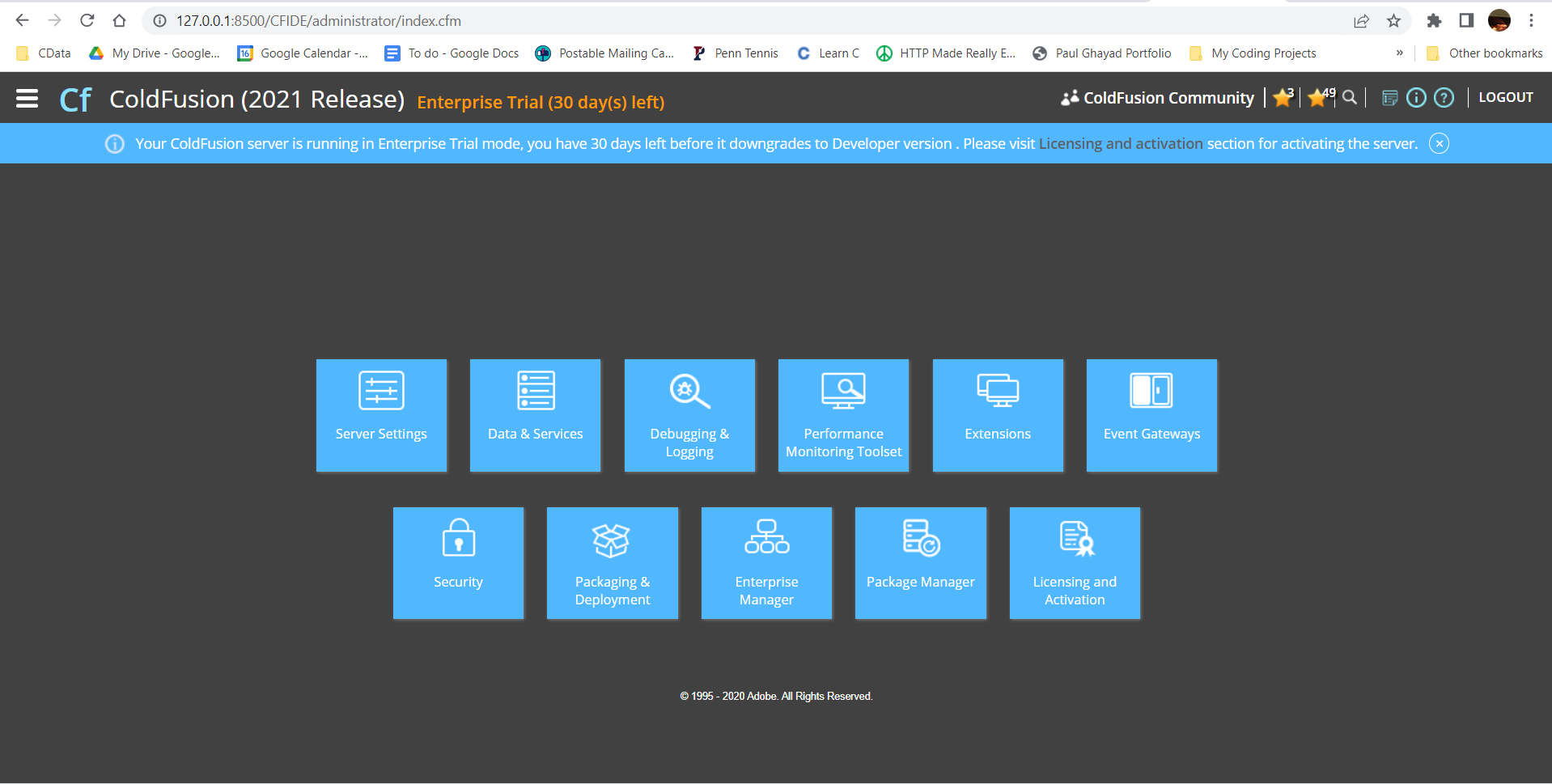
From the ColdFusion administrator interface, choose Data & Services.
-
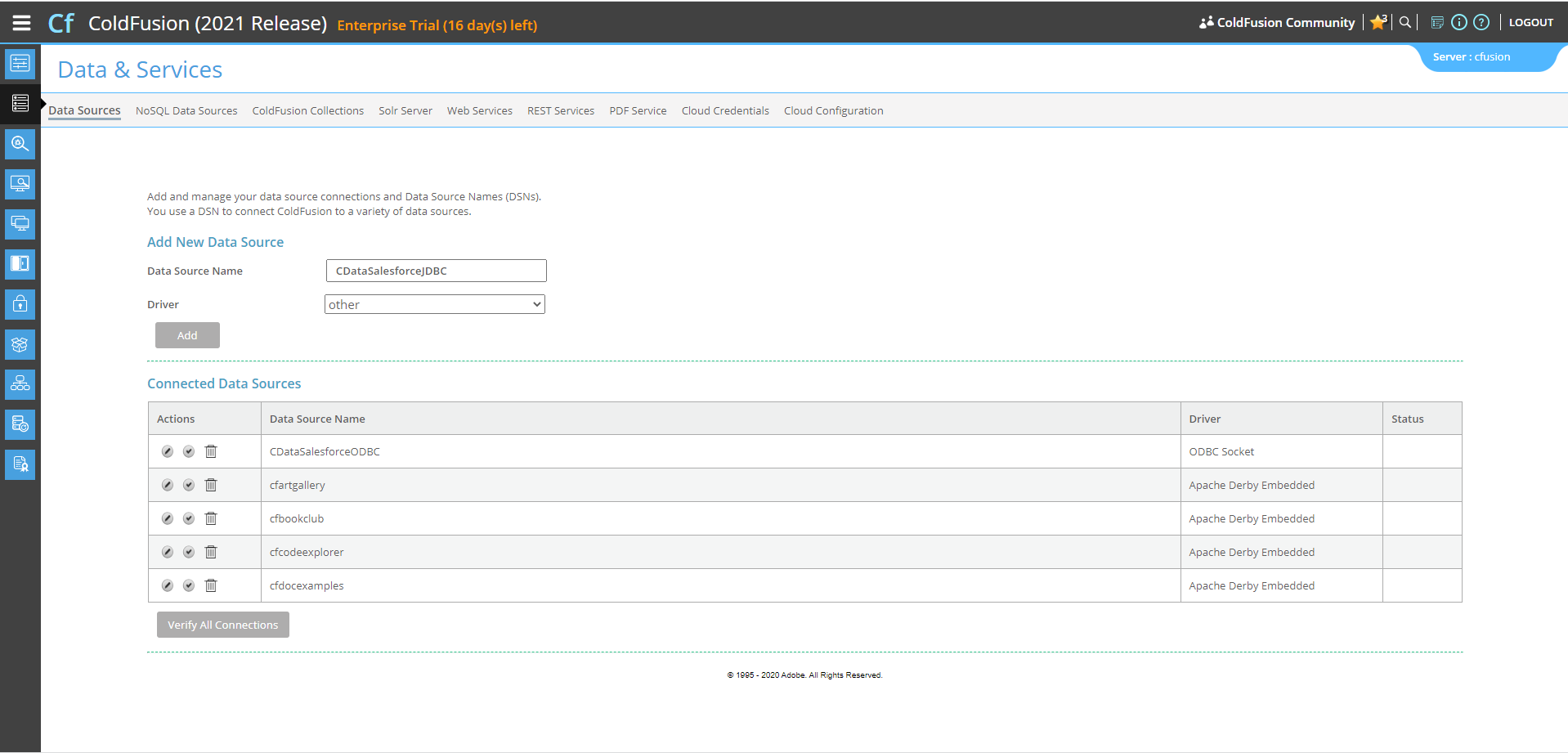
Here, we can "Add New Data Source". The data source name can be any name, provided it conforms to the ColdFusion
variable naming conventions. For our JDBC driver, choose "other", then click the "Add" button.
-
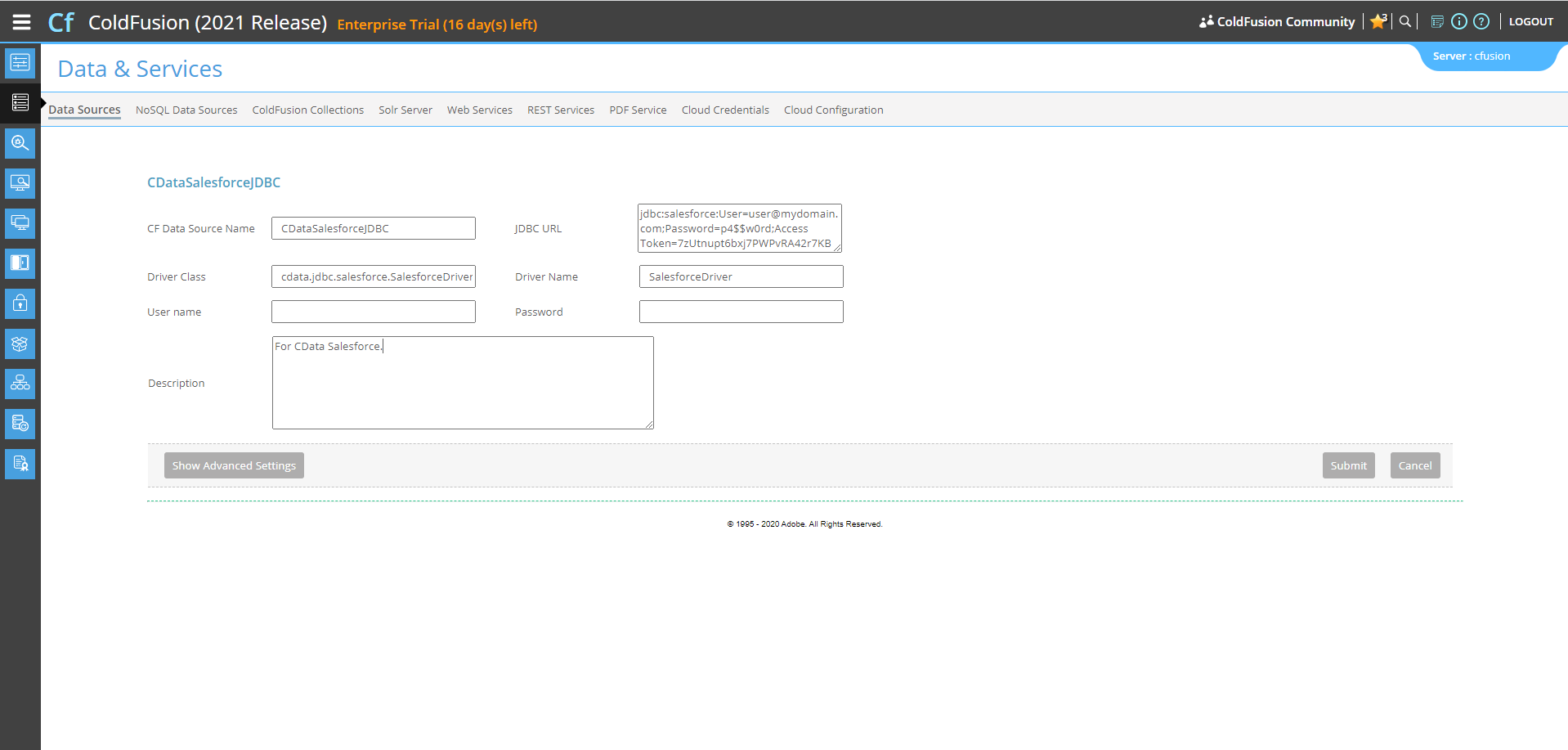
Next, populate the driver properties.
- JDBC URL will need to be in the format: jdbc:api:|connectionString|.
- A typical connection string looks like this:
jdbc:api:Profile=C:\profiles\Placid.apip;AuthScheme=APIKey;ProfileSettings='APIKey=your_project_api_token';
- The Driver Class is: cdata.jdbc.api.APIDriver
- The Driver Name is arbitrary and simply used to recognize the data source in the ColdFusion administration console.
-
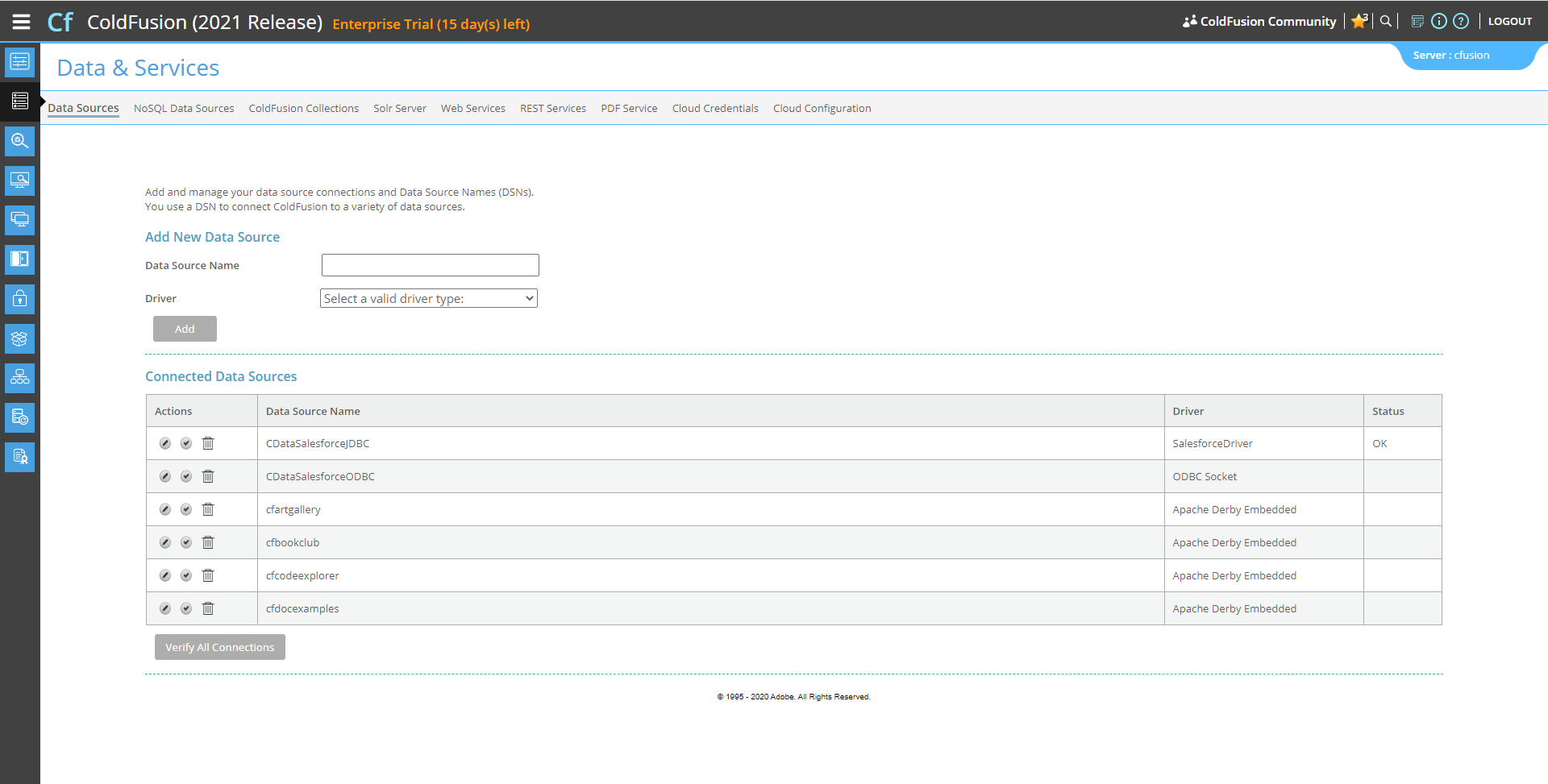
Now, test the connection by clicking the check mark to the left of the CDataPlacidJDBC data source you just created.
When the data source reports an "OK" status, it is ready for use.
-
Next, create a new ColdFusion Markup file (.cfm) and place it in the wwwroot directory ("C:\ColdFusion2021\cfusion\wwwroot")
for ColdFusion.
The following code queries the data source:
        <cfquery name="PlacidQuery" dataSource="CDataPlacidJDBC">
          SELECT * FROM Collections
        </cfquery>
And a CFTable can be used to quickly output the table in HTML:<cftable query = "PlacidQuery" border = "1" colHeaders colSpacing = "2" headerLines = "2" HTMLTable maxRows = "500" startRow = "1"> <cfcol header="<b></b>" align="Left" width=2 text=""/> <cfcol header="<b></b>" align="Left" width=15 text=""/> ... </cftable>Full code, including the HTML portion is available below:<html> <head><title>CData Software | Placid Collections Table Demo </title></head> <body> <cfoutput>#ucase("Placid Collections Table Demo")#</cfoutput> <cfquery name="PlacidQuery" dataSource="CDataPlacidJDBC"> SELECT * FROM Collections </cfquery> <cftable query = "PlacidQuery" border = "1" colHeaders colSpacing = "2" headerLines = "2" HTMLTable maxRows = "500" startRow = "1"> <cfcol header="<b></b>" align="Left" width=2 text=""/> <cfcol header="<b></b>" align="Left" width=15 text=""/> ... </cftable> </body> </html> -
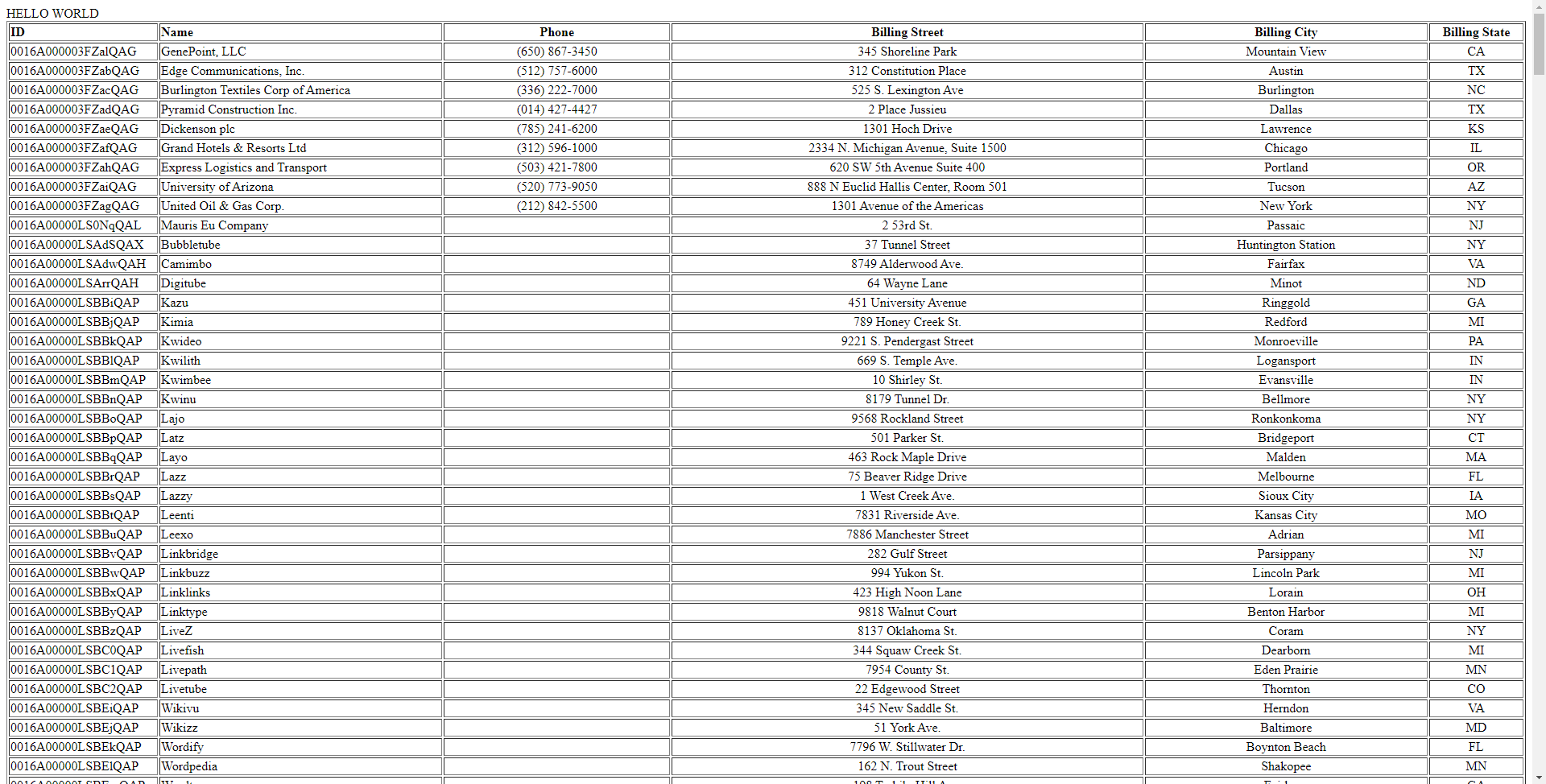
Finally, run the code locally in a browser at the default port of 8500. It produces a table populated with Placid data!
As a note, the CData JDBC Drivers also support parameterized queries using the cfqueryparam element. For example:
SELECT * FROM Account WHERE name =
Get Started Today
Download a free, 30-day trial of the CData JDBC Driver for Placid and start building Placid-connected applications with Adobe ColdFusion. Reach out to our Support Team if you have any questions.