






Integrate Google's Vertex AI Agent with Live Presto Data via CData Connect AI

Vertex AI provides a development ecosystem for building AI agents using the Agent Development Kit (ADK). ADK enables developers to create tool-augmented agents that can reason, take actions, and interact with external systems through structured tool interfaces. These agents can be tested locally in the ADK Web interface and extended with advanced logic for enterprise workflows.
By integrating Vertex AI ADK with CData Connect AI through the built-in MCP (Model Context Protocol) Server, your agents gain the ability to query, analyze, and act on live Presto data in real time. This connection bridges Google's agent-building framework with the governed enterprise connectivity of CData Connect AI, ensuring every request runs securely against authorized data sources without manual data movement.
This article outlines the steps to configure Presto connectivity in Connect AI, generate the required authentication token, configure the Vertex AI ADK environment, and verify that your agent can successfully communicate with live Presto data through the CData MCP Server.
About Presto Data Integration
Accessing and integrating live data from Trino and Presto SQL engines has never been easier with CData. Customers rely on CData connectivity to:
- Access data from Trino v345 and above (formerly PrestoSQL) and Presto v0.242 and above (formerly PrestoDB)
- Read and write access all of the data underlying your Trino or Presto instances
- Optimized query generation for maximum throughput.
Presto and Trino allow users to access a variety of underlying data sources through a single endpoint. When paired with CData connectivity, users get pure, SQL-92 access to their instances, allowing them to integrate business data with a data warehouse or easily access live data directly from their preferred tools, like Power BI and Tableau.
In many cases, CData's live connectivity surpasses the native import functionality available in tools. One customer was unable to effectively use Power BI due to the size of the datasets needed for reporting. When the company implemented the CData Power BI Connector for Presto they were able to generate reports in real-time using the DirectQuery connection mode.
Getting Started
Step 1: Configure Presto connectivity for Vertex AI
Connectivity to Presto from Vertex AI is made possible through CData Connect AI's Remote MCP Server. To interact with Presto data from Vertex AI, start by creating and configuring a Presto connection in CData Connect AI.
- Log into Connect AI, click Sources, and then click Add Connection
- Select Presto from the Add Connection panel
-
Enter the necessary authentication properties to connect to Presto.
Set the Server and Port connection properties to connect, in addition to any authentication properties that may be required.
To enable TLS/SSL, set UseSSL to true.
Authenticating with LDAP
In order to authenticate with LDAP, set the following connection properties:
- AuthScheme: Set this to LDAP.
- User: The username being authenticated with in LDAP.
- Password: The password associated with the User you are authenticating against LDAP with.
Authenticating with Kerberos
In order to authenticate with KERBEROS, set the following connection properties:
- AuthScheme: Set this to KERBEROS.
- KerberosKDC: The Kerberos Key Distribution Center (KDC) service used to authenticate the user.
- KerberosRealm: The Kerberos Realm used to authenticate the user with.
- KerberosSPN: The Service Principal Name for the Kerberos Domain Controller.
- KerberosKeytabFile: The Keytab file containing your pairs of Kerberos principals and encrypted keys.
- User: The user who is authenticating to Kerberos.
- Password: The password used to authenticate to Kerberos.

- Click Save & Test
- Navigate to the Permissions tab and update user-based permissions



Add a Personal Access Token
A Personal Access Token (PAT) is used to authenticate the connection to Connect AI from Vertex AI. It is best practice to create a separate PAT for each integration to maintain granular access control.
- Click the gear icon () at the top right of the Connect AI app to open Settings
- On the Settings page, go to the Access Tokens section and click Create PAT
- Give the PAT a descriptive name and click Create
- Copy the token when displayed and store it securely. It will not be shown again

With the Presto connection configured and a PAT generated, Vertex AI can now connect to Presto data through the CData MCP Server.
Step 2: Install required dependencies
Enable the necessary Google Cloud APIs so Vertex AI ADK can run Gemini models, build agent environments, and access supporting services inside your Google Cloud project. These APIs provide the backend capabilities that ADK relies on during development and execution.
- Visit the Google Cloud Console
- Click the Project Picker at the top of the page and choose New Project
- Create the project and note the Project ID. Save this ID later for environment configuration
- From the left navigation menu, open APIs & Services and then choose Enabled APIs & Services
- Click Enable Apis and services
- Enable the following APIs:
- Vertex AI API
- Cloud Build API
- Artifact Registry API
- Service Networking API
- Cloud Logging API

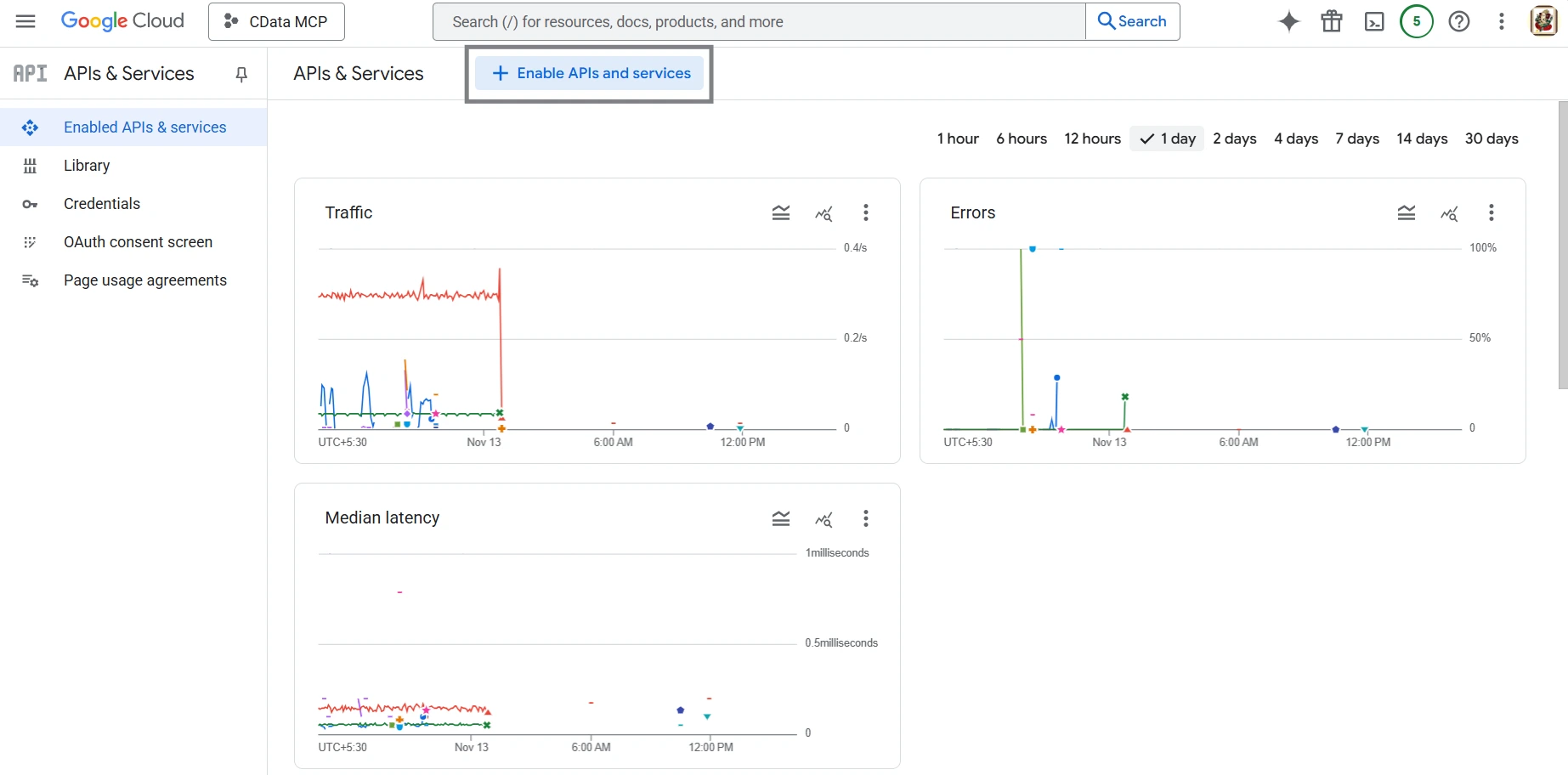
With these services enabled, your Google Cloud project is prepared for Vertex AI ADK development and local tool execution.
Prepare the Vertex AI ADK project folder
Create the project directory and set up the Python environment. This step prepares a clean workspace where ADK installs correctly and loads your agent without dependency conflicts.
- Open Google Cloud console and select the Cloud Shell. Make sure to select the project you created from the project picker.
- Create the ADK project directories:
- Create and activate a Python virtual environment:
- Install the required ADK and MCP packages:

				mkdir -p ~/adk_agents/cdata_mcp_agent
				cd ~/adk_agents/cdata_mcp_agent
		python3 -m venv .venv
		source .venv/bin/activate
				python -m pip install --upgrade pip
				python -m pip install google-adk
				python -m pip install mcp
				python -m pip install --upgrade "google-cloud-aiplatform[agent_engines]"
Step 3: Create the ADK Agent files
Define the agent modules so ADK recognizes your agent. This structure allows Vertex AI to load your MCP configuration and register the tools exposed by the CData MCP Server.
- Create agent.py file and paste the code below in it
- Create another file __int__.py and paste the code below in it
import os
import base64
import logging

from google.adk.agents import LlmAgent
from google.adk.tools.mcp_tool.mcp_toolset import MCPToolset
from google.adk.tools.mcp_tool.mcp_session_manager import StreamableHTTPConnectionParams

# ---------- Logging ----------
logging.basicConfig(level=logging.INFO)
logger = logging.getLogger(__name__)

# ---------- CData MCP config ----------
CDATA_MCP_URL = os.environ.get("CDATA_MCP_URL", "https://mcp.cloud.cdata.com/mcp")
CDATA_USER_ID = os.environ.get("CDATA_USER_ID")
CDATA_PAT = os.environ.get("CDATA_PAT")

tools = []

if not (CDATA_USER_ID and CDATA_PAT):
    logger.warning(
        "CData MCP credentials not set (CDATA_USER_ID or CDATA_PAT missing); "
        "starting agent WITHOUT MCP tools."
    )
else:
    # Basic auth header: base64("user:pat")
    basic_auth_bytes = f"{CDATA_USER_ID}:{CDATA_PAT}".encode("utf-8")
    basic_auth_header = base64.b64encode(basic_auth_bytes).decode("utf-8")

    try:
        logger.info("Initializing CData MCPToolset against %s", CDATA_MCP_URL)

        tools.append(
            MCPToolset(
                connection_params=StreamableHTTPConnectionParams(
                    url=CDATA_MCP_URL,
                    headers={
                        "Authorization": f"Basic {basic_auth_header}",
                        # ADK handles content-type etc. internally;
                        # we just pass auth headers.
                    },
                ),
            )
        )

        logger.info("CData MCPToolset initialized successfully.")
    except Exception as e:
        logger.exception("Failed to initialize CData MCPToolset")

# ---------- Root agent ----------
root_agent = LlmAgent(
    model="gemini-2.0-flash",
    name="cdata_mcp_agent",
    instruction=(
        "You are a data assistant. Use the CData MCP tools (if available) to "
        "list connections, list catalogs/schemas/tables, and run SQL-style queries."
    ),
    tools=tools,
)
		from .agent import root_agent
		__all__ = ["root_agent"]
Export environment variables
Export the required environment variables to authenticate to Connect AI. These values enable the agent to initialize the MCP toolset and communicate with the CData MCP Server. Before you do that obtain a Google API key so ADK can authenticate to Gemini models. This key enables the agent to run LLM reasoning and route tool calls correctly inside the Vertex AI ADK environment.
- Visit the Google AI Studio API Key page
- Click Create API Key. Provide a name for the api-key and choose or create a project if you do not have one
- Click on Create a key and then copy the API key
- Return to the Google Cloud Shell page and run the environment variable exports. Replace "your_cdata_email", "your_pat", "your-project-id", and "your_google_api_key" with your values

		export CDATA_MCP_URL="https://mcp.cloud.cdata.com/mcp"
		export CDATA_USER_ID="your_cdata_email"
		export CDATA_PAT="your_pat"
		export GOOGLE_API_KEY="your_google_api_key"
		export VERTEXAI_PROJECT="your-project-id"
		export VERTEXAI_LOCATION="us-central1"
Step 4: Launch the ADK web interface
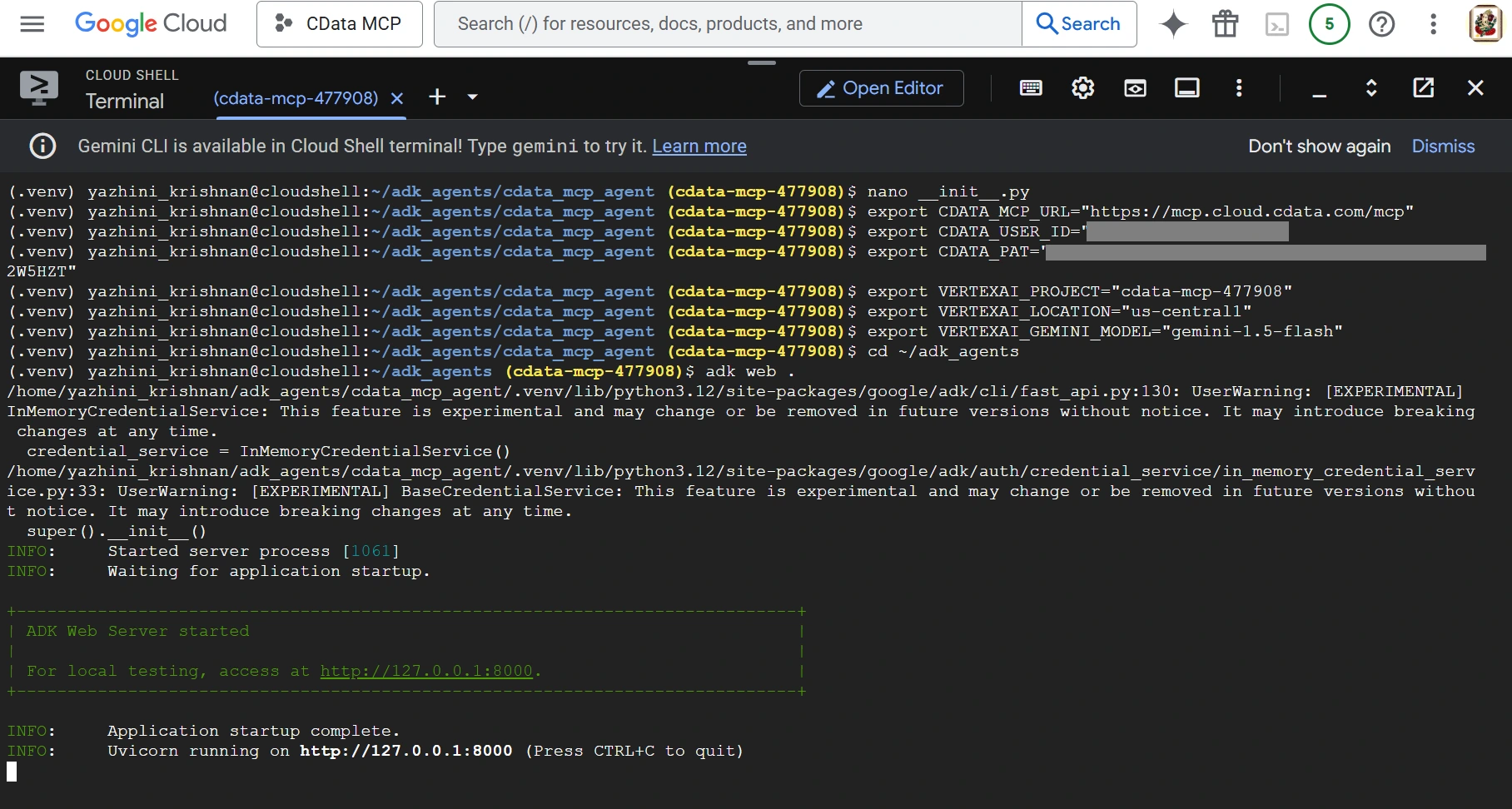
Start the ADK Web interface to load your agent. The interface initializes the runtime and makes your MCP-enabled agent available for interactive testing.
- Move to the parent folder:
- Launch ADK Web:
cd ~/adk_agents
adk web .
Step 5: Select your agent and test MCP connectivity
Select your agent from the ADK Web interface. ADK loads the MCP tools and prepares the environment so you issue live MCP queries.
- Open the ADK Web UI from the browser tab
- Select cdata_mcp_agent from the agent dropdown
- Enter list catalogs in the chat panel. ADK returns a live list of your Connect AI connections


At this point, your Vertex AI ADK agent communicates with the CData Connect AI MCP Server and retrieves live Presto data metadata through remote MCP tools.
Get CData Connect AI
To access 300+ SaaS, Big Data, and NoSQL sources directly from your cloud applications, try CData Connect AI today!
