






Build a PostgreSQL Interface for Pushbullet Data using the CData JDBC Driver

There are a vast number of PostgreSQL clients available on the Internet. From standard Drivers to BI and Analytics tools, PostgreSQL is a popular interface for data access. Using our JDBC Drivers, you can now create PostgreSQL entry-points that you can connect to from any standard client.
To access Pushbullet data as a PostgreSQL database, use the CData JDBC Driver for Pushbullet and a JDBC foreign data wrapper (FDW). In this article, we compile the FDW, install it, and query Pushbullet data from PostgreSQL Server.
Connect to Pushbullet Data as a JDBC Data Source
To connect to Pushbullet as a JDBC data source, you will need the following:
- Driver JAR path: The JAR is located in the lib subfolder of the installation directory.
Driver class:
cdata.jdbc.api.APIDriver
- JDBC URL:
The URL must start with "jdbc:api:" and can include any of the connection properties in name-value pairs separated with semicolons.
Using API Key Authentication
Pushbullet uses token-based authentication (Access Token). To obtain an Access Token:
- Log in to your Pushbullet account at https://www.pushbullet.com
- Navigate to Settings > Account
- Click "Create Access Token"
- Copy the generated token
After obtaining your Access Token, set the following connection properties:
- AuthScheme: Set this to APIKey.
- APIKey: Set this to your Pushbullet Access Token.
Example Connection String
Profile=C:\profiles\Pushbullet.apip;ProfileSettings='APIKey=your_access_token;';AuthScheme=APIKey;
Connecting to Pushbullet
Once the authentication is configured, you can connect to Pushbullet and query data from any of the available tables such as Users, Pushes, Devices, Chats, Subscriptions, and Channels.
Built-in Connection String Designer
For assistance in constructing the JDBC URL, use the connection string designer built into the Pushbullet JDBC Driver. Either double-click the JAR file or execute the jar file from the command-line.
java -jar cdata.jdbc.api.jar
Fill in the connection properties and copy the connection string to the clipboard.
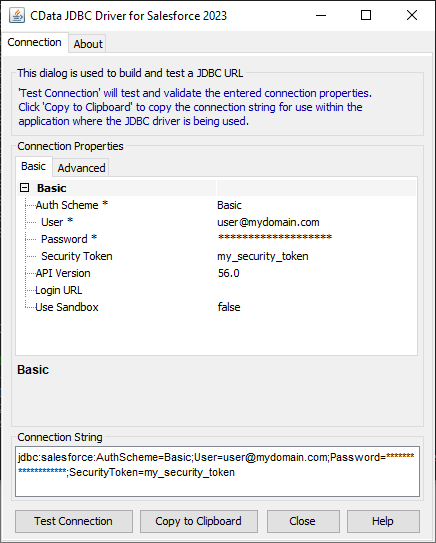
A typical JDBC URL is below:
jdbc:api:Profile=C:\profiles\Pushbullet.apip;ProfileSettings='APIKey=your_access_token;';AuthScheme=APIKey;
Build the JDBC Foreign Data Wrapper
The Foreign Data Wrapper can be installed as an extension to PostgreSQL, without recompiling PostgreSQL. The jdbc2_fdw extension is used as an example (downloadable here).
- Add a symlink from the shared object for your version of the JRE to /usr/lib/libjvm.so. For example:
ln -s /usr/lib/jvm/java-6-openjdk/jre/lib/amd64/server/libjvm.so /usr/lib/libjvm.so
- Start the build:
make install USE_PGXS=1
Query Pushbullet Data as a PostgreSQL Database
After you have installed the extension, follow the steps below to start executing queries to Pushbullet data:
- Log into your database.
-
Load the extension for the database:
CREATE EXTENSION jdbc2_fdw;
-
Create a server object for Pushbullet:
CREATE SERVER API
FOREIGN DATA WRAPPER jdbc2_fdw OPTIONS (
drivername 'cdata.jdbc.api.APIDriver',
url 'jdbc:api:Profile=C:\profiles\Pushbullet.apip;ProfileSettings='APIKey=your_access_token;';AuthScheme=APIKey;',
querytimeout '15',
jarfile '/home/MyUser/CData/CData\ JDBC\ Driver\ for\ Salesforce MyDriverEdition/lib/cdata.jdbc.api.jar');
-
Create a user mapping for the username and password of a user known to the MySQL daemon.
CREATE USER MAPPING for postgres SERVER API OPTIONS (
username 'admin',
password 'test');
-
Create a foreign table in your local database:
postgres=# CREATE FOREIGN TABLE users (
users_id text,
users_ text,
users_ numeric)
SERVER API OPTIONS (
table_name 'users');
postgres=# SELECT * FROM users;