






How to connect to RabbitMQ Data from Spring Boot

Spring Boot is a framework that makes engineering Java web applications easier. It offers the ability to create standalone applications with minimal configuration. When paired with the CData JDBC driver for RabbitMQ, Spring Boot can work with live RabbitMQ data. This article shows how to configure data sources and retrieve data in your Java Spring Boot Application, using the CData API Driver for JDBC.
With built-in optimized data processing, the CData JDBC Driver offers unmatched performance for interacting with live RabbitMQ data. When you issue complex SQL queries to RabbitMQ, the driver pushes supported SQL operations, like filters and aggregations, directly to RabbitMQ and utilizes the embedded SQL engine to process unsupported operations client-side (often SQL functions and JOIN operations). Its built-in dynamic metadata querying allows you to work with and analyze RabbitMQ data using native data types.
Creating the Spring Boot Project in Java
In an IDE (in this tutorial, we use IntelliJ), choose a Maven project:
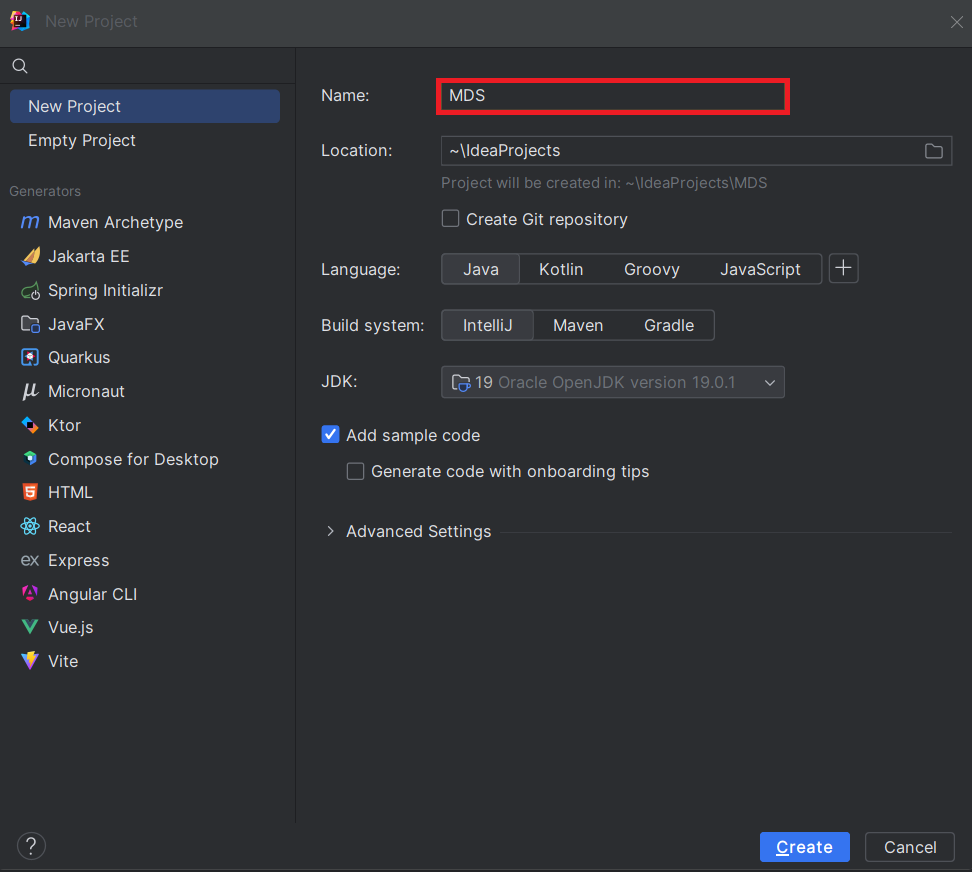 In the generated project, go to the pom.xml file, and add the required dependencies for Spring Boot:
<?xml version="1.0" encoding="UTF-8"?>
<project xmlns="http://maven.apache.org/POM/4.0.0" xmlns:xsi="http://www.w3.org/2001/XMLSchema-instance"
xsi:schemaLocation="http://maven.apache.org/POM/4.0.0 https://maven.apache.org/xsd/maven-4.0.0.xsd">
<modelVersion>4.0.0</modelVersion>
<parent>
<groupId>org.springframework.boot</groupId>
<artifactId>spring-boot-starter-parent</artifactId>
<version>2.7.2</version>
<relativePath/>
</parent>
<groupId>com.example</groupId>
<artifactId>demo</artifactId>
<version>0.0.1-SNAPSHOT</version>
<name>demo</name>
<description>Demo project for Spring Boot</description>
<properties>
<java.version>1.8</java.version>
</properties>
<build>
<plugins>
	<plugin>
		<groupId>org.springframework.boot</groupId>
		<artifactId>spring-boot-maven-plugin</artifactId>
	</plugin>

	<plugin>
		<groupId>org.apache.maven.plugins</groupId>
		<artifactId>maven-install-plugin</artifactId>
		<version>2.5.1</version>
		<executions>
			<execution>
				<id>id.install-file</id>
				<phase>clean</phase>
				<goals>
					<goal>install-file</goal>
				</goals>
				<configuration>
					<file>C:\Program Files\CData[product_name] ####\lib\cdata.jdbc.api.jar</file>
					<groupId>org.cdata.connectors</groupId>
					<artifactId>cdata-api-connector</artifactId>
					<version>23</version>
					<packaging>jar</packaging>
				</configuration>
			</execution>
		</executions>
	</plugin>
</plugins>
</build>

<dependencies>
<dependency>
	<groupId>org.springframework.boot</groupId>
	<artifactId>spring-boot-starter-web</artifactId>
</dependency>
<dependency>
	<groupId>org.springframework.boot</groupId>
	<artifactId>spring-boot-starter-jdbc</artifactId>
	<version>2.7.0</version>
</dependency>
<dependency>
	<groupId>org.cdata.connectors</groupId>
	<artifactId>cdata-api-connector</artifactId>
	<version>23</version>
</dependency>

<dependency>
	<groupId>org.springframework.boot</groupId>
	<artifactId>spring-boot-starter-test</artifactId>
	<scope>test</scope>
</dependency>
</dependencies>


<distributionManagement>
<repository>
	<uniqueVersion>false</uniqueVersion>
	<id>test</id>
	<name>My Repository</name>
	<url>scp://repo/maven2</url>
	<layout>default</layout>
</repository>
</distributionManagement>

</project>
Note: The year (####) and the version number (as seen in the provided XML script) should be adjusted according to the current version of the CData JDBC driver being utilized.
Project Structure
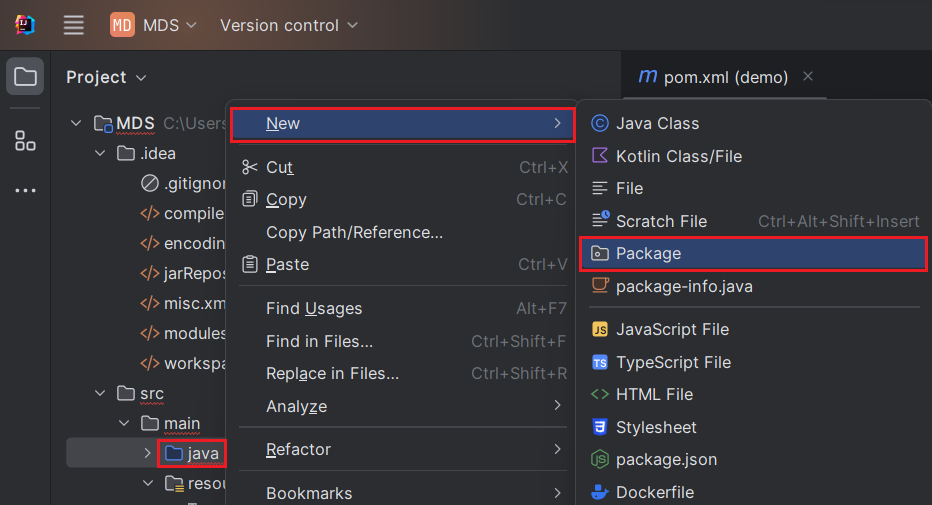
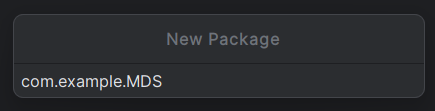
In the java directory, create a new package. Usually the name of the package is the name of the groupId
(com.example) followed by the artifactId (.MDS).
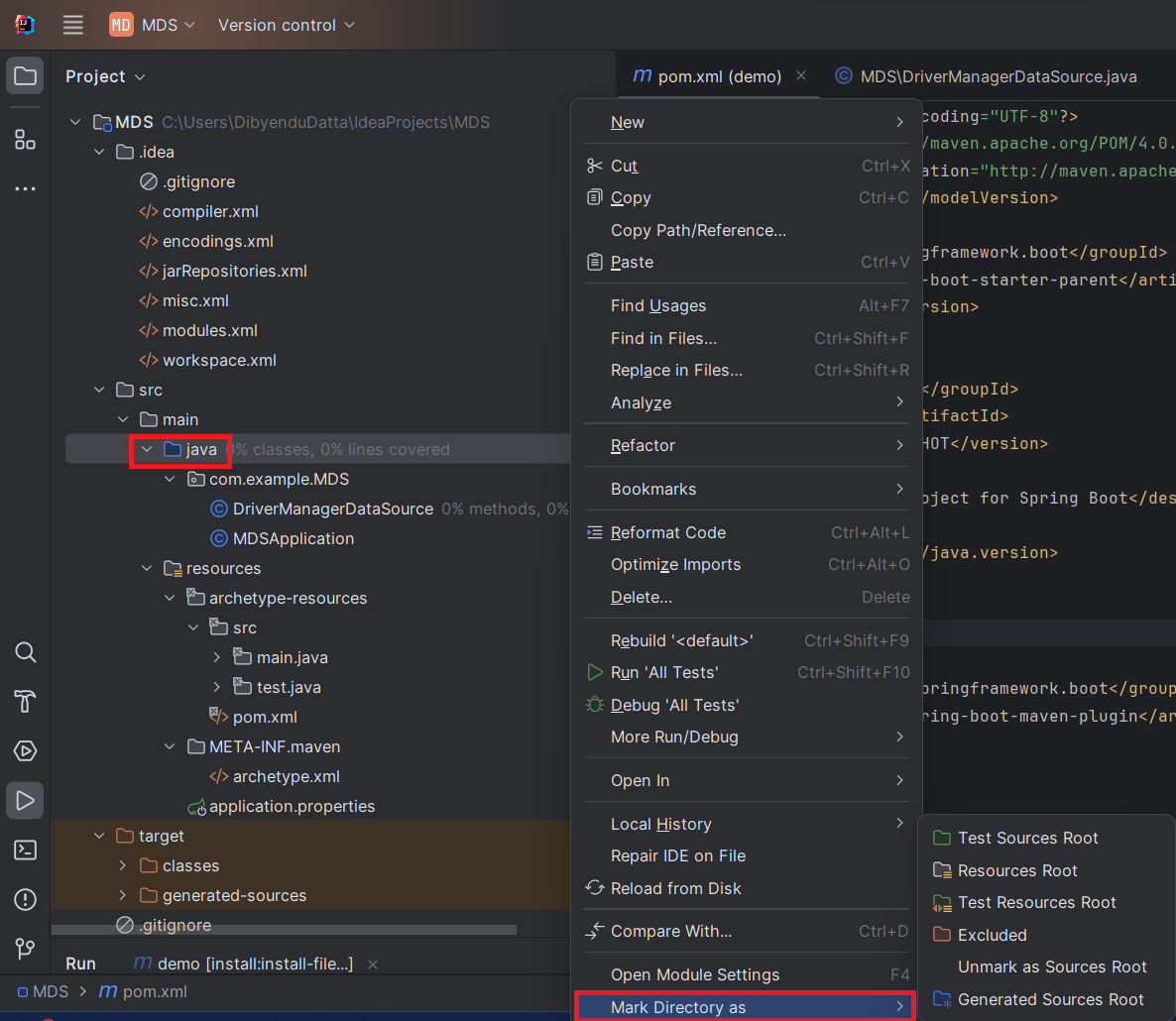
Mark the "java" directory as the "Sources Root" (denoted by a blue color). To do this, right-click the java directory and choose Mark Directory as -> Sources Root (As shown below). Additionally, mark the "resources" directory as the "Resources Root."
Store Database Connection Properties
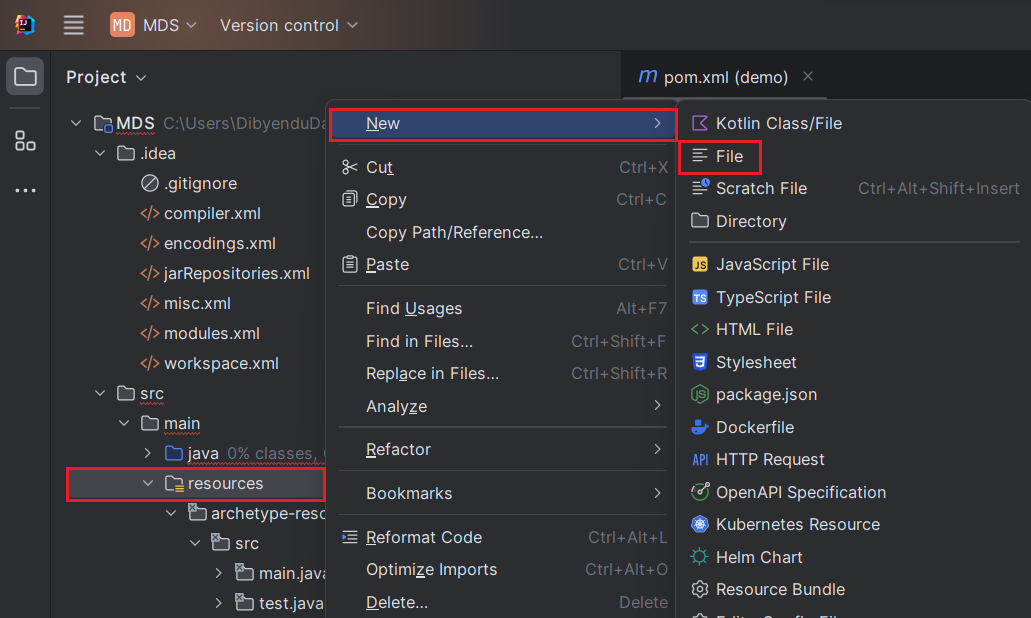
Create an "application.properties" file to store the database connection properties. To do this, right-click on the "resources" folder, opt for New -> File, input the file name as "application.properties," and press Enter.
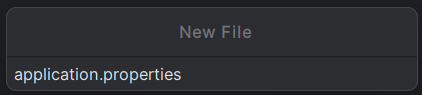
In the application.properties file, we set the configuration properties for the RabbitMQ JDBC Driver, using the Class name and JDBC URL:
	spring.datasource.driver=cdata.jdbc.api.APIDriver
	spring.datasource.url=jdbc:api:Profile=C:\profiles\\RabbitMQ.apip;AuthScheme=Basic;URL=http://localhost:15672;User=guest;Password=guest;
Built-in Connection String Designer
For assistance in constructing the JDBC URL, use the connection string designer built into the RabbitMQ JDBC Driver. Either double-click the JAR file or execute the jar file from the command-line.
java -jar cdata.jdbc.api.jar
About RabbitMQ Management HTTP API
RabbitMQ is an open-source message broker that supports multiple messaging protocols. The RabbitMQ Management HTTP API provides HTTP-based access to management and monitoring data for a RabbitMQ server. The API exposes information about virtual hosts, exchanges, queues, bindings, connections, channels, consumers, users, permissions, policies, and cluster-wide statistics.
The Management plugin must be enabled on the RabbitMQ server for the HTTP API to be available. By default, the management interface listens on port 15672.
Using Basic Authentication
RabbitMQ Management HTTP API uses HTTP Basic authentication. You must supply the username and password of a RabbitMQ management user.
To enable access to the management API:
- Ensure the RabbitMQ Management plugin is enabled on your server (rabbitmq-plugins enable rabbitmq_management).
- Use an existing management user or create one with the appropriate management tag (management, policymaker, monitoring, or administrator).
- Note the full base URL of your RabbitMQ Management HTTP API (e.g., http://localhost:15672).
After configuring your RabbitMQ server, set the following connection properties to connect:
- AuthScheme: Set this to Basic.
- URL: Set this to the base URL of your RabbitMQ Management HTTP API (e.g., http://localhost:15672).
- User: Set this to your RabbitMQ management username (e.g., guest).
- Password: Set this to your RabbitMQ management password.
Example connection string:
Profile=C:\profiles\RabbitMQ.apip;AuthScheme=Basic;URL=http://localhost:15672;User=guest;Password=guest;
Available Tables
The RabbitMQ profile provides access to the following tables:
- Overview - Cluster-wide statistics and information about the RabbitMQ node
- Nodes - Information about individual nodes in the RabbitMQ cluster
- NodeMemory - Detailed memory usage breakdown for a specific cluster node
- Connections - List of all open AMQP connections to the broker
- Channels - List of all open AMQP channels across all connections
- Consumers - List of all consumers registered across all queues
- Exchanges - List of exchanges declared across all virtual hosts
- Queues - List of queues declared across all virtual hosts
- Bindings - List of all bindings between exchanges and queues
- VirtualHosts - List of virtual hosts configured on the broker
- VhostPermissions - User permissions within a specific virtual host
- Users - List of all RabbitMQ users
- Permissions - Permission records for all users across all virtual hosts
- TopicPermissions - Topic-level permission records for all users
- Policies - List of policies applied to queues and exchanges in virtual hosts
- OperatorPolicies - List of operator policies applied to queues in virtual hosts
- Parameters - List of component parameters (e.g., federation, shovel) per virtual host
- GlobalParameters - List of global parameters that apply across all virtual hosts
- VhostLimits - Resource limits configured for specific virtual hosts
- UserLimits - Resource limits configured for specific users
- FeatureFlags - List of feature flags and their enabled/disabled state on the node
- DeprecatedFeatures - List of deprecated features and their usage state
- AuthAttempts - Authentication attempt statistics for the node
- ClusterName - The name of the RabbitMQ cluster
- WhoAmI - Information about the currently authenticated management user
- ExchangeBindingsSource - Bindings for which a specific exchange is the source
- ExchangeBindingsDestination - Bindings for which a specific exchange is the destination
- QueueBindings - Bindings for a specific queue within a virtual host

After setting the properties in the application.properties file, we now configure them.
Data Source Configuration
First, we mark the RabbitMQ data source as our primary data source. Then, we create a Data Source Bean.
Create a DriverManagerDataSource.java file and create a Bean within it, as shown below. If @Bean gives an error, Spring Boot may not have loaded properly. To fix this, go to File -> Invalidate Caches and restart. Additionally, make sure that Maven has added the Spring Boot dependencies.
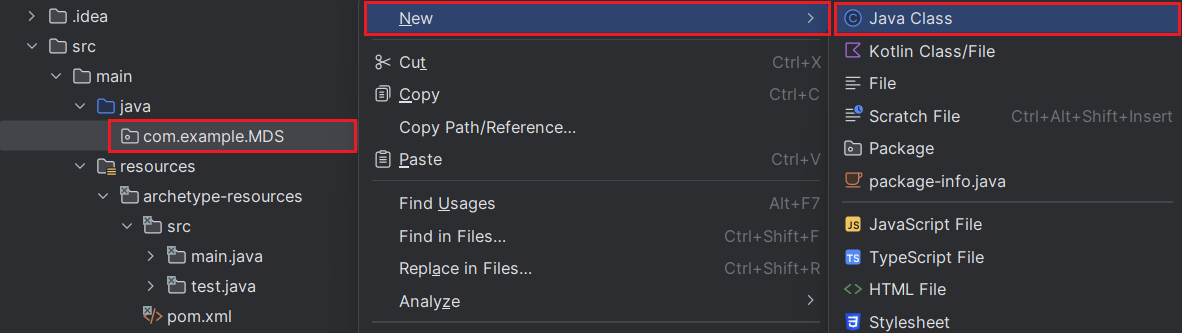
To create a data source bean, we use the DriverManagerDataSource Class. This class allows us to set
the properties of the data source. To create this Java class, right-click on "com.example.MDS" package, and choose New -> Java Class.
The following code shows the bean definition of our data source. Each driver should have a bean.
import org.springframework.beans.factory.annotation.Autowired;
import org.springframework.boot.jdbc.DataSourceBuilder;
import org.springframework.context.annotation.Bean;
import org.springframework.context.annotation.Primary;
import org.springframework.core.env.Environment;
import javax.sql.DataSource;

public class DriverManagerDataSource{
	@Autowired
	private static Environment env;

	@Bean(name ="API")
	@Primary
	public static DataSource APIDataSource()
	{

	DataSourceBuilder<?> dataSourceBuilder = DataSourceBuilder.create();
		dataSourceBuilder.driverClassName("cdata.jdbc.api.APIDriver");
		dataSourceBuilder.url("jdbc:api:Profile=C:\profiles\\RabbitMQ.apip;AuthScheme=Basic;URL=http://localhost:15672;User=guest;Password=guest;");
		return dataSourceBuilder.build();
	}

	//@Override
	public void setEnvironment( final Environment environment) {
	env=environment;
	}
}
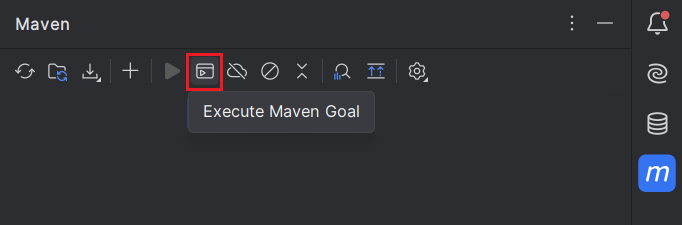
Next, move the RabbitMQ jar file to the Documents folder (see path in command below) - The idea is to have a path without any spaces for the jar file. Then, click the
Maven icon (top right corner of IntelliJ) and click "Execute Maven Goal." Now, run the following command:

mvn install:install-file "-Dfile=C:\Program Files\CData[product_name] ####\lib\cdata.jdbc.api.jar" -DgroupId=org.cdata.connectors -DartifactId=cdata-api-connector -Dversion=23 -Dpackaging=jar
Follow either of the given steps to run this command:
- The "-Dfile location" can be kept as the default installation path of the CData JDBC Driver. Make sure to keep the path in quotations in this case. Also, change the year and "Dversion" based on the current version of the driver being used.
- As mentioned earlier in the article, in case you relocate the
jar file to the Documents folder, make sure to modify the path in the provided command. In such instances, avoid enclosing the Dfile location in quotations and edit "Dversion" based on the current version of the driver being used.
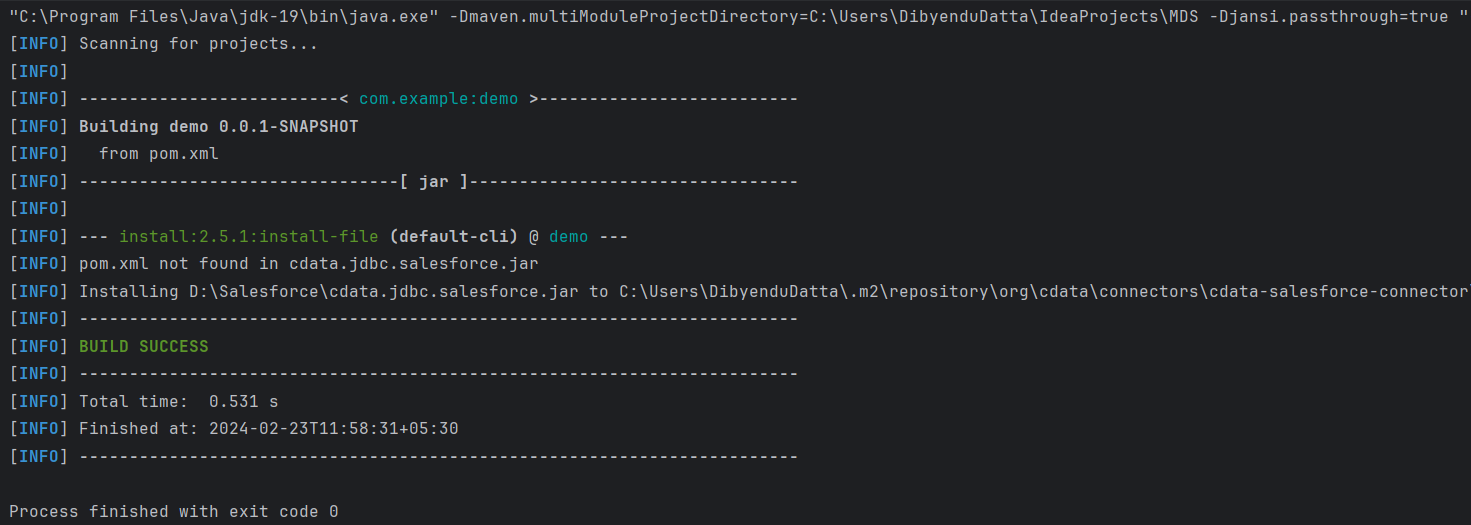
After pressing enter, we see the following output:
Testing the Connection
The last step is testing the connection. Create a new Java class following the format
import org.springframework.boot.SpringApplication;
import org.springframework.boot.autoconfigure.SpringBootApplication;
import org.springframework.boot.autoconfigure.jdbc.DataSourceAutoConfiguration;
import java.sql.Connection;
import java.sql.SQLException;
import static com.example.demo.DriverManagerDataSources.APIDataSource;


@SpringBootApplication(exclude = {DataSourceAutoConfiguration.class})
	public class MDSApplication {
		//remove the comment on the line below
		public static void main (){
		SpringApplication.run(DemoApplication.class, args);
		Connection conn = APIDataSource().getConnection();
		System.out.println("Catalog: "+ conn.getCatalog());
	}
}
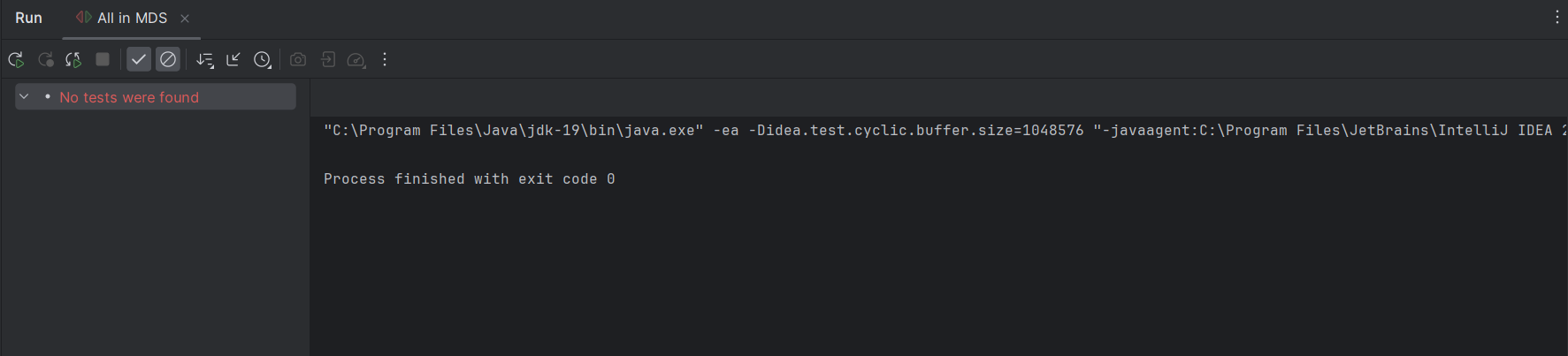
The output generated should look like this:
Free Trial & More Information
Download a free, 30-day trial of the CData JDBC Driver for RabbitMQ and start working with your live RabbitMQ in Spring Boot.