






Getting Started with the CData Excel Add-In for Salesforce Data Cloud
This guide explains everything you need to get started with the CData Excel Add-In for Salesforce Data Cloud. You will learn how to install the add-in, understand licensing behavior, configure your first connection, and import real-time Salesforce Data Cloud data directly into Excel for analysis, reporting, and automation.
Installation & Licensing
System Requirements
- Windows: Windows 10/11 or Windows Server 2016+
- Microsoft Excel: Excel 2016 or later, Excel for Microsoft 365
- .NET Framework: .NET Framework 4.0 or later
Installing the Excel Add-In
Download and install the Excel Add-In from the CData website by visiting the Excel Add-In download page. Fill in the appropriate contact information when prompted.
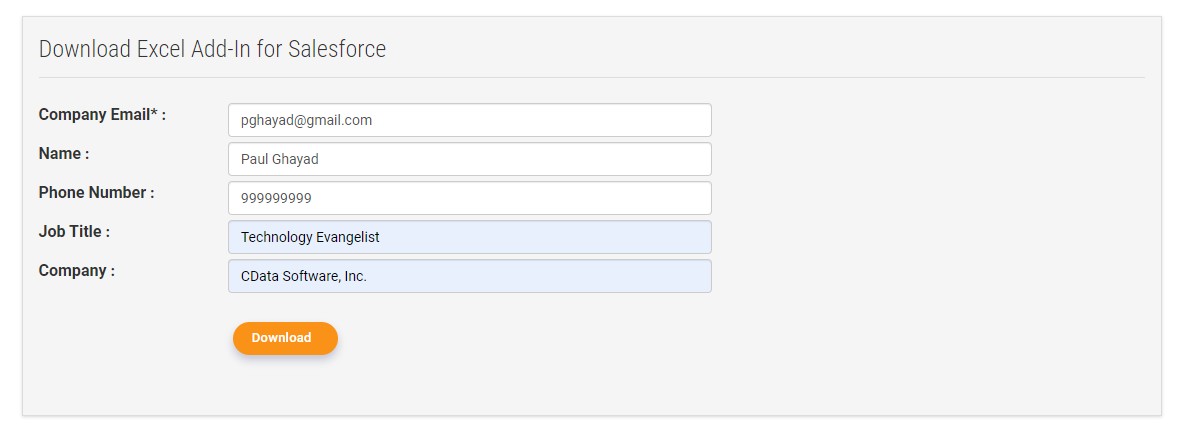
Note: If you are downloading a licensed installer, use your company email address and license key.
- Run the installer and follow the setup wizard
- Once installation is complete, open Excel and verify that the CData tab appears in the Excel ribbon
Licensing the Excel Add-In
The Excel Add-In handles licensing during installation. When running the installer, you can choose to:
- Use the trial license, or
- Install a licensed build provided by CData
If you require a subscription license, contact the CData Orders Team at [email protected] to obtain your license key. Once the add-in is installed, it is ready for use.
Common Licensing Questions
Can I install the add-in on multiple machines?
Your subscription tier determines how many activations are included. Contact [email protected] for details.
I lost my license key. How do I retrieve it?
Email [email protected] with your order number, and we'll resend your license key.
How do I transfer my license?
To transfer the license to a different machine, you will need to submit a License Transfer Request on our site linked below:
https://www.cdata.com/lic/transfer/
After the License Transfer Request is submitted and successfully processed, an activation will be added to your Product Key and you will be able to activate the full license on the other machine. Once this process is finished, the license on the previous machine will be invalid.
For additional licensing questions, contact [email protected]. Viewing and upgrading your license can now be done through our self-service portal at portal.cdata.com.
Connection Configuration
Once the add-in is installed, you can configure a secure connection to Salesforce Data Cloud directly from the Excel ribbon. The add-in stores connection settings inside the Excel environment and uses them to fetch live Salesforce Data Cloud data.
Creating a New Connection
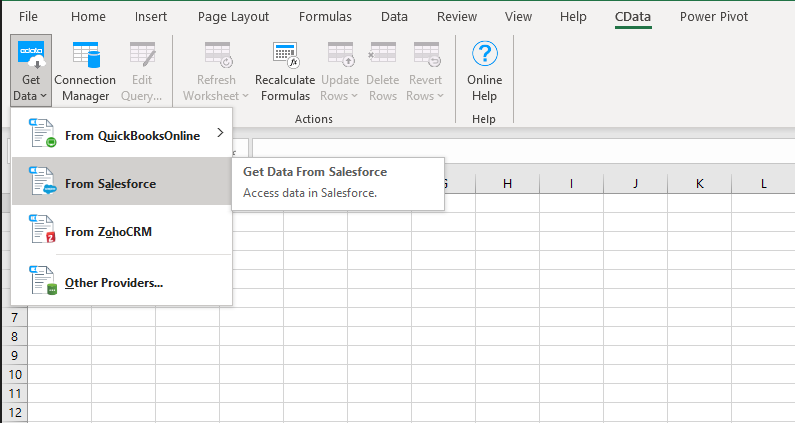
- Open Excel and navigate to the CData tab in the ribbon
- Click Get Data > From Salesforce Data Cloud. Then, click New SalesforceDataCloud Connection to create a new connection
- Provide a name for your connection and enable Update, Insert, or Delete operations as required
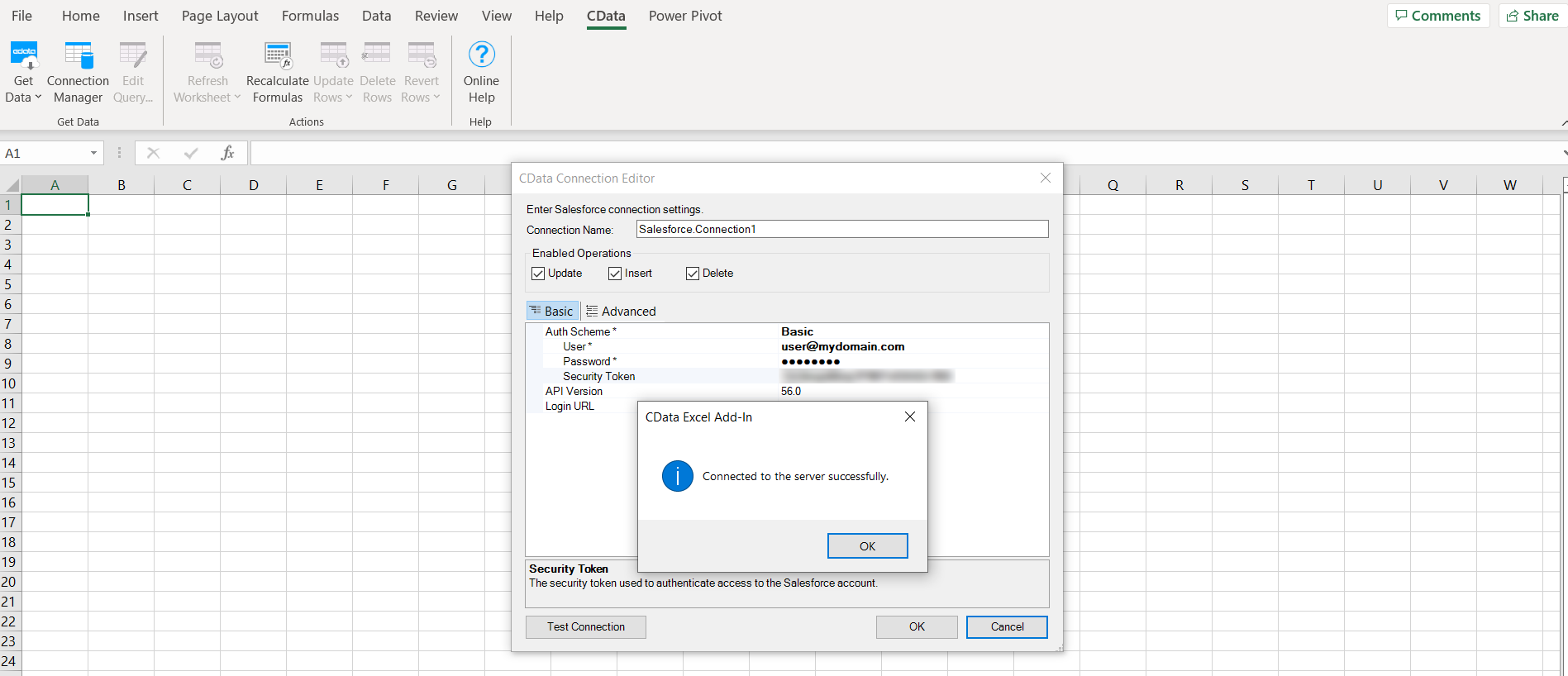
- The CData Connection dialog opens. Enter the authentication details required for Salesforce Data Cloud (OAuth, API token, credentials, etc.)
Configuring Connection Properties
Salesforce Data Cloud supports authentication via the OAuth standard.
OAuth
Set AuthScheme to OAuth.
Desktop Applications
CData provides an embedded OAuth application that simplifies authentication at the desktop.
You can also authenticate from the desktop via a custom OAuth application, which you configure and register at the Salesforce Data Cloud console. For further information, see Creating a Custom OAuth App in the Help documentation.
Before you connect, set these properties:
- InitiateOAuth: GETANDREFRESH. You can use InitiateOAuth to avoid repeating the OAuth exchange and manually setting the OAuthAccessToken.
- OAuthClientId (custom applications only): The Client ID assigned when you registered your custom OAuth application.
- OAuthClientSecret (custom applications only): The Client Secret assigned when you registered your custom OAuth application.
When you connect, the driver opens Salesforce Data Cloud's OAuth endpoint in your default browser. Log in and grant permissions to the application.
The driver then completes the OAuth process as follows:
- Extracts the access token from the callback URL.
- Obtains a new access token when the old one expires.
- Saves OAuth values in OAuthSettingsLocation so that they persist across connections.
- Click Test Connection to validate your input
- Click OK to save the connection
- From the CData ribbon, click Get Data > From Salesforce Data Cloud and choose the connection you just made
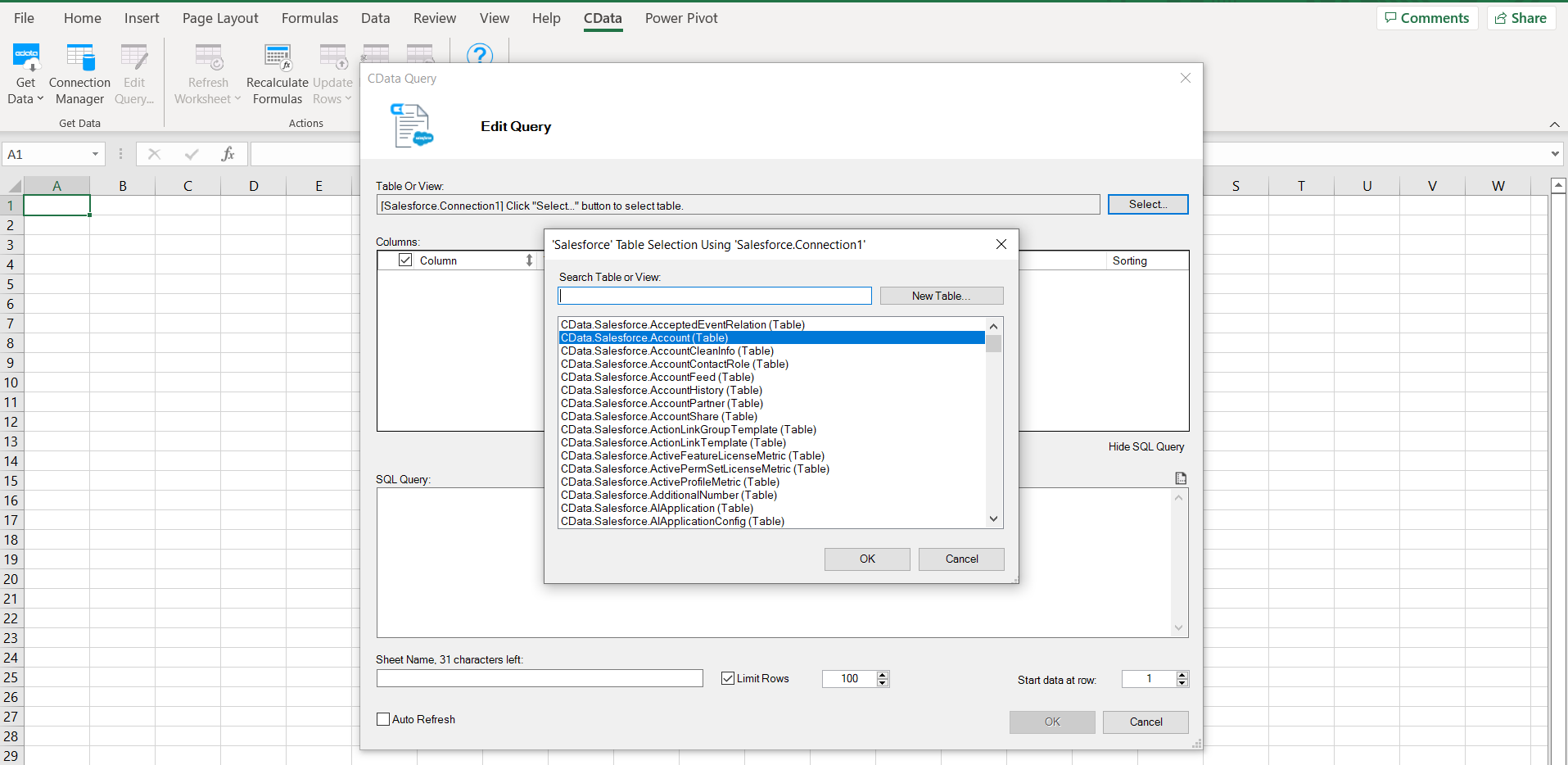
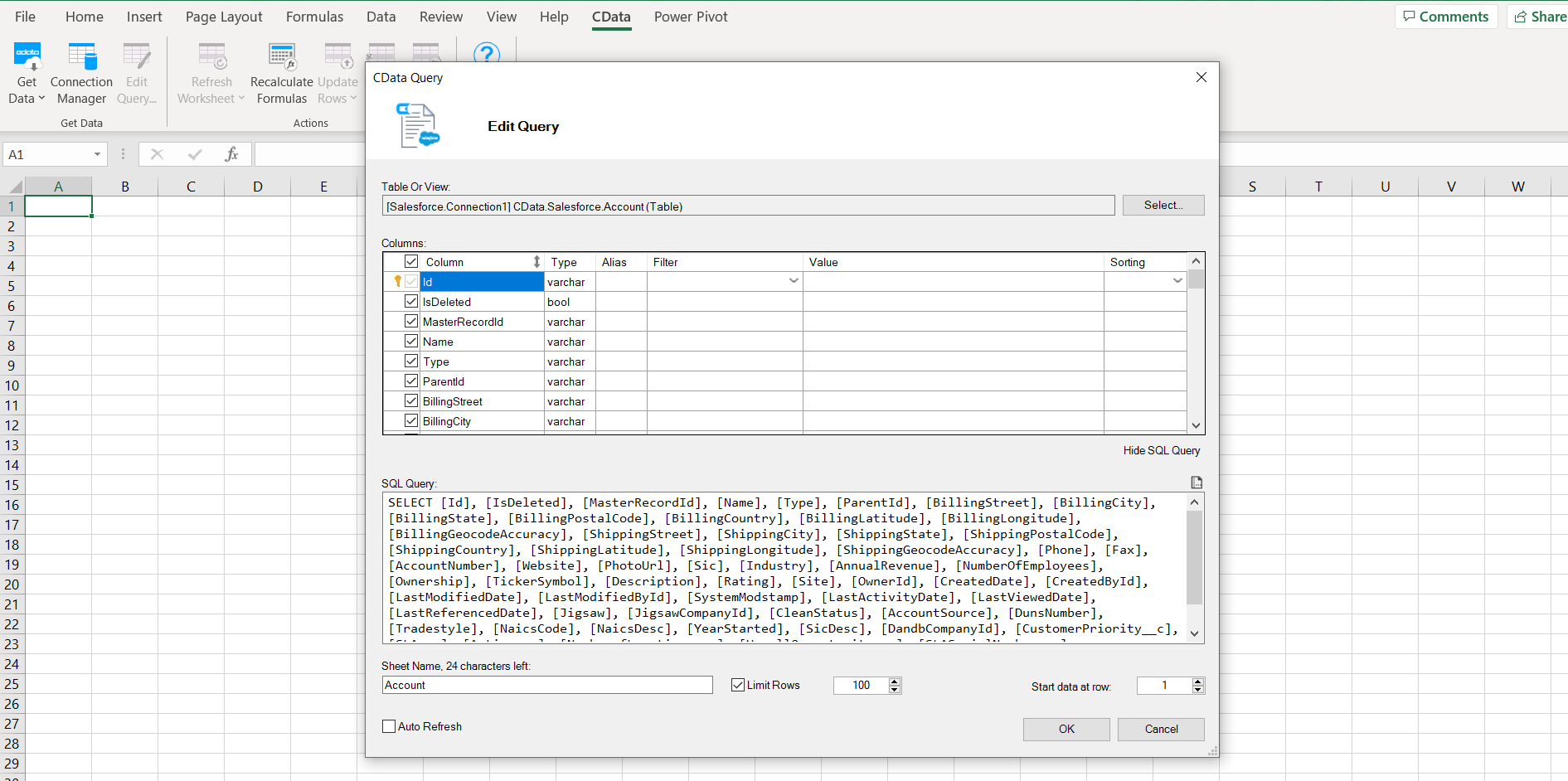
- The CData Query window opens. Click Select to choose a table or view
- Select your desired table and click OK
- A SQL query is automatically generated for your selected table
- Review the query (optional), then click OK to run it
- The results populate directly into your Excel worksheet
- Technical Support: [email protected]
- Community Forum: CData Community Site
- Help Documentation: Installed locally and available online
- Does Excel require administrator rights to install the add-in?
Administrative privileges are required for installation. - How do I activate a license?
Licensing occurs during installation. Licensed installers automatically apply subscription keys. - Can I use multiple Salesforce Data Cloud accounts?
Each time you click Get Data, you can configure a new connection. - Can I connect through a proxy?
You can configure proxy settings in the Connection dialog. - Why is my query slow?
Add filters using the query editor or narrow the selected fields. - How do I enable logging?
Add the following to your connection manager:
- Logfile: /path/to/logfile.log
- Verbosity: 3
Be prepared to securely upload the log file upon request when reaching out to [email protected] for troubleshooting analysis.
- How do I refresh data?
Select the imported table and click Refresh from the CData ribbon.
For other OAuth methods, including Web Applications and Headless Machines, refer to the Help documentation.
Testing your Connection
Importing Data into Excel
After creating a connection, you can import Salesforce Data Cloud data into Excel using the built-in query interface.
Selecting Tables and Views
Running the Query
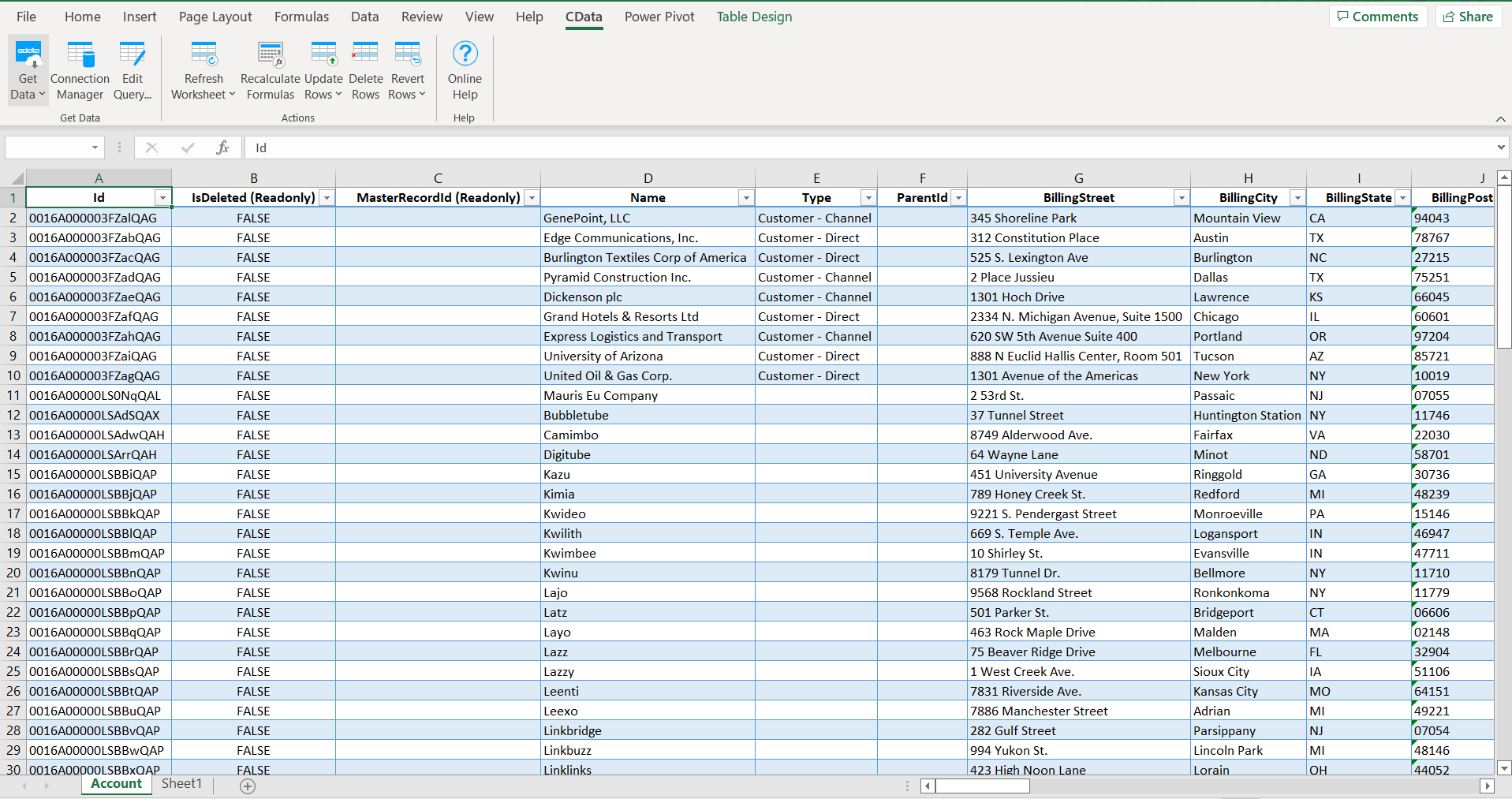
You can now build pivot tables, charts, or use Excel formulas to analyze your Salesforce Data Cloud data.
Common Connection Issues
Authentication Failed
Solution: Verify your credentials or OAuth configuration. Ensure that your Salesforce Data Cloud account has the required API permissions.
Cannot Connect to Salesforce Data Cloud
Solution: Check your internet connection, firewall settings, or proxy configuration. Contact [email protected] for specific port requirements.
Table Not Found
Solution: Confirm your account has access to the selected Salesforce Data Cloud data object. Use the table selector in the Query window to browse available resources.
Query Returned No Results
Solution: Verify any filters or WHERE clauses in the generated SQL. Remove or adjust filters to broaden your query.
What's Next
Now that you have installed, licensed, and configured the Excel Add-In, explore how to automate reporting, refresh live dashboards, and build advanced queries using SQL or Excel functions.
| Excel Add-In | Article Title |
|---|
Get Support
If you need assistance at any point:
FAQs
Installation & Licensing
Connecting
Performance & Troubleshooting
For questions not covered in this FAQ, contact [email protected].
Ready to get started?
Download a free trial of the Excel Add-In for Salesforce Data Cloud to get started:
Download NowLearn more:
 Excel Add-In for Salesforce Data Cloud
The Salesforce Data Cloud Excel Add-In is a powerful tool that allows you to connect with live Salesforce Data Cloud data, directly from Microsoft Excel.
Use Excel to read, write, and update Salesforce Data Cloud 0, etc. Perfect for mass imports / exports / updates, data cleansing & de-duplication, Excel based data analysis, and more!
