Integrate ScrapingBee Data in the Pentaho Report Designer

The CData JDBC driver for ScrapingBee data enables access to live data from dashboards and reports. This article shows how to connect to ScrapingBee data as a JDBC data source and publish reports based on ScrapingBee data in Pentaho.
Connect and Create a Report
- Copy the JAR file of the driver, located in the lib subfolder of the installation directory, to the \Report-Designer\lib\jdbc\ folder in the Pentaho directory.
- Run the report-designer.bat file in the \Report-Designer\ folder to open the Report-Designer UI.
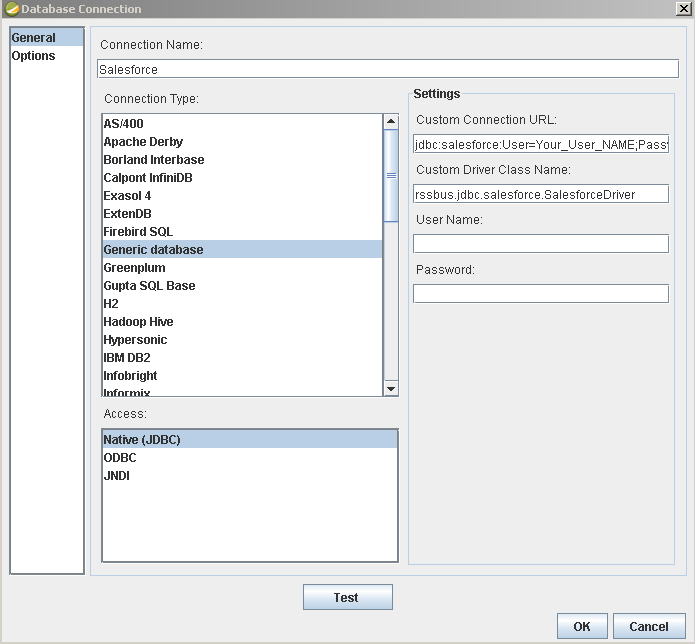
Create a new data source with the driver by clicking Data -> Add Data Source -> Advanced -> JDBC (Custom) and then creating a new ScrapingBee connection. In the resulting dialog, configure the connection properties as shown below.
Custom Connection URL property: Enter the JDBC URL. This starts with jdbc:api: and is followed by a semicolon-separated list of connection properties.
Using API Key Authentication
ScrapingBee uses API key authentication. To obtain an API key:
- Sign in to your ScrapingBee account at https://app.scrapingbee.com
- Navigate to the Dashboard and locate your API key in the top section.
- Copy the API key for use in the connection string.
After obtaining your API key, set the following connection properties:
- AuthScheme: Set this to APIKey.
- APIKey: Set this to your ScrapingBee API key.
Example Connection String
Profile=C:\profiles\ScrapingBee.apip;AuthScheme=APIKey;ProfileSettings="APIKey=your_api_key";
Connecting to ScrapingBee
Once the authentication is configured, you can connect to ScrapingBee and query data from any of the available tables. All tables require at least one input parameter (such as a search query or product ID) to retrieve data.
Built-in Connection String Designer
For assistance in constructing the JDBC URL, use the connection string designer built into the ScrapingBee JDBC Driver. Either double-click the JAR file or execute the jar file from the command-line.
java -jar cdata.jdbc.api.jar
Fill in the connection properties and copy the connection string to the clipboard.

When you configure the JDBC URL, you may also want to set the Max Rows connection property. This will limit the number of rows returned, which is especially helpful for improving performance when designing reports and visualizations.
Below is a typical JDBC URL:
jdbc:api:Profile=C:\profiles\ScrapingBee.apip;AuthScheme=APIKey;ProfileSettings="APIKey=your_api_key";
- Custom Driver Class Name: Enter cdata.jdbc.api.APIDriver.
- User Name: The username to authenticate with.
- Password: The password to authenticate with.
Add ScrapingBee Data to a Report
You are now ready to create a report with ScrapingBee data.
-
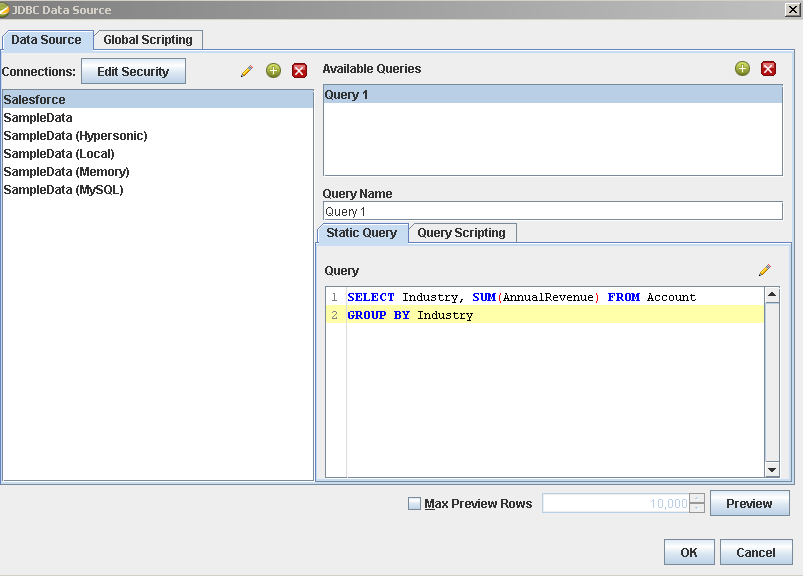
Add the ScrapingBee source to your report: Click Data -> Add Data Source -> JDBC and select the data source.
Configure the query. This article uses the one below:
SELECT , FROM GoogleSearchResults WHERE SearchQuery = 'cdata drivers'
- Drag a chart onto your report and double-click it to edit the chart. Run the report to display the chart. You can use the results of this query to create a simple chart for the GoogleSearchResults table.
- Finally, run the report to see the chart.