






How to work with ServiceDesk Plus Data in Apache Spark using SQL

Apache Spark is a fast and general engine for large-scale data processing. When paired with the CData JDBC Driver for ServiceDesk Plus, Spark can work with live ServiceDesk Plus data. This article describes how to connect to and query ServiceDesk Plus data from a Spark shell.
The CData JDBC Driver offers unmatched performance for interacting with live ServiceDesk Plus data due to optimized data processing built into the driver. When you issue complex SQL queries to ServiceDesk Plus, the driver pushes supported SQL operations, like filters and aggregations, directly to ServiceDesk Plus and utilizes the embedded SQL engine to process unsupported operations (often SQL functions and JOIN operations) client-side. With built-in dynamic metadata querying, you can work with and analyze ServiceDesk Plus data using native data types.
Install the CData JDBC Driver for ServiceDesk Plus
Download the CData JDBC Driver for ServiceDesk Plus installer, unzip the package, and run the JAR file to install the driver.
Start a Spark Shell and Connect to ServiceDesk Plus Data
- Open a terminal and start the Spark shell with the CData JDBC Driver for ServiceDesk Plus JAR file as the jars parameter:
$ spark-shell --jars /CData/CData JDBC Driver for ServiceDesk Plus/lib/cdata.jdbc.api.jar
- With the shell running, you can connect to ServiceDesk Plus with a JDBC URL and use the SQL Context load() function to read a table.
Using OAuth Authentication
ServiceDeskPlus uses Zoho OAuth 2.0 for secure authentication. To set up OAuth access:
- Register your application in the Zoho Developer Console at https://api-console.zoho.com
- Configure your redirect URI to match your application setup
- Note your Client ID and Client Secret from the application settings
After setting the following connection properties, you are ready to connect:
- AuthScheme: Set this to OAuth.
- OAuthClientId: Set this to your Zoho application Client ID.
- OAuthClientSecret: Set this to your Zoho application Client Secret.
- Scope: Set this to the required ServiceDeskPlus permissions (default includes read access to requests, problems, assets, and projects).
- Domain: Set this to your ServiceDeskPlus domain
- Portal: Set this to your ServiceDeskPlus portal
Example Connection String
Profile=C:\profiles\ServiceDeskPlus.apip;ProfileSettings="Portal=itdesk;Domain=.in;Scope=SDPOnDemand.requests.READ SDPOnDemand.problems.READ SDPOnDemand.assets.READ SDPOnDemand.projects.READ";AuthScheme=OAuth;OAuthClientId=your_client_id;OAuthClientSecret=your_client_secret;
Built-in Connection String Designer
For assistance in constructing the JDBC URL, use the connection string designer built into the ServiceDesk Plus JDBC Driver. Either double-click the JAR file or execute the jar file from the command-line.
java -jar cdata.jdbc.api.jar
Fill in the connection properties and copy the connection string to the clipboard.
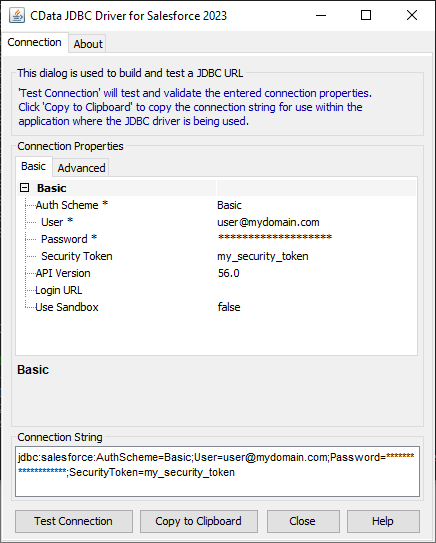
Configure the connection to ServiceDesk Plus, using the connection string generated above.
scala> val api_df = spark.sqlContext.read.format("jdbc").option("url", "jdbc:api:Profile=C:\profiles\ServiceDeskPlus.apip;ProfileSettings="Portal=itdesk;Domain=.in;Scope=SDPOnDemand.requests.READ SDPOnDemand.problems.READ SDPOnDemand.assets.READ SDPOnDemand.projects.READ";AuthScheme=OAuth;OAuthClientId=your_client_id;OAuthClientSecret=your_client_secret;").option("dbtable","AnnouncementComments").option("driver","cdata.jdbc.api.APIDriver").load() - Once you connect and the data is loaded you will see the table schema displayed.
Register the ServiceDesk Plus data as a temporary table:
scala> api_df.registerTable("announcementcomments")-
Perform custom SQL queries against the Data using commands like the one below:
scala> api_df.sqlContext.sql("SELECT , FROM AnnouncementComments WHERE AnnouncementId = 12345").collect.foreach(println)You will see the results displayed in the console, similar to the following:

Using the CData JDBC Driver for ServiceDesk Plus in Apache Spark, you are able to perform fast and complex analytics on ServiceDesk Plus data, combining the power and utility of Spark with your data. Download a free, 30 day trial of any of the hundreds of CData JDBC Drivers and get started today.