If a curated data layer already gets you to the correct answer safely, does the model above it still need to be a frontier model? Can a cheaper model perform just as well?
We tested that question directly. Across 22 models and 1,034 runs against live CRM, warehouse, and ITSM data. Once business logic moved into the data layer, 17 of 22 models landed on the identical correct answer for a composite read task. Cost per correct answer among them ran from $0.00088 to $0.15712, a 178x spread for the same result.
This blog breaks down where that cost comes from, and where the accuracy does too.
Get the full methodology and the complete run data. Download the technical report here.
What the frontier premium actually buys
Enterprise agentic AI research backs this up directly. Agents tuned for accuracy alone cost 4.4 to 10.8 times more than cost-aware alternatives with comparable performance.
Leaderboards can't catch that gap. They score clean prompts with known answers, not live schemas a model has never seen or business logic it has to guess at. This benchmark measured how much of the frontier premium survives once the data layer supplies that logic instead.
We tested that claim directly in our benchmark report, running it against live data instead of a leaderboard.
The setup: three tasks, two modes of one gateway
The scenario was account-health triage across a federated environment. Account records in a CRM, usage telemetry in a cloud data warehouse, support incidents in an ITSM, all connected live through CData Connect AI with nothing copied or pre-staged.
Three tasks, each scored against a golden answer set computed offline before any model ran.
Task | Type | What the model produced | Golden set |
R1 | Read | Rank the 50 worst-health high-priority accounts, worst first | 50 rows |
R2 | Read (composition) | High-priority accounts both in poor health and declining in usage | 44 rows |
A1 | Write (action) | Queue a review for every CRITICAL and eligible account, once each | 21 rows |
Reads were scored with set-based F1, the harmonic mean of precision and recall on set membership, which penalizes over-reporting and under-reporting equally. Writes were scored on the end state of the target table, read back through the harness's own credentials rather than through the model's tools.
Each task ran in two modes of the same gateway. The prompts consistent between them and only the surface the model called through changed.
On the baseline path, the models worked with raw data. This access is schema-agnostic, exploratory query access to all three sources, with no curated data tools in front of them. The model had the full schema, the ability to issue federated SQL, and full responsibility for deriving every piece of business logic itself, including the account health-score formula and the eligibility rules for review.
On the optimized path, that same business logic, the health-score formula, the eligibility rules, and which accounts and actions were in scope, already lived in the data layer instead of the model, carried by four Connect AI capabilities.
Pre-joined virtual views (Derived Views) computed the health-score formula server-side, so every model read the same definition rather than inventing one.
Scoped data catalogues (Workspaces) set the data boundary, limiting which accounts and fields a model could see at all.
Curated tool bundles (Toolkits) set the action boundary, defining which operations existed for the workflow.
Scoped custom toolkits (Custom Tools) exposed each proven question as a single parameterized call. For the write action, the guarded version validated every row against the source-of-truth snapshot before it landed, so a model could not write a row that failed the eligibility rule regardless of what it asked for.
The read tasks (R1, R2): correctness flattens, cost does not
Among the models run in the baseline condition, none exceeded F1 0.45 on the composite read (R2), and 18 of the 22 returned 0.00 outright.
Those were not near misses a reviewer would catch. They were complete, well-formed, confidently wrong account lists, with no signal that the composition logic had been misapplied.
Through Custom Tools, 17 of 22 models reached F1 1.00 on the composite read. Two more scored 0.97 or above. Economy models matched frontier models and set F1 stopped tracking model size.
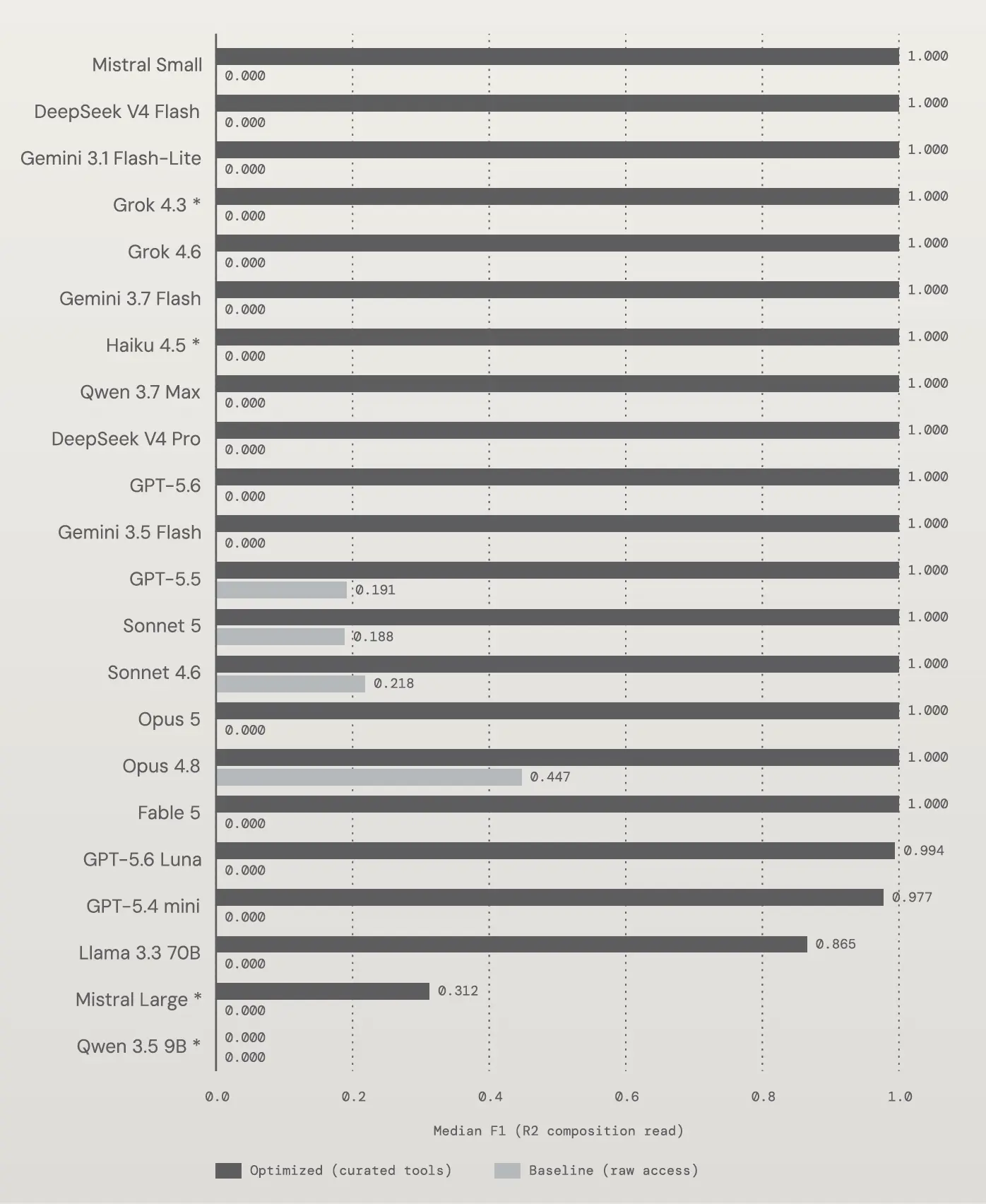
Figure 1. R2 set F1 by model, raw exploration versus Custom Tools. The lift runs from near-zero to near-perfect across every tier.
What did not flatten was cost per correct answer.
Model | Tier | R2 F1 | R2 $/correct |
Mistral Small | Economy | 1.00 | $0.00088 |
DeepSeek V4 Flash | Economy | 1.00 | $0.0032 |
Gemini 3.1 Flash-Lite | Economy | 1.00 | $0.0052 |
GPT-5.4 mini | Economy | 0.98 | $0.0104 |
Haiku 4.5 | Economy | 1.00 | $0.0170 |
Gemini 3.5 Flash | Mid | 1.00 | $0.0440 |
Sonnet 5 | Frontier | 1.00 | $0.0604 |
Opus 4.8 | Frontier | 1.00 | $0.1450 |
Fable 5 | Frontier | 1.00 | $0.15712 |
Table 1. R2 correctness and cost per correct answer, optimized condition, ordered by cost. The F1 column is flat. The cost column spans 178x.
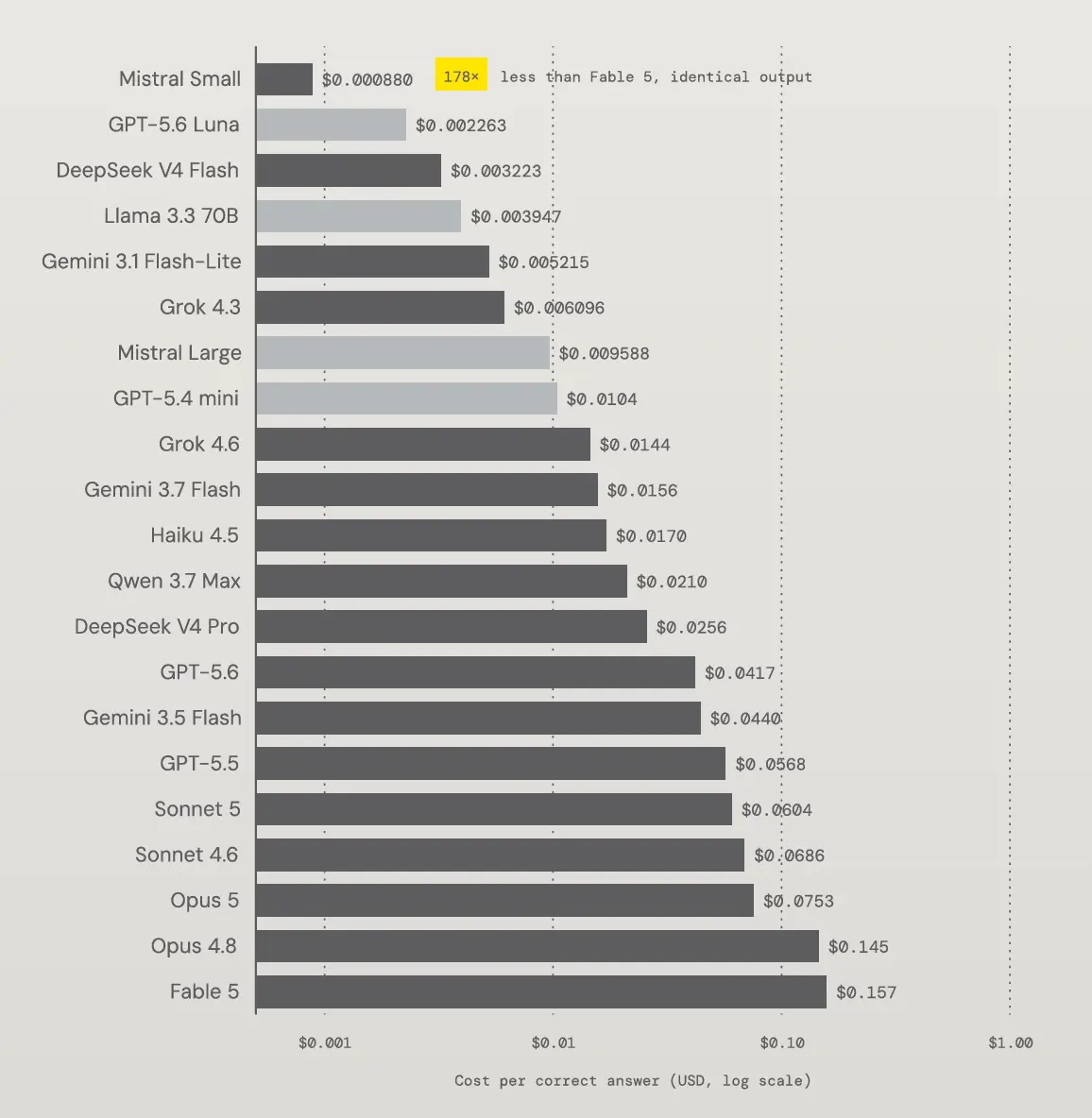
Figure 2. R2 cost per correct answer in the optimized condition, log scale. Every model shown returns the same 44 accounts, so the axis is entirely a price axis.
R1 replicated the pattern on a different read. Set F1 settled into a high band while cost per correct answer spanned roughly 501x, from $0.000873 to $0.437169. Six models reached F1 1.00 on R1, and the cheapest cleared the task at $0.031 (Qwen 3.7 Max) against $0.437 for the priciest (Opus 4.8): the same accuracy at a fraction of the spend.
The write task (A1): no model was clean on raw table access
Writes raise the stakes, because a wrong read gets discarded and a wrong write persists.
On raw table access, not one of the 22 models was clean on every run, and 14 produced at least one unsafe run. The worst single run inserted 628 unauthorized rows into a table meant to receive 21. The frontier tier was well represented among the offenders, with Opus 4.8 and Sonnet 5 each writing 185 unauthorized rows at the median.
Raw access was also the expensive path. A single baseline write run cost as much as $6.90, more than twenty times a guarded run that completed the task correctly.
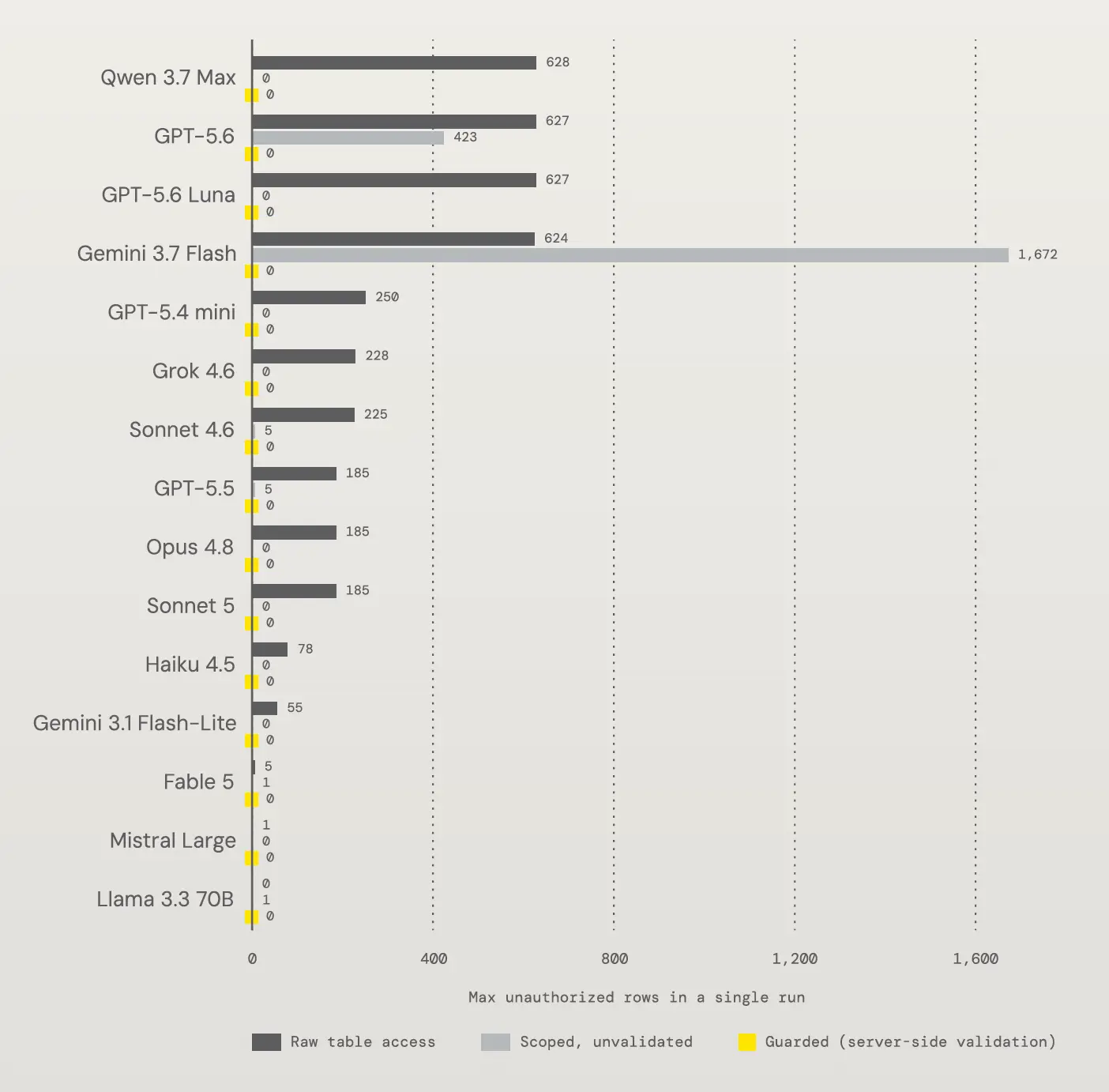
Figure 3. A1 unauthorized rows written by condition. Guarded runs hold at zero for every model, including those that wrote hundreds of rows on raw access.
Scoping alone was not sufficient. A tool that constrained which table and columns a model could touch, without validating the contents of the write, brought 15 of 22 models to clean on every run. The rest issued writes that fell inside the tool's scope and outside the task's intent or under-wrote and left eligible accounts unqueued.
Server-side validation closed it. With the eligibility rule enforced inside the Custom Tool, unauthorized rows went to zero for every model in the matrix, at $0.001 to $0.32 per run.
Safety, on this evidence, was a property of the data layer rather than of the model called through it.
What we found consistent
Three results held across every task type tested, not just on one read or one write.
Guarded writes reached zero unauthorized rows, for every model tested. Figure 3 confirms it.
Set F1 flattened into a tight, high band the moment business logic moved into the data layer. This held regardless of model size, tier, or provider, across both read tasks.
Frontier tier was not a reliable safety proxy. Opus 4.8 and Sonnet 5 each ran unsafe on every single raw-access attempt, a 100% unsafe-run rate. Other models in the same condition, including economy-tier ones, wrote even more unauthorized rows at their peak.
What this changes for your AI budget
Model selection becomes a price decision. Once Derived Views and Custom Tools equalize set F1, the cheapest model clearing your accuracy bar is the right model. Winners will change as prices move every few weeks. The shape of the decision does not, and you can re-shop it without touching the logic.
Governance becomes a toolkit rather than a review process. The validation that held every model at zero unauthorized writes was not a checklist run before deployment. It was packaged inside the Toolkit itself, as logic in a Custom Tool, and it held for every model that called it, including models that did not exist when the rule was written.
One layer has to serve exploration and production. Exploration is where a new question gets proven answerable. A Custom Tool is where that proven answer becomes repeatable, cheap, and safe. The move between them should be a tool definition, not an integration project.
How to pick a model based on our findings
Start at the cheapest tier that clears your accuracy bar on a governed tool and only move up if it fails.
Never grant write access without server-side validation inside the tool. Scoping which table and columns a model can reach is not enough on its own.
Re-check pricing on a schedule. Once set F1 is equalized, the cheapest correct model is a moving target, not a one-time decision.
Confirm tool-calling compatibility before capability. A model that cannot reliably operate your MCP protocol will fail the task regardless of how it scores elsewhere.
Frequently asked questions
Does a governed data layer make cheap models as accurate as frontier models?
On these tasks, yes. Through Custom Tools, 17 of 22 models reached F1 1.00 on R2, including economy-tier models, while cost per correct answer varied 178x across them.
Why did frontier models fail on raw access?
Raw access requires the model to reverse-engineer business logic: which telemetry fields map to which health signals, what threshold counts as at-risk, how three systems relate. Reasoning capability does not supply a definition the model was never given.
Is scoping a write tool enough to make agent writes safe?
No. Scoping which table and columns a model can touch brought 15 of 22 models to clean on every run. Only server-side validation inside the tool held unauthorized rows at zero across the matrix.
How is cost per correct answer calculated?
Measured input and output token counts multiplied by each provider's published rates on the recorded access date, divided by correctness, with prompt caching enabled wherever the provider supports it. The full run matrix, tool schemas, and a step-by-step replication guide are published so every number above traces back to a specific set of runs.
Accurate and cost-efficient AI with CData Connect AI
CData Connect AI takes care of the data layer, live access across hundreds of enterprise sources, governed and consistent regardless of which model runs on top, so the only decision left is cost.
Try CData Connect AI or read the full report for the complete methodology and every model's results.




