For most of my last job I couldn’t answer the one question that mattered most: did any of this turn into a customer?
I could tell you how much traffic I’d brought in, which pages were climbing, and what people searched before they found us. I had a good report. And every time somebody asked the follow-up, I said some version of I don’t know, that lives in a system I don’t have. You can only say that a few times before it starts to feel like a description of you rather than of your tooling.
Then that changed, quickly, and mostly because I found out the data was reachable. I’m a few weeks into a new job now and I’m doing the same thing again, in the same order.
TL;DR: My own tools recorded what I did and nothing about what came of it, so that’s what I reported. The missing half lived in the CRM, which belonged to another team. I asked for read access through CData Connect AI, described the report I wanted to a coding agent, and it built the thing. The technical work I’d been dreading turned out to be the thing I didn’t have to do at all.
What my tools recorded, and what they didn’t
Every tool I had recorded my own activity and stopped there.
My analytics knew how many people arrived. My CMS knew how many posts I’d shipped. My search console knew which queries were moving. All of it real. None of it answered the question the people above me were holding: whether any of it made a difference to something the company counts.
So I reported activity. It took me a long time to see why. Given only the systems I owned, activity reporting wasn’t a shortcut. It was the honest maximum.
The problem was never that I was thinking too small. The data I could reach had quietly drawn a boundary around the questions I bothered to form. After long enough I’d stopped generating the ones I couldn’t answer, and I never noticed it happening.
The three questions I’d stopped asking
For a while I treated the gap as a permanent condition, the way you treat weather. It lived in the CRM, the CRM belonged to a different team, and that was that.
What I needed was three things: whether the people arriving from my work turned into leads, whether those leads turned into deals, and what those deals were worth. I’d stopped asking those so long ago that I’d forgotten they were questions.
Nobody had ever told me no. I’d decided that for them.
I didn’t know this was a thing I could do
I knew the data existed somewhere. I assumed reaching it was a project: a request, a queue, an engineer, a pipeline, weeks. That assumption did more damage than any gatekeeper, because it meant I never got as far as asking, so I never found out I was wrong.
What changed was finding out my company already ran a connectivity layer across our enterprise systems, and that read access to one of them was a permission rather than a project. It took me embarrassingly long to find that out.
Alt: The Two Buttons meme, sweating over a choice between asking for data access and assuming it is not allowed, labelled “me, for a year”.
Asking turned out to be the easy part
So I asked, and I got read access to the CRM through CData Connect AI, which turned out to already be running there. I had never heard of it.
Nobody fought me on it. I’d braced for a negotiation. The plumbing already existed. Somebody granted me read access to one system through it, and the whole thing took an afternoon.
None of this put me outside the rules. That mattered to me more than I’d expected. Every query I ran was logged with my name on it. Connections can also be configured so queries run under your own permissions in the source system rather than a shared account. That setting decides whether you’re reading your own slice or everything, so it’s the one thing I’d ask about up front.
The part I thought I’d have to learn first
I didn’t build any of it.
I described what I wanted in plain English to a coding agent, and it worked out how to get it: which interface to use, how the systems were addressed, how to ask for a summary instead of dragging everything down and counting it locally. When the numbers looked wrong, I said the numbers look wrong, and it found that I’d described one of the filters ambiguously and asked me which reading I meant.
The technical work stopped being mine, and it stopped deciding whether I could have the report at all. The skill that mattered was knowing what I wanted to know. Everything downstream of that was a conversation.
If you want to explore a system you’ve never seen, connect an AI client to it and ask what’s in there: what the objects are called, what values a field takes, what’s populated and what never got filled in. Connect AI publishes a Model Context Protocol (MCP) server for that, and CData documents the Claude path. It’s how I learned the shape of the CRM without reading a single page of documentation. For the report that runs every Monday without me, the agent built against the REST Data API instead.
The other thing: say out loud that you want the summary. My instinct was to pull everything down and count it myself, because that’s what you do with a spreadsheet export. The moment I said so, the whole thing got simpler.
Alt: The Waiting Skeleton meme, captioned about waiting to learn SQL before asking anyone for the data.
The four weeks after I rebuilt what I measured
Building the first version of the reporting took me a day or two. Working the plan the report gave me took about four weeks.
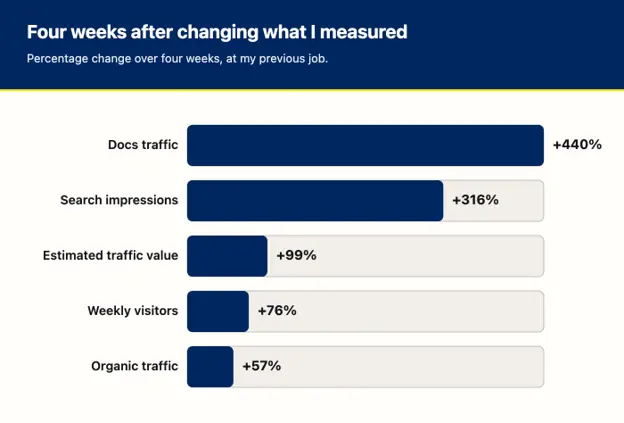
Percentage change over four weeks, at my previous job.
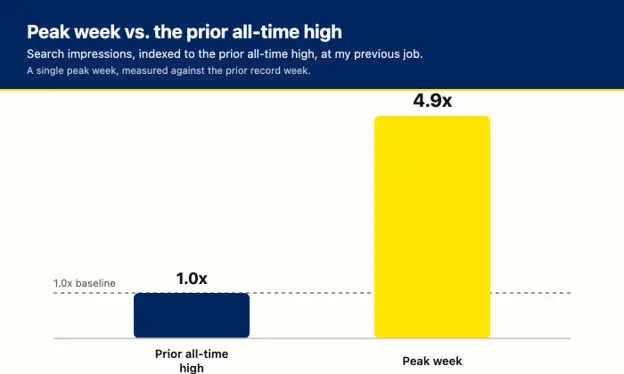
Search impressions, indexed to the prior all-time high, at my previous job. A single peak week, measured against the prior record week.
Those are two different measurements and I don’t want them read as one. The first chart is the four-week change across the metrics I was tracking. The second is one week, the best one, held up against the previous record week.
The reporting didn’t produce those numbers. A weekly audit habit produced them: finding what was broken, fixing it, and doing more of whatever moved. What the reporting did was tell me which of my work to repeat.
Those particular metrics are mine and they won’t be yours. I’m in developer marketing, so my evidence is search impressions, docs traffic, and where pages ranked. The direction is what transfers, not the rows.
The rooms I got invited into
I didn’t see this coming. The scope of my work expanded almost immediately, and not because anyone promoted me or handed me a broader mandate. It expanded because I could speak about the piece of the business my work touched. When you can only describe your own activity, the conversations you get invited into are conversations about your activity. Once I could describe what happened downstream, the questions coming at me were about next quarter.
My influence over what we worked on grew faster in that stretch than at any other point in my career. My judgment was the same. I could show the reasoning behind it now.
It also pulled me closer to how the business thinks. People warn you about that, and they have it backwards. I got better at protecting the work I believed in, because I could explain why it mattered in a language the rest of the company already spoke.
That’s why I’d build the reporting first in any job I ever take again.
The part that stays mine
I have built a scorecard and then started working for the scorecard. It doesn’t feel like cheating while you’re doing it. It feels like rigor. The tell is small and physical: I catch myself adjusting a definition after I’ve already seen the result.
I’m still working on it. I’m still cleaning up data downstream, and I still can’t cleanly separate the work I touched directly from the work I only influenced, and I don’t know when that gets finished or whether it does. My role keeps expanding, so it keeps turning out to touch more systems than the last version of the report knew about, and every time that happens I need context from somewhere upstream or downstream of me to understand what I’m even looking at. So I ask. My boss, the people who own the systems, whoever sits closer to the data than I do.
Every report has a definition like mine buried in it. Somebody decided what counts. Six months later nobody remembers it was a decision.
So the agent didn’t shrink my job. It moved it. The agent will write whatever definition I describe, with total confidence, forever. Deciding what should count, and noticing when that decision has started doing something I didn’t intend, is the part that stays mine.
Two habits keep me honest. I write down what I’m excluding before I look at the output, because a slice I name is a scope decision and a slice I keep quiet is a flattering number. And where my numbers disagree with the official ones, the official ones win and I go find my mistake.
Alt: The Distracted Boyfriend meme, with the author looking away from the work toward the metric that was meant to describe it.
Where I’d start now
I’d start with the question I’d stopped asking, which for me had been sitting there long enough to stop feeling like a question. The one you’d want answered about your own work if the data weren’t in the way. Its other half lives in a system somebody else owns. In sales operations that might be which deals the support history predicted. In finance it might be which spend turned into usage. In support it might be whether the customers you rescued renewed.
Then I’d find out who owns that system and ask for read access to the specific thing I needed. Name the question, not the dataset. The ask I’d been rehearsing in my head was much larger than the one I needed to make, and there may already be a connectivity layer running that nobody thought to offer you.
If there isn't, sign up for a free trial of Connect AI, no credit card required. Salesforce is one of hundreds of available sources.
For lighter use or ongoing exploration, Connect AI Developer Edition is free with no expiration: five connections, five users, and 500 tool calls a month.
Start free and let the agent handle what I spent years assuming I'd have to learn first. Write down what you're leaving out before you look at the answer.
Frequently asked questions
What's the difference between reporting activity and reporting impact?
Activity is what you did: emails sent, posts shipped, tickets closed. Impact is what came of it, like a lead, a deal, or a customer who stayed. The distinction matters because your own tools record your activity and nothing downstream of it, so activity reporting is the most that one person's own tools can honestly show. Reporting impact means reaching data another team owns.
Do I need to know SQL to build my own reporting?
No, and this is the part that changed recently. I described what I wanted in plain English to a coding agent and it handled the interface, the query, and the conventions for addressing each system. The skill that matters is knowing what you want to know, and then checking the answer, because an agent will write whatever definition you describe without mentioning that the definition is doing something you didn't intend.
How do I get access to data another team owns?
I asked the team that owned the system for read access to the one object I needed, and framed it as a question instead of a dataset request. Nobody fought me on it. Many companies already run a connectivity layer that makes this a permission change rather than an engineering project, and access through that kind of layer is logged against your user, so it's auditable rather than an untracked credential.
Can I connect Claude or ChatGPT to my company's data and ask it questions?
Yes. Connect AI exposes connected systems through a Model Context Protocol (MCP) server, and an MCP-capable client like Claude can connect and answer questions conversationally, with a documented Claude path. That's the fastest way to learn what's in a system you've never seen. For a report that runs on a schedule without you, the REST Data API is the better target, since MCP is built for a model asking questions inside a conversation.
Isn't building your own reporting a governance problem?
Not when it runs through a layer the organization already governs. Every query is logged with the user who ran it, and connections can be configured for per-user authentication so queries execute under your own entitlements in the source system rather than a shared service account. The pattern that causes trouble is shared credentials with no attribution. The rule I follow: where my numbers disagree with the official ones, the official ones win.
What's the most common mistake in reporting your own impact?
Deciding what counts after you've seen the result. Almost nobody fabricates. What happens is you pick a favorable slice and believe your own reason for picking it, so write down what you're excluding and how you're defining things before you look at the output, then publish the exclusions next to the numbers. Watch for the moment you find yourself adjusting a definition because you didn't like what it produced.
How much does Connect AI Developer Edition cost?
It's free with no credit card and no expiration — announced June 23, 2026 — with five active connections, five users, and 500 tool calls per month, including MCP server support. The 14-day free trial on CData's pricing page applies to the paid plans, which is a separate thing from the free tier.
References




