






Connect to Customer.io Data from PowerBuilder via ODBC

The CData ODBC Driver for Customer.io can be used from any platform or development technology that supports ODBC, including PowerBuilder. This article shows how to connect to Customer.io data and execute queries from the Database Painter and controls such as the DataWindow.
Connect to Customer.io as an ODBC Data Source
If you have not already, first specify connection properties in an ODBC DSN (data source name). This is the last step of the driver installation. You can use the Microsoft ODBC Data Source Administrator to create and configure ODBC DSNs.
Using API Key Authentication
To obtain your Customer.io App API Key, navigate to the Customer.io UI under Data & Integrations > Integrations > Customer.io API and generate your API key.
After setting the following connection properties, you are ready to connect:
- AuthScheme: Set this to APIKey.
- APIKey: Set this to your Customer.io App API Key.
Example Connection String
Profile=C:\profiles\CustomerIO.apip;AuthScheme=APIKey;ProfileSettings="APIKey=your_api_key";
Create a Profile for the ODBC Driver for Customer.io
Follow the steps below to use the Database Painter tool to create a database profile based on an ODBC DSN (data source name) for Customer.io. In the Database Painter, you can use wizards and the UI to work with Customer.io data.
- In PowerBuilder, click Tools -> Database Painter.
- In the Objects window in the Database Painter, right-click the ODBC node and click New Profile.
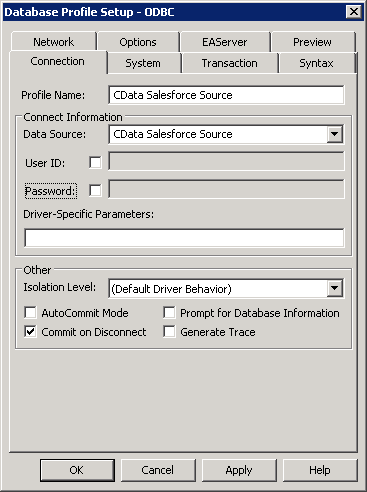
- On the Connection tab, enter a name for the profile and select the Customer.io DSN in the Data Source menu.
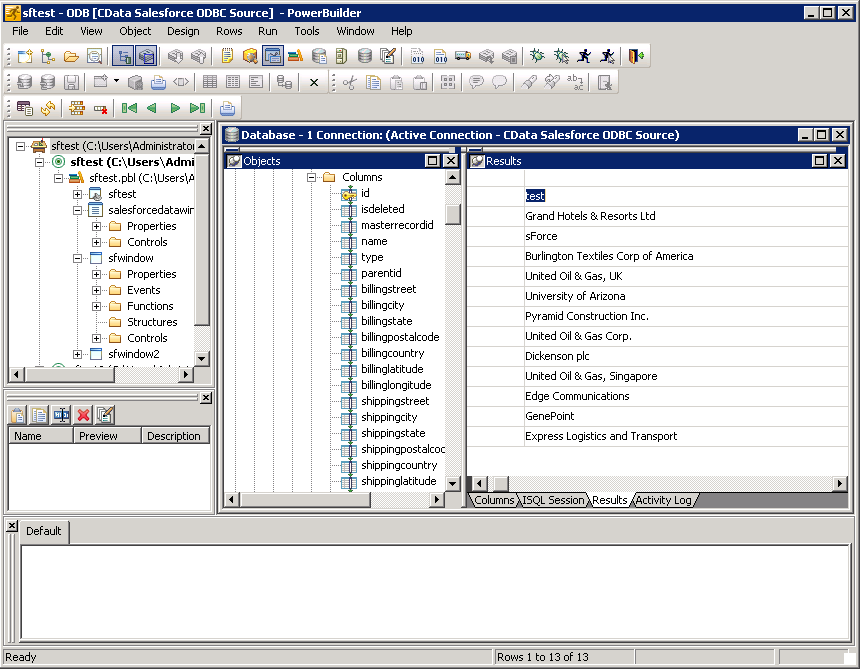
- To view and modify a table, right-click a table and then click Edit Data -> Grid.
Using Customer.io Data with PowerBuilder Controls
You can use standard PowerBuilder objects to connect to ODBC data sources and execute queries. The following example shows how to retrieve Customer.io data into a DataWindow. You can add the following code to the open method:
SQLCA.DBMS = "ODBC"
SQLCA.DBParm = "ConnectString='DSN=CData API Source'"
CONNECT USING SQLCA;
dw_customers.SetTransObject(SQLCA);
dw_customers.Retrieve();