






Establish a Live Connection with Oracle Eloqua Reporting Data using Tableau Bridge

The Tableau Bridge enables you to publish dashboards to Tableau Cloud while maintaining live connectivity with any data source. In this article, you will use the Tableau Bridge to maintain data freshness in a published workbook by listening for changes in the underlying Oracle Eloqua Reporting data.
The CData ODBC drivers offer unmatched performance for interacting with live Oracle Eloqua Reporting data in Tableau Cloud due to optimized data processing built into the driver. When you issue complex SQL queries from Tableau Cloud to Oracle Eloqua Reporting, the driver pushes supported SQL operations, like filters and aggregations, directly to Oracle Eloqua Reporting and utilizes the embedded SQL engine to process unsupported operations (often SQL functions and JOIN operations) client-side. With built-in dynamic metadata querying, you can visualize and analyze Oracle Eloqua Reporting data using native Tableau data types.
Connect to Oracle Eloqua Reporting as an ODBC Data Source
If you have not already, first specify connection properties in an ODBC DSN (data source name). This is the last step of the driver installation. You can use the Microsoft ODBC Data Source Administrator to create and configure ODBC DSNs.
Oracle Eloqua Reporting supports the following authentication methods:
- Basic authentication (User and Password)
- OAuth 2.0 code grant flow
- OAuth 2.0 password grant flow
Basic Authentication (User and Password)
To perform authentication with a user and password, specify these properties:
- AuthScheme: Basic.
- Company: The company name associated with your Oracle Eloqua Reporting account.
- User: Your login account name.
- Password: Your login password.
OAuth Authentication (Code Grant Flow)
To authenticate with the OAuth code grant flow, you must set AuthScheme to OAuth and create a custom OAuth application. For information about how to create a custom OAuth application, see the Help documentation.
Then set the following properties:
- InitiateOAuth: GETANDREFRESH. Used to automatically get and refresh the OAuthAccessToken.
- OAuthClientId: The client Id assigned when you registered your application.
- OAuthClientSecret: The client secret that was assigned when you registered your application.
- CallbackURL: The redirect URI that was defined when you registered your application.
When you connect, the driver opens Oracle Eloqua Reporting's OAuth endpoint in your default browser. Log in and grant permissions to the application. When the access token expires, the driver refreshes it automatically.
OAuth Authentication (Password Grant Flow)
With the OAuth password grant flow, you can use your OAuth application's credentials alongside your user credentials to authenticate without the need to grant permission manually via a browser prompt. You must create an OAuth app (see the Help documentation) to use this authentication method.
Set the following properties:
- AuthScheme: OAuthPassword
- Company: The company's unique identifier.
- User: Your login account name.
- Password: Your login password.
- OAuthClientId: The client Id assigned when you registered your custom OAuth application.
- OAuthClientSecret: The client secret assigned when you registered your custom OAuth application.
When you configure the DSN, you may also want to set the Max Rows connection property. This will limit the number of rows returned, which is especially helpful for improving performance when designing reports and visualizations.
Add Oracle Eloqua Reporting Data to a Dashboard
- From a new workbook, click Data -> New Data Source -> Other Databases (ODBC).
Select the CData Data Source Name (for example: CData OracleEloquaReporting Source). - In the Database menu, select CData.
- In the Table box, enter a table name or click New Custom SQL to enter an SQL query. This article retrieves the table.
- Drag the table onto the join area. At this point, you can include multiple tables, leveraging the built-in SQL engine to process complex data requests.
- Click the tab for your worksheet. Columns are listed as Dimensions and Measures, which you can drag and drop onto the dashboard to create visualizations.
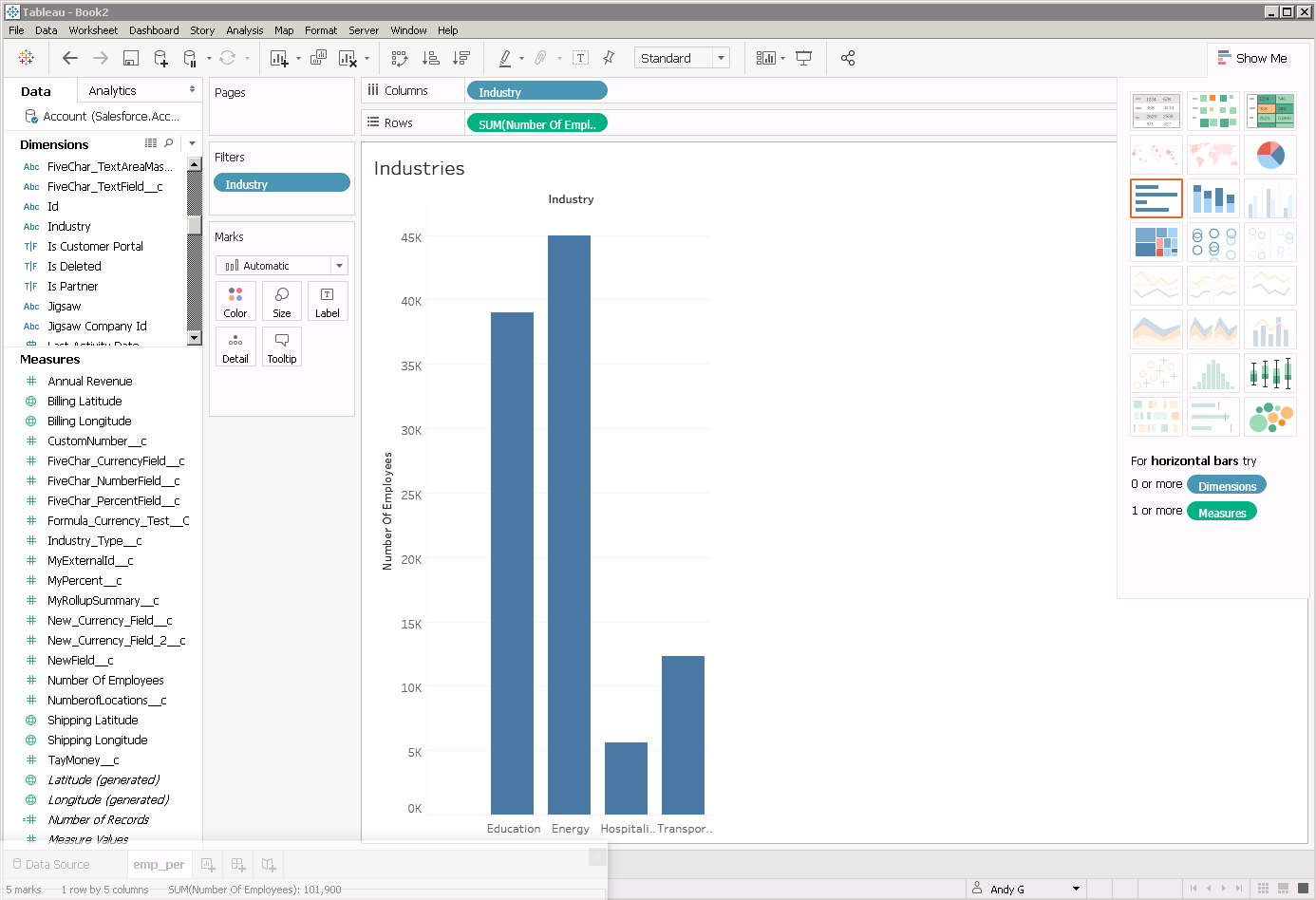
Set Up Tableau Bridge as a Service
- In the Server menu, select Start Tableau Bridge Client.
- Sign in to the Tableau Bridge using a site admin level account.
- If prompted, select the Tableau Cloud site where you want to publish live data. The bridge client will open and is accessible from the system tray.
- By default, the Tableau Bridge client is set to Application mode. Select 'Switch to service' to enable Tableau Bridge to handle live connections.
- Log in to your Tableau Cloud site as an administrator.
- From your site, click Settings, then Bridge.
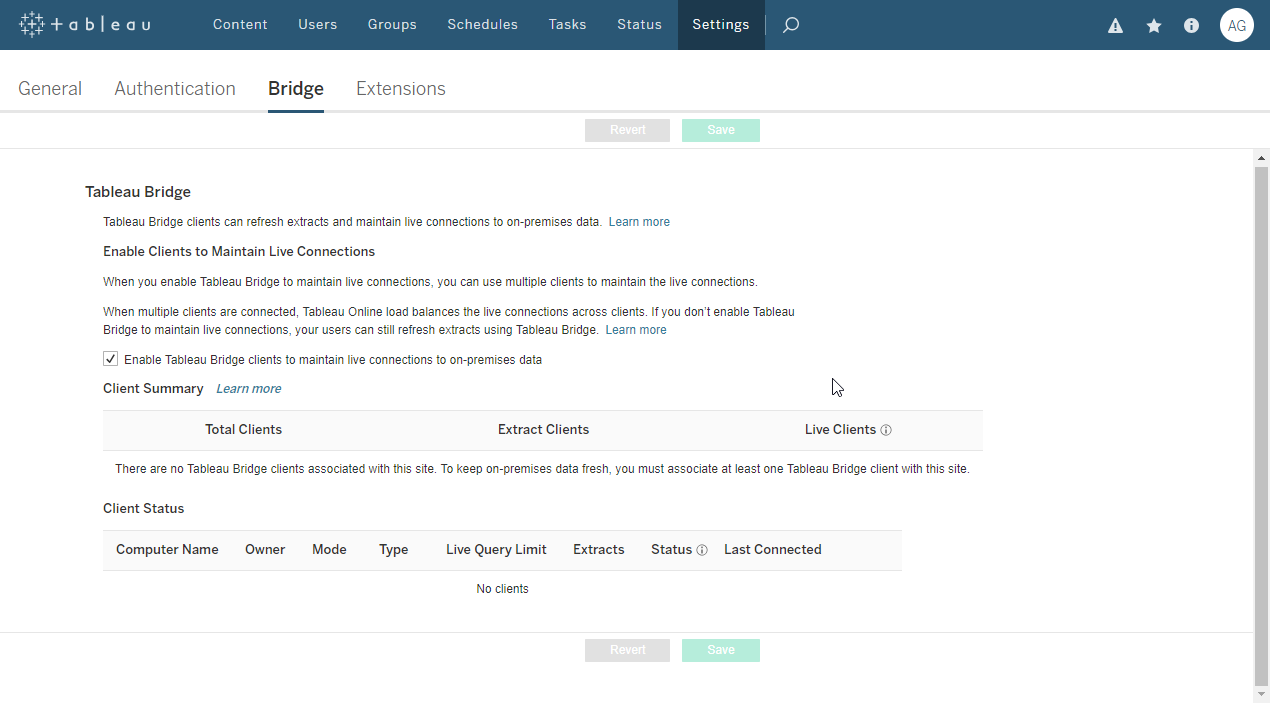
- In the Bridge settings, under Enable Clients to Maintain Live Connections, check the box labeled 'Enable Tableau Bridge clients to maintain live connections to on-premises data.'
Publish a Dashboard Containing the Live Data Source
Having configured both the Tableau Bridge and Tableau Cloud to enable live data connections, you can now publish your workbook to Tableau Cloud. From the Server menu, select Publish Workbook.
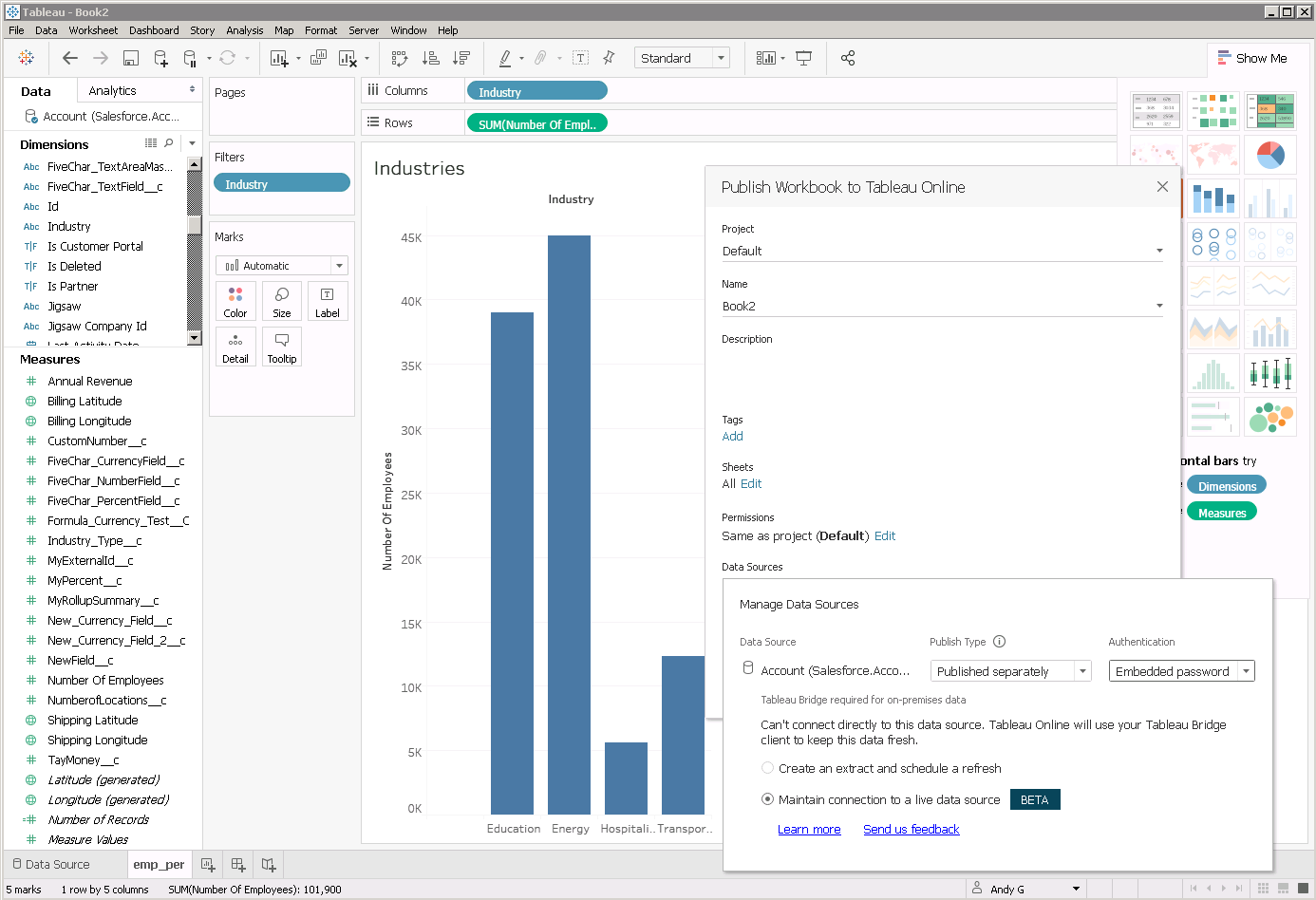
After choosing the workbook name and project that you wish to publish to, configure the deployment so that the CData ODBC driver for Oracle Eloqua Reporting is embedded in your workbook as a separate, live data source.
- Under Data Sources, select the option to Edit the embedded data sources in the workbook.
- Change Publish Type to 'Published separately,' then select a desired means of authentication.
- Last, select 'Maintain connection to a live data source' and click the green Publish Workbook button.
The published workbook now updates alongside the underlying Oracle Eloqua Reporting data. From a published dashboard, simply click the Refresh button to reflect the most recent changes.
Ready to get started?
Download a free trial of the Oracle Eloqua Reporting ODBC Driver to get started:
Download NowLearn more:
 Oracle Eloqua Reporting ODBC Driver
The Oracle Eloqua Reporting ODBC Driver is a powerful tool that allows you to connect with live data from Oracle Eloqua Reporting, directly from any applications that support ODBC connectivity.
Access Oracle Eloqua Reporting data like you would a database - read, write, and update Oracle Eloqua Reporting 0, etc. through a standard ODBC Driver interface.
