






DataBind Controls to Hugging Face Data in Delphi

The CData ODBC driver for Hugging Face supports the ODBC standard to enable integration of live Hugging Face data with visual form designers and other rapid development tools in Delphi. The ODBC driver simplifies data access strategies for applications that share a single codebase like Delphi by providing a single API for database development. This article shows how to how to connect to Hugging Face data and query data from a simple visual component library (VCL) application, as well as from Delphi code.
Create a Connection to Hugging Face Data
If you have not already, first specify connection properties in an ODBC DSN (data source name). This is the last step of the driver installation. You can use the Microsoft ODBC Data Source Administrator to create and configure ODBC DSNs.
HuggingFace Hub uses token-based authentication to enable access to its API. The API provides access to machine learning models, datasets, spaces, papers, and other resources on the HuggingFace Hub platform.
Using API Key Authentication
To authenticate to HuggingFace Hub, you will need to provide an API Key (Access Token). To obtain your access token:
- Log in to your HuggingFace account at https://huggingface.co
- Navigate to Settings > Access Tokens
- Click "New token" to create a new access token
- Select the appropriate permissions (read or write)
- Copy the token value
After obtaining your access token, set the following connection properties:
- AuthScheme: Set this to APIKey.
- APIKey: Set this to your HuggingFace access token.
Example connection string
Profile=C:\profiles\HuggingFace.apip;ProfileSettings='APIKey=hf_xxxxxxxxxxxxxxxxxxxx';
You can then follow the steps below to use the Data Explorer to create a FireDAC connection to Hugging Face data.
- In a new VCL Forms application, expand the FireDAC node in the Data Explorer.
- Right-click the ODBC Data Source node in the Data Explorer.
- Click Add New Connection.
- Enter a name for the connection.
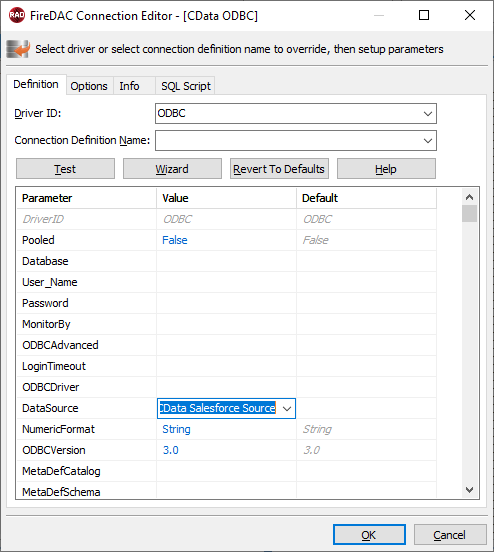
- In the FireDAC Connection Editor that appears, set the DataSource property to the name of the ODBC DSN for Hugging Face.
Create VCL Applications with Connectivity to Hugging Face Data
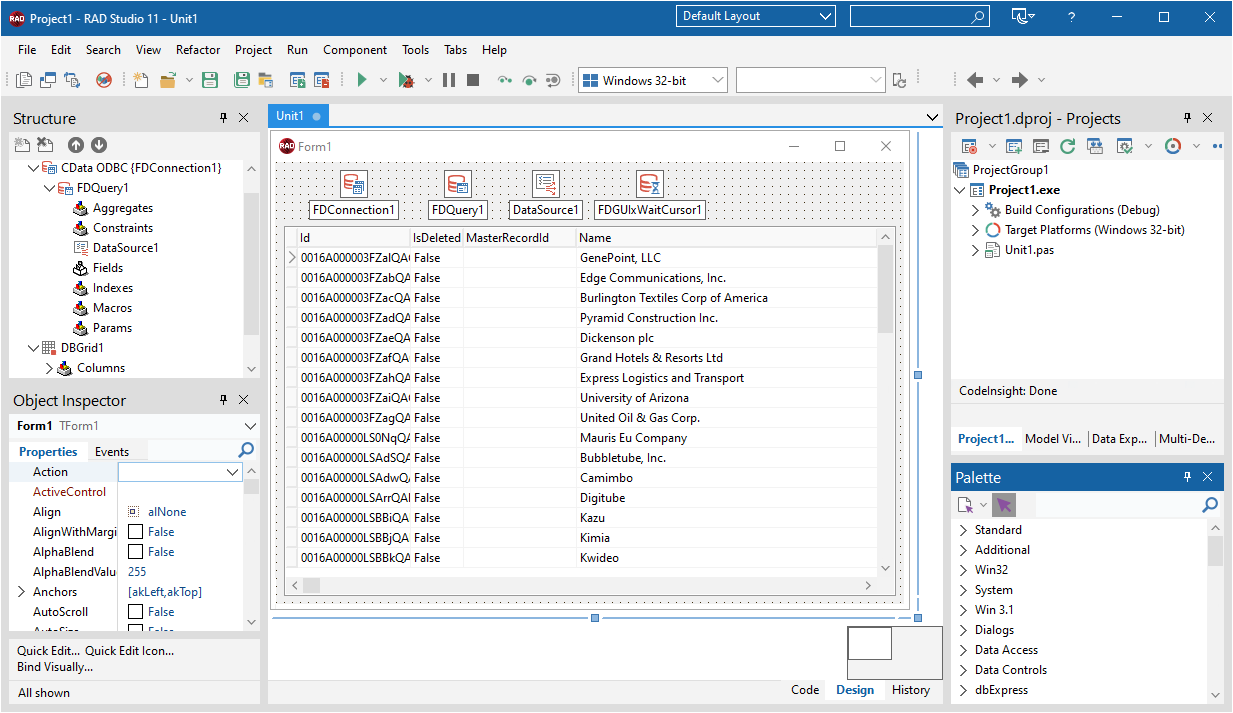
Follow the procedure below to start executing queries to Hugging Face data from a simple VCL application that displays the results of a query in a grid.
-
Drop a TFDConnection component onto the form and set the following properties:
- ConnectionDefName: Select the FireDAC connection to Hugging Face data.
- Connected: Select True from the menu and, in the dialog that appears, enter your credentials.
-
Drop a TFDQuery component onto the form and set the properties below:
- Connection: Set this property to the TFDConnection component, if this component is not already specified.
SQL: Click the button in the SQL property and enter a query. For example:
SELECT , FROM Collections WHERE = ''
- Active: Set this property to true.
Drop a TDataSource component onto the form and set the following property:
- DataSet: In the menu for this property, select the name of the TFDQuery component.
-
Drop a TDBGrid control onto the form and set the following property:
- DataSource: Select the name of the TDataSource.
- Drop a TFDGUIxWaitCursor onto the form — this is required to avoid a run-time error.
Execute Commands to Hugging Face with FireDAC Components
You can use the TFDConnection and TFQuery components to execute queries to Hugging Face data. This section provides Hugging Face data-specific examples of executing queries with the TFQuery component.
Connect to Hugging Face Data
To connect to the data source, set the Connected property of the TFDConnection component to true. You can set the same properties from code:
FDConnection1.ConnectionDefName := 'myhuggingface';
FDConnection1.Connected := true;
Create Parameterized Queries
Parameterized resources can improve performance: Preparing statements is costly in system resources and time. The connection must be active and open while a statement is prepared. By default, FireDAC prepares the query to avoid recompiling the same query over and over. To disable statement preparation, set ResourceOptions.DirectExecute to True; for example, when you need to execute a query only once.
Execute a Query
To execute a query that returns a result set, such as a select query, use the Open method. The Open method executes the query, returns the result set, and opens it. The Open method will return an error if the query does not produce a result set.
FDQuery1.Open('select * from Collections where = :',['']);
Related Articles
Below you can find other articles for using the CData ODBC Driver with RAD Studio, Delphi, and C++ Builder.