




Use the CData ODBC Driver for JD Edwards in MicroStrategy

MicroStrategy is an analytics and mobility platform that enables data-driven innovation. When you pair MicroStrategy with the CData ODBC Driver for JD Edwards, you gain database-like access to live JD Edwards data from MicroStrategy, expanding your reporting and analytics capabilities. In this article, we walk through creating a database instance for JD Edwards in MicroStrategy Developer and creating a Warehouse Catalog based on JD Edwards data.
The CData ODBC driver offers unmatched performance for interacting with live JD Edwards data in MicroStrategy due to optimized data processing built into the driver. When you issue complex SQL queries from MicroStrategy to JD Edwards, the driver pushes supported SQL operations, like filters and aggregations, directly to JD Edwards and utilizes the embedded SQL engine to process unsupported operations (often SQL functions and JOIN operations) client-side. With built-in dynamic metadata querying, you can visualize and analyze JD Edwards data using native MicroStrategy data types.
Connect to JD Edwards as an ODBC Data Source
Information for connecting to JD Edwards follows, along with different instructions for configuring a DSN in Windows and Linux environments (the ODBC Driver for JD Edwards must be installed on the machine hosting the connected MicroStrategy Intelligence Server).
The driver connects to JD Edwards through your Application Interface Services (AIS) Server. Set the following connection properties:
- URL: The base HTTPS URL of your AIS Server (e.g., https://jde-ais.example.com:8300).
- User: Your JD Edwards username.
- Password: Your JD Edwards password.
- Environment (optional): The JD Edwards environment to use (e.g., PD920 for production or DV920 for development). If not specified, the AIS Server's default environment is used.
- Role (optional): The JD Edwards role for the session. If not specified, the AIS Server's default role is used.
- DeviceName (optional): An identifier for the connecting device or application, used for auditing and logging on the AIS Server.
- Jasserver (optional): The specific Java Application Server (JAS) instance to route requests through, useful in clustered environments.
Choosing Which Data Is Exposed
JD Edwards organizes tables and business views by System Code, and the driver exposes each System Code as its own schema. Use these properties to control which schemas are available:
- DataModel: One or more ERP modules (comma-separated) whose System Codes are exposed as schemas, or All to expose every System Code in the connected instance. Defaults to FinancialManagement.
- SystemCodes: A comma-separated list of additional System Codes to expose alongside those from DataModel (e.g., 42,43).
When you connect, the driver sends your credentials to the AIS Server to obtain a session token and caches it. The driver requests a new token automatically before the session expires.
When you configure the DSN, you may also want to set the Max Rows connection property. This will limit the number of rows returned, which is especially helpful for improving performance when designing reports and visualizations.
Windows
If you have not already, first specify connection properties in an ODBC DSN (data source name). This is the last step of the driver installation. You can use the Microsoft ODBC Data Source Administrator to create and configure ODBC DSNs.
Linux
If you are installing the CData ODBC Driver for JD Edwards in a Linux environment, the driver installation predefines a system DSN. You can modify the DSN by editing the system data sources file (/etc/odbc.ini) and defining the required connection properties.
/etc/odbc.ini
[CData JDEdwards Sys]
Driver = CData ODBC Driver for JD Edwards
Description = My Description
URL = https://your-jde-environment-app.example.com
User = admin
Password = myPassword
For specific information on using these configuration files, please refer to the help documentation (installed and found online).
Create a JD Edwards Database Instance in MicroStrategy Developer
You can connect to JD Edwards in MicroStrategy Developer by adding a database instance based on the CData ODBC Driver for JD Edwards.*
- Open MicroStrategy Developer and select a Project Source.
- Navigate to Administration -> Configuration Managers -> Database Instances and right-click to add a new instance.
- Name the instance, select Generic DBMS as the database connection type, and create a new database connection.
- In the database connection wizard, name the connection and create a new Database Login name, using filler values for the user and password.
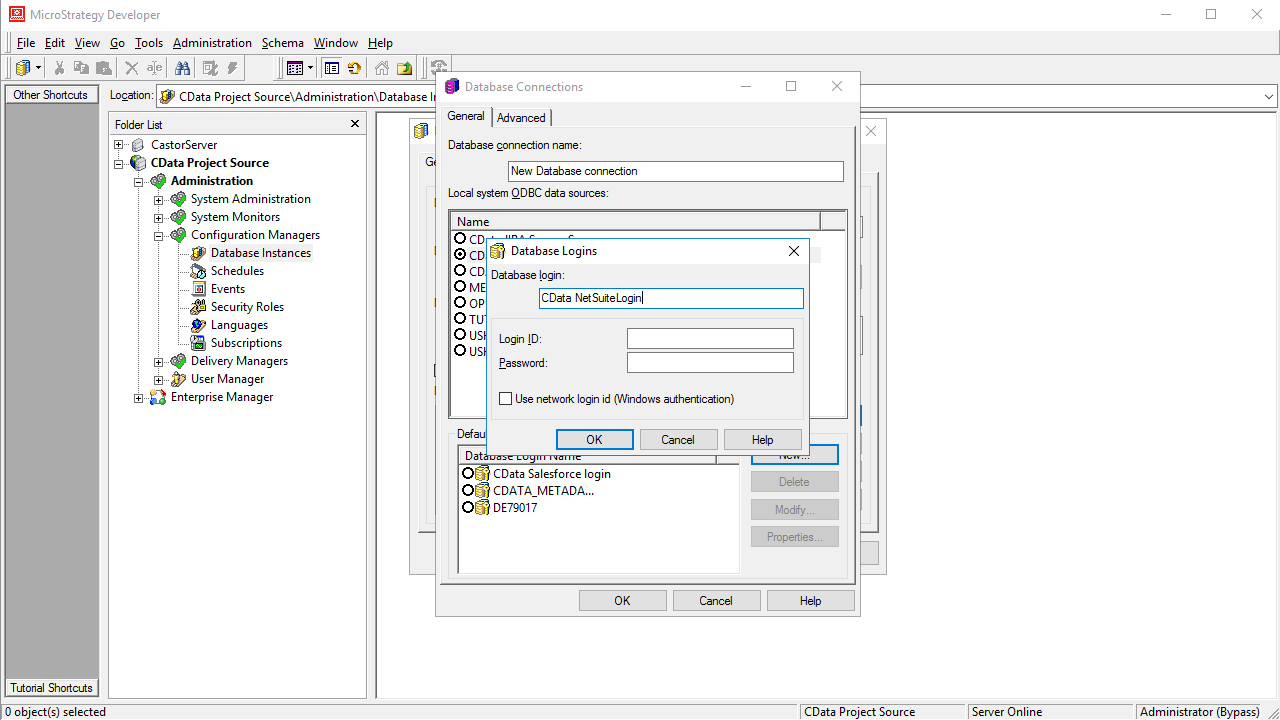
- Select the DSN that you configured earlier as the ODBC data source (i.e., CData JDEdwards Sys).
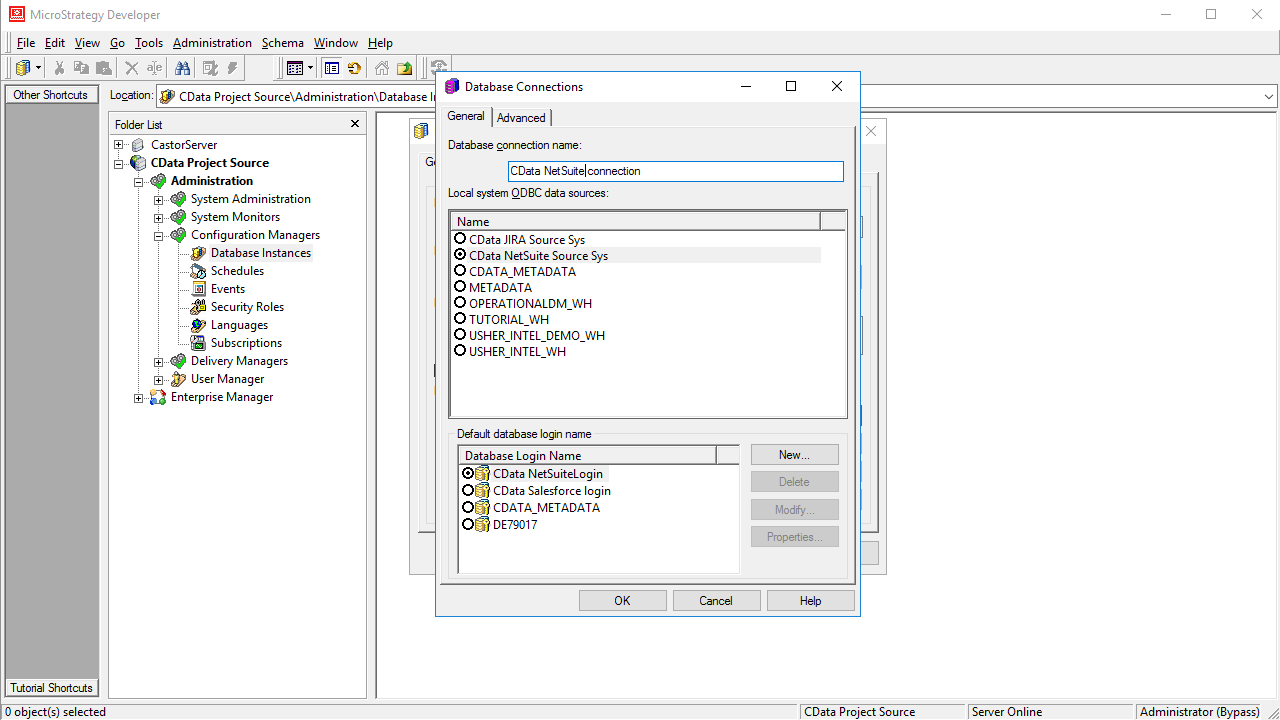
- Select the newly created database connection.
- In the Project Source, right-click the project and open the Project configuration.
- Navigate to Database Instances and select the newly created database instance.
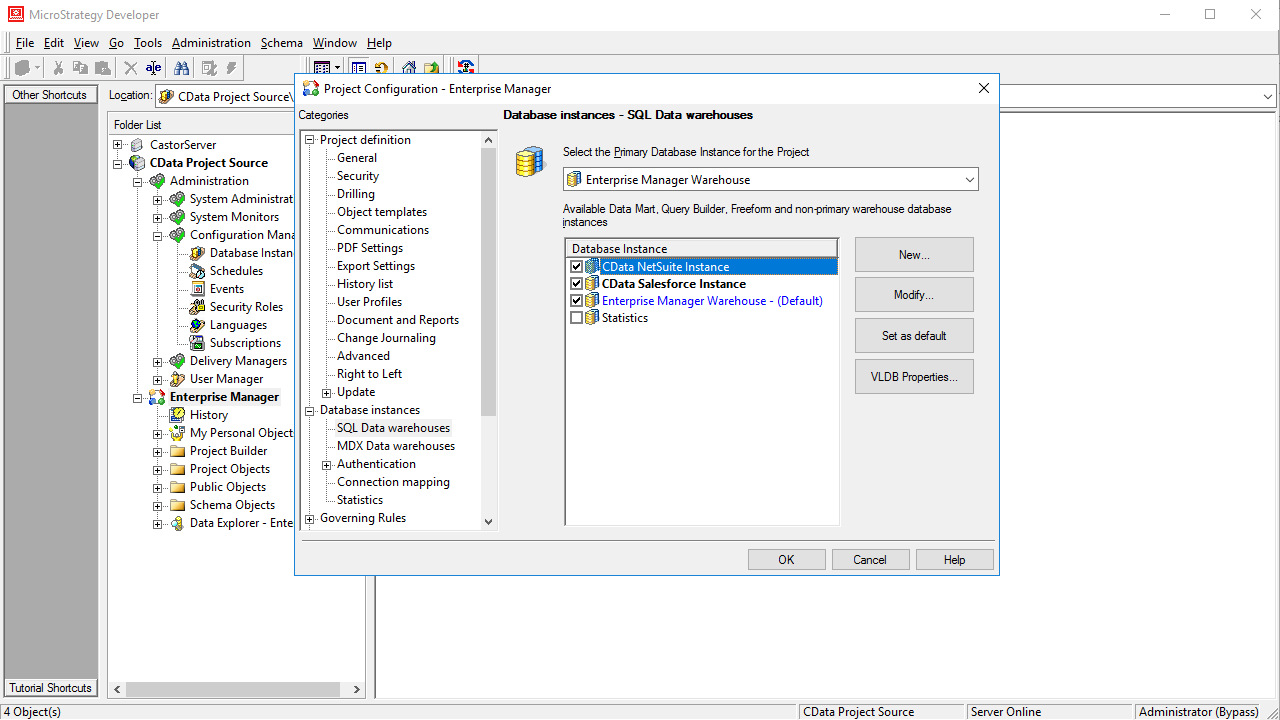
- Close MicroStrategy Developer and restart the connected MicroStrategy Intelligence Server to complete the database instance creation.
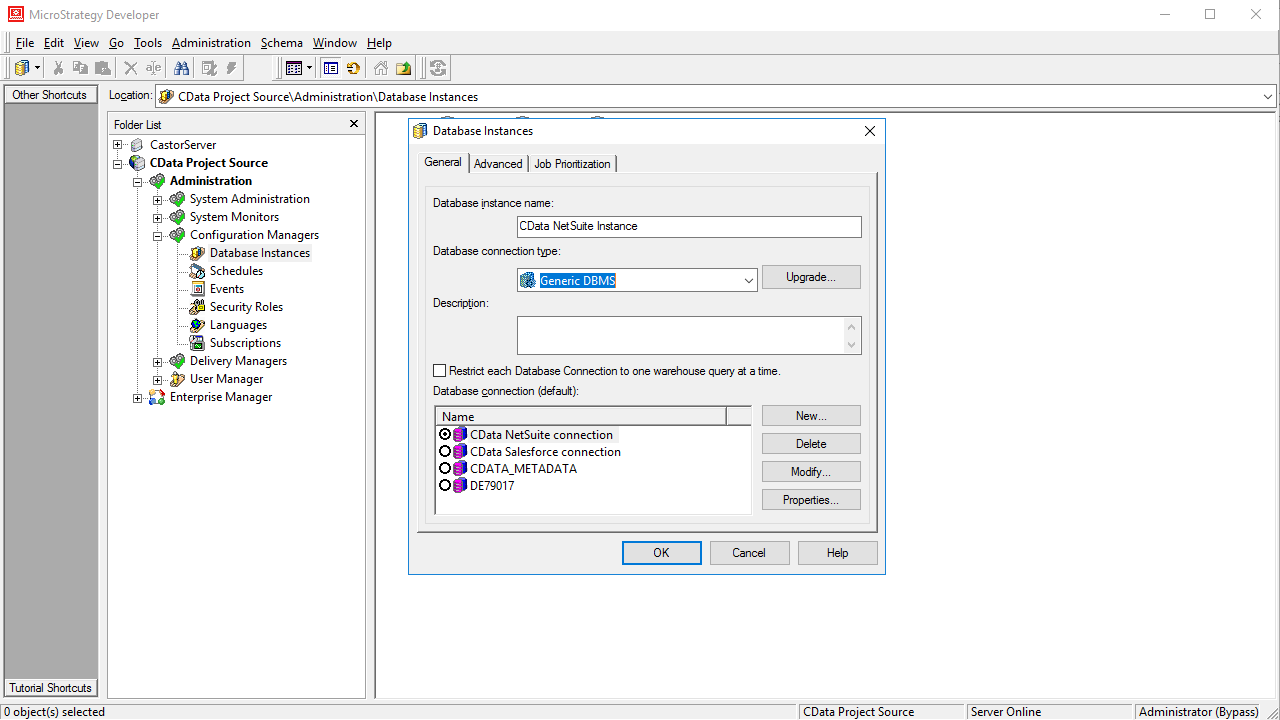
With the database instance configured, you will now be able to connect to JD Edwards data from the Warehouse Catalog and Data Import.
Connect to JD Edwards Data from the Warehouse Catalog
Once you have created a database instance based on the ODBC Driver for JD Edwards, you can connect to data from the Warehouse Catalog.
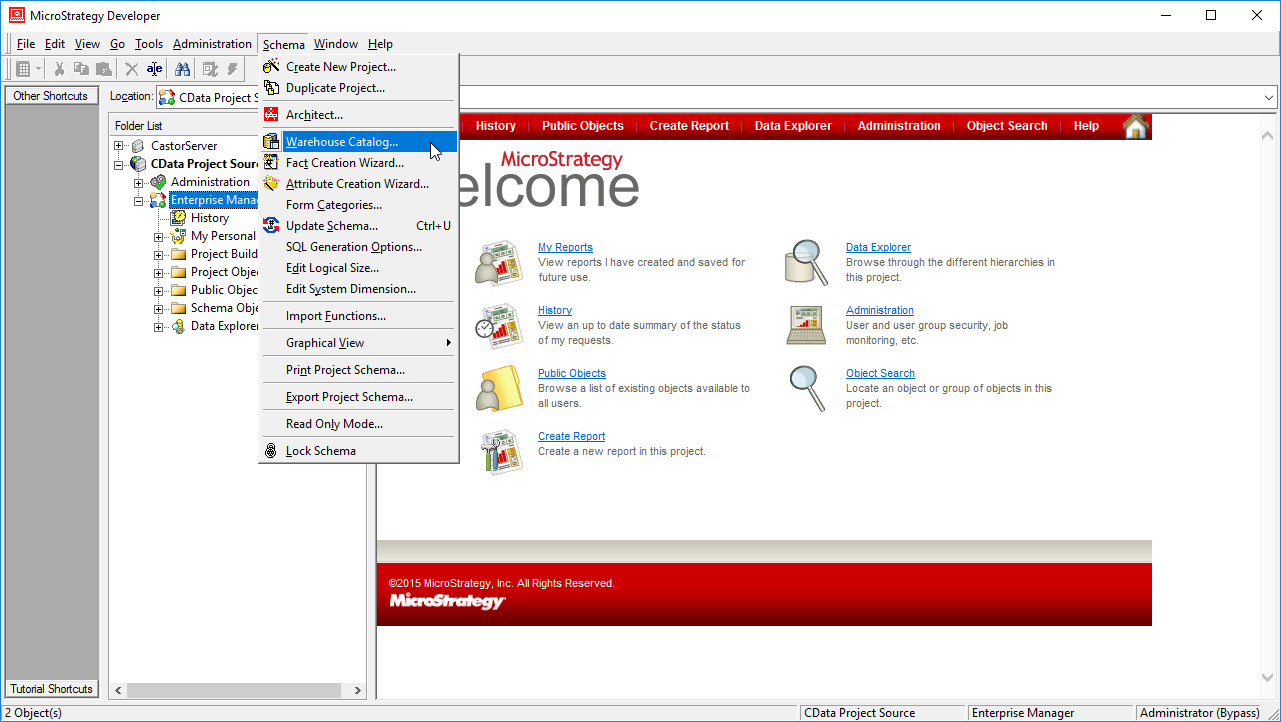
- Select your project and click Schema -> Warehouse Catalog.
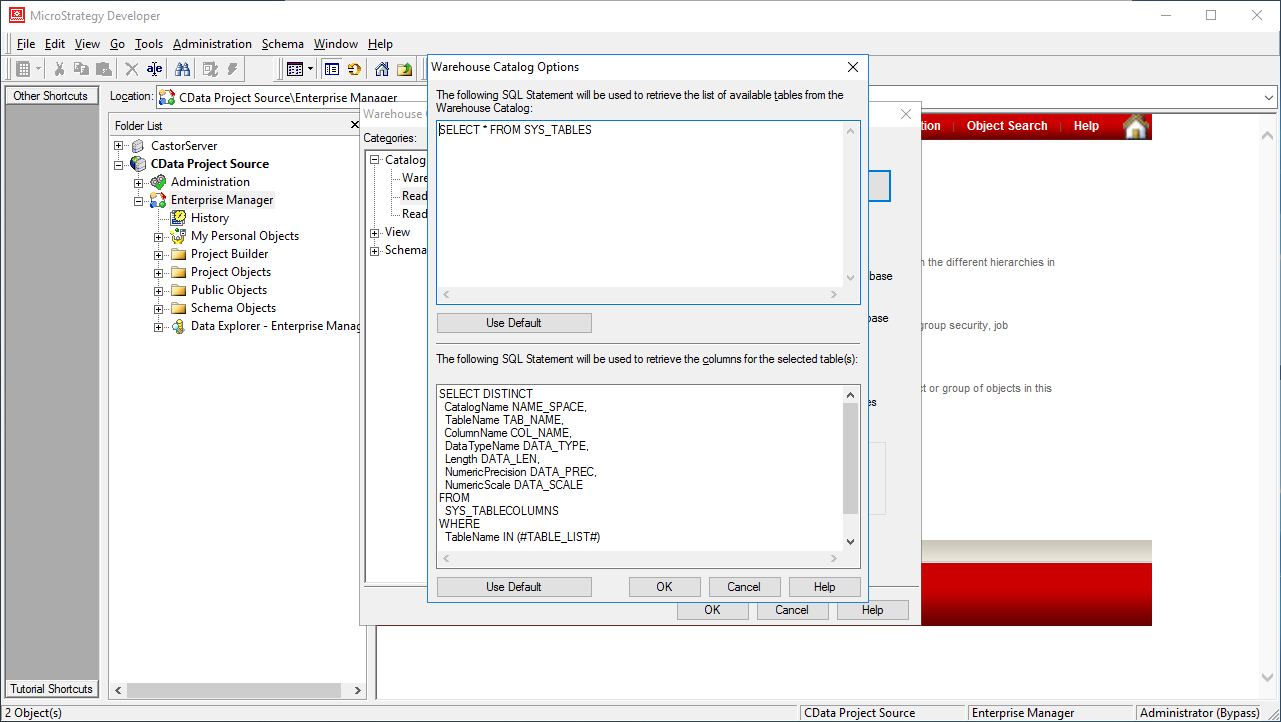
- In the Read Settings for the Catalog, click Settings and set the queries to retrieve the schema:
- To retrieve the list of tables, use the following query:
SELECT CatalogName NAME_SPACE, TableName TAB_NAME FROM SYS_TABLES - To retrieve the list of columns for selected tables, use the following query:
SELECT DISTINCT
  CatalogName NAME_SPACE,
  TableName TAB_NAME,
  ColumnName COL_NAME,
  DataTypeName DATA_TYPE,
  Length DATA_LEN,
  NumericPrecision DATA_PREC,
  NumericScale DATA_SCALE
FROM
  SYS_TABLECOLUMNS
WHERE
  TableName IN (#TABLE_LIST#)
ORDER BY
  1,2,3
- To retrieve the list of tables, use the following query:
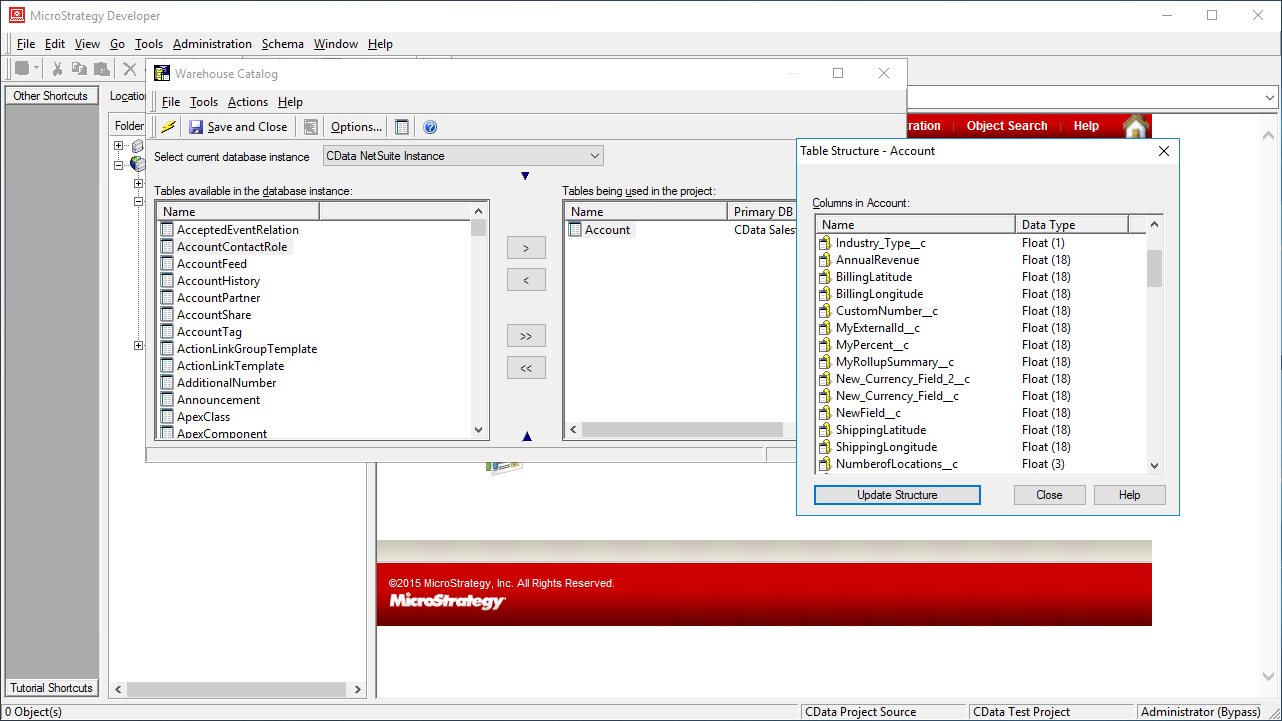
- Select tables to be used in the project.
If you are interested in connecting to JD Edwards from other MicroStrategy products, you can read about connecting from MicroStrategy Web and connecting from MicroStrategy Desktop.
Note: connecting using a ODBC driver requires a 3- or 4-tier architecture.
Ready to get started?
Download a free trial of the JD Edwards ODBC Driver to get started:
Download NowLearn more:
 JD Edwards ODBC Driver
The JD Edwards ODBC Driver is a powerful tool that allows you to connect with live data from JD Edwards, directly from any applications that support ODBC connectivity.
Access JD Edwards data like you would a database - read JD Edwards AccountLedger, ProposalofPayment, ContractRevenueSummary, EmployeeEnrollment, RentIncreaseAmounts, etc. through a standard ODBC Driver interface.