






How to Connect to Live Jira Data from Gemini CLI (via CData Connect AI)

Gemini CLI is a command-line interface tool that provides direct access to Google's Gemini AI models for code generation, text analysis, and conversational AI capabilities. When combined with CData Connect AI Remote MCP, you can leverage Gemini CLI to interact with your Jira data in real-time through natural language queries. This article outlines the process of connecting to Jira using Connect AI Remote MCP and configuring Gemini CLI to interact with your Jira data.
CData Connect AI offers a dedicated cloud-to-cloud interface for connecting to Jira data. The CData Connect AI Remote MCP Server enables secure communication between Gemini CLI and Jira. This allows you to ask questions and take actions on your Jira data using natural language through Gemini CLI, all without the need for data replication to a natively supported database. With its inherent optimized data processing capabilities, CData Connect AI efficiently channels all supported SQL operations, including filters and JOINs, directly to Jira. This leverages server-side processing to swiftly deliver the requested Jira data.
In this article, we show how to configure Gemini CLI to conversationally explore (or Vibe Query) your data using natural language. With Connect AI you can query and interact with live Jira data, plus hundreds of other sources.
About Jira Data Integration
CData simplifies access and integration of live Jira data. Our customers leverage CData connectivity to:
- Gain bi-directional access to their Jira objects like issues, projects, and workflows.
- Use SQL stored procedures to perform functional actions like changing issues status, creating custom fields, download or uploading an attachment, modifying or retrieving time tracking settings, and more.
- Authenticate securely using a variety of methods, including username and password, OAuth, personal access token, API token, Crowd or OKTA SSO, LDAP, and more.
Most users leverage CData solutions to integrate Jira data with their database or data warehouse, whether that's using CData Sync directly or relying on CData's compatibility with platforms like SSIS or Azure Data Factory. Others are looking to get analytics and reporting on live Jira data from preferred analytics tools like Tableau and Power BI.
Learn more about how customers are seamlessly connecting to their Jira data to solve business problems from our blog: Drivers in Focus: Collaboration Tools.
Getting Started
Step 1: Configure Jira Connectivity for Gemini CLI
Connectivity to Jira from Gemini CLI is made possible through CData Connect AI Remote MCP. To interact with Jira data from Gemini CLI, we start by creating and configuring a Jira connection in CData Connect AI.
- Log into Connect AI, click Sources, and then click Add Connection
- Select "Jira" from the Add Connection panel
-
Enter the necessary authentication properties to connect to Jira.
To connect to JIRA, provide the User and Password. Additionally, provide the Url; for example, https://yoursitename.atlassian.net.

- Click Save & Test
-
Navigate to the Permissions tab in the Add Jira Connection page and update the User-based permissions.



Add a Personal Access Token
A Personal Access Token (PAT) is used to authenticate the connection to Connect AI from Gemini CLI. It is best practice to create a separate PAT for each service to maintain granularity of access.
- Click on the Gear icon () at the top right of the Connect AI app to open the settings page.
- On the Settings page, go to the Access Tokens section and click Create PAT.
-
Give the PAT a name and click Create.
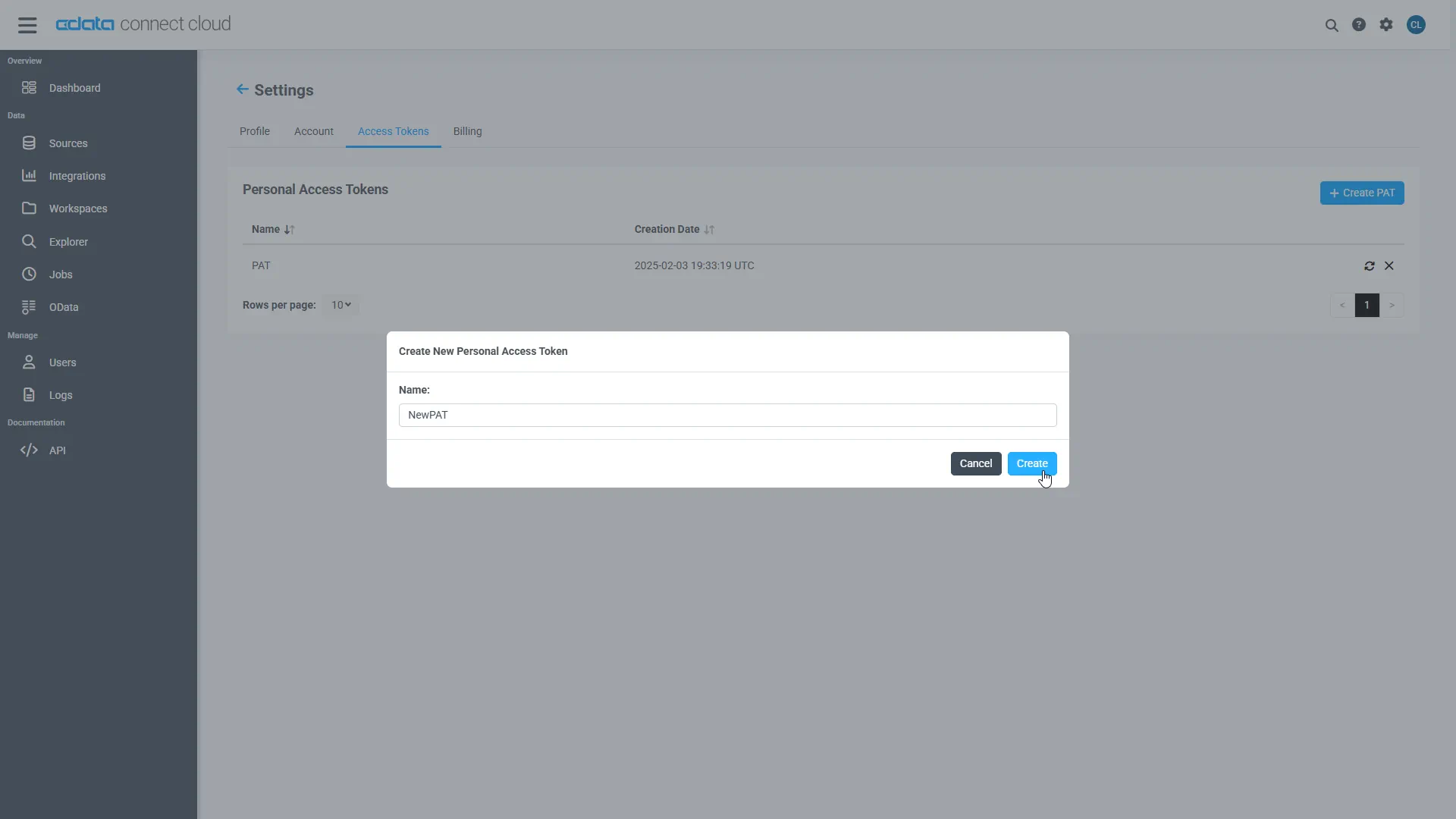
- The personal access token is only visible at creation, so be sure to copy it and store it securely for future use.
With the connection configured and a PAT generated, we are ready to connect to Jira data from Gemini CLI.
Step 2: Configure Gemini CLI for CData Connect AI
Follow these steps to configure Gemini CLI to connect to CData Connect AI:
-
Ensure Gemini CLI is installed on your system. If not, install it using npm:
npm install -g @google-gemini/cli
-
Locate your Gemini CLI settings file. If the file doesn't exist, create it:
- Linux/Unix/Mac: ~/.gemini/settings.json
- Windows: %USERPROFILE%\.gemini\settings.json
-
Add the CData Connect AI Remote MCP Server to the mcpServers object in your settings file. Replace YOUR_EMAIL and YOUR_PAT with your Connect AI email address and the PAT created previously:
{
  "mcpServers": {
    "cdata-connect-cloud": {
      "httpUrl": "https://mcp.cloud.cdata.com/mcp",
      "headers": {
        "Authorization": "Basic YOUR_EMAIL:YOUR_PAT"
      }
    }
  }
}
For example, if your email is [email protected] and your PAT is Uu90pt5vEO..., the Authorization header would be:"Authorization": "Basic [email protected]:Uu90pt5vEO..."
- Save the settings file. Gemini CLI will now use the CData Connect AI MCP Server for data operations.
Step 3: Query Live Jira Data with Natural Language
With Gemini CLI configured and connected to CData Connect AI, you can now interact with your Jira data using natural language queries. The MCP integration allows you to ask questions and receive responses from the Jira data source in real-time.
Start using Gemini CLI to explore your data:
-
Open your terminal and start a Gemini CLI session:
gemini
-
You can now use natural language to query your Jira data. For example:
- "Show me all customers from the last 30 days"
- "What are my top performing products?"
- "Analyze sales trends for Q4"
- "List all active projects with their current status"
- Gemini CLI will automatically translate your natural language queries into appropriate SQL queries and execute them against your Jira data through the CData Connect AI MCP Server.
The combination of Gemini CLI's natural language processing capabilities and CData Connect AI's robust data connectivity enables you to explore and analyze your Jira data without writing complex SQL queries or needing deep technical knowledge of the underlying data structure.
Get CData Connect AI
To get live data access to 300+ SaaS, Big Data, and NoSQL sources directly from your cloud applications, try CData Connect AI today!
