






How to create Visio diagrams from Lakebase Data

Automate the process of entering data into Visio diagrams and keeping your diagrams up to date with the CData ODBC Driver for Lakebase. The driver surfaces Lakebase data as an ODBC data source that can be accessed by applications with built-in ODBC support like Microsoft Office. This article shows how to create a simple diagram to start brainstorming about Visio projects linked to Lakebase data.
Connect to Lakebase as an ODBC Data Source
If you have not already, first specify connection properties in an ODBC DSN (data source name). This is the last step of the driver installation. You can use the Microsoft ODBC Data Source Administrator to create and configure ODBC DSNs.
To connect to Databricks Lakebase, start by setting the following properties:- DatabricksInstance: The Databricks instance or server hostname, provided in the format instance-abcdef12-3456-7890-abcd-abcdef123456.database.cloud.databricks.com.
- Server: The host name or IP address of the server hosting the Lakebase database.
- Port (optional): The port of the server hosting the Lakebase database, set to 5432 by default.
- Database (optional): The database to connect to after authenticating to the Lakebase Server, set to the authenticating user's default database by default.
OAuth Client Authentication
To authenicate using OAuth client credentials, you need to configure an OAuth client in your service principal. In short, you need to do the following:
- Create and configure a new service principal
- Assign permissions to the service principal
- Create an OAuth secret for the service principal
For more information, refer to the Setting Up OAuthClient Authentication section in the Help documentation.
OAuth PKCE Authentication
To authenticate using the OAuth code type with PKCE (Proof Key for Code Exchange), set the following properties:
- AuthScheme: OAuthPKCE.
- User: The authenticating user's user ID.
For more information, refer to the Help documentation.
Connect Lakebase Data to Diagrams
Follow the steps below to use the Data Selector Wizard to import data into your diagram.
- Open Visio and click File -> New. Open the Brainstorming template.
- On the Data tab, click Custom Import and select Other OLEDB or ODBC data source.
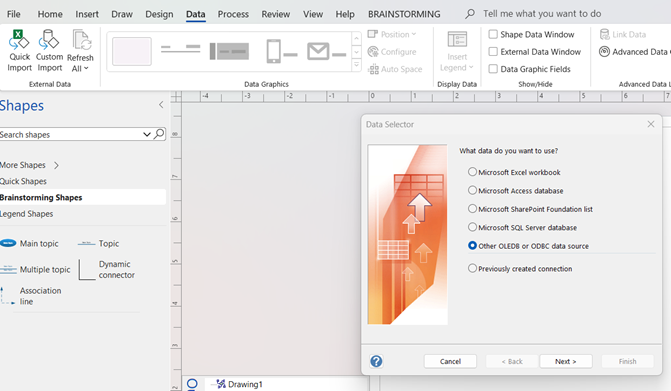
- Select the ODBC option and select ODBC DSN.
- Select the DSN for Lakebase, select the table you want to import, and finish the wizard. This article uses Orders as an example.
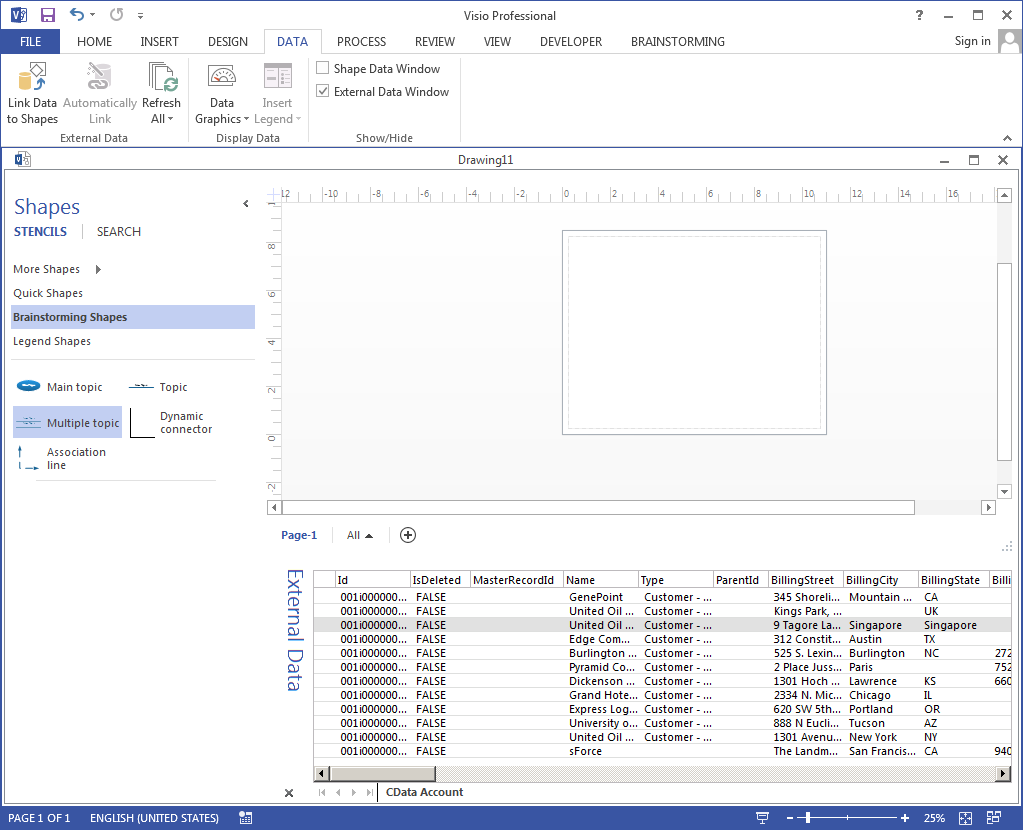
Link Lakebase Entities to Shapes
Follow the steps below to create a simple diagram that shows how to create shapes from your data, one of the ways to link Lakebase entities to shapes:
- Click Brainstorming Shapes and drag a main topic onto the drawing page. Enter Orders as the text of the main topic.
- Click Topic.
- Select a row in the External Data window and drag it onto the drawing page.
- Right-click the Topic shape and click Data -> Edit Data Graphic.
- Click New Item.
- In the Data Field menu, select a column. In the Displayed As menu, select how to display them.
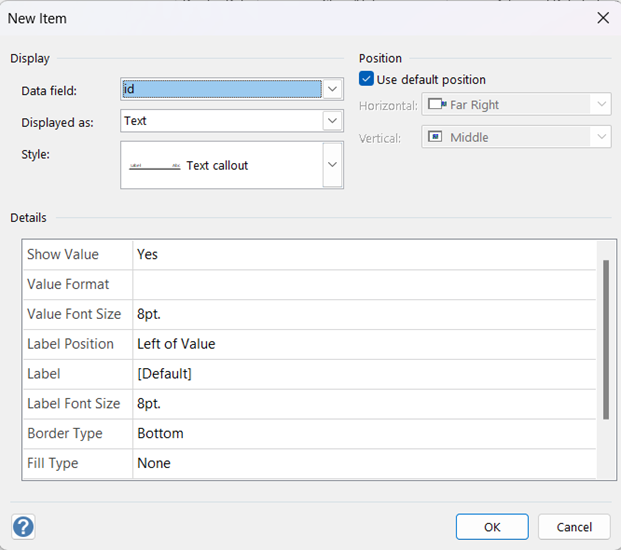
- Drag a few other Lakebase entities onto the drawing page and add association lines back to the main topic, Orders. New topics have the same configuration: Numeric columns displayed in data bars stand out in contrast to other Orders entities.
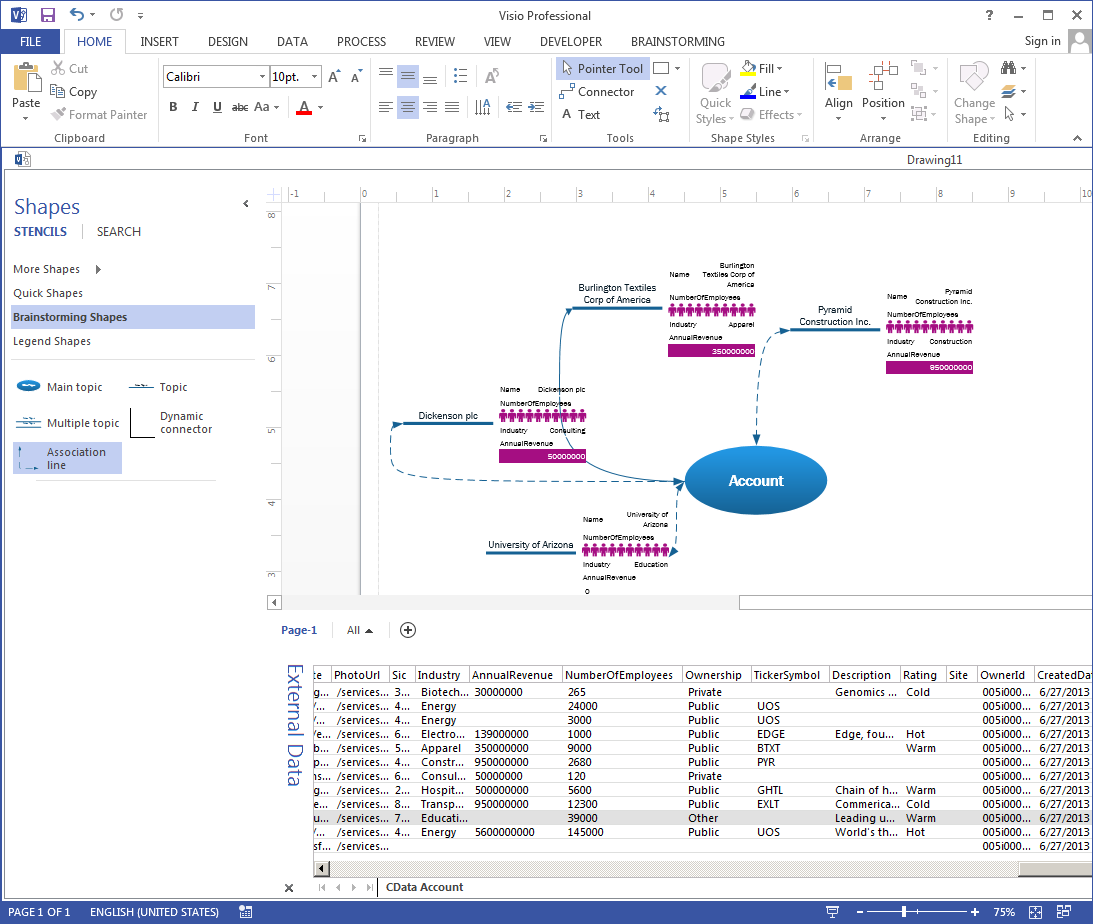
You can refresh your diagram from the Data tab, synchronizing your shapes with the external Lakebase data.
Ready to get started?
Download a free trial of the Lakebase ODBC Driver to get started:
Download NowLearn more:
 Lakebase ODBC Driver
The Lakebase ODBC Driver is a powerful tool that allows you to connect with live data from Lakebase, directly from any applications that support ODBC connectivity.
Access Lakebase data like you would a database - read, write, and update Lakebase 0, etc. through a standard ODBC Driver interface.
