






Query NASA Data through ODBC in Node.js

Node.js is a JavaScript runtime environment that allows you to run JavaScript code outside of a browser. With the CData API Driver for ODBC, you can access live NASA data from Node.js apps and scripts. In this article, we walk through installing node-odbc and the required tools to create a simple Node.js app with access to live NASA data.
With built-in optimized data processing, the CData ODBC Driver offers unmatched performance for interacting with live NASA data in Node.js. When you issue complex SQL queries from Node.js to NASA, the driver pushes supported SQL operations, like filters and aggregations, directly to NASA and utilizes the embedded SQL engine to process unsupported operations client-side (often SQL functions and JOIN operations).
Connecting to NASA Data
If you have not already done so, provide values for the required connection properties in the data source name (DSN). You can use the built-in Microsoft ODBC Data Source Administrator to configure the DSN. This is also the last step of the driver installation. See the "Getting Started" chapter in the help documentation for a guide to using the Microsoft ODBC Data Source Administrator to create and configure a DSN.
Using API Key Authentication
Most NASA API endpoints (APOD, NeoWS, DONKI, TechTransfer) require a NASA API key. Register for a free key at https://api.nasa.gov. The default DEMO_KEY provides limited access (30 requests/hour, 50 requests/day); a registered key allows 1,000 requests/hour.
The following endpoints do not require an API key and work without authentication: EONET (Earth Observatory Natural Event Tracker), EPIC (Earth Polychromatic Imaging Camera), NASA Image and Video Library, and TechPort.
After obtaining your API key, set the following connection properties:
- AuthScheme: Set this to APIKey.
- APIKey: Set this to your NASA API key. Use DEMO_KEY for limited testing.
Example Connection String
Profile=C:\profiles\NASA.apip;AuthScheme=APIKey;APIKey=YOUR_NASA_API_KEY
Connecting to NASA
Once the authentication is configured, you can connect to NASA and query data from any of the available tables such as AstronomyPictureOfDay, NearEarthObjectFeed, EonetEvents, and NasaImageLibrary.
Building node-odbc
In order to connect to NASA through the CData ODBC Driver, you need to build node-odbc manually (after installing the required tools).
Installing the Required Tools
The following commands install the tools required to build node-odbc (note the -g parameter, which installs the tools globally).
npm i -g windows-build-tools
npm i -g node-gyp
Building node-odbc
After installing the required tools, create a directory for the Node.js app and install odbc (which builds the binary for us to use in our Node.js script).
mkdir nodeodbc
cd nodeodbc
npm i -g node
Querying NASA from Node.js
With the ODBC Driver installed, a DSN Configured, and node-odbc built, we are ready to query live NASA data from a Node.js app. The sample code below connects to a specific DSN and queries the AstronomyPictureOfDay table.
myscript.js
const odbc = require('odbc');

async function queryAPI() {
    const connection = await odbc.connect(`DSN=CData API Source`);
    const data = await connection.query('SELECT ,  FROM AstronomyPictureOfDay');
    console.log(data);
}

queryAPI();
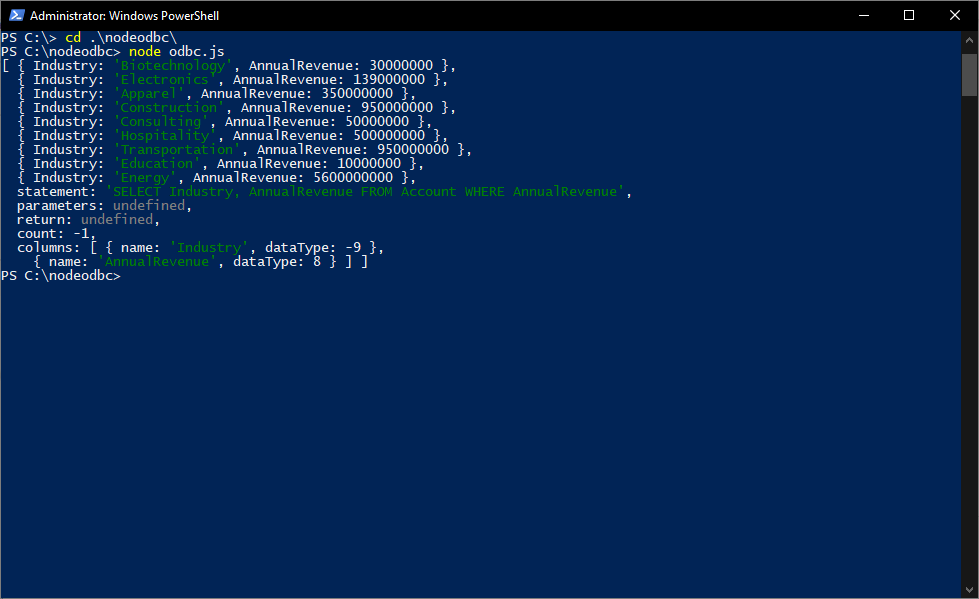
Once you write the app, use node to execute the script:
node myscript.js
Download a free, 30-day trial of the CData API Driver for ODBC and start working with your live NASA data in Node.js. Reach out to our Support Team if you have any questions.