






Use the CData ODBC Driver for Pinecone in MicroStrategy Web

MicroStrategy is an analytics and mobility platform that enables data-driven innovation. When you pair MicroStrategy with the CData ODBC Driver for Pinecone, you gain database-like access to live Pinecone data from MicroStrategy, expanding your reporting and analytics capabilities. In this article, we walk through adding Pinecone as external data in MicroStrategy Web and creating a simple visualization of Pinecone data.
The CData ODBC driver offers unmatched performance for interacting with live Pinecone data in MicroStrategy due to optimized data processing built into the driver. When you issue complex SQL queries from MicroStrategy to Pinecone, the driver pushes supported SQL operations, like filters and aggregations, directly to Pinecone and utilizes the embedded SQL engine to process unsupported operations (often SQL functions and JOIN operations) client-side. With built-in dynamic metadata querying, you can visualize and analyze Pinecone data using native MicroStrategy data types.
Connect to Pinecone as an ODBC Data Source
Information for connecting to Pinecone follows, along with different instructions for configuring a DSN in Windows and Linux environments (the ODBC Driver for Pinecone must be installed on the machine hosting the connected MicroStrategy Intelligence Server).
Authentication
To authenticate to Pinecone, and connect to your own data or to allow other users to connect to their data, you can use API Key authentication.
Using API Key Authentication
To authenticate using an API Key, you need to obtain your API Key from your Pinecone console at https://app.pinecone.io/.
You can then connect by setting the AuthScheme to APIKey and providing your API key:
- AuthScheme: Set this to APIKey.
- APIKey: Set this to your API key from Pinecone.
Example connection strings:
Standard API Key Configuration:
Profile=C:\profiles\Pinecone.apip;AuthScheme=APIKey;ProfileSettings='APIKey=your_api_key;APIVersion=2025-10';
When you configure the DSN, you may also want to set the Max Rows connection property. This will limit the number of rows returned, which is especially helpful for improving performance when designing reports and visualizations.
Windows
If you have not already, first specify connection properties in an ODBC DSN (data source name). This is the last step of the driver installation. You can use the Microsoft ODBC Data Source Administrator to create and configure ODBC DSNs.
Linux
If you are installing the CData ODBC Driver for Pinecone in a Linux environment, the driver installation predefines a system DSN. You can modify the DSN by editing the system data sources file (/etc/odbc.ini) and defining the required connection properties.
/etc/odbc.ini
[CData API Sys]
Driver = CData ODBC Driver for Pinecone
Description = My Description
Profile = C:\profiles\Pinecone.apip
AuthScheme = APIKey
ProfileSettings = 'APIKey = your_api_key
APIVersion = 2025-10'
For specific information on using these configuration files, please refer to the help documentation (installed and found online).
Connect to and Visualize Pinecone Data using MicroStrategy Web
Once you have created a database instance in MicroStrategy Developer and connected it to a project, you can perform a data import of Pinecone data from MicroStrategy Web. Alternatively, you can create a new data source based on the ODBC Driver.*
- Open MicroStrategy Web and select your project.
- Click Add External Data, select Databases, and choose Select a Table as the Import Option.
- In the Import from Tables wizard, click to add a new data source.
- Select DSN Data Sources
- Set the DSN property to the previously configured DSN (CData API Sys)
- Set the Version property to Generic DBMS
- Set the User and Password properties (or use filler values)
- Set the Data Source Name
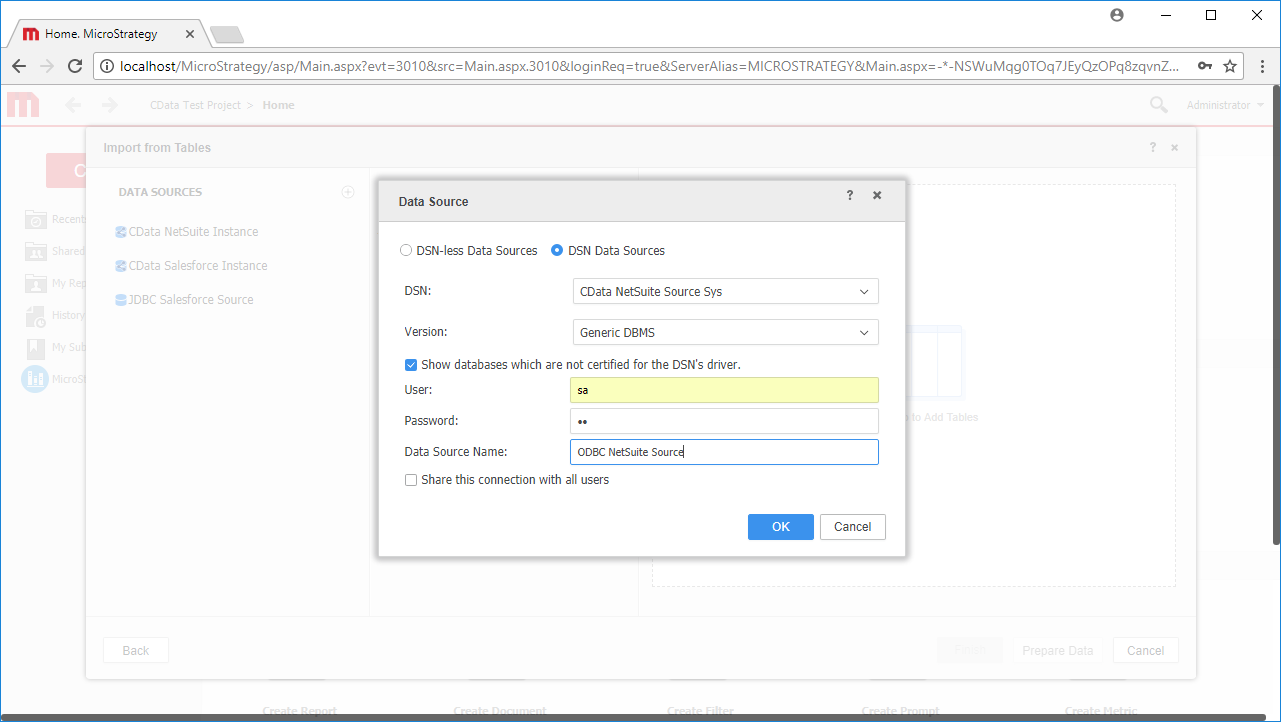
- After creating the data source, click to edit the catalog options and set the following queries and click OK.
- SQL statement to retrieve tables available in the data source
SELECT CatalogName NAME_SPACE, TableName TAB_NAME FROM SYS_TABLES - SQL statement to retrieve columns for the selected tables
SELECT DISTINCT
  CatalogName NAME_SPACE,
  TableName TAB_NAME,
  ColumnName COL_NAME,
  DataTypeName DATA_TYPE,
  Length DATA_LEN,
  NumericPrecision DATA_PREC,
  NumericScale DATA_SCALE
FROM
  SYS_TABLECOLUMNS
WHERE
  TableName IN (#TABLE_LIST#)
ORDER BY
  1,2,3
- SQL statement to retrieve tables available in the data source
- Drag a table into the pane.
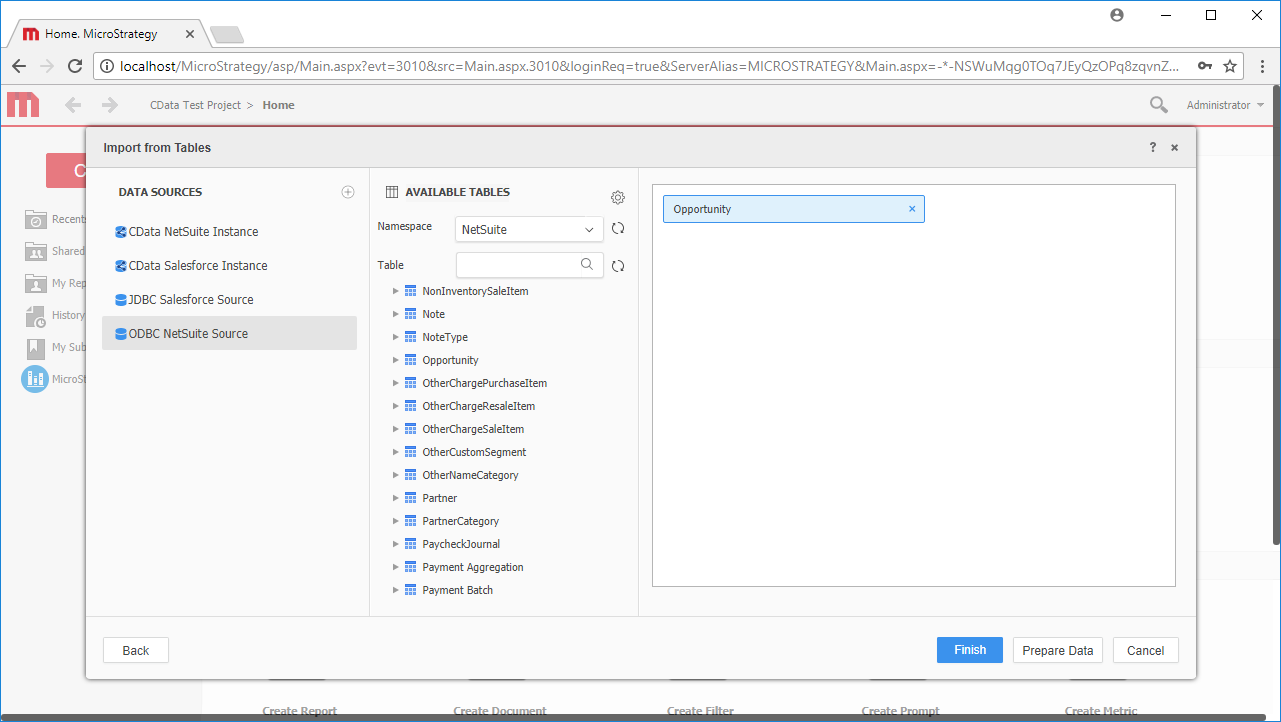 Note: Since we create a live connection, we can import whole tables and utilize the filtering and aggregation features native to the MicroStrategy products.
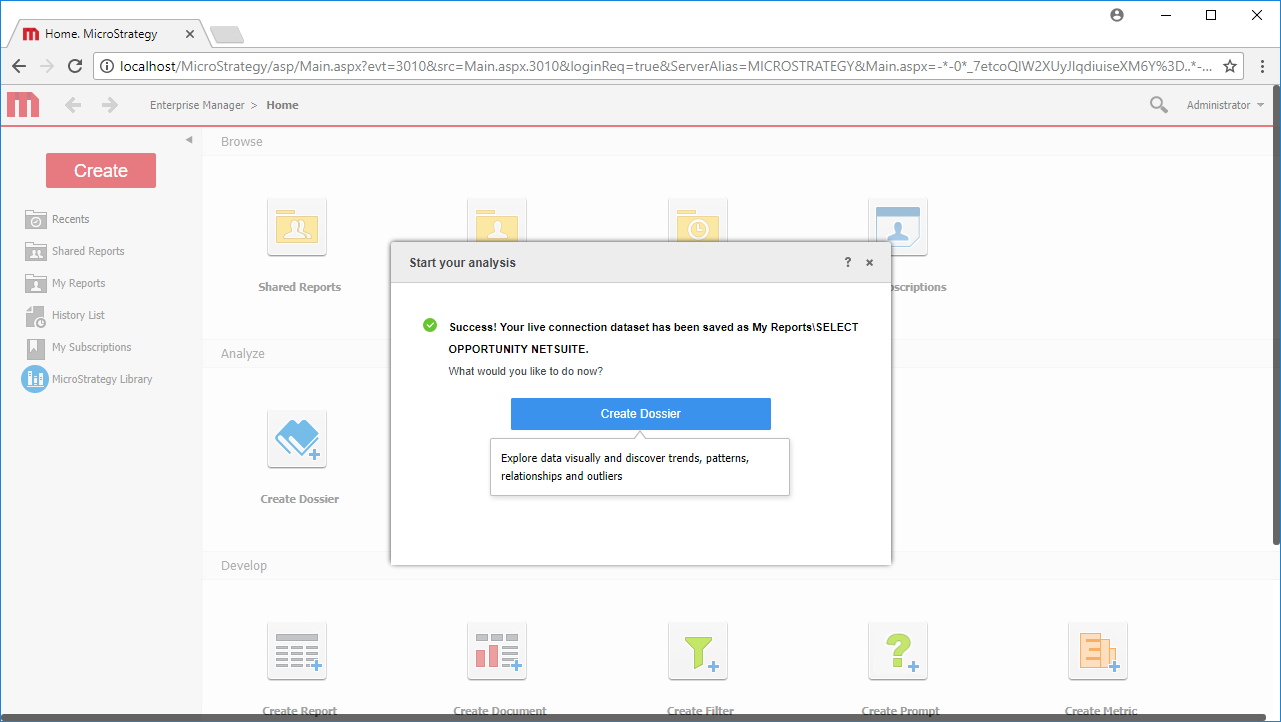
 - Click Finish, choose to the option to connect live, save the query, and choose the option to create a new dossier.
- Choose a visualization, choose fields to display, and apply any filters to create a new visualization of Pinecone data. Data types are discovered automatically through dynamic metadata discovery. Where possible, the complex queries generated by the filters and aggregations will be pushed down to Pinecone, while any unsupported operations (which can include SQL functions and JOIN operations) will be managed client-side by the CData SQL engine embedded in the driver.
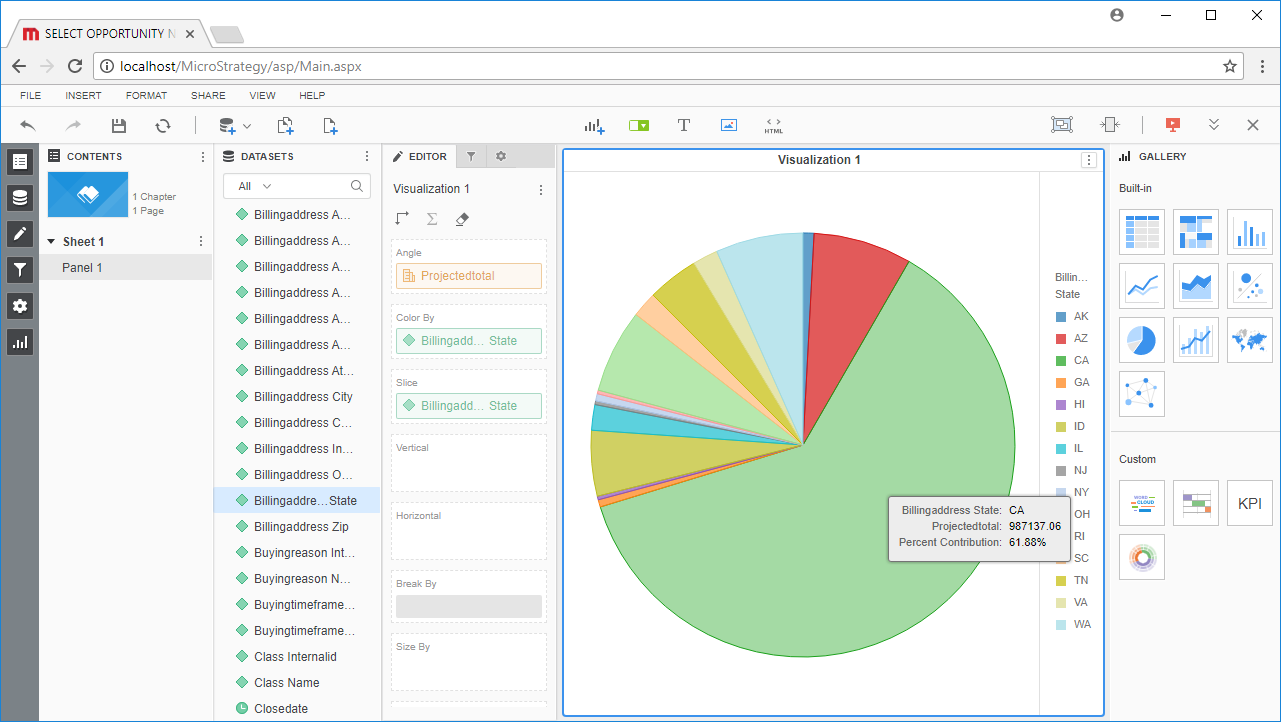
- Once you have finished configuring the dossier, click File -> Save.
Using the CData ODBC Driver for Pinecone in MicroStrategy Web, you can easily create robust visualizations and reports on Pinecone data. Read our other articles on connecting to Pinecone in MicroStrategy and connecting to Pinecone in MicroStrategy Desktop for more examples.
Note: connecting using a ODBC driver requires a 3- or 4-tier architecture.